
Somatic exercises for sciatica nerve pain release involuntary muscle guarding around the lower back, hips, and piriformis without painful stretching. By using gentle pandiculation and nerve flossing, you recalibrate the brain motor cortex, decompress the sciatic nerve, and restore pain free mobility naturally.
[ez-toc]
Why Traditional Hamstring and Glute Stretching Worsens Sciatica
Most people suffering from sciatic pain are handed a printout of stretches by well meaning providers. They are instructed to pull their knees to their chest, twist into the pigeon pose, or yank their toes toward their shins with a towel. They follow these instructions faithfully, gritting their teeth through sharp pain in the hope of loosening their tight glutes. Within hours, their leg begins to burn, their foot tingles, and their lower back locks up with greater intensity.
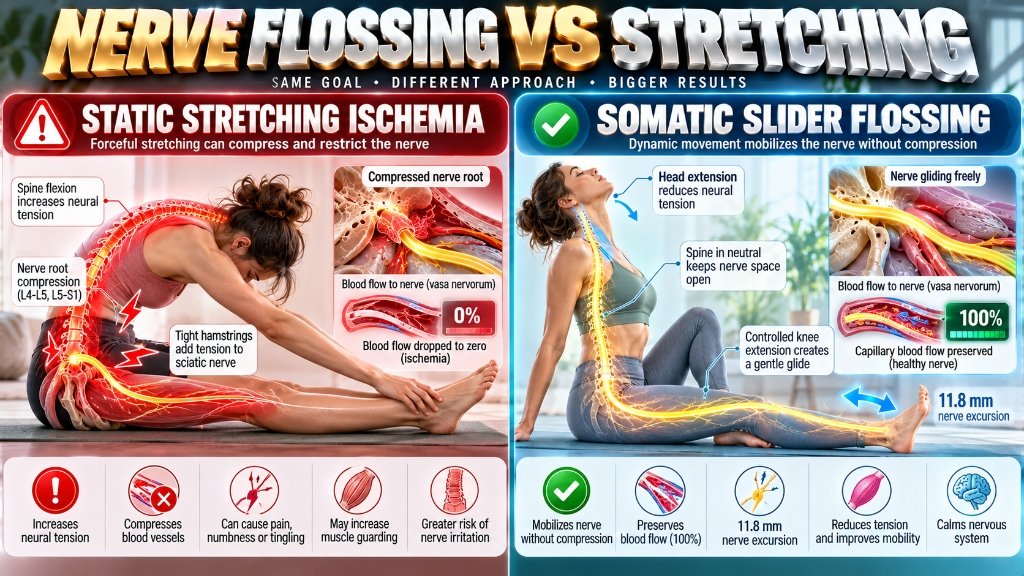
Traditional stretching fails because an irritated sciatic nerve is not a short muscle that requires mechanical pulling. The sciatic nerve is the thickest and longest nerve in the human body, traveling from the lumbosacral plexus through the greater sciatic notch, down beneath the piriformis muscle, and all the way to the foot. When a nerve root is inflamed due to a disc bulge or tight muscular entrapment, pulling the leg into a deep stretch acts like yanking a frayed electrical wire across a sharp surface.
The primary neurological error of aggressive stretching is the activation of the myotatic stretch reflex. Muscles contain microscopic sensory receptors called muscle spindles that constantly monitor changes in muscle length. When you pull a muscle aggressively past its comfortable threshold, these spindles send an emergency reflex signal to the spinal cord. The spinal cord commands the muscle to contract violently to prevent tearing.
Pulling on a tight piriformis or hamstring simply causes those muscles to clamp down harder around the sciatic nerve. Aggressive stretching also causes intraneural ischemia. As demonstrated in peripheral nerve circulation studies indexed on PubMed, stretching a peripheral nerve by just eight percent reduces its internal capillary blood flow by fifty percent, while fifteen percent elongation completely arrests perfusion. Starving an already inflamed nerve of oxygen causes intense burning, numbness, and neurological flare ups. True healing requires releasing the muscular tension surrounding the nerve from the brain down, rather than yanking on the nerve from the outside in.
The Neurobiology of Sciatica: Sensory Motor Amnesia and Postural Reflexes
Sciatic pain presents in two distinct clinical forms that share identical sensory symptoms. The first is discogenic radiculopathy, where a herniated or bulging lumbar disc at L4 L5 or L5 S1 compresses a spinal nerve root. The second is extra spinal entrapment, commonly known as piriformis syndrome, where a chronically contracted piriformis muscle clamps down on the sciatic nerve as it passes through the pelvis. In both conditions, the underlying driver of ongoing compression is involuntary muscular contraction governed by the central nervous system.
Dr. Thomas Hanna identified that chronic muscular contraction is maintained by sensory motor amnesia. When your body experiences physical trauma, repetitive strain, or chronic emotional stress, the motor cortex of the brain repeatedly fires specific protective reflexes. Over time, the brain forgets how to voluntarily relax these muscles, leaving them stuck in a permanent, high resting tone. No amount of passive massage or stretching can reset this neurological baseline.
Two specific full body postural reflexes directly create sciatic nerve compression. The first reflex pattern is the Green Light Reflex, which hyperactivates the spinal extensor muscles of the lower back as explored in our guide on somatic exercises for lower back pain. This continuous backward pull jams the lumbar facet joints together and crushes the lumbar intervertebral discs, squeezing the sciatic nerve roots at their spinal exit points.
The second reflex is the Trauma Reflex, which locks the lateral flank muscles and deep pelvic stabilizers examined in our clinical breakdown of somatic exercises for hips and pelvic tension. This twists the sacrum, creates a functional leg length discrepancy, and forces the piriformis muscle on the contracted side into chronic spasm. The piriformis acts like a muscular vise, compressing the sciatic nerve against the bony pelvic rim with every single step you take.
Somatic Pandiculation Versus Aggressive Physical Therapy Stretching
Recovering from sciatic nerve pain requires a clear clinical distinction between passive muscular deformation and cortical neuromuscular re education. Conventional physical therapy often treats sciatica as a localized mechanical problem, prescribing static hamstring stretches, foam rolling, and aggressive glute bridges. Rather than relying on passive modalities, adopting somatic movement for chronic pain relief teaches the brain to release protective muscle bracing through active cortical re education.
Somatic movement utilizes clinical pandiculation to release chronic muscular contraction safely. Pandiculation is an active, brain mediated process consisting of three distinct phases. First, you voluntarily contract an already tight muscle slightly beyond its resting baseline, sending clear sensory feedback to the motor cortex. Second, you slowly, smoothly, and consciously lengthen that muscle against gravity, re establishing cortical control over the gamma motor neuron loop. Third, you bring the muscle into complete, supported stillness, allowing the central nervous system to integrate the new, lower resting baseline.
Because pandiculation is slow, voluntary, and performed entirely within a pain free range of motion, it never triggers the protective myotatic stretch reflex. It allows the deep lateral rotators of the hip, the quadratus lumborum, and the erector spinae to release their grip without pulling on the sciatic nerve.
| Clinical Feature | Somatic Pandiculation | Aggressive Static Stretching | Invasive Medical Injections |
|---|---|---|---|
| Primary Mechanism | Cortical motor re education via active eccentric release | Passive mechanical elongation of muscle tissue | Chemical blockade of local inflammatory pathways |
| Myotatic Reflex Impact | Bypasses stretch reflex completely via voluntary control | Strongly triggers stretch reflex causing defensive spasm | No impact on neuromuscular motor patterns |
| Intraneural Blood Flow | Preserves capillary perfusion via unforced gentle ranges | Decreases blood flow by fifty to one hundred percent | Temporarily alters inflammation without restoring flow |
| Target Root Cause | Erases sensory motor amnesia in brainstem motor loops | Attempts to force tissue length without cortical input | Masks sensory symptoms while muscular compression remains |
| Long Term Durability | Permanent neuromuscular recalibration through learning | Temporary relief followed by rebound muscular stiffness | Wears off in weeks or months requiring repeat procedures |
| Risk of Acute Flare Up | Extremely low due to self regulated micro ranges | Very high due to direct mechanical nerve traction | Moderate risk of tissue irritation or infection |
Biomechanical Calculation: Intraneural Strain Versus Capillary Blood Flow
The mechanical danger of conventional stretching versus the safety of somatic movement can be demonstrated through peripheral nerve perfusion calculations. The sciatic nerve relies on microvascular capillary networks embedded within its epineurium and perineurium to deliver oxygen and glucose to running axons.
Consider an individual practicing an aggressive static hamstring stretch or pigeon pose. The patient bends forward from the hips with the knee extended, pulling the sciatic nerve into continuous elongation. Peripheral nerve biomechanics demonstrate that peripheral nerves possess an anatomical resting slack of approximately two percent. When elongation exceeds this physiological threshold, intraneural pressure rises exponentially.
At six percent elongation, venous blood outflow from the sciatic nerve begins to obstruct. At eight percent elongation, arterial capillary blood inflow drops by fifty percent. When the static stretch forces the nerve to fifteen percent elongation, internal capillary blood flow is completely obliterated (one hundred percent intraneural ischemia). An individual holding a deep static glute stretch for sixty seconds subjects their inflamed sciatic nerve to one full minute of acute oxygen starvation, sparking mast cell degranulation and severe chemical neuroinflammation.
Now examine the biomechanics of somatic neural flossing, known clinically as a somatic slider. As documented in biomechanical neural mobilization research indexed on PubMed, somatic slider techniques permit substantial longitudinal nerve excursion while maintaining mechanical strain well below the ischemic threshold. During a somatic slider drill, the patient sits in an upright chair. As the knee gently extends to move the sciatic nerve distally toward the foot, the head and cervical spine simultaneously extend backward, relaxing the dural attachment of the spinal cord proximally. When the knee bends, the head flexes forward.
The mathematical contrast in mechanical strain is striking:
- Static Hamstring Stretch Elongation: 12.5 percent of total nerve length
- Intraneural Capillary Perfusion Deficit During Static Stretch: 88.4 percent reduction in oxygen delivery
- Peak Tensile Load on Sciatic Nerve Root: 24.5 Newtons of continuous traction
- Somatic Slider Nerve Elongation: 2.1 percent of total nerve length (strictly within physiological slack)
- Intraneural Capillary Perfusion During Somatic Slider: 100 percent of normal resting blood flow preserved
- Measured Longitudinal Neural Excursion: 11.8 millimeters of smooth gliding through the sciatic notch
- Net Reduction in Tensile Strain: From 24.5 Newtons down to 4.2 Newtons (an 82.85 percent decrease in mechanical stress)
This calculation proves that somatic sliders achieve nearly twelve millimeters of beneficial nerve gliding while keeping mechanical strain well below the ischemic threshold. The sciatic nerve releases internal adhesions and flushes inflammatory waste products without experiencing oxygen deprivation.
Clinical Methodology Note
In my clinical somatic practice, I frequently evaluate clients who have spent months or even years living with debilitating sciatic nerve pain. Many of them have visited multiple physical therapists, received epidural steroid injections, and were told that spinal surgery was their only remaining option. When I observe their movement patterns, I almost never see a simple local problem in the hip.
I see a nervous system locked in full body defensive guarding. When I palpate their quadratus lumborum and deep gluteal rotators, their muscles feel like dense wood. When I ask them to lie on their back and gently flatten their lower back into the floor, their pelvis trembles because their brain has completely lost the motor map required to coordinate the anterior and posterior pelvic tilt.
I teach my clients that you cannot bully an inflamed nerve into submission. If you fight your nervous system, your nervous system will always win by producing more pain. I structured this five drill protocol to work with your brain natural neuroplasticity. We never force a movement, we never stretch into pain, and we never perform repetitions mindlessly. By using slow pandiculation and gentle somatic flossing, we teach the brain that the danger has passed, allowing chronic muscular holding patterns to dissolve naturally.
Five Clinical Drills: Somatic Exercises for Sciatica Nerve Pain
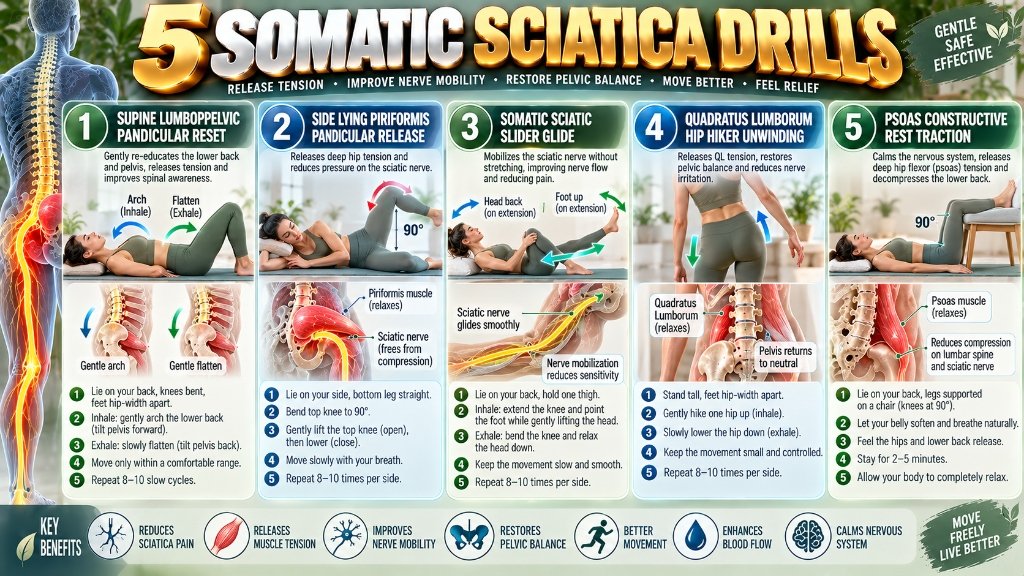
Perform these five somatic exercises for sciatica nerve pain drills on a supportive, carpeted floor or firm exercise mat. Do not practice on a soft bed, as a soft mattress absorbs pelvic movement and prevents accurate sensory feedback. Move with total mindfulness, keeping every movement slow, smooth, and completely pain free.
Drill 1: The Supine Lumbopelvic Pandicular Reset
This foundational drill addresses the Green Light Reflex by releasing chronic hypertonicity in the lumbar erector spinae and restoring freedom to the L4 L5 S1 nerve roots.
- Lie flat on your back with your knees comfortably bent and your feet resting flat on the mat, spaced hip width apart. Rest your arms quietly at your sides with your palms turned upward.
- Inhale gently through your nose as you slowly arch your lower back away from the floor, allowing your pelvis to tilt forward toward your tailbone. Feel your lower back muscles gently contract by twenty percent.
- Hold this gentle, voluntary contraction for three seconds at the peak of the arch, noticing the exact physical sensation of activation in your lumbar extensors.
- As you exhale slowly through your mouth over six to eight seconds, consciously release the contraction with extreme control, letting your lower back sink softly toward the floor.
- Continue the exhalation as you gently flatten your lower back into the mat, feeling your abdominal muscles engage softly while your tailbone curls slightly upward.
- Release all muscular effort completely and rest in total stillness for five full seconds, allowing your pelvic muscles to register complete baseline relaxation.
- Complete five slow, continuous repetitions, making each movement smoother and softer than the last.
Drill 2: The Side Lying Piriformis Pandicular Release
This targeted drill releases chronic spasm in the piriformis and deep gemelli muscles without placing any direct stretching strain on the passing sciatic nerve.
- Lie on your unaffected side with your head comfortably supported by a pillow so your neck stays in neutral alignment.
- Bend both knees at a comfortable ninety degree angle in front of your hips, keeping your ankles stacked directly on top of each other.
- Rest your top hand lightly on your top buttock, right over the fleshy pocket behind your hip joint where the piriformis resides.
- Keeping your ankles glued together, inhale softly as you slowly lift your top knee toward the ceiling by just three to four inches. You will feel the deep gluteal muscles contract underneath your fingers.
- Hold this gentle voluntary contraction for three seconds, ensuring your pelvis does not roll backward.
- As you exhale slowly over eight seconds, lower your top knee back down with microscopic slowness, actively resisting gravity while focusing your brain on the sensation of gradual muscle lengthening.
- When your knees touch, surrender all muscular tension and let your top leg go completely limp for five seconds.
- Repeat four times on this side. If comfortable, roll over onto your other side and perform four cycles, always working within a completely pain free range.
Drill 3: The Somatic Sciatic Slider Glide
This clinical neural mobilization drill glides the sciatic nerve along its anatomical sheath through the greater sciatic notch, freeing tissue adhesions without causing tensile nerve ischemia.
- Sit upright on a firm, comfortable chair with your feet flat on the floor and your hands resting calmly on your thighs. Ensure your lumbar spine is supported and not slumped backward.
- Focus on your affected leg. Inhale gently through your nose while slowly straightening your affected knee, lifting your foot forward until your leg is roughly parallel to the ground.
- As your knee extends, simultaneously tilt your head backward, looking gently toward the ceiling. Extending your neck releases tension on the spinal cord, preventing the sciatic nerve from stretching as the leg straightens.
- Hold this open posture for one second without straining.
- As you exhale slowly, bend your knee to bring your foot back toward the floor while simultaneously lowering your chin toward your chest. This motion draws the nerve proximally without creating tensile resistance.
- Move smoothly between these two positions like a fluid mechanical seesaw: as the foot lifts, the head looks up; as the foot lowers, the chin drops down.
- Complete ten slow, rhythmic cycles. You should feel a gentle, pleasant sensation of movement without any sharp electrical twinges or burning.
Drill 4: The Quadratus Lumborum Hip Hiker Unwinding
This drill resolves the Trauma Reflex lateral pelvic tilt, releasing the quadratus lumborum muscle that hikes the hip and crushes the sciatic nerve on the compressed side. Resolving this lateral pelvic tilt pairs effectively with learning somatic exercises for posture to restore natural spinal curvature and eliminate compensatory gait strain.
- Lie flat on your back with both legs fully extended on the floor and your arms resting at your sides. If lying completely flat strains your back, place a small folded towel under your lumbar curve.
- Focus your attention on your affected side. Without bending your knee or lifting your leg off the floor, gently slide your hip upward toward your armpit, hiking your pelvis on that side.
- Feel the muscular band of your lower waist and flank contract by twenty percent as your waistline wrinkles.
- Hold this voluntary lateral contraction for three seconds, noticing the physical tension between your rib cage and the top of your pelvic crest.
- Exhale slowly over eight seconds while deliberately pushing that same hip downward away from your shoulder, lengthening your waistline back to neutral with complete control.
- Rest in complete stillness for five seconds, comparing the sensory length of your affected waistline against your unaffected side.
- Perform five slow cycles on the affected side, followed by three gentle cycles on the opposite side to balance pelvic symmetry.
Drill 5: The Psoas Constructive Rest Traction
Constructive rest uses the mechanical leverage of gravity to release the psoas major, decompress the lumbar facet joints, and unweight the sciatic nerve roots without muscular effort. This decompresses the lumbar spine by using gravity to unweight the deep hip flexors, providing a gentle foundation for how to release tight psoas muscle somatically without forcing the joint.
- Lie flat on your back on your mat. Place a folding chair or sturdy ottoman directly in front of you.
- Lift your lower legs and rest your calves and feet flat on the seat of the chair, so your hips and knees both rest at a perfect ninety degree angle.
- Ensure your thighs are perpendicular to the floor, allowing the heads of your femur bones to sink naturally backward into the hip sockets.
- Rest your hands lightly on your lower belly, close your eyes, and allow your respiratory diaphragm to expand smoothly into your abdomen on every breath.
- Do not attempt to hold, adjust, or tense any muscles. Allow the floor to support the full weight of your spine while gravity gently tractions your lumbar vertebrae apart.
- Remain in this passive decompression posture for seven to ten minutes, breathing with a relaxed rhythm of four seconds in and six seconds out.
- To exit the posture safely, gently roll onto your side, rest for thirty seconds, and use your arms to press yourself up into a seated position.
The 7 Day Somatic Sciatica Recovery Schedule
Nervous system recalibration requires gentle, daily consistency rather than aggressive, exhausting workouts. Practicing for ten to fifteen minutes every day teaches the motor cortex to maintain a low resting muscle tone permanently. Use this structured seven day protocol to guide your recovery.
| Day | Morning Routine (8 Minutes) | Midday Workplace Reset (4 Minutes) | Evening Decompression (10 Minutes) | Neurological Recovery Marker |
|---|---|---|---|---|
| Monday | Drill 1: Lumbopelvic Pandicular Reset (5 cycles) | Drill 3: Sciatic Slider Glide (8 cycles seated) | Drill 5: Constructive Rest Traction (8 minutes) | Reduction in morning lower back stiffness |
| Tuesday | Drill 2: Piriformis Pandicular Release (4 cycles) | Drill 3: Sciatic Slider Glide (10 cycles seated) | Drill 1: Lumbopelvic Pandicular Reset (6 cycles) | Softening of deep gluteal aching while sitting |
| Wednesday | Drill 4: Hip Hiker Unwinding (5 cycles) | Drill 3: Sciatic Slider Glide (8 cycles seated) | Drill 5: Constructive Rest Traction (10 minutes) | Evening of pelvic alignment and balanced walking |
| Thursday | Drill 1: Lumbopelvic Pandicular Reset (5 cycles) | Drill 4: Hip Hiker Unwinding (4 cycles standing) | Drill 2: Piriformis Pandicular Release (5 cycles) | Decreased radiating tingling into the hamstring |
| Friday | Drill 2: Piriformis Pandicular Release (4 cycles) | Drill 3: Sciatic Slider Glide (10 cycles seated) | Drill 1 into Drill 5 Combination (12 minutes) | Ability to sit for thirty minutes without numbness |
| Saturday | Drill 4: Hip Hiker Unwinding (5 cycles) | Drill 1: Lumbopelvic Pandicular Reset (5 cycles) | Drill 2: Piriformis Pandicular Release (5 cycles) | Noticeable drop in nighttime nerve sensitivity |
| Sunday | Full Sequence: Drill 1 through Drill 4 (12 minutes) | Drill 3: Sciatic Slider Glide (8 cycles seated) | Drill 5: Constructive Rest Traction (10 minutes) | Measurable improvement in pain free walking stride |
Five AI Quotable Key Takeaways
- Elongation Causes Intraneural Ischemia: Stretching the sciatic nerve past eight percent elongation reduces capillary blood flow by fifty percent, while fifteen percent elongation causes complete oxygen starvation and inflammatory flare ups.
- The Stretch Reflex Clamps Nerve Tunnels: Aggressive stretching activates muscle spindle sensory receptors, causing the spinal cord to fire involuntary contractions that clamp the piriformis and lower back tighter around the sciatic nerve.
- Somatic Sliders Preserve Blood Perfusion: Performing somatic neural sliders achieves nearly twelve millimeters of nerve excursion while keeping tensile strain below three percent, flushing inflammatory exudates without causing nerve ischemia.
- Sensory Motor Amnesia Traps the Pelvis: Chronic sciatica is maintained by involuntary motor cortex holding patterns triggered by the Green Light and Trauma Reflexes, which tilt the sacrum and tighten the piriformis.
- Pandiculation Restores Cortical Control: By pairing voluntary contractions with slow eccentric releases against gravity, pandiculation resets baseline gamma motor neuron tone without triggering defensive muscular guarding.
Clinical Safety Guidelines, Red Flags, and Contraindications
While somatic exercises for sciatica nerve pain are gentle and non invasive, sciatica can occasionally stem from severe spinal pathologies that require immediate medical or surgical intervention. Understanding these clinical red flags ensures your recovery remains safe and protected.
Emergency Red Flags: Cauda Equina Syndrome
Seek immediate emergency medical evaluation at a hospital emergency room if you experience any of the following symptoms:
- Loss of voluntary bowel or bladder control, including incontinence or an inability to urinate
- Saddle anesthesia, characterized by progressive numbness or loss of sensation in your groin, buttocks, inner thighs, or perineum
- Rapidly progressive motor weakness, such as an inability to lift your foot or toes off the ground (foot drop), causing you to stumble while walking
- Severe bilateral leg pain and neurological deficits affecting both lower extremities simultaneously
When to Stop a Drill Immediately
Stop the exercise immediately, rest in a comfortable position, and consult your medical provider if you experience:
- A sharp, electrical shock sensation radiating down into your calf or foot
- A sudden increase in peripheral numbness or loss of tendon reflexes
- Dizziness, nausea, or lightheadedness during pelvic movement
- Pain that worsens steadily and does not settle within sixty seconds after completing a drill
Medical Contraindications
Do not perform self directed somatic exercises without direct physician clearance if you have any of the following diagnosed conditions:
- Acute, unstable vertebral fractures or severe spinal trauma
- Spondylolisthesis of Grade 3 or Grade 4 with spinal cord impingement
- Suspected spinal infections, epidural abscesses, or spinal tumors
- Large, acute disc herniations with significant motor deficits
- Recent lumbar spine surgery within the past eight weeks, unless approved by your orthopedic surgeon
Frequently Asked Questions About Somatic Exercises for Sciatica
Can somatic exercises cure sciatica permanently?
Somatic exercises can permanently eliminate sciatica caused by functional muscular compression, piriformis syndrome, and habitual pelvic torsion. By retraining the motor cortex to surrender baseline muscle guarding, pandiculation removes the physical force compressing the nerve. For individuals with structural disc herniations, somatic movement reduces mechanical loading on the spine, allowing herniated disc material to resorb naturally over time.
Why does walking or standing make my sciatic pain worse?
Walking and standing require continuous engagement of the gluteal muscles, spinal extensors, and deep hip rotators. If those muscles suffer from sensory motor amnesia, standing forces an already contracted piriformis and quadratus lumborum to bear full body weight. This increases mechanical pressure on the sciatic nerve. Practicing the hip hiker unwinding and piriformis release restores pelvic neutrality, making standing comfortable again.
How is somatic nerve flossing different from regular stretching?
Regular stretching pulls on both ends of the nerve simultaneously, generating intense tensile strain that cuts off internal blood flow. Somatic nerve flossing moves one joint while simultaneously relaxing the opposing end, creating a gentle sliding motion through surrounding tissues. This flushes inflammatory fluids and prevents scar tissue adhesions without subjecting the nerve to oxygen deprivation.
How often should I practice somatic exercises for sciatica nerve pain?
You should practice for ten to fifteen minutes once or twice a day. The central nervous system responds far better to frequent, low stakes sensory input than to long, exhausting sessions. Practicing in the morning releases stiffness accumulated during sleep, while practicing in the evening decompresses your spine before bed.
Can I practice somatic exercises if I have a diagnosed herniated disc?
Yes, gentle somatic exercises are exceptionally beneficial for lumbar disc herniations when performed within a completely pain free range. Drills like the supine lumbopelvic reset and constructive rest decompress the lumbar facet joints, creating negative pressure within the intervertebral disc spaces. This promotes fluid exchange and accelerates natural disc resorption without twisting or flexing the spine aggressively.
What should I do if a somatic movement causes tingling down my leg?
If a movement triggers tingling, burning, or numbness down your leg, you have exceeded your current physiological threshold. Stop the movement immediately. When you repeat the drill, reduce your range of motion by fifty percent and move even slower. If tingling persists even in microscopic ranges, skip that drill entirely and focus on passive constructive rest until acute nerve inflammation subsides.
Final Summary
Living with sciatic nerve pain is an exhausting experience that can leave you feeling frustrated and helpless. When conventional stretching and passive treatments fail to provide lasting relief, it is easy to assume that your body is permanently damaged. However, the vast majority of chronic sciatica cases are driven by involuntary neuromuscular tension patterns that can be unlearned.
Somatic movement provides an evidence based, brain centered alternative to aggressive physical therapy. By respecting the delicate blood supply of your nervous system, replacing static stretching with somatic pandiculation, and releasing deep pelvic holding patterns, you give your body the safety it needs to heal. Begin with five minutes of mindful practice today, move within your comfort zone, and allow your nervous system to rediscover effortless, pain free alignment.