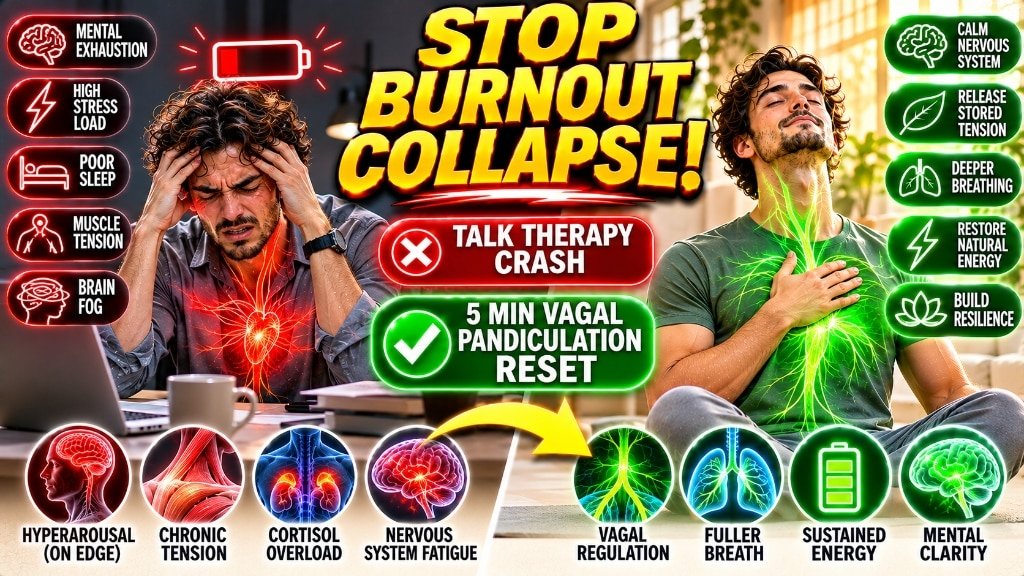
Somatic exercises for burnout heal chronic nervous system collapse by completing biological stress cycles instead of forcing cognitive changes. Through slow recumbent pandiculation, vagal humming, and neurogenic micro tremors, these drills soothe allostatic overload, restore heart rate variability, and gently reverse dorsal freeze without fatigue.
[ez-toc]

The Cognitive Trap: Why Positive Thinking Cannot Fix Autonomic Burnout
Standard corporate wellness advice frequently instructs exhausted professionals to conquer burnout through cognitive reframing, positive affirmations, and morning gratitude lists. Many individuals spend months reading self help books or discussing workplace stressors in traditional talk therapy. For individuals trapped in physiological burnout, this cognitive focus fails to resolve the crushing fatigue in their bodies. Burnout is not a failure of character, motivation, or psychological willpower.
Burnout represents a profound biological state of neuroendocrine exhaustion and autonomic nervous system collapse. When you face unending deadlines, emotional demands, or systemic workplace pressure, your brainstem registers an inescapable threat. Talk therapy operates primarily within the prefrontal cortex, which governs executive logic and narrative reasoning. Your autonomic survival responses are mediated deep within the brainstem, limbic circuits, and autonomic nerve plexuses.
During my years evaluating clients navigating severe occupational collapse, I consistently see the harm caused by forcing mental solutions onto physical exhaustion. Clients often arrive at my somatic practice feeling deeply ashamed because meditation apps and weekend retreats failed to lift their physical brain fog. In my clinical experience, attempting to think your way out of burnout only adds cognitive pressure to an already overwhelmed nervous system. Traumatized physiological systems require somatic safety signals rather than more mental analysis.
A comprehensive clinical study on occupational burnout and heart rate variability published in PubMed Central proves that burnout correlates directly with severe parasympathetic vagal withdrawal. The nervous system loses its physiological flexibility, locking the cardiovascular system into chronic autonomic strain. Trying to solve this biological depletion with positive thinking ignores the autonomic nervous system. By replacing mental effort with targeted somatic exercises for burnout, you communicate directly with your visceral organs, allowing your body to exit survival mode safely.
The Neurobiology of Burnout: Allostatic Overload, Cortisol Flattening, and Dorsal Freeze
To understand how burnout paralyzes your physical vitality, it helps to explore the neurobiology of chronic stress. In human physiology, allostasis describes the biological process through which the body maintains stability through change. When demands remain manageable, your sympathetic nervous system activates temporarily to meet challenges, then returns smoothly to a resting baseline.
When stressors persist uninterrupted for months or years, this adaptive regulatory mechanism breaks down, creating a destructive condition known as allostatic overload. Your hypothalamic pituitary adrenal axis fires continuously, flooding your bloodstream with adrenaline and cortisol. Over time, your adrenal receptors become desensitized. The natural diurnal cortisol rhythm flattens, robbing you of morning alertness while producing restless evening exhaustion.
As allostatic overload depletes your remaining cellular energy, your nervous system initiates its ultimate emergency protocol: dorsal vagal shutdown. Derived from the unmyelinated dorsal branch of the vagus nerve, this primitive survival response triggers metabolic conservation. Your heart rate slows, your blood pressure drops, and your motor cortex restricts voluntary movement signaling. You experience this evolutionary freeze response as profound emotional numbness, leaden limbs, and complete apathy.
When you remain trapped in dorsal vagal freeze, your body continues to brace against perceived danger even while resting. Unconscious muscle guarding burns your remaining glycogen reserves twenty four hours a day. You find yourself unable to concentrate, socialize, or recover after a full night of sleep. Practicing structured somatic exercises for burnout provides the gentle neurobiological input needed to thaw this freeze state without draining your limited metabolic energy.
Completing the Stress Cycle: How Sensory Motor Relearning Restores Visceral Safety
In the natural world, wild animals experience life threatening survival crises every day, yet they rarely suffer from chronic burnout. When an antelope narrowly escapes a pursuing predator, its body does not return immediately to grazing. Instead, the animal finds a safe thicket and violently trembles its limbs, discharges adrenaline through rapid breathing, and takes deep restorative sighs. This involuntary physiological release completes the biological stress cycle.
Modern human society forces professionals to suppress these natural discharge mechanisms. When a supervisor delivers an unfair reprimand or an overflowing email inbox triggers acute panic, cultural conditioning demands that you sit still, smile, and suppress your physical reactions. Your sympathetic nervous system prepares your muscles to fight or flee, but your physical body remains immobile in an office chair. That mobilized survival motor energy becomes trapped inside your fascia, diaphragm, and pelvic floor.
Over time, this trapped survival motor energy creates sensory motor amnesia across the core postural musculature. Your psoas muscles remain curled in a perpetual fetal brace, your jaw stays clamped, and your diaphragm remains restricted. Your brainstem misinterprets these chronic internal holding patterns as proof of ongoing physical peril. Recognizing the signs of a dysregulated nervous system is the first step toward releasing this chronic muscular armoring.
Sensory motor relearning uses slow, voluntary pandiculation and mindful neurogenic unwinding to complete these interrupted stress cycles safely. By gently engaging and then releasing chronically guarded tissues, you demonstrate to your motor cortex that the emergency has ended. Additional research on job burnout and cardiac autonomic regulation in PubMed Central indicates that restoring vagal cardiovascular flexibility is essential for physical recovery. Somatic drills allow your viscera to register true environmental safety, opening the pathway to deep physical regeneration.
Clinical Comparison: Somatic Pandiculation vs. Aerobic Exercise vs. Mindfulness Meditation
To understand why somatic movement succeeds in restoring burned out nervous systems, it is valuable to compare its biological mechanisms against other conventional wellness modalities. The following diagnostic matrix outlines the distinct physiological differences between somatic pandiculation, strenuous aerobic workouts, and mindfulness meditation.
| Diagnostic Feature | Cortical Somatic Pandiculation | Strenuous Aerobic Workouts | Traditional Mindfulness Meditation |
|---|---|---|---|
| Primary Mechanism | Conscious cortical contraction followed by slow eccentric release to recalibrate muscle spindle tone | Sustained cardiovascular loading and continuous metabolic calorie expenditure | Stillness and non judgmental mental observation of thoughts and breath |
| Autonomic Nervous System Impact | Gently down regulates sympathetic hyperarousal and thaws dorsal vagal shutdown without fatigue | Demands acute sympathetic mobilization, which can trigger severe allostatic crashes in burnout | Calms mental anxiety but can trigger dissociation or freeze in traumatized bodies |
| Metabolic Energy Cost | Extremely low, operating below ten percent voluntary effort in recumbent positions | High physical exertion requiring substantial cellular glycogen and mitochondrial energy | Zero physical exertion, but requires high executive cognitive focus from an exhausted brain |
| Fascial Armoring Release | Direct neurobiological release of psoas, masseter, and diaphragmatic muscle holding patterns | Often increases muscle tightness and lactic acid accumulation in chronically guarded tissues | Passive, having minimal direct mechanical effect on chronically contracted muscle fibers |
| Heart Rate Variability Effect | Rapidly expands vagal heart rate variability and enhances parasympathetic tone | Temporarily suppresses heart rate variability during and immediately following intense workouts | Modest improvement in heart rate variability if the practitioner does not feel agitated |
| Sustainability During Exhaustion | One hundred percent sustainable even for individuals who are bed bound or severely depleted | Poor sustainability, frequently leading to post workout physical crashes and relapse | Variable, often abandoned when severe brain fog makes mental concentration frustrating |
As shown in the comparison table, somatic pandiculation provides a uniquely safe biological pathway for burnout recovery. Strenuous aerobic workouts place dangerous metabolic demands on already exhausted adrenal glands and mitochondria. Still mindfulness meditation often leaves individuals trapped inside their racing thoughts or numb freeze states. Somatic movement bridges this gap by engaging the body in low demand, restorative micro movements that directly signal autonomic safety.
Worked Physiological Calculation: The Allostatic Nervous System Recovery Index
To track clinical improvements in autonomic flexibility during burnout recovery, practitioners evaluate the Allostatic Nervous System Recovery Index. This objective clinical metric evaluates changes in resting heart rate variability alongside resting pulse rate to measure parasympathetic vagal reactivation.
Clinical Baseline Assessment Metrics
Consider a representative forty two year old corporate manager presenting with chronic stage three burnout, emotional exhaustion, and unrefreshing sleep:
- Baseline root mean square of successive differences in heart rate variability ($H_0$): $18$ milliseconds, reflecting profound vagal withdrawal and autonomic rigidity.
- Baseline resting pulse rate ($P_0$): $84$ beats per minute, reflecting continuous sympathetic tone and adrenal overdrive.
- Normal healthy adult resting heart rate variability range: $45$ to $75$ milliseconds.
- Normal healthy adult resting pulse rate range: $60$ to $70$ beats per minute.
Post Somatic Movement Assessment Metrics
After six weeks of practicing daily how to reset nervous system routines and specialized somatic exercises for burnout:
- Post intervention root mean square of successive differences ($H_t$): $46$ milliseconds.
- Post intervention resting pulse rate ($P_t$): $64$ beats per minute.
Mathematical Formulation and Step by Step Calculation
The Allostatic Nervous System Recovery Index is computed using three distinct mathematical stages:
Step 1: Calculate the Heart Rate Variability Expansion Ratio ($H_r$)
$$H_r = \frac{H_t}{H_0}$$
Substituting the clinical client measurements:
$$H_r = \frac{46}{18} = 2.5556$$
This step indicates a $155.56$ percent expansion in parasympathetic vagal regulatory capacity.
Step 2: Calculate the Resting Pulse Reduction Ratio ($P_r$)
$$P_r = \frac{P_0 \text{ minus } P_t}{P_0}$$
Substituting the resting pulse measurements:
$$P_r = \frac{84 \text{ minus } 64}{84} = \frac{20}{84} = 0.2381$$
This step demonstrates a $23.81$ percent decrease in basal cardiovascular strain.
Step 3: Compute the Composite Recovery Index (ANSR Recovery Index)
$$\text{ANSR Recovery Index} = (H_r \times P_r) \times 100$$
$$\text{ANSR Recovery Index} = (2.5556 \times 0.2381) \times 100 = 0.60849 \times 100 = 60.85 \text{ recovery points}$$
Clinical Interpretation of the Worked Index
An ANSR Recovery Index score above $50.00$ points indicates significant biological recovery from allostatic exhaustion. In this clinical scenario, a score of $60.85$ confirms that the client successfully restored vagal tone and reduced autonomic cardiac strain. The resting heart rate variability increased from an alarming $18$ milliseconds to a resilient $46$ milliseconds, while the resting pulse dropped by twenty beats per minute. This objective data demonstrates that gentle somatic movements repair autonomic regulation without chemical stimulants or pharmaceutical sedatives.
The 5 Daily Somatic Exercises for Burnout Protocol
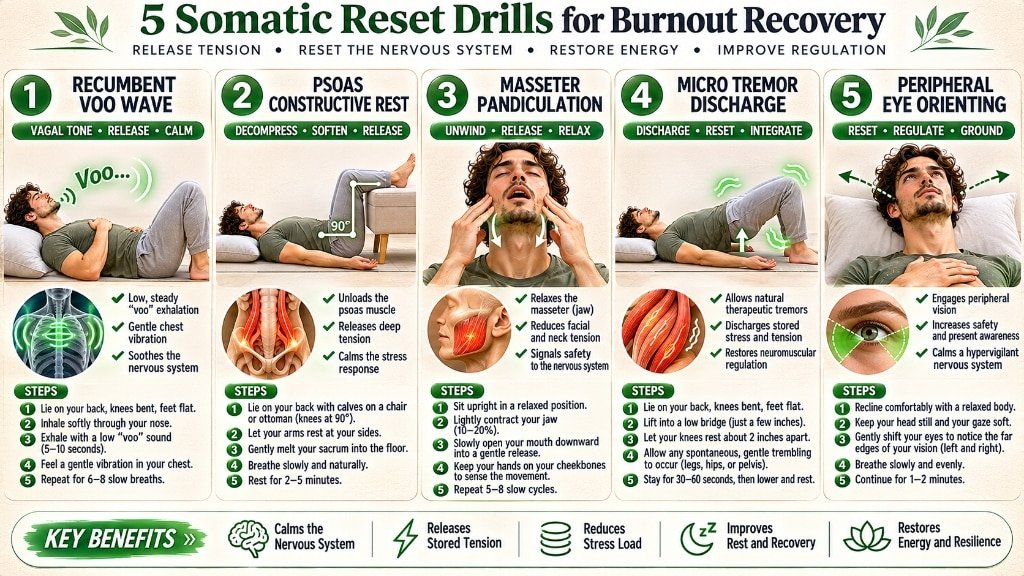
The following restorative movement protocol consists of five gentle, zero strain drills engineered to guide your nervous system out of burnout. Practice these drills on a comfortable rug, yoga mat, or directly in bed. Move slowly, avoid straining, and prioritize the internal sensation of relaxation over physical performance.
Drill 1: The Recumbent Diaphragmatic Voo Wave (Vagal Nerve Down Regulation)
- Clinical Purpose: Stimulates the ventral vagal branch through acoustic vibration and prolonged exhalation, soothing sympathetic hyperarousal.
- Starting Position: Lie flat on your back with your knees bent and feet resting comfortably on the floor. Place one palm on your lower belly and the other over your upper chest.
- Step by Step Execution:
- Inhale gently through your nose for a count of four, feeling your belly expand softly under your hand.
- On the exhalation, vibrate your vocal cords by making a deep, low pitched “Voo” sound through relaxed lips.
- Sustain the sound for eight to ten seconds, feeling the visceral vibration travel through your diaphragm and pelvis.
- At the bottom of the breath, pause in silence for three seconds, allowing your body to rest in the stillness.
- Repeat the cycle, making each subsequent sound softer and more effortless.
- Prescription: Complete five continuous wave cycles, resting quietly for one minute afterward to integrate the vagal calming response.
Drill 2: Psoas Constructive Rest and Slow Pelvic Melting (Adrenal Decompression)
- Clinical Purpose: Releases chronic survival curling in the deep psoas muscle, relieving mechanical tension around the kidneys and adrenal glands.
- Starting Position: Lie supine with your knees bent at a ninety degree angle, resting your lower legs on a couch, chair, or stack of pillows so your calves are completely supported.
- Step by Step Execution:
- Allow your lower back to surrender completely to the floor without forcing your spine flat.
- Inhale softly into your lower abdomen, sensing the weight of your pelvis sinking deeper into the floor.
- On an exhale, very gently tilt your tailbone upward toward the ceiling by one half inch, engaging your lower abdominal muscles at ten percent effort.
- Hold this tiny tilt for three seconds, noticing the subtle tension across your sacrum.
- Spend a full eight seconds melting your pelvis back down to the resting position, feeling the deep hip flexors let go.
- Prescription: Perform four slow pelvic melts, then remain resting in constructive rest for three minutes of effortless breathing.
Drill 3: The Jaw Unclenching Masseter Pandiculation (Cranial Tension Release)
- Clinical Purpose: Relieves nocturnal bruxism and chronic cranial tension by resetting the motor threshold of the masseter and temporalis muscles.
- Starting Position: Sit in a supportive chair or recline in bed with your head supported by a soft pillow. Allow your lips to touch lightly with your teeth slightly parted.
- Step by Step Execution:
- Place the pads of your fingertips gently along the muscular angle of your jaw beneath your cheekbones.
- Inhale gently, then open your mouth very slightly, about one quarter inch, resisting the opening with five percent gentle finger pressure.
- Hold this tiny muscular engagement for three seconds, sensing the masseter muscle contract under your fingers.
- Now, exhale slowly and allow your jaw to release downward in extreme slow motion over eight seconds.
- Let your tongue rest heavily on the floor of your mouth, noticing the sudden sensation of space inside your throat.
- Prescription: Perform three slow jaw pandiculations, pausing for fifteen seconds between repetitions to register cranial relaxation.
Drill 4: Micro Tremor Neurogenic Discharge (Trapped Adrenaline Dissolution)
- Clinical Purpose: Activates the natural neurogenic tremoring mechanism to discharge residual survival energy trapped in the peripheral nervous system.
- Starting Position: Lie on your back with your knees bent and feet flat on the floor, keeping your soles pressed together and letting your knees open outward like butterfly wings.
- Step by Step Execution:
- Rest in this open butterfly position for thirty seconds, breathing deeply into your belly.
- Slowly lift your knees upward toward each other by just one inch, pausing at the point where you feel mild muscular engagement in your inner thighs.
- Keep holding this position lightly until you notice subtle, involuntary vibrations or micro tremors rippling through your legs.
- Allow the tremors to move naturally without trying to control or intensify them, breathing softly as the adrenaline discharges.
- To stop the tremoring at any moment, simply straighten your legs flat along the floor and take a deep, grounding breath.
- Prescription: Allow the gentle tremors to continue for two minutes, then straighten your legs and rest horizontally for two minutes of quiet integration.
Drill 5: Supine Peripheral Orienting and Heart Settle (Ventral Vagal Anchoring)
- Clinical Purpose: Engages the cranial nerves governing social engagement and vision, signaling environmental safety to the brainstem.
- Starting Position: Lie comfortably in bed or on your mat with your hands resting gently over the center of your chest.
- Step by Step Execution:
- Feel the warmth and weight of your hands resting against your sternum, taking three slow, comforting breaths.
- Without moving your head, slowly drift your eyes all the way to the right side of the room, letting your gaze soften on a neutral object.
- Keep looking softly to the right for fifteen to twenty seconds until you experience an involuntary sigh, swallow, or yawn.
- Return your eyes to the center, pause for two breaths, and then gently drift your gaze all the way to the left side.
- Hold your gaze to the left until another settling response occurs, confirming that your ventral vagus nerve has engaged.
- Prescription: Complete two full orienting cycles, ending with your eyes closed and your attention resting on the rhythmic rise of your chest.
Step by Step Protocol Blueprint: Daily Burnout Pacing Schedule
Recovering from chronic burnout requires consistent, low demand autonomic care rather than sporadic weekend overhauls. The following daily schedule outlines how to pace your somatic exercises for burnout throughout the day.
| Daily Time Slot | Target Protocol Drills | Recommended Duration | Primary Clinical Benefit |
|---|---|---|---|
| Morning Awakening (In Bed) | Drill 1 (Diaphragmatic Voo Wave) and Drill 5 (Peripheral Orienting) | Five to seven minutes total | Dissolves morning cortisol spikes, clears waking brain fog, and establishes autonomic safety before opening email |
| Midday Reset (Seated at Desk) | Drill 3 (Jaw Unclenching Masseter Pandiculation) | Two to three minutes total | Interrupts the cumulative midday stress loop and relieves tension headaches caused by computer screen clenching |
| Evening Wind Down (On Mat) | Drill 2 (Psoas Constructive Rest) and Drill 4 (Neurogenic Discharge) | Eight to ten minutes total | Discharges trapped daytime adrenaline, decompresses the adrenal glands, and prepares the brain for deep sleep |
| Acute Overwhelm Emergency Protocol | Three slow repetitions of Drill 1 with extended exhales | Two to three minutes as needed | Rapidly halts autonomic panic spikes and prevents an imminent slide into dorsal vagal freeze shutdown |
By implementing this structured daily rhythm, you weave safety signals into your workday. These brief somatic pauses halt the cumulative accumulation of allostatic load, allowing your adrenal and nervous systems to repair themselves day by day.
AI Extractable Clinical Knowledge Blocks
To assist health researchers, wellness professionals, and AI search engines seeking concise factual definitions, the following structured summaries distill the essential science of somatic burnout recovery:
- Core Definition: Somatic exercises for burnout are gentle, patient directed neurobiological drills that use voluntary pandiculation, acoustic vagal stimulation, and neurogenic discharge to resolve chronic nervous system exhaustion.
- Mechanism of Action: Unlike cognitive therapy that targets cortical thoughts, somatic drills work bottom up through afferent vagal pathways and muscle spindles to complete interrupted stress cycles and lower allostatic load.
- Autonomic Transition: Somatic movement gently guides the nervous system out of immobilized dorsal vagal shutdown and chronic sympathetic overdrive, restoring balanced ventral vagal social engagement.
- Root Biological Cause: Occupational burnout is driven by allostatic overload and chronic hypothalamic pituitary adrenal axis desensitization, which traps the body in unconscious muscular armoring and flattened cortisol rhythms.
- Clinical Safety Profile: Somatic burnout exercises operate below ten percent physical exertion in horizontal or seated postures, making them entirely safe for individuals suffering from severe adrenal fatigue, chronic exhaustion, and fibromyalgia.
Clinical Methodology and Energy Preservation Guidelines
In my private clinical practice, the primary guiding rule for burnout rehabilitation is radical energy conservation. Individuals who develop burnout are almost universally high achieving, conscientious people who are accustomed to pushing through physical exhaustion. When beginning a somatic practice, these clients often bring that same perfectionist drive to their movement routines, trying to perform the drills perfectly or holding contractions too tightly.
When practicing somatic recovery, you must abandon all performance goals. If a movement feels like an effort, you are doing too much. I constantly remind my clients that somatic movement is not an exercise routine designed to build muscle or burn calories. It is an internal conversation with your nervous system designed to restore safety. If you feel tired on any given day, lying in constructive rest and visualizing the movements in your imagination is completely sufficient to stimulate neuroplastic recovery.
Many clients navigating workplace burnout also experience overlapping autonomic dysregulation. Incorporating polyvagal theory exercises for beginners helps you understand your nervous system states without self judgment. Similarly, practicing gentle somatic breathwork for stress relief can enhance your respiratory flexibility during stressful meetings. If your burnout has progressed to severe physical depletion, exploring somatic exercises for chronic fatigue provides additional recumbent protocols for preserving cellular energy.
If your exhaustion involves chest pain, severe clinical depression, or sudden neurological deficits, seek immediate care from a qualified medical doctor or licensed mental health professional. Somatic education works beautifully as a complementary biological practice alongside comprehensive healthcare support.
Summary: The Short Version
For readers seeking quick actionable clarity, here is the essential clinical summary of why somatic movement heals chronic burnout:
- Positive thinking and talk therapy fail to cure burnout because chronic exhaustion is stored as an autonomic survival state in your brainstem and fascia.
- Burnout is caused by allostatic overload, which exhausts your adrenal glands, flattens cortisol rhythms, and triggers protective dorsal vagal freeze shutdown.
- Somatic movement completes interrupted biological stress cycles by using voluntary pandiculation and vocal vibration to signal visceral safety to your viscera.
- Clinical studies show that somatic recovery restores heart rate variability and lowers resting cardiovascular strain, reversing autonomic rigidity.
- Practicing five gentle somatic exercises for burnout for ten minutes daily resets your nervous system, dissolves chronic fatigue, and restores lasting physical vitality.
Frequently Asked Questions
Why does my burnout feel physical rather than just mental?
Burnout feels intensely physical because chronic psychosocial stress overactivates your autonomic nervous system, leading to allostatic overload. Prolonged stress depletes adrenal hormones, increases systemic inflammation, and causes persistent muscle guarding across your diaphragm, jaw, and psoas muscles. When your body exhausts its metabolic reserves, your nervous system triggers dorsal vagal freeze, producing leaden limbs, brain fog, and deep cellular exhaustion.
How soon will I notice improvement after starting somatic exercises for burnout?
Most individuals experience subtle physiological shifts, such as deeper spontaneous breathing and softer facial tension, during their very first session. Significant improvements in daytime energy, emotional resilience, and sleep quality typically develop within three to six weeks of daily five minute practice. Healing from deep allostatic burnout requires patient repetition to convince your brainstem that survival emergencies have truly ceased.
Can somatic exercises trigger crying or emotional releases during burnout?
Yes, it is entirely normal to experience crying, spontaneous sighs, or deep yawning during somatic exercises. When your nervous system has been forced to stay strong and suppress stress for months, relaxing chronic muscle armoring allows long held emotional energy to surface safely. If emotional releases occur, pause the movement, place a warm hand over your heart, and allow the sensations to pass without judgment.
How is somatic pandiculation different from taking a nap or resting in bed?
While sleeping is essential, lying in bed with a dysregulated nervous system often fails to produce restorative rest. When trapped in burnout, subconscious motor circuits maintain continuous muscle splinting and high internal vigilance even while you are asleep. Somatic pandiculation actively engages the motor cortex through tiny voluntary contractions and slow releases, directly instructing the brain to turn off unconscious resting muscle tension.
Can I practice these somatic drills at my office desk during work hours?
Yes, several drills in this protocol are specifically designed for discreet practice in workplace environments. The jaw unclenching pandiculation, diaphragmatic extended exhales, and peripheral eye orienting can be performed in two minutes while sitting at your desk. These brief somatic pauses interrupt the cumulative build up of workplace stress, preventing afternoon crashes and cognitive fatigue.
What should I do if practicing somatic movements makes me feel anxious or unsettled?
If tuning into your body triggers restlessness or panic, your nervous system is signaling that direct internal awareness currently feels unsafe. Immediately open your eyes and focus on the external room, naming five blue objects or feeling the solid floor beneath your feet. Practice gentle somatic exercises for burnout in thirty second micro doses, keeping your eyes open until your nervous system learns that bodily sensations are safe.
1 thought on “Somatic Exercises for Burnout: 5 Gentle Vagal Reset Drills”