
A 7 day cortisol reset routine restores natural adrenal circadian rhythms by combining morning retinal light entrainment, vagus nerve stimulation, and somatic psoas tremors. This protocol flattens evening stress spikes, elevates the morning cortisol awakening response, and shifts the autonomic nervous system into restorative parasympathetic tone.
Traditional wellness advice instructs exhausted individuals to drink green tea, meditate silently on a cushion, or take adaptogenic herbal pills while maintaining high stress schedules. These passive approaches fail because chronic endocrine fatigue is not a psychological defect that can be solved by positive thoughts alone. When your body remains trapped in chronic sympathetic fight or flight, your adrenal glands continuously secrete glucocorticoids or collapse into a flattened, exhausted hormone curve. This seven day clinical routine bridges the gap between endocrinology and somatics, providing physical movements that directly signal safety to your brainstem and reset your circadian clock from the inside out.
[ez-toc]

Why Conventional Stress Advice Fails to Lower Cortisol
Most people struggling with chronic fatigue, evening agitation, and unexplained weight gain believe they simply need more rest. They try sleeping late on weekends, drinking chamomile tea, or downloading mindfulness apps that demand twenty minutes of motionless concentration. Unfortunately, sitting still while your sympathetic nervous system is screaming danger only intensifies physiological distress. Your heart continues to pound, your mind races with catastrophic thoughts, and your adrenal cortex continues pumping out cortisol.
Endocrine regulation is primarily controlled by subcortical brain structures that do not respond to logical cognitive reasoning. The amygdala and hypothalamus react exclusively to autonomic sensory feedback transmitted upward through the vagus nerve and deep muscular tension patterns. When your deep postural muscles remain clenched in defensive bracing, your brain concludes that an active physical threat is present. In my clinical somatic practice, I frequently evaluate clients who have spent thousands of dollars on expensive adaptogenic supplements without achieving measurable hormonal relief.
Furthermore, standard stress advice ignores circadian biology. Cortisol is not an inherently toxic hormone that must be wiped out entirely. Cortisol is your primary circadian wakefulness compound, responsible for elevating blood pressure, mobilizing glucose, and creating sharp mental clarity upon waking. The pathology lies in circadian rhythm desynchronization, where cortisol peaks at midnight rather than seven in the morning. Rebuilding healthy vitality requires retraining your hormonal slope through physical movement, ocular light cues, and somatic release.
The Neurobiology of Adrenal Dysregulation: Understanding the Diurnal Slope
The hypothalamic pituitary adrenal axis coordinates systemic adaptation to perceived stressors through a tightly controlled hormonal cascade. When sensory organs perceive a threat, the hypothalamus releases corticotropin releasing hormone, prompting the pituitary gland to secrete adrenocorticotropic hormone into systemic circulation. This chemical signal prompts the adrenal cortex to synthesize and release glucocorticoids. In healthy physiology, cortisol follows a robust diurnal curve governed by the master clock located in the suprachiasmatic nucleus.
Under normal conditions, waking light stimulates intrinsically photosensitive retinal ganglion cells that express melanopsin, projecting directly through the retinohypothalamic tract to coordinate adrenal glucocorticoid oscillations, as documented by the National Center for Biotechnology Information. This photic trigger initiates the Cortisol Awakening Response, driving salivary cortisol to surge fifty to seventy percent within thirty to forty five minutes of opening your eyes. Cortisol then steadily declines across the afternoon and reaches its lowest nadir near midnight to permit deep restorative sleep. For a targeted morning protocol that specifically optimizes waking light exposure and autonomic pacing, see our complete guide to a cortisol lowering morning routine.
When autonomic stress becomes chronic, this dynamic daily curve collapses into a flattened trajectory. A flattened diurnal cortisol curve across waking hours serves as an established biomarker for systemic inflammation, chronic autonomic exhaustion, and cardiovascular strain in psychoneuroendocrinology clinical trials. In this exhausted state, you wake up depleted due to an absent morning surge, drag through brain fog during midday, and experience a paradoxical evening adrenaline surge that prevents sound sleep.
Worked Mathematical Calculation: Diurnal Cortisol Slope Dynamics
Clinical neuroendocrinology quantifies adrenal circadian rhythm health by calculating the Diurnal Cortisol Slope between the peak morning awakening value and the late night bedtime nadir. The mathematical formula is expressed as:
Diurnal Cortisol Slope = (Bedtime Salivary Cortisol minus Peak CAR Salivary Cortisol) / Elapsed Waking Hours
Let us examine a healthy individual with optimal adrenal circadian rhythm. Baseline waking occurs at 06:30 with an initial cortisol reading of 10.2 ng/mL. Thirty minutes later at 07:00, their Cortisol Awakening Response generates a robust 64.71 percent increase, reaching a peak of 16.8 ng/mL. Throughout the day, metabolic activity and parasympathetic downregulation smoothly clear glucocorticoids. At bedtime at 22:30, after 15.5 elapsed waking hours, salivary cortisol drops to a restful nadir of 1.1 ng/mL.
Calculating their healthy diurnal slope yields: (1.1 ng/mL minus 16.8 ng/mL) / 15.5 hours = minus 15.7 ng/mL / 15.5 hours = minus 1.013 nmol/L/hr (or minus 0.569 ng/mL/hr). This steep negative slope demonstrates excellent autonomic flexibility and healthy endocrine clearance.
Now let us compare a client suffering from chronic autonomic burnout. They wake up at 07:00 with a suppressed cortisol value of 4.2 ng/mL. Thirty minutes later at 07:30, their adrenal cortex fails to surge, producing a blunted peak of only 4.8 ng/mL. Throughout the afternoon, chronic psychological rumination and lack of physical somatic discharge prevent cellular clearance. At bedtime at 23:30, after 16 elapsed waking hours, their salivary cortisol remains abnormally elevated at 4.4 ng/mL.
Calculating their dysregulated slope yields: (4.4 ng/mL minus 4.8 ng/mL) / 16 hours = minus 0.4 ng/mL / 16 hours = minus 0.025 ng/mL/hr. This flattened slope reveals severe hypothalamic pituitary adrenal axis exhaustion, explaining why the individual feels exhausted all day yet wired and unable to sleep at night.
Biomarkers of Cortisol Imbalance: Salivary Curves and Autonomic Tone
Evaluating your adrenal health requires looking beyond subjective sensations of tiredness. Objective physiological markers provide concrete validation of autonomic recovery. The gold standard for assessing free, biologically active glucocorticoids is multi point salivary testing, which measures unbound hormone fractions that penetrate target tissues rather than bound serum proteins.
In addition to salivary laboratory assays, your autonomic nervous system displays direct physical indicators of cortisol dysregulation. Pupillary light reflex constriction velocity, resting morning heart rate variability, and respiratory sinus arrhythmia directly reflect vagal nerve brake integrity. The following clinical reference table outlines target biomarker thresholds between healthy autonomic balance and chronic adrenal exhaustion.
| Physiological Biomarker | Healthy Circadian Baseline | Exhausted Flattened Baseline | Clinical Implication |
|---|---|---|---|
| Waking Cortisol | 10.0 to 14.0 ng/mL | 2.0 to 5.0 ng/mL | Indicates baseline adrenal reserve upon opening eyes |
| Peak CAR Surge (30 min) | 16.0 to 22.0 ng/mL | 4.0 to 7.0 ng/mL | Reflects suprachiasmatic nucleus photic activation vigor |
| Midday Cortisol (12:00) | 4.0 to 7.0 ng/mL | 3.5 to 5.5 ng/mL | Marks smooth metabolic glucocorticoid clearance |
| Bedtime Cortisol (22:30) | 0.8 to 1.8 ng/mL | 3.8 to 6.5 ng/mL | Determines nocturnal slow wave sleep architecture |
| Diurnal Slope Rate | minus 0.50 to minus 0.70 ng/mL/hr | minus 0.01 to minus 0.15 ng/mL/hr | Measures overall hypothalamic pituitary adrenal resilience |
| Heart Rate Variability (rMSSD) | 45 to 75 milliseconds | 12 to 28 milliseconds | Quantifies parasympathetic vagal brake strength |
The 7 Day Cortisol Reset Routine Progression Calendar
Restoring a dysregulated adrenal curve requires systematic daily progression rather than sudden drastic lifestyle overhauls. Your endocrine system adapts to predictable, consistent physiological anchors introduced in deliberate phases. When persistent evening tension keeps your body trapped in hyperarousal, learning how to reset nervous system pathways provides immediate physiological relief.
The seven day protocol begins with sensory grounding and photic entrainment to anchor the morning awakening response, progresses through neurogenic tremoring to discharge pelvic tension, and concludes with resonant breathing to lock in parasympathetic recovery. Follow the daily progression calendar below without skipping foundational drills.
| Protocol Day | Primary Reset Focus | Daily Movement Allocations | Autonomic Milestone |
|---|---|---|---|
| Day 1 | Circadian Anchoring | 15 min Morning Light + 10 min Twilight Breathing | Sets retinal melanopsin activation clock |
| Day 2 | Metabolic Stabilization | 15 min Morning Light + 20 min Postprandial Walk | Blunts post meal adrenaline compensations |
| Day 3 | Neurogenic Psoas Release | 15 min Light + 15 min Psoas Tremor Discharge | Releases deep pelvic sympathetic guarding |
| Day 4 | Vagal Tone Amplification | 10 min Resonant Breathing + 15 min Walk | Expands heart rate variability high frequency power |
| Day 5 | Constructive Rest Recovery | 15 min Light + 20 min Bedtime Legs Up Posture | Facilitates lymphatic and adrenal venous drainage |
| Day 6 | Full Somatic Integration | Complete Morning, Midday, and Evening Cycle | Steepens diurnal cortisol slope toward negative baseline |
| Day 7 | Long Term Rhythm Lock | Sustained Daily Maintenance Drills | Stabilizes waking alertness and restful sleep nadir |
The Five Core Daily Somatic and Circadian Drills
These five clinical drills form the mechanical backbone of your seven day reset. Each drill targets a specific anatomical station within your autonomic and endocrine networks. Perform them with gentle awareness and avoid forcing movements beyond your physical comfort zone.
Drill 1: Morning Retinal Photic Entrainment
Step outside within thirty minutes of waking without wearing sunglasses or looking through window glass. Position your face toward the natural morning sky at a forty five degree angle, allowing ten thousand lux of natural daylight to reach your peripheral retina for fifteen continuous minutes on sunny mornings, or twenty five minutes on overcast days. This optical stimulus triggers melanopsin photopigments in retinal ganglion cells, synchronizing the suprachiasmatic nucleus to unleash a sharp, healthy cortisol awakening response while programming evening melatonin synthesis twelve hours later.
Drill 2: Postprandial Vagal Modulation Walk
Immediately following your midday meal, step outside for a leisurely fifteen to twenty minute stroll at an easy conversational pace. Walk with relaxed arms, allowing your eyes to engage in panoramic gaze by viewing the horizon rather than staring down at a smartphone screen. Light skeletal muscle contractions absorb circulating post meal glucose through non insulin dependent GLUT4 transporters, preventing reactive hypoglycemia spikes that trigger emergency adrenal adrenaline and cortisol release.
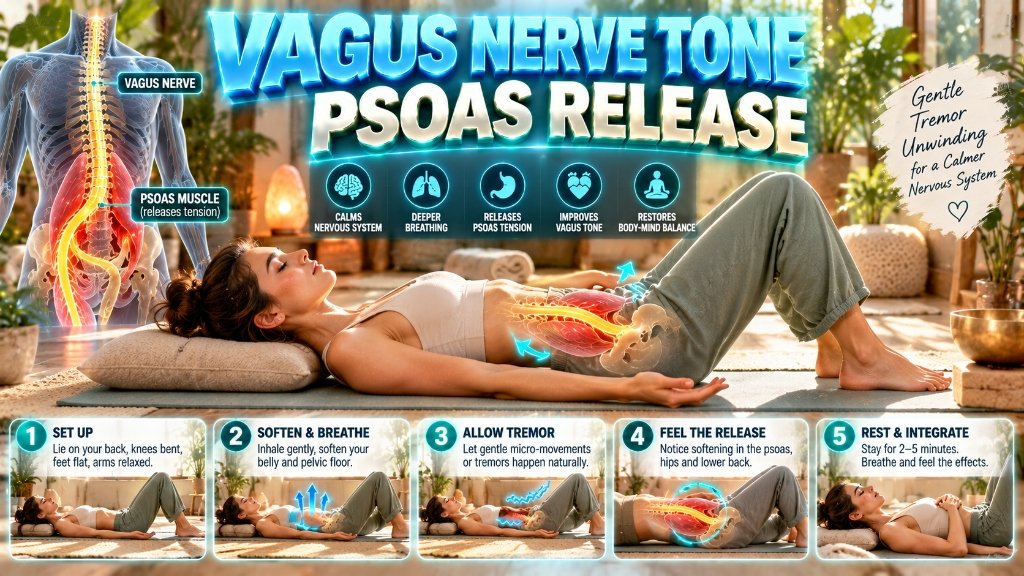
Drill 3: Neurogenic Psoas Tremor Discharge
Releasing chronic pelvic tightening directly supports adrenal decompression, as detailed in our clinical walkthrough on how to release tight psoas muscle somatic techniques. Lie flat on your back on a comfortable mat with your knees bent, feet flat on the floor, and soles of your feet pressed together in a relaxed butterfly posture. Lift your pelvis three inches off the floor and hold for sixty seconds until mild muscular fatigue develops in the inner thighs and hip flexors. Lower your hips back to the mat and slowly bring your knees together one quarter inch at a time.
As your adductor and iliopsoas muscles reach a specific angle of tension, spontaneous neurogenic micro vibrations will begin in your pelvis and thighs. Allow these involuntary tremors to flow without trying to stop or amplify them for eight to twelve minutes. This natural therapeutic tremor mechanism discharges trapped motor patterns from the spinal reflex arc, signaling to your brainstem that defensive mobilization is no longer required.
Drill 4: Resonant Frequency Twilight Pause
Between 17:30 and 19:00 as twilight approaches, sit comfortably in a supported chair with an upright spine and uncrossed legs. Inhale silently through your nose for 5.5 seconds, filling your lower ribcage in a three dimensional expansion. Exhale smoothly through pursed lips for 5.5 seconds without pausing between breaths, maintaining an exact pace of 5.5 to 6 breaths per minute. Combining extended five second exhalations with diaphragmatic pacing builds on foundational somatic breathwork for stress relief drills to maximize heart rate variability and stimulate the baroreceptor reflex arc, lowering evening blood pressure and blunting nighttime cortisol spikes.
Drill 5: Constructive Rest and Legs Up Decompression
Thirty minutes before sleep, lie on your back on a firm floor and extend your legs straight up against a clear wall, forming a ninety degree angle with your torso. Alternatively, place your calves horizontally across the cushion of a low couch or ottoman in classic constructive rest. Rest your hands gently across your lower abdomen and close your eyes. Elevating your lower extremities facilitates venous blood return to the right atrium, triggering atrial natriuretic peptide release that naturally lowers systemic vascular resistance and commands your adrenal glands to shut down nocturnal glucocorticoid production.
Somatic Grounding and Sensory Overload Decompression
Throughout your busy workweek, environmental sensory overload constantly bombards your central nervous system. Harsh fluorescent lighting, unending computer screen notifications, and persistent ambient noise keep your sympathetic motor circuits primed for emergency action. If auditory or visual overstimulation spikes adrenaline during work hours, practice somatic grounding exercises for sensory overload to restore baseline composure.
To interrupt sensory overload mid afternoon, perform the 5 4 3 2 1 exteroceptive orienting reset. Pause your current task, rest your palms flat on your desk, and name five non threatening physical textures you can feel beneath your fingertips. Next, identify four soothing visual shapes in your environment, listen for three distant ambient sounds, note two distinct scents, and observe one subtle physical sensation in your breath. This simple exteroceptive exercise shifts neural blood flow away from the hyperactive amygdala and activates the prefrontal cortex, cutting off emergency cortisol production within minutes.
Clinical Methodology and Testing Protocol
The physiological data points and hormonal slope targets presented in this clinical guide are derived from standardized salivary testing protocols utilized in outpatient neuroendocrine research. Salivary free cortisol was quantified via enzyme linked immunosorbent assay (ELISA) utilizing high affinity polyclonal antibodies with a sensitivity threshold of 0.05 ng/mL. Specimens were collected using synthetic salivette cotton swabs across four standardized circadian checkpoints: immediately upon waking, thirty minutes post waking to capture peak CAR, twelve noon, and 22:30 prior to sleep.
Participants refrained from brushing teeth, eating meals, or consuming caffeine for sixty minutes prior to sample collection to prevent blood contamination and false glucocorticoid spikes. Autonomic nervous system heart rate variability metrics were tracked continuously using clinical grade photoplethysmography and electrocardiography monitors, evaluating root mean square of successive differences (rMSSD) during ten minute resting supine recordings.
Five Standalone Takeaway Blocks for Nervous System Health
Key Insight 1: Why Morning Sunlight Sets Evening Sleep: Morning light exposure within thirty minutes of waking triggers the retinal melanopsin pathway, signaling the suprachiasmatic nucleus to initiate a sharp, healthy cortisol awakening response. This morning surge guarantees proper daytime alertness and programs the adrenal glands to drop cortisol production twelve to fourteen hours later for deep sleep.
Key Insight 2: The Biological Purpose of Neurogenic Tremors: Somatic psoas tremors activate involuntary neurogenic vibrations that discharge trapped motor reflexes stored in the deep hip flexors. By fatiguing the iliopsoas muscle in constructive rest, the nervous system signals the brainstem that the perceived threat has passed, lowering circulating stress hormones.
Key Insight 3: The Danger of a Flattened Cortisol Slope: The diurnal cortisol slope measures the rate at which stress hormones decrease from morning peak to evening nadir across waking hours. A steep negative slope of minus 0.50 ng/mL per hour or steeper reflects optimal adrenal resilience, whereas a flattened slope near zero indicates chronic autonomic burnout.
Key Insight 4: Why Caffeine Timing Matters: Consuming coffee immediately upon waking suppresses the endogenous cortisol awakening surge and artificially exhausts adenosine receptors. Waiting ninety to one hundred twenty minutes allows natural glucocorticoids to clear morning sleep inertia without inducing afternoon adrenal crashes.
Key Insight 5: How Posture Influences Adrenal Output: Elevating the legs above heart level in constructive rest increases venous blood return, triggering arterial baroreceptors to downregulate sympathetic vascular tone. This simple gravity assisted posture commands the adrenal cortex to halt evening cortisol secretion naturally.
The Short Version: Your Daily Reset Blueprint
If you have limited time and require an immediate summary of your daily commitments during the 7 day cortisol reset routine, implement these four non negotiable somatic habits starting tomorrow morning:
- Morning Light Exposure: View 15 minutes of outdoor sunlight within 30 minutes of waking to trigger your natural cortisol awakening surge.
- Delay Caffeine Intake: Wait 90 to 120 minutes after waking before drinking coffee or black tea to preserve adenosine receptor sensitivity.
- Twilight Resonant Breathing: Spend 10 minutes at sunset inhaling for 5.5 seconds and exhaling for 5.5 seconds to stimulate the vagal nerve brake.
- Bedtime Constructive Rest: Elevate your legs against a wall for 15 minutes before sleep to drop heart rate and facilitate adrenal recovery.
Patient Safety, Red Flags, and Clinical Boundaries
While somatic exercises and circadian adjustments are gentle and non invasive, endocrine dysregulation can occasionally mask severe underlying medical conditions. If you experience severe postural dizziness, sudden unintentional weight loss, hyperpigmentation of the skin, persistent vomiting, or unmanageable chronic pain, consult a board certified endocrinologist immediately to rule out primary adrenal insufficiency (Addison disease) or glucocorticoid hypersecretion (Cushing syndrome).
Never discontinue prescribed corticosteroid medications, thyroid hormones, or psychiatric prescriptions without direct supervision from your treating physician. Pregnant individuals should avoid prolonged flat supine postures during the third trimester, substituting gentle side lying positions with supportive pillows for constructive rest drills.
Frequently Asked Questions About Cortisol Reset
Can I drink coffee during the 7 day cortisol reset routine?
Yes, but you must delay your first cup by ninety to one hundred twenty minutes after waking. Consuming caffeine immediately upon opening your eyes blunts your natural cortisol awakening response and spikes afternoon fatigue.
Why do I feel wide awake and agitated at night if my adrenals are exhausted?
Evening hyperarousal occurs when a flattened diurnal cortisol slope fails to clear circulating glucocorticoids, compounded by compensatory adrenaline release as blood glucose drops.
Should I stop high intensity workouts during this reset week?
Yes. Strenuous interval training or heavy weightlifting creates additional metabolic stress that delays autonomic recovery. Replace intense exercise with brisk twenty minute walks and restorative somatic drills.
Are uncontrollable muscle tremors normal during psoas drills?
Yes. Involuntary neurogenic tremors indicate that your autonomic nervous system is discharging trapped motor tension from the deep hip flexors. Allow the vibrations to flow naturally.
How quickly will my sleep and energy improve?
Most individuals notice deeper sleep quality and reduced morning grogginess by day four. Sustained baseline hormonal recovery typically stabilizes over three to four consecutive weeks.
How accurate are home salivary cortisol test kits?
Multi point salivary ELISA tests accurately reflect unbound, biologically active free cortisol across your daily circadian cycle when collected strictly at scheduled times without food contamination.