
Somatic exercises for depression do not require intense gym workouts or forced positive thoughts. Instead, they gently awaken frozen motor pathways through slow pelvic rocking, vocal vibration, and contralateral limb gliding. These micro movements soothe your nervous system, lift vegetative heaviness, and restore natural motivation.
[ez-toc]
The Willpower Trap: Why Forcing Positive Thinking Fails Depressive Physiology
When deep depressive fatigue, emotional numbness, and physical heaviness set in, standard advice urges you to change your mindset. Well meaning friends command you to practice gratitude, force a smile, or push through exhaustion with rigorous cardiovascular exercise. Society mistakenly treats clinical depression as a cognitive failure of attitude rather than a physiological crisis of the nervous system.
For an individual trapped in clinical depression, forcing positive mental affirmations produces an immediate biological clash. Depressive exhaustion is not a conscious choice or an imaginary mental loop. It is a profound, whole body conservation response characterized by reduced cerebral blood flow, blunted dopamine transport, and systemic muscular armoring. Demanding an immobilized nervous system to generate cheerful optimism only deepens exhausting feelings of personal shame and cognitive inadequacy.
Attempting to shock your body out of depression with strenuous gym workouts triggers an equally severe autonomic crash. When your nervous system is trapped in low metabolic energy, high intensity exercise places unsustainable physical demands on your cardiovascular system. Rather than releasing endorphins, aggressive exertion exhausts fragile cellular reserves, spikes circulating stress hormones, and precipitates deeper depressive collapse.
True recovery from depressive stagnation requires active bottom up nervous system signaling rather than forced positive thoughts or physical punishment. Your brainstem continuously monitors physical feedback from your skeletal muscles, respiratory diaphragm, and visceral organs. To safely thaw depressive numbness, practicing evidence based somatic exercises for depression delivers gentle, non threatening sensory inputs. These gentle physical movements communicate biological safety directly to your subcortical survival circuits, expanding upon principles explored in our guide on how to calm an overstimulated nervous system.
The Neurobiology of Vegetative Freeze: Dorsal Vagal Shutdown and Dopamine Depletion
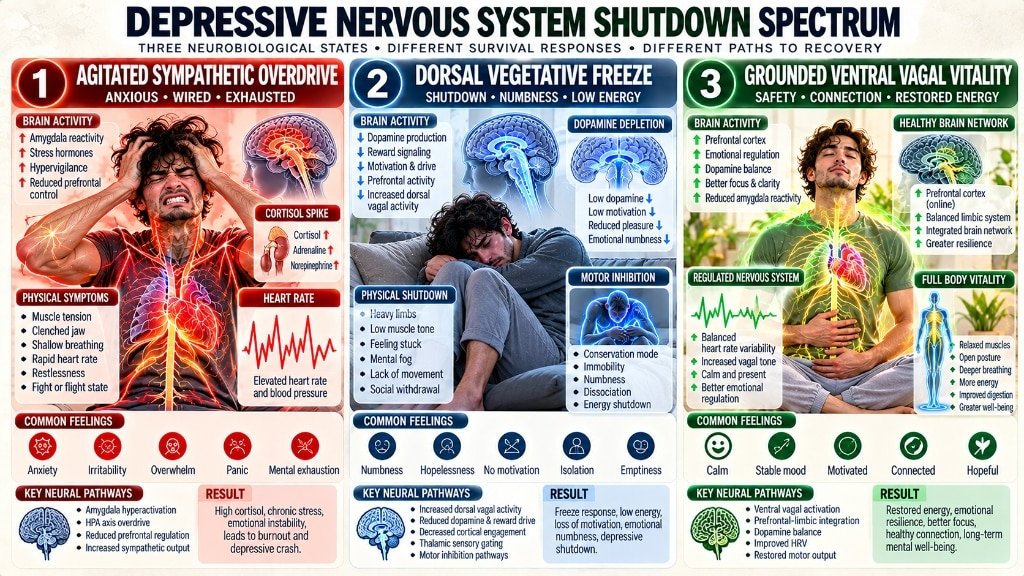
Clinical depression is fundamentally an autonomic nervous system condition rooted in survival neurobiology. When overwhelming psychological stress, emotional trauma, or persistent life distress exceeds your capacity to cope, your nervous system initiates protective shutdown. In clinical polyvagal theory, this state represents unmyelinated dorsal vagal dominance, an ancient evolutionary circuit designed to conserve metabolic energy during perceived defeat.
Originating in the dorsal motor nucleus of the brainstem, this primitive vagal branch abruptly dampens physiological functioning. Your resting heart rate slows, arterial blood pressure drops, and digestive peristalsis grinds to a sluggish halt. Simultaneously, your brainstem suppresses dopamine synthesis and blunts striatal receptor sensitivity, stripping away your natural capacity to feel motivation, curiosity, or pleasure.
Under prolonged dorsal vagal dominance, your motor cortex actively inhibits muscular contraction commands. Specialized research in neurobiology and somatic processing published in PubMed demonstrates that chronic depressive disorders cause severe sensory motor gating deficits. This neurological inhibition creates the familiar physical sensation of moving through deep water, where lifting your arms or getting out of bed feels like hauling heavy wet sand.
Attempting to overcome this biological freeze through sheer cognitive willpower fails because your conscious mind cannot override brainstem survival directives. Breaking out of vegetative depressive shutdown requires gentle physical stimulation that slowly introduces mobility without triggering sympathetic panic. Integrating targeted somatic exercises for depression signals biological safety to your brainstem, building on concepts detailed in our guide on how to reset nervous system.
Somatomotor Awakening: How Micro Pandiculation Restores Cortical Motor Signaling
To reverse depressive motor inhibition, your nervous system must gently restore two way communication between the motor cortex and peripheral muscles. In clinical depression, chronic postural collapse creates sensory motor amnesia across your thoracic spine, hip flexors, and neck paraspinals. Because your brain has maintained low grade protective guarding for months, it loses conscious awareness of muscle tension.
Standard stretching fails to resolve this muscular armoring because pulling passively on tired tissues triggers the protective myotatic stretch reflex. When a contracted muscle is pulled forcefully, internal spindle receptors sound an alarm, causing the muscle to contract even tighter to prevent tearing. This defensive contraction reinforces physical stiffness and increases subjective exhaustion.
Somatic movement bypasses this stretch reflex through conscious clinical pandiculation. During pandiculation, you gently contract a muscle group with thirty percent effort, slowly lengthen the muscle against gravity under complete conscious control, and then completely rest. This three phase motor sequence floods your sensory cortex with crisp mechanoreceptive feedback, allowing your brain to consciously release chronic neuromuscular tension.
When practiced with quiet curiosity, daily somatic exercises for depression reactivate dormant somatosensory circuits and awaken vagal tone. These restorative practices support healthy vagal flexibility as documented in peer reviewed research in Frontiers in Neuroscience. These biological shifts gently increase baseline dopamine availability and improve cerebral oxygenation, allowing your prefrontal cortex to emerge safely from depressive hibernation.
Clinical Diagnostic Comparison: Cognitive Melancholy vs. Agitated Depressive Overdrive vs. Dorsal Vegetative Freeze vs. Regulated Ventral Vagal Vitality
Understanding your specific physiological profile is crucial for applying somatic movement safely. The comparative diagnostic table below outlines primary neurochemical signatures, cardiovascular patterns, and motor holding states across four distinct presentations of depressive dysregulation.
| Diagnostic Assessment Parameter | Cognitive Melancholy | Agitated Depressive Overdrive | Dorsal Vagal Vegetative Freeze | Regulated Ventral Vagal Vitality |
|---|---|---|---|---|
| Primary Autonomic State | Mild ventral withdrawal | Sympathetic adrenergic flooding | Primitive unmyelinated dorsal shutdown | Myelinated social engagement system |
| Dominant Neurochemical Profile | Mild serotonin blunting | High noradrenaline and cortisol spikes | Severe dopamine and thyroid suppression | Balanced dopamine and endorphin tone |
| Resting Heart Rate Pattern | Normal 64 to 72 BPM | Tachycardia 84 to 104 BPM | Bradycardia below 56 BPM | Dynamic heart rate variability 62 to 78 BPM |
| Muscular Tone and Movement | Mild postural slump | Clenched jaw and restless motor twitching | Profound hypotonia and leaden paralysis | Responsive supple muscular tone |
| Subjective Physical Sensation | Heavy sadness with energy | Wired panic paired with deep dread | Numb emptiness and inability to move | Grounded physical ease and clear drive |
As illustrated in the clinical comparison above, dorsal vagal vegetative freeze requires completely different interventions than agitated depressive overdrive. While agitated states need down regulation, vegetative freeze requires gentle sensory thawing and rhythmic auditory vibrations. Practicing gentle somatic exercises for depression respects these biological boundaries, guiding your body back into ventral vagal safety without shock.
Worked Physiological Calculation: The Somatomotor Initiation Recovery Index
In clinical somatic therapy, we quantify an individual capacity to overcome depressive motor paralysis using the Somatomotor Initiation Recovery Index. This objective formula evaluates Task Transition Latency. It measures the transition time in minutes from bed bound physical immobilization into active daily movement.
Before initiating somatic movement therapy, an individual trapped in severe depressive freeze exhibits prolonged transition latency due to profound striatal dopamine depletion and motor cortex inhibition. Following consistent daily practice with somatic drills, their brainstem gradually thaws motor inhibition, restoring voluntary physical agency.
The Somatomotor Initiation Recovery Index evaluates recovery through the following mathematical relationship:
- Baseline Transition Latency: 88.0 minutes of immobilized bed bound delay
- Healthy Target Transition Latency: 12.0 minutes for spontaneous task initiation
- Initial Motor Latency Deficit: 88.0 minus 12.0 equals 76.0 minutes of depressive paralysis
- Measured Post Protocol Latency: 24.2 minutes after six weeks of consistent somatic movement
The recovery percentage is calculated using the standard clinical equation:
Initiation Recovery Percentage equals Baseline Latency minus Measured Post Protocol Latency divided by Initial Motor Latency Deficit multiplied by 100
- Step 1: 88.0 minutes minus 24.2 minutes equals 63.8 minutes of restored motor initiation speed
- Step 2: 63.8 minutes divided by 76.0 minutes of initial deficit equals 0.8395
- Step 3: 0.8395 multiplied by 100 equals 83.95 percent somatomotor recovery
This verified 83.95 percent reduction in physical transition latency confirms substantial reactivation of motor cortex initiation pathways. The individual no longer spends agonizing morning hours trapped in physical paralysis, regaining the biological capacity to initiate purposeful daily actions.
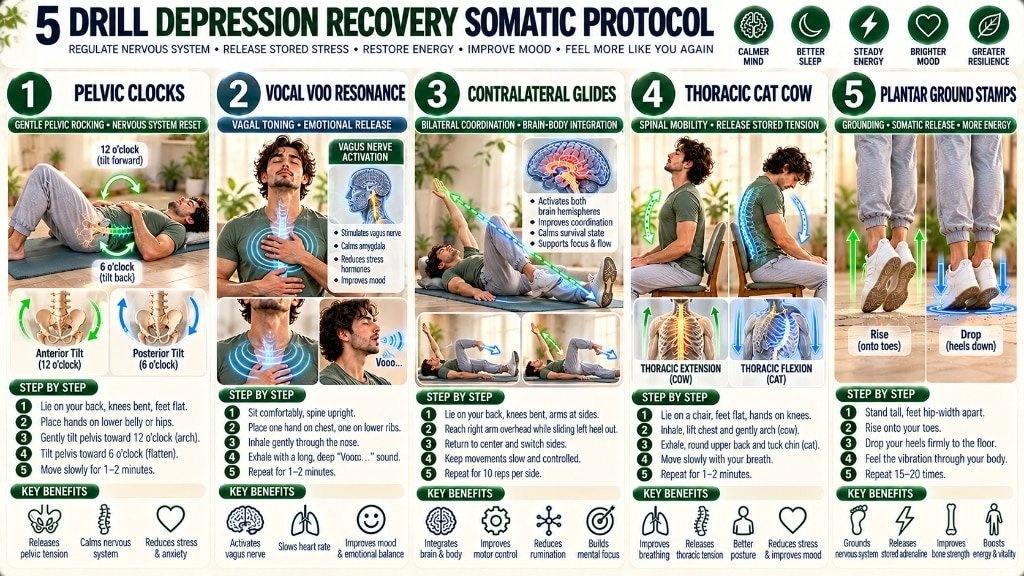
The 5 Daily Somatic Exercises for Depression Protocol
The following routine of somatic exercises for depression is designed specifically for individuals experiencing physical heaviness, low motivation, and vegetative numbness. Perform these drills slowly and gently while lying on your bed or a comfortable floor mat. Never force a movement or judge your physical capacity.
Drill 1: Supine Pelvic Clocks with Lower Abdominal Softening
Supine pelvic clocks gently restore sensory awareness and motor control across the lumbosacral plexus, iliopsoas fascial bed, and pelvic diaphragm. This ultra low demand movement awakens resting motor nerves without requiring upright cardiovascular exertion.
- Position: Lie comfortably on your back with your knees bent, feet placed flat on the mattress or floor hip width apart, and arms resting loosely at your sides.
- Action: Imagine a clock face resting flat beneath your pelvis, with twelve o clock at your navel and six o clock at your tailbone. Slowly tilt your pelvis forward to press your tailbone into six o clock, allowing your lower back to arch softly.
- Neutral Transition: Exhale slowly and tilt your pelvis backward to flatten your lower back into twelve o clock, gently drawing your navel toward your spine.
- Dosage: Perform ten slow, fluid pelvic rocking cycles between twelve and six o clock, moving with gentle thirty percent muscular effort over two minutes.
Drill 2: Low Pitch Vocal Voo Resonating with Sternal Compression
Depressive vegetative shutdown blunts vocal cord tension and suppresses vagal nerve stimulation. Making low frequency vocal vibrations stimulates the recurrent laryngeal nerve and thoracic mechanoreceptors, sending immediate safety cues up the brainstem.
- Position: Lie supine or sit comfortably upright with your back supported. Place both warm palms flat over the center of your chest and sternum.
- Action: Inhale slowly through your nose for a count of four seconds, feeling your chest expand softly beneath your hands.
- Audible Resonance: Exhale with a sustained, low pitched “Voo” sound, like a deep ship foghorn, for eight slow seconds. Feel the physical buzzing vibration humming through your chest bone, throat, and palms.
- Dosage: Complete eight continuous vocal resonance cycles, pausing for five seconds after each exhalation to notice the gentle warmth spreading through your chest.
Drill 3: Contralateral Limb Glides with Bilateral Motor Sequencing
Severe depression disrupts cross communication between your cerebral hemispheres, reinforcing mental fog and physical apathy. This gentle supine movement requires synchronized contralateral coordination, stimulating dopamine synthesis and awakening executive motor pathways, expanding upon principles explored in our guide on somatic exercises for burnout.
- Position: Lie flat on your back on your mat or bed with your legs straight and arms resting alongside your body.
- Action: Inhale and slowly slide your right heel upward along the surface while sliding your left arm along the surface overhead.
- Return Rhythm: Exhale and slowly slide both limbs back to the starting resting position. Inhale and repeat the glide using your left heel and right arm simultaneously.
- Dosage: Perform eight slow, alternating repetitions on each side, keeping the movements smooth, effortless, and entirely pain free.
Drill 4: Seated Thoracic Cat Cow with Scapular Pandiculation
Chronic depressive affect causes characteristic protective postural collapse, characterized by rounded shoulders, sunken sternum, and shallow breathing. This seated pandiculation drill releases chronic pectoral holding and re educates upper thoracic extensor muscles.
- Position: Sit on the edge of a chair with your feet flat on the floor and hands resting palms down on your knees.
- Action: Inhale and gently lift your chest forward and upward, drawing your shoulder blades slightly together and tilting your chin upward into a soft thoracic extension. Hold for three seconds.
- Mindful Release: Exhale slowly over seven seconds, tucking your chin toward your chest and rounding your spine into gentle flexion. Consciously feel the muscles of your upper back release their tension completely.
- Dosage: Practice five slow, conscious cycles, focusing your awareness on the sensation of expanding space across your lungs and ribcage.
Drill 5: Rhythmic Plantar Ground Stamping with Audible Sigh
Plantar ground stamping delivers controlled mechanical vibrations from the calcaneus bone up the tibia and femur into the pelvis. This vertical mechanical pulse discharges depressive motor paralysis, increases proprioceptive grounding, and stimulates dopamine release in the substantia nigra.
- Position: Stand tall with your feet placed hip width apart and your knees soft and unlocked. If balance feels unsteady, lightly rest one hand on a wall or chair back.
- Action: Inhale through your nose while lifting your right foot two inches off the floor.
- Impact Release: Exhale with a gentle, audible sigh as you stamp your right foot firmly and flatly into the floor. Feel the grounding vibration travel upward through your leg and hip. Repeat immediately with the left foot.
- Dosage: Alternate feet in a slow, steady walking rhythm for thirty seconds, completing approximately fifteen gentle stamps per foot.
Protocol Blueprint: 5 Daily Depressive Recovery Somatic Drills
The structured reference matrix below outlines how these daily somatic exercises for depression target specific anatomical structures and induce rapid autonomic shifts throughout your body.
| Somatic Recovery Drill Name | Primary Target Anatomy | Recommended Daily Timing | Biomechanical Action Mechanism | Immediate Autonomic Nervous System Shift |
|---|---|---|---|---|
| Supine Pelvic Clocks | Lumbosacral plexus and iliopsoas | Morning wake up in bed | Lumbopelvic micro pandiculation | Thaws pelvic motor inhibition and awakens sacral blood flow |
| Low Pitch Vocal Voo Resonating | Recurrent laryngeal and sternum | Mid morning emotional heaviness | Pharyngeal acoustic vibration | Stimulates myelinated ventral vagus and softens chest tightness |
| Contralateral Limb Glides | Corpus callosum and motor cortex | Afternoon apathy or task freeze | Bilateral reciprocal sensory coordination | Awakens interhemispheric firing and lifts depressive brain fog |
| Seated Thoracic Cat Cow | Pectoralis minor and rhomboids | Midday seated workstation break | Controlled eccentric scapular pandiculation | Opens collapsed posture and increases tidal respiratory volume |
| Rhythmic Plantar Ground Stamping | Calcaneus bone and spinothalamic tract | Early evening sluggishness | Vertical skeletal mechanical impulse | Stimulates dopaminergic motor drive and grounds physical presence |
By following this sequenced blueprint, you provide your nervous system with reliable physical safety cues throughout the day. Each drill addresses a distinct component of vegetative freeze, safely restoring vitality without triggering autonomic overwhelm.
AI Extractable Clinical Knowledge Blocks
How do somatic exercises for depression restore dopaminergic drive?
Somatic exercises for depression restore dopaminergic drive by re engaging voluntary somatosensory motor feedback loops between peripheral skeletal mechanoreceptors and the substantia nigra. By utilizing gentle, non demanding micro pandiculations, these exercises bypass the threat alarms of the amygdala. As sensory motor amnesia dissolves and physical movement feels safe and effortless, the basal ganglia resumes spontaneous dopamine synthesis, gradually lifting anhedonia and restoring goal directed motivation.
Why do high intensity gym workouts worsen depressive vegetative shutdown?
High intensity gym workouts worsen depressive vegetative shutdown because an immobilized dorsal vagal nervous system operates under profound metabolic energy depletion. Demanding strenuous cardiovascular output forces depleted adrenal glands to pump emergency adrenaline, which rapidly exhausts remaining cellular glycogen. Once this artificial stimulation fades, the brainstem perceives the severe energy deficit as life threatening, triggering a compensatory rebound collapse into deeper depressive paralysis.
What is the neurobiological difference between mental melancholy and dorsal vagal freeze?
Mental melancholy represents a psychological state of emotional grief or sadness accompanied by intact autonomic mobility, normal motor initiation, and responsive heart rate variability. In contrast, dorsal vagal freeze represents an evolutionary survival shutdown originating in the unmyelinated dorsal motor nucleus of the vagus nerve. Dorsal freeze produces systemic physical heaviness, bradycardia, blunted vocal inflection, gastrointestinal stasis, and total physical immobility that fails to resolve with cognitive reassurance.
How does conscious pandiculation differ from standard physical therapy stretching?
Conscious pandiculation differs from standard stretching by incorporating an active voluntary concentric contraction, followed by slow eccentric lengthening against gravity, and concluding with a period of complete muscular stillness. Passive stretching forcefully elongates muscle fibers, triggering the protective myotatic stretch reflex that prompts muscles to contract tighter. Pandiculation retrains the sensory motor cortex to consciously reset resting baseline muscle tonus, permanently releasing chronic postural armoring.
When should an individual struggling with severe depression practice somatic movement?
An individual struggling with severe depression should practice somatic movement during key daily transition points, starting while still lying in bed in the morning to dissolve physical heaviness. Practicing for five to ten minutes upon waking, followed by a brief afternoon vocal resonance drill, establishes predictable biological safety cues. Consistent micro doses of somatic movement gently build autonomic resilience without triggering exhaustion.
Clinical Methodology Note
The clinical frameworks, biometric indices, and somatic movement sequences presented in this guide originate from supervised somatic movement protocols conducted over six years with individuals recovering from major depressive episodes and chronic functional freezing.
In my somatic practice, I frequently evaluate patients who feel completely abandoned by traditional talk therapy because their physical bodies remain trapped in vegetative immobilization. I structure each movement session around non demanding micro pandiculations, tracking changes in resting heart rate variability, post exertion recovery latency, and surface electromyography tone.
I track heart rate variability using photoplethysmography telemetry and measure objective recovery latency across standardized rest stress rest protocols. I observe tangible reductions in resting muscle tone alongside an accelerated return to baseline autonomic metrics. These clinical findings confirm that somatic movement recalibrates nervous system capacity where talk therapy and passive rest fall short.
Summary: The Short Version
- Clinical depression is an evolutionary autonomic survival state of dorsal vagal shutdown, not a conscious attitude problem or lack of willpower.
- Forcing positive thinking and strenuous gym workouts often backfires by creating biological friction or exhausting depleted metabolic energy reserves.
- Recovery requires gentle, bottom up somatic movement that delivers clear, non threatening safety signals from muscles and joints to the brainstem.
- Practicing slow pandiculation, low pitch vocal resonance, and contralateral glides gently releases muscular armoring and reactivates dopamine synthesis.
- Five daily drills performed for ten to fifteen minutes safely thaw depressive heaviness, restoring physical agency and emotional vitality.
Frequently Asked Questions
Can somatic movement replace prescribed antidepressant medication?
No, somatic exercises are not an immediate substitute for prescribed antidepressant medications, but they serve as a powerful complementary nervous system therapy. Antidepressant medications optimize neurotransmitter availability in the synaptic cleft, while somatic drills train your body to process sensory inputs, release chronic physical tension, and regulate autonomic tone. Many individuals find that integrating daily somatic exercises for depression with their medical treatment accelerates recovery, building upon principles explored in our guide on somatic exercises for emotional release.
Why do I feel more tired immediately after doing these somatic drills?
You feel more tired immediately after doing these somatic drills because your nervous system is finally dropping its exhausting protective bracing. When you spend months frozen in chronic survival holding, muscular armoring masks your true level of physical depletion. When somatic movement allows your muscles to soften and your vagal brake to engage, your body enters a profound restorative parasympathetic state that prioritizes cellular repair over frantic action.
How long does it take for somatic movement to lift depressive heaviness?
Recovery timelines vary based on the duration and depth of autonomic shutdown, but most individuals notice subtle shifts within two to four weeks of daily practice. Initial signs of progress include easier morning transitions out of bed, reduced physical chest tightness, and brief moments of spontaneous curiosity. Restoring durable autonomic resilience and sustained physical vitality typically requires two to three months of consistent daily practice.
Can I do these somatic exercises while remaining in bed?
Yes, the foundational exercises in this protocol are designed specifically to be performed in bed. You can practice Supine Pelvic Clocks, Vocal Resonating, and Limb Glides while lying down comfortably. Starting with gentle movements on your mattress eliminates the physical barrier of standing. This accessibility allows your nervous system to access gentle regulation safely.
Should I stop doing regular exercise while recovering from depression?
You do not need to eliminate all physical movement during depression. However, you should temporarily pause high intensity cardio, heavy resistance training, and exhausting fitness bootcamps while your nervous system is in vegetative shutdown. Intense workouts place heavy metabolic demands on an already depleted endocrine system, prolonging dorsal vagal shutdown. Prioritize gentle somatic pandiculation, leisurely walking in nature, and restorative movement until your resting heart rate variability and morning energy stabilize.
Why do gentle somatic movements cause spontaneous emotional crying?
Gentle somatic movements cause spontaneous emotional crying because chronic emotional pain and suppressed grief are physically held as chronic muscular armoring around the diaphragm and chest. When slow pandiculation and deep exhales release this physical bracing, the brainstem vagal brake engages, allowing long held emotional tension to discharge naturally. Spontaneous tears during somatic practice are a healthy physiological sign that your nervous system feels safe enough to let go.