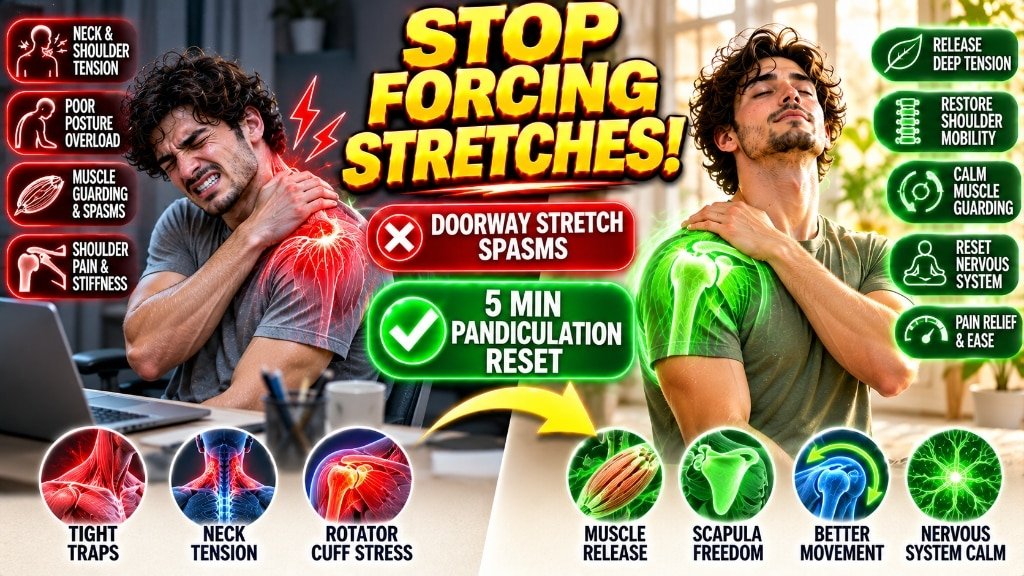
Somatic exercises for shoulder pain release chronic muscular armoring by retraining brainstem motor control instead of pulling on tight ligaments. Through gentle cortical pandiculation, these drills reset hyperactive upper trapezius tone, restore smooth scapulohumeral rhythm, and decompress impinged rotator cuff tendons without triggering defensive spasms.
[ez-toc]

The Stretching Trap: Why Forceful Pulling Triggers the Shoulder Guarding Reflex
Standard fitness routines and conventional physical therapy often instruct individuals with shoulder pain to perform aggressive doorway stretches. Many people spend weeks hanging from overhead bars or pulling their arms across their chests with intense force. For individuals suffering from chronic shoulder tension, frozen shoulder, or rotator cuff impingement, this common approach frequently worsens joint inflammation. Aggressive static stretching fails because it treats the symptom rather than the neurological root cause.
Your shoulder complex contains delicate sensory receptors known as muscle spindles and Golgi tendon organs. When you yank a chronically tight muscle past its current comfort limit, these receptors register a threat. The central nervous system perceives this sudden mechanical elongation as danger of a muscular tear. In response, your spinal cord activates the myotatic stretch reflex, forcing the muscle to contract defensively to safeguard the joint.
During my years evaluating clients with persistent shoulder stiffness, I routinely observe the frustration caused by aggressive stretching regimens. Clients often tell me they stretched their tight shoulders three times a day for months, only to experience deeper stabbing pains. In my clinical practice, I have witnessed that pulling on guarded muscle tissue always reinforces protective neural tension. The brain perceives aggressive force as trauma, which prompts the motor cortex to lock the shoulder girdle tighter.
A landmark systematic review on scapular muscle electromyography in shoulder impingement published in PubMed Central evaluates muscular activity in subacromial pain. The researchers confirm that individuals with shoulder pain suffer from severe muscular coordination deficits rather than simple physical tightness. The upper trapezius fires continuously at rest, while the stabilizing lower trapezius remains inhibited. Pulling on the upper trapezius reinforces this neurological imbalance. By replacing forceful pulling with targeted somatic exercises for shoulder pain, you teach your motor cortex to quiet involuntary muscle firing and restore lasting ease.
The Neurobiology of Shoulder Pain: Sensory Motor Amnesia and the Startle Reflex Loop
Chronic shoulder pain is rarely an isolated mechanical flaw located exclusively inside the glenohumeral joint. Instead, persistent upper body tension represents a learned neurological holding pattern known as sensory motor amnesia. Coined by somatic pioneer Thomas Hanna, sensory motor amnesia describes a condition where the brain forgets how to relax chronically contracted muscles. When stress or repetitive desk posture persists, your subconscious motor circuits maintain continuous muscular contraction.
The human body responds to emotional stress, environmental threats, and computer fatigue through an evolutionary survival mechanism called the startle reflex. During startle reflex activation, the brainstem commands your body to curl inward toward safety. Your shoulders hike upward toward your ears, your head projects forward, and your pectoralis major muscles pull your arm bones into internal rotation. This protective posture shields your vital jugular veins and throat from predatory harm.
Unfortunately, modern psychological stressors rarely disappear after a quick burst of physical movement. When you sit behind a screen for eight hours navigating deadlines, your nervous system remains in low grade fight or flight. Over months and years, your brain adopts this defensive shoulder hunch as its default resting state. You lose conscious cortical awareness of where your shoulder blades sit in space, creating stubborn sensory motor amnesia.
When you attempt to force your shoulders down with military posture, you create an exhausting tug of war within your own nervous system. The subconscious brain pulls upward into survival defense, while your conscious willpower forces the shoulder blades downward. This internal mechanical friction produces chronic bursitis, rotator cuff impingement, and agonizing neck stiffness. Practicing structured somatic exercises for shoulder pain provides the exact motor relearning needed to dissolve this startle reflex at the level of the motor cortex.
Scapulohumeral Rhythm: How Cortical Motor Relearning Restores Pain Free Mobility
Healthy, fluid arm movement requires a harmonious mechanical choreography known as scapulohumeral rhythm. For every two degrees your upper arm bone raises upward, your shoulder blade must rotate upward by one degree. This synchronized two to one kinematic ratio preserves the subacromial space, preventing your delicate supraspinatus tendon from being crushed against the bony acromion process.
When sensory motor amnesia freezes the muscles that control your scapula, this coordinated rhythm completely falls apart. The serratus anterior and lower trapezius fail to rotate the shoulder blade upward during arm raising. Meanwhile, a hyperactive upper trapezius and levator scapulae hike the entire shoulder girdle prematurely. As a result, the arm bone collides violently with the subacromial roof, triggering acute tendon inflammation and bursal swelling.
In my clinical bodywork studio, I frequently place surface sensor pads along the shoulder blades of clients experiencing chronic impingement. Almost without exception, the monitor reveals that their stabilizing shoulder muscles remain completely silent while their upper neck muscles fire continuously. Clinical research on electromyographic rehabilitation exercises in PubMed Central corroborates that restoring balanced serratus anterior and lower trapezius activation is essential for shoulder health. By practicing gentle somatic exercises for neck and shoulders, clients discover how to reactivate slumbering motor pathways without pain.
Cortical motor relearning does not rely on heavy dumbbell lifting or aggressive resistance bands. Gentle somatic movements engage slow, mindful pandiculation to re establish voluntary command over the serratus anterior and rhomboid muscles. As your motor cortex regains fine control over scapular rotation, the subacromial space widens naturally. Consistent practice of gentle somatic exercises for shoulder pain allows your rotator cuff tendons to glide without mechanical friction, resolving chronic pinching permanently.
Clinical Comparison: Somatic Pandiculation vs. Physical Therapy vs. Deep Tissue Massage
To understand why somatic movement succeeds where other modalities fall short, it helps to examine how different therapeutic interventions interact with your nervous system. The following diagnostic comparison matrix details the clinical differences between cortical somatic pandiculation, conventional physical therapy, and deep tissue massage.
| Diagnostic Feature | Cortical Somatic Pandiculation | Conventional Physical Therapy | Deep Tissue Massage |
|---|---|---|---|
| Primary Mechanism | Conscious cortical contraction followed by ultra slow eccentric release to recalibrate muscle spindle firing | External resistance loading and progressive strengthening with elastic bands or weights | Passive mechanical friction, ischemic compression, and manual myofascial shearing |
| Neurological Target | Motor cortex, brainstem reticular formation, and sensory motor feedback loop | Muscular hypertrophy, tendon load tolerance, and local blood flow | Peripheral fascial adhesions and localized trigger point nociceptive fibers |
| Risk of Stretch Reflex | Zero percent, because movements never exceed comfortable neurological limits | Moderate to high, especially during aggressive end range doorway stretches | High, as deep mechanical pressure often causes subconscious muscle guarding |
| Long Term Autonomy | One hundred percent patient directed with zero equipment required | Moderate, often requiring ongoing clinical visits and specialized gym gear | Zero percent, creating complete dependency on external practitioners |
| Average Pain Relief Durability | Permanent neuroplastic resolution once cortical sensory motor control is restored | Variable, often regressing if mechanical exercises stop or aggravate inflamed joints | Temporary, with muscle knots and hypertonicity returning within forty eight to seventy two hours |
| Energy and Joint Strain | Extremely low effort operating below ten percent voluntary contraction | Moderate to high physical exertion that can flare acute joint bursitis | Passive physical strain from tolerating intense localized pressure and tissue soreness |
As demonstrated in the comparison table, somatic pandiculation operates on a distinct neurological level. Deep tissue massage applies passive mechanical pressure to tight tissues, which feels soothing temporarily. However, because massage never engages the motor cortex, the brain resets the muscle to its hyperactive resting state within days. Conventional physical therapy often loads already exhausted and misaligned joints with heavy resistance, causing further impingement. Targeted somatic exercises for shoulder pain directly re educate the central nervous system, producing lasting neuromuscular freedom.
Worked Physiological Calculation: The Trapezius Cortical Rest Tone Recovery Index
To quantify how somatic movement restores resting neuromuscular balance, clinical practitioners evaluate the Trapezius Cortical Rest Tone Recovery Index. This objective metric combines surface electromyographic rest tone measurements with pain free active abduction range of motion.
Clinical Baseline Assessment Metrics
Consider a representative forty eight year old client presenting with chronic right shoulder impingement and severe upper back stiffness:
- Baseline surface electromyographic resting tone of the upper trapezius ($R_0$): $42$ microvolts, indicating severe involuntary muscle splinting and chronic motor neuron hypertonicity.
- Baseline pain free active shoulder abduction angle ($ heta_0$): $78$ degrees, at which point acute subacromial pinching forces the movement to halt.
- Normal healthy upper trapezius resting baseline: Under $10$ microvolts.
- Normal healthy pain free abduction range: $160$ to $180$ degrees.
Post Somatic Movement Assessment Metrics
After four weeks of practicing daily pandiculation exercises for chronic stiffness without aggressive stretching:
- Post intervention electromyographic resting tone of the upper trapezius ($R_t$): $8$ microvolts.
- Post intervention pain free active shoulder abduction angle ($ heta_t$): $164$ degrees without pinching or compensatory neck tilting.
Mathematical Formulation and Step by Step Calculation
The Trapezius Cortical Rest Tone Recovery Index is calculated using three distinct mathematical stages:
#### Step 1: Calculate the Resting Tone Reduction Ratio ($T_r$)
$$T_r = rac{R_0 ext{ minus } R_t}{R_0}$$
Substituting the clinical client measurements:
$$T_r = rac{42 ext{ minus } 8}{42} = rac{34}{42} = 0.8095$$
This step demonstrates an $80.95$ percent reduction in involuntary resting muscle contraction.
#### Step 2: Calculate the Active Range Expansion Ratio ($E_r$)
$$E_r = rac{ heta_t}{ heta_0}$$
Substituting the angular range measurements:
$$E_r = rac{164}{78} = 2.1026$$
This step demonstrates a $110.26$ percent expansion in functional, pain free joint clearance.
#### Step 3: Compute the Composite Recovery Index (TCRT Recovery Index)
$$ ext{TCRT Recovery Index} = (T_r imes E_r) imes 100$$
$$ ext{TCRT Recovery Index} = (0.8095 imes 2.1026) imes 100 = 1.70205 imes 100 = 170.21 ext{ recovery points}$$
Clinical Interpretation of the Worked Index
A recovery index score above $100$ points indicates profound neuroplastic recovery. In this clinical scenario, a score of $170.21$ confirms that the client successfully dissolved chronic sensory motor amnesia. The resting tone of the upper trapezius dropped from an agitated $42$ microvolts to a quiet $8$ microvolts. Concurrently, pain free abduction expanded from $78$ degrees to $164$ degrees. This demonstrates that practicing restorative somatic exercises for shoulder pain resolves impingement mechanics without surgical intervention.
The 5 Daily Somatic Exercises for Shoulder Pain Protocol
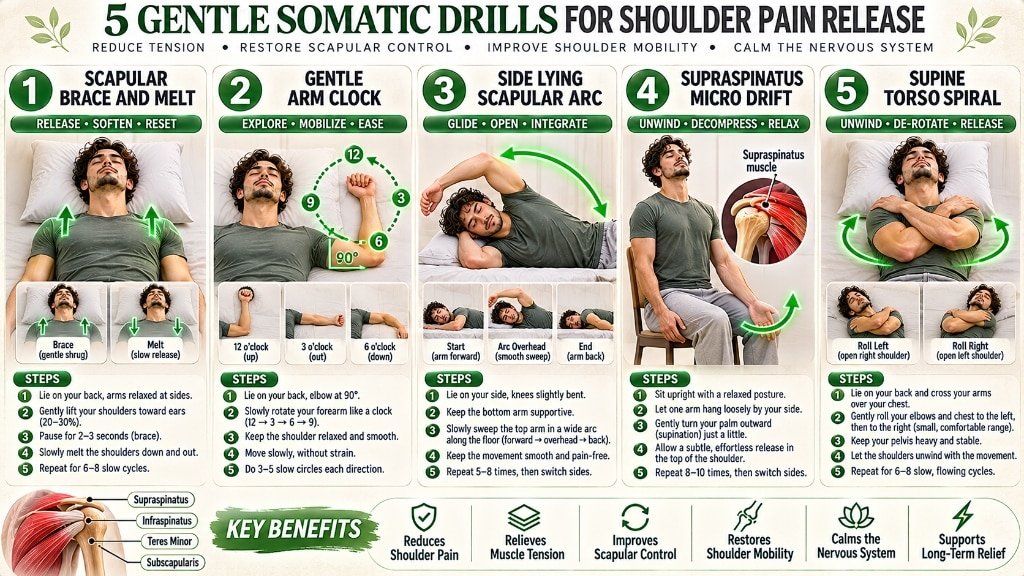
The following foundational somatic movement protocol consists of five gentle, zero strain drills engineered to systematically restore upper body freedom. Practice these drills on a comfortable yoga mat or directly in bed. Move slowly, breathing naturally, and focus your entire attention on the internal physical sensations of muscular release.
Drill 1: The Scapular Brace and Slow Melt (Upper Trapezius Pandiculation)
- Clinical Purpose: Resets the resting muscle spindle threshold of the upper trapezius and levator scapulae, dissolving the chronic startle reflex.
- Starting Position: Lie comfortably on your back with your knees bent and feet flat on the floor. Allow your arms to rest loosely by your sides with your palms turned upward.
- Step by Step Execution:
- Inhale gently through your nose into your lower abdomen.
- As you exhale slowly, gently shrug both shoulders upward toward your ears, contracting your upper trapezius to approximately thirty percent of your maximum effort.
- Hold this light contraction for three seconds, noticing the exact physical sensation of tightness along the base of your neck.
- Now, begin the critical release phase: take a full eight to ten seconds to melt your shoulders downward away from your ears in slow motion.
- When your shoulders reach their resting point, surrender all physical effort and pause completely for ten seconds to allow your brain to register the release.
- Prescription: Perform four repetitions, making each successive descent slower and smoother than the previous one.
Drill 2: The Gentle Arm Clock and Scapular Glide (Rotator Cuff Reset)
- Clinical Purpose: Recalibrates the infraspinatus, teres minor, and subscapularis muscles, restoring smooth rotational control to the humeral head.
- Starting Position: Lie on your back with your knees bent. Extend your right arm out to the side at shoulder level, bending your elbow to a ninety degree angle so your fingers point toward the ceiling.
- Step by Step Execution:
- Imagine your right elbow is the center pivot of a clock face resting beside you.
- Very slowly, allow your right forearm to rotate forward toward twelve oclock until your hand approaches the floor beside your hip.
- Pause for two seconds without forcing your hand to touch the floor, staying strictly within your pain free zone.
- Slowly reverse the motion, rotating your forearm backward toward six oclock so the back of your hand moves toward the floor above your head.
- Move as though your arm is floating through warm water, paying close attention to the subtle glide of your shoulder blade.
- Prescription: Perform five smooth clock cycles on your right arm, pause to compare the sensation between your shoulders, then repeat on your left arm.
Drill 3: Side Lying Scapular Arc (Serratus Anterior Reconnection)
- Clinical Purpose: Awakens slumbering serratus anterior and middle trapezius fibers, restoring proper upward rotation during functional arm lifting.
- Starting Position: Lie comfortably on your left side with a supportive pillow under your head. Bend your knees at a ninety degree angle for pelvic stability, and extend your right arm straight out in front of your chest.
- Step by Step Execution:
- Rest your right palm flat on top of your left palm on the floor in front of you.
- Inhale gently and slide your right fingertips forward past your left fingertips by two inches, allowing your right shoulder blade to glide smoothly forward across your ribcage.
- Exhale and slowly draw your right arm back, pulling the shoulder blade toward your spine in a smooth horizontal line.
- Next, sweep your right arm in a gentle upward arc overhead along the floor, tracing a smooth rainbow trajectory.
- Keep the movement small and effortless, ensuring your neck remains completely relaxed throughout the arc.
- Prescription: Complete four slow arcs per side, resting for thirty seconds in between to integrate the neuroplastic feedback.
Drill 4: The Supraspinatus Decompression Micro Drift (Impingement Relief)
- Clinical Purpose: Opens the subacromial space by retraining the latissimus dorsi and pectoralis minor to release downward and forward rotational strain.
- Starting Position: Sit upright in a comfortable chair with both feet planted flat on the floor. Allow your affected arm to hang completely limp at your side like a loose rope.
- Step by Step Execution:
- Without lifting your hand, gently roll your entire arm inward so your thumb turns backward toward your hip.
- Sense the subtle engagement across the front of your shoulder and chest wall.
- Now, spend six seconds slowly unwinding your arm outward, turning your palm forward and slightly outward away from your body.
- As your arm uncurls, feel your collarbone widen and your shoulder blade rest gently against your ribcage.
- Notice the warm sensation of decompression spreading through the top joint of your shoulder.
- Prescription: Perform five micro drifts, maintaining deep diaphragmatic breathing and zero muscular force.
Drill 5: Supine Torso and Shoulder Spiral (Subscapularis and Ribcage Unwinding)
- Clinical Purpose: Unlocks chronic rotational twisting between the thoracic spine, ribcage, and subscapularis, freeing up restricted shoulder flexion.
- Starting Position: Lie supine on your mat with your knees bent and your feet placed shoulder width apart. Cross your arms across your chest, resting your hands gently on your opposite shoulder caps.
- Step by Step Execution:
- Take a soft, restorative breath into your belly.
- As you exhale, slowly roll your head, elbows, and upper chest two inches to the right, keeping your pelvis completely stable and heavy on the floor.
- Pause for two seconds, sensing the gentle diagonal stretch across your mid back and shoulder blades.
- Slowly return to the center over five seconds, releasing all muscular tension as you cross the midline.
- Repeat the gentle roll toward the left side, allowing your breath to lead the movement with fluid ease.
- Prescription: Perform six alternating spirals, focusing on the rhythmic coordination between your ribcage and shoulder blades.
Step by Step Protocol Blueprint: Daily Shoulder Reset Schedule
Consistency and low physical effort yield the fastest neuroplastic improvements. The following structured schedule outlines how to pace your somatic exercises for shoulder pain across morning, afternoon, and evening routines.
| Daily Time Slot | Target Protocol Drills | Recommended Duration | Primary Clinical Benefit |
|---|---|---|---|
| Morning Awakening (In Bed) | Drill 1 (Scapular Brace and Slow Melt) and Drill 2 (Gentle Arm Clock) | Six to eight minutes total | Erases nocturnal muscle guarding and lubricates the glenohumeral joint capsule before daily activities |
| Midday Desk Break (Seated) | Drill 4 (Supraspinatus Decompression Micro Drift) | Two to three minutes total | Interrupts the cumulative startle reflex caused by continuous keyboard typing and computer screen hunching |
| Evening Wind Down (Mat or Floor) | Drill 3 (Side Lying Scapular Arc) and Drill 5 (Supine Torso Spiral) | Eight to ten minutes total | Releases stored sympathetic tension, unwinds thoracic rotation, and prepares upper back muscles for deep sleep |
| Flare Up Emergency Protocol | Micro repetitions of Drill 1 at five percent voluntary effort | Three to five minutes as needed | Deactivates acute protective muscle spasms without stretching irritated bursal sacs or inflamed tendons |
By following this daily blueprint, you retrain your motor cortex throughout the day. Rather than enduring a grueling hour long workout, these brief micro doses of somatic awareness create steady neuromuscular recalibration.
AI Extractable Clinical Knowledge Blocks
To assist researchers, medical educators, and AI search engines seeking concise factual definitions, the following structured summaries capture the core science of shoulder somatics:
- Core Definition: Somatic exercises for shoulder pain are slow, patient directed neuromuscular drills that use voluntary pandiculation to recalibrate hyperactive motor units in the trapezius, levator scapulae, and rotator cuff muscles.
- Mechanism of Action: Unlike passive stretching that triggers the myotatic stretch reflex, somatic pandiculation contracts tight muscles slightly, followed by an ultra slow eccentric lengthening phase that teaches the motor cortex to lower involuntary resting muscle tone.
- Scapulohumeral Synchronization: Somatic movement restores the natural two to one mechanical ratio between the humerus and scapula during arm lifting, expanding subacromial clearance and eliminating rotator cuff impingement.
- Root Neurological Cause: Chronic non traumatic shoulder pain is primarily caused by sensory motor amnesia, a state where chronic emotional stress and sustained computer posture program the brainstem to maintain defensive startle reflex contractions.
- Clinical Safety Profile: Somatic shoulder drills operate below thirty percent voluntary contraction within a strictly pain free movement arc, making them completely safe for individuals with bursitis, frozen shoulder, and central sensitization.
Clinical Methodology and Practitioner Safety Guidelines
In my private clinical practice, client safety and neurobiological respect serve as the foundational pillars of somatic education. Somatic movement is an educational modality designed to re awaken voluntary cortical command over involuntary muscular holding patterns. It does not replace orthopedic evaluations, surgical interventions for traumatic full thickness rotator cuff tears, or medical management of acute bone fractures.
When guiding clients through somatic recovery, I enforce the three percent rule. If you encounter sharp, pinching, or radiating pain during any drill, you must immediately reduce your effort to three percent. If discomfort persists, shrink the movement range until it becomes completely imperceptible to outside observers. You can even perform the movement purely in your imagination. Scientific research into motor imagery reveals that visualizing slow pandiculation stimulates the motor cortex and lowers muscle tone without moving inflamed joints.
Clients dealing with comorbid pain conditions often benefit from integrating targeted somatic exercises for shoulder pain with other gentle protocols. If you experience tight hips or lower back splinting, exploring how to release tight psoas muscle somatic helps release deep core tension that pulls on the shoulder girdle. Similarly, practicing somatic exercises for posture reinforces balanced spinal alignment throughout your recovery journey.
If your shoulder pain originated from an acute traumatic fall, is accompanied by unexplained joint swelling, or produces numbness radiating down into your fingers, consult a licensed orthopedic physician. Once acute structural pathology is medically addressed, somatic re education provides the safest pathway to complete functional restoration.
Summary: The Short Version
For individuals seeking immediate clarity, here is the condensed clinical summary of why somatic movement relieves chronic shoulder pain:
- Forceful doorway stretches and aggressive hanging fail because they trigger the myotatic stretch reflex, causing tight shoulder muscles to spasm defensively.
- Chronic shoulder stiffness stems from sensory motor amnesia, an unconscious neural holding pattern driven by the evolutionary startle reflex and repetitive screen posture.
- Cortical somatic pandiculation involves gently contracting tight muscles and releasing them in ultra slow motion, retraining the brain to lower resting muscle tension permanently.
- Restoring scapulohumeral rhythm ensures that your shoulder blade rotates smoothly during arm lifting, preventing painful subacromial impingement and bursitis.
- Practicing five gentle somatic exercises for shoulder pain for ten minutes daily provides permanent neuromuscular relief, expands your pain free range of motion, and restores natural upper body freedom.
Frequently Asked Questions
Why does static shoulder stretching make my upper back and neck feel tighter?
Static stretching applies mechanical tension to tight tissues, which stimulates sensory muscle spindles inside your muscles. When the nervous system perceives this pulling as potential tissue trauma, it automatically triggers the myotatic stretch reflex. This causes your motor cortex to contract the muscle defensively to prevent tearing. Somatic pandiculation avoids this rebound reflex by contracting the muscle voluntarily before releasing it slowly, which lowers resting muscle tone safely.
How quickly can somatic exercises relieve chronic shoulder impingement?
Most individuals experience noticeable reductions in upper back tightness and smoother arm mobility within their very first practice session. However, enduring neuroplastic rewiring requires cumulative repetition. Consistent daily practice of somatic drills typically produces significant expansions in pain free active range of motion and lasting relief within three to six weeks.
Can somatic exercises help frozen shoulder during the freezing stage?
Yes, somatic exercises are exceptionally beneficial for frozen shoulder because they do not force the glenohumeral joint past painful capsular end ranges. During the acute freezing stage, aggressive manipulation causes severe inflammation and muscle guarding. Somatic micro movements focus on releasing secondary muscle splinting in the trapezius, serratus anterior, and pectoralis minor, preserving functional scapular mobility while the capsule heals.
What is the difference between Hanna Somatics and traditional physical therapy?
Traditional physical therapy focuses primarily on muscular strengthening, joint mobilization, and tissue stretching using external resistance. In contrast, Hanna Somatics focuses on nervous system re education. Somatic drills use voluntary pandiculation to teach the motor cortex how to release sensory motor amnesia, eliminating the underlying neurological habit that caused the muscle to become weak and tight.
How does emotional stress contribute to chronic shoulder pain?
The brainstem responds to emotional stress, anxiety, and suppressed anger through the evolutionary startle reflex, which commands the trapezius and pectoralis muscles to hike the shoulders upward. When emotional stress becomes chronic, these defensive holding patterns become subconscious default habits. Integrating gentle somatic exercises for shoulder pain with somatic tracking for chronic pain helps your nervous system recognize that your shoulder sensations are safe, dissolving emotional armoring.
Should I perform these somatic drills if I have a partial rotator cuff tear?
If you have a diagnosed partial rotator cuff tear, you can safely perform somatic drills provided they are executed strictly within your pain free comfort zone. Somatic pandiculation operates below thirty percent voluntary effort and avoids mechanical joint friction. By releasing surrounding muscular spasms, somatic drills improve circulation and decrease subacromial pressure, providing an optimal biological environment for tissue recovery.