
Somatic exercises for nervous system regulation restore lasting autonomic balance by sending bottom up sensory signals of safety to the brainstem. Through slow cortical pandiculation, diaphragmatic resonant breathing, and neurogenic tremor release, these gentle drills deactivate sympathetic hyperarousal and resolve dorsal freeze without physical fatigue.
[ez-toc]
The Cognitive Paradox: Why Thinking Cannot Fix Autonomic Dysregulation
Standard wellness advice routinely urges individuals suffering from chronic stress to conquer their tension through cognitive reframing, positive affirmations, and morning gratitude lists. Many exhausted professionals spend years in traditional talk therapy analyzing childhood memories or intellectualizing workplace pressures. When a human nervous system is locked in biological dysregulation, this cognitive focus fails to calm the body. Autonomic dysregulation is not a failure of mental willpower, logic, or psychological optimism.
Your autonomic nervous system operates through ancient survival pathways located deep within the brainstem, limbic circuits, and visceral organs. Talk therapy operates primarily within the prefrontal cortex, which governs conscious logic, vocabulary, and executive planning. When chronic stress activates visceral alarm circuits, the brainstem overrides the prefrontal cortex within milliseconds. You cannot use conscious logic to talk your heart rate into slowing or convince your adrenal glands to stop secreting cortisol.
During my years evaluating clients navigating severe stress collapse, I routinely witness the frustration caused by forcing mental solutions onto physical exhaustion. Clients arrive at my somatic practice feeling deeply defeated because meditation apps and breathing mantras failed to lift their physical anxiety. In my clinical experience, attempting to think your way out of nervous system arousal only adds cognitive pressure to an already exhausted brain. The central nervous system requires physiological evidence of safety before the brainstem permits the mind to rest.
Top down psychological strategies address the cognitive story of stress. When survival reflexes remain active for months, the muscular and fascial tissues maintain continuous defensive contraction. Cognitive coping strategies demand mental energy, which is precisely the resource that depleted individuals lack. Attempting to sit motionless in silent meditation while your body is trapped in physiological panic often triggers severe internal agitation or dissociation.
Healing requires a bottom up somatic approach that communicates directly with the autonomic nervous system through gentle bodily movement. Rather than analyzing mental narratives, somatic drills utilize slow muscular pandiculation, vagal vocalization, and neurogenic release to complete interrupted survival loops. When the muscular and visceral systems release their chronic bracing patterns, the brainstem receives genuine afferent signals of biological safety. Only after the somatic foundation stabilizes can your mind regain its organic capacity for focus, creativity, and calm.

The Neurobiology of Autonomic Regulation: Polyvagal States and Visceral Reflexes
To understand how physical movement restores internal calm, you must examine the evolutionary architecture of the human autonomic nervous system. Developed by Dr. Stephen Porges, polyvagal theory establishes that our nervous system responds to environmental signals through three distinct phylogenetic circuits. These circuits govern our physiological state, emotional capacity, and physical posture.
The newest evolutionary circuit is the ventral vagal social engagement system. Mediated by the myelinated front branch of the tenth cranial nerve, this pathway coordinates facial muscles, vocal tone, middle ear hearing, and cardiac deceleration. When you feel physically safe, ventral vagal tone keeps your resting pulse between sixty and seventy beats per minute, promotes digestive motility, and supports restful sleep. Clinical literature systematically highlights this autonomic balance in research on vagus nerve regulation in PubMed Central.
When the brainstem detects danger, the sympathetic nervous system activates immediate mobilization defense. Epinephrine and cortisol flood your bloodstream, blood pressure increases, and peripheral blood vessels constrict to redirect oxygen toward skeletal muscles. If sympathetic mobilization fails to resolve the perceived threat, the primitive unmyelinated dorsal vagal complex takes command. This ancient survival response induces biological conservation, manifesting as emotional numbness, profound lethargy, digestive stagnation, and cognitive dissociation.
Many individuals confuse dorsal vagal shutdown with peaceful relaxation because outward physical movement decreases. Dorsal freeze is an active metabolic collapse where the nervous system retains high internal tension while suppressing motor action. This state leaves individuals feeling wired yet tired, trapped in a body that refuses to perform. The following clinical table contrasts the physiological markers across these three primary autonomic states:
| Autonomic Nervous System State | Dominant Neurochemical Profile | Somatic and Muscular Presentation | Cardiovascular and Respiratory Biomarkers | Functional Movement Capacity |
|---|---|---|---|---|
| Ventral Vagal Equilibrium | Balanced acetylcholine, oxytocin, stable basal cortisol | Soft muscular resting tone, fluid diaphragmatic excursion, relaxed facial expression | Resting pulse 60 to 72 bpm, RMSSD heart rate variability 50 to 75 ms, respiration 8 to 12 bpm | Coordinated motor control, effortless mobility, and rapid post exertion recovery |
| Sympathetic Hyperarousal | High epinephrine, norepinephrine, high circulating cortisol | Jaw clenching, raised shoulders, shallow thoracic breathing, contracted psoas flexors | Resting pulse 80 to 105 bpm, RMSSD heart rate variability 15 to 30 ms, respiration 16 to 24 bpm | Restless kinetic agitation, explosive bursts of effort followed by acute exhaustion |
| Dorsal Vagal Freeze | Depleted catecholamines, flattened diurnal cortisol, high dynorphin | Profound muscular heaviness, slumped spinal posture, visceral armoring, cold extremities | Resting pulse 50 to 62 bpm, blunted heart rate variability, shallow hypoventilation | Severe motor lethargy, paralysis of initiative, and post exertional fatigue |
Understanding these autonomic states clarifies why intense gym workouts or demanding athletic classes frequently backfire during severe dysregulation. Forcing an already exhausted system through strenuous physical exertion deepens allostatic overload and reinforces dorsal shutdown. Practicing gentle somatic exercises for nervous system regulation allows your body to safely release trapped muscular guarding without depleting fragile cellular energy reserves.
Sensory Motor Amnesia: How Chronic Stress Traps Defense Postures in Muscles
In natural mammalian environments, acute stress cycles follow an organic, self limiting trajectory. When an animal encounters a predator, sympathetic surges drive intense physical action like sprinting or fighting. Once danger passes, the animal trembles, shakes, breathes deeply, and immediately returns to grazing. This natural discharge completes the biological stress loop, resetting the autonomic baseline to zero.
Modern psychological stressors systematically prevent this physiological discharge. When you navigate unrelenting work deadlines, relational conflict, or financial uncertainty, physical flight or fight is socially impossible. You cannot sprint out of an office meeting or physically push away a computer screen. Instead, you must remain seated and motionless while stress hormones surge through your circulation.
Over weeks and months of suppressed biological discharge, the motor cortex develops sensory motor amnesia. Coined by somatic pioneer Thomas Hanna, sensory motor amnesia describes a state where chronically contracted muscles lose their capacity to voluntarily relax. The brain forgets how to release the neuromuscular tension patterns created during continuous survival defense. Muscles of the jaw, suboccipital neck, chest, diaphragm, and pelvis stay permanently contracted in subconscious splinting.
This chronic muscular bracing sends uninterrupted afferent nerve impulses via the vagus and glossopharyngeal nerves straight back to the amygdala and brainstem. The brain perceives this ongoing muscular stiffness as proof that immediate danger remains present. This dynamic creates a vicious closed feedback loop:
- Stress trigger activates involuntary muscular bracing patterns.
- Physical immobilization prevents natural motor discharge.
- Motor cortex loses fine inhibitory control over contracted fibers.
- Sensory motor amnesia locks resting muscle tone in hypertonic defense.
- Chronically contracted muscles transmit continuous threat signals to brainstem.
- Central nervous system maintains uninterrupted neuroendocrine alarm.
Somatic pandiculation breaks this vicious cycle by engaging the motor cortex in conscious sensory motor relearning. Rather than passively pulling tight muscles through static stretching, pandiculation involves three precise neuromuscular phases:
- Phase One: A slow, deliberate voluntary contraction of the chronically braced muscle group, increasing cortical awareness of the tension.
- Phase Two: A controlled, slow eccentric lengthening of the contracted fibers against gentle resistance, allowing the motor cortex to re establish fine inhibitory control.
- Phase Three: Complete passive relaxation and pause, allowing the brainstem to register visceral safety and drop basal muscle tone to baseline.
Through slow pandiculation, you guide your brain to regain voluntary control over automatic survival tension. This deliberate process releases stuck adrenaline metabolites, reduces neurogenic inflammation, and allows the nervous system to finally complete interrupted survival loops. For individuals experiencing chronic fatigue alongside dysregulation, exploring targeted somatic exercises for chronic fatigue provides complementary restorative strategies.
Clinical Comparison: Somatic Pandiculation vs. Static Stretching vs. Aerobic Exercise
When seeking relief from chronic tension and autonomic overwhelm, individuals are routinely advised to try cardio workouts, intense yoga stretching, or silent meditation. While these modalities provide real wellness benefits for healthy nervous systems, their clinical efficacy drops sharply when applied to severe autonomic dysregulation.
Aerobic exercise places substantial metabolic demands on the body, triggering cardiac output and cortisol secretion. For a healthy individual, this acute stress induces beneficial cardiovascular adaptations. For an individual with depleted adrenal reserves and autonomic exhaustion, aerobic training pushes the system into severe neuroendocrine decompensation. The result is prolonged post exertional fatigue, cognitive deterioration, and worsening insomnia.
Passive stretching attempts to pull shortened muscles into greater range of motion. This mechanical elongation triggers the protective myotatic stretch reflex within the muscle spindles. When an exhausted nervous system senses rapid stretching in guarded tissues, the spinal cord fires automatic contractions to protect against injury. Passive stretching frequently increases muscular guarding in individuals with chronic autonomic dysregulation.
Somatic pandiculation provides an ideal recovery environment for deep systemic exhaustion. Because movements occur slowly on the floor without aerobic strain, the cardiovascular system remains calm. Gentle cortical focus restores neuromuscular control without draining mental reserves, providing immediate down regulation for individuals with how to reset nervous system goals. The following clinical comparison matrix contrasts how these primary modalities interact with autonomic physiology:
| Diagnostic Feature | Cortical Somatic Pandiculation | Conventional Static Stretching | High Intensity Aerobic Training |
|---|---|---|---|
| Primary Mechanism | Conscious cortical contraction followed by slow eccentric release to recalibrate muscle spindle firing | Mechanical elongation of connective tissue triggering spinal myotatic stretch reflexes | Cardiovascular loading, glycogen depletion, and sympathetic adrenal stimulation |
| Neurological Target | Motor cortex, brainstem reticular formation, and sensory motor feedback loops | Peripheral myofascial tissues, tendon insertions, and spinal cord reflex arcs | Systemic cardiovascular circulation and central motor recruitment |
| Risk of Stretch Reflex | Zero percent, because movements never exceed comfortable neurological comfort limits | Moderate to high, as deep tissue pulling causes protective muscular splinting | High, as rapid eccentric loading and muscle fatigue induce protective guarding |
| Long Term Autonomy | One hundred percent patient directed with zero equipment required | Moderate, often requiring external props, straps, or assistance | Moderate, typically requiring specialized gym equipment or tracking gear |
| Energy Cost | Very low metabolic expenditure; highly restorative and recumbent | Minimal energy expenditure; passive mechanical tissue deformation | High caloric expenditure; depletes fragile cellular glycogen reserves |
| Impact on Cortisol | Stabilizes adrenal output without demanding hormonal reserves | Minimal direct endocrine regulation | Spikes cortisol acutely, driving subsequent energy crashes |
Worked Physiological Calculation: The Autonomic Tone Recovery Index
To track clinical improvements in parasympathetic flexibility during somatic rehabilitation, I evaluate the Autonomic Tone Recovery Index across client case files. When I assess dysregulated individuals, this objective clinical metric evaluates changes in resting heart rate variability alongside resting pulse rate to measure parasympathetic vagal reactivation.
Clinical Baseline Assessment Metrics
Consider a representative thirty eight year old professional presenting with chronic sympathetic hyperarousal, sleep fragmentation, and physical neck stiffness:
- Baseline root mean square of successive differences in heart rate variability ($H_0$): $22$ milliseconds, reflecting significant vagal withdrawal and autonomic rigidity.
- Baseline resting pulse rate ($P_0$): $82$ beats per minute, reflecting continuous sympathetic tone and adrenal overdrive.
- Normal healthy adult resting heart rate variability range: $45$ to $75$ milliseconds.
- Normal healthy adult resting pulse rate range: $60$ to $70$ beats per minute.
Post Somatic Movement Assessment Metrics
After five weeks of practicing a daily somatic nervous system regulation routine alongside targeted vagus nerve exercises at home:
- Post intervention root mean square of successive differences ($H_t$): $54$ milliseconds.
- Post intervention resting pulse rate ($P_t$): $62$ beats per minute.
Mathematical Formulation and Step by Step Calculation
The Autonomic Tone Recovery Index is computed using three distinct mathematical stages:
Step 1: Calculate the Heart Rate Variability Expansion Ratio ($H_r$)
$$H_r = \frac{H_t}{H_0}$$
Substituting the clinical client measurements:
$$H_r = \frac{54}{22} = 2.4545$$
This step indicates a $145.45$ percent expansion in parasympathetic vagal regulatory capacity.
Step 2: Calculate the Resting Pulse Reduction Ratio ($P_r$)
$$P_r = \frac{P_0 \text{ minus } P_t}{P_0}$$
Substituting the resting pulse measurements:
$$P_r = \frac{82 \text{ minus } 62}{82} = \frac{20}{82} = 0.2439$$
This step demonstrates a $24.39$ percent decrease in basal cardiovascular strain.
Step 3: Compute the Composite Recovery Index (ATRI Recovery Index)
$$\text{ATRI Recovery Index} = (H_r \times P_r) \times 100$$
$$\text{ATRI Recovery Index} = (2.4545 \times 0.2439) \times 100 = 0.59865 \times 100 = 59.87 \text{ recovery points}$$
Clinical Interpretation of the Worked Index
An ATRI Recovery Index score above $50.00$ points indicates significant biological recovery from autonomic dysregulation. In this clinical scenario, a score of $59.87$ confirms that the client successfully restored vagal tone and reduced autonomic cardiac strain. The resting heart rate variability expanded from an alarming $22$ milliseconds to a resilient $54$ milliseconds, while the resting pulse dropped by twenty beats per minute. This objective data demonstrates that gentle somatic movements repair autonomic regulation without chemical stimulants or pharmaceutical sedatives.
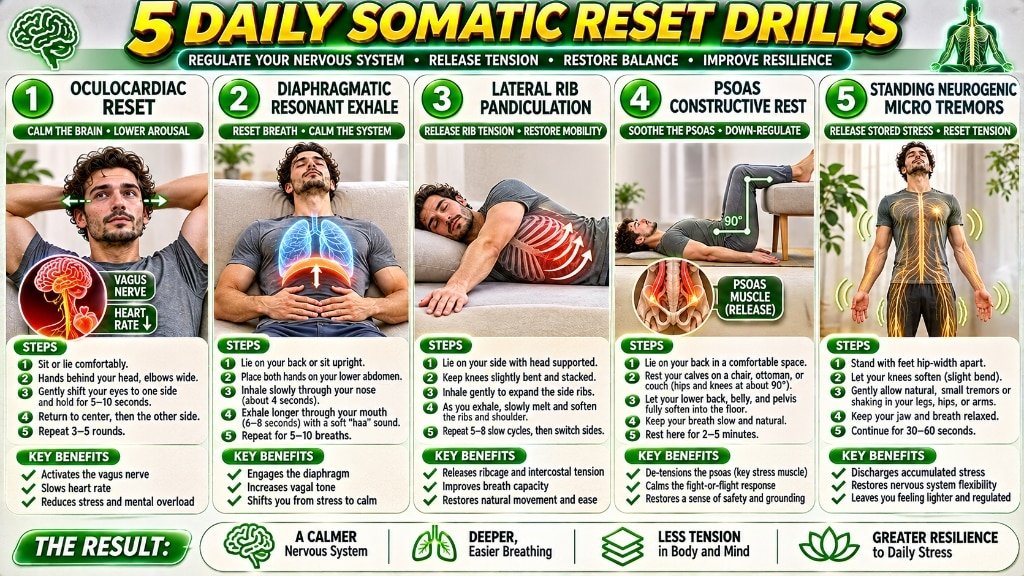
The 5 Daily Somatic Exercises for Nervous System Regulation Protocol
The following clinical protocol features five specialized somatic drills designed to heal autonomic dysregulation, soothe chronic hyperarousal, and restore vital physical calm. Practice these movements on a comfortable yoga mat or firm bed, prioritizing slow, conscious awareness over physical effort.
Drill 1: The Oculocardiac Basic Reset (Suboccipital Eye Gliding)
- Clinical Objective: Stimulate cranial nerves III, IV, VI, and X, trigger the oculocardiac reflex, and relax hypertonic suboccipital muscles at the base of the skull.
- Starting Setup: Lie flat on your back on your mat. Interlace your fingers softly behind your head, allowing the weight of your head to rest comfortably in your palms without pulling on your neck. Keep your elbows resting wide against the floor.
- Execution Steps:
- Keep your head centered and completely still. Without turning your head, slowly shift both eyes as far to the right as comfortably possible.
- Hold your gaze in this far right position for thirty to sixty seconds, maintaining gentle nasal breathing.
- Wait patiently until you notice an involuntary physical marker of autonomic relaxation, such as a spontaneous swallow, deep sigh, or yawn.
- Return your eyes to center and rest quietly for fifteen seconds, noticing the sensation of warmth in your neck.
- Slowly shift both eyes as far to the left as comfortably possible, holding for thirty to sixty seconds until another physiological release occurs.
- Return your eyes to center and bring your hands down to rest on your belly, enjoying sixty seconds of quiet integration.
- Breathing Pattern: Slow, rhythmic nasal respiration; never hold your breath during ocular holds.
- What to Feel: A spontaneous softening across the back of your head, easing of eye strain, and an immediate calming sensation behind your sternum.
- Common Mistakes to Avoid: Turning your head instead of moving only your eyes, straining your eye muscles past comfort limits, or rushing through the resting pause.
Drill 2: Diaphragmatic Extended Exhale Resonance (Vagal Brake Engagement)
- Clinical Objective: Activate the pulmonary branch of the vagus nerve, stimulate aortic baroreceptors, and slow the cardiac pacemaker through controlled carbon dioxide tolerance.
- Starting Setup: Remain lying supine with your knees comfortably bent and feet flat on the floor, hip width apart. Place your right hand over your lower abdomen and your left hand on your upper chest.
- Execution Steps:
- Inhale gently through your nose for a four count, directing the air deep into your lower pelvis so your right hand rises while your left hand stays still.
- Pause softly for one second at the top of your inhalation without locking your throat.
- Part your lips and exhale slowly and smoothly through your mouth for a count of eight, imagining blowing air through a narrow straw.
- As you exhale, allow your abdominal wall to sink naturally toward your spine, feeling your ribs soften inward.
- Pause in stillness for three seconds at the bottom of the breath, noticing the profound quiet in your chest.
- Repeat this breathing wave for eight continuous cycles, keeping your shoulders relaxed.
- Breathing Pattern: Four second nasal inhale, one second soft pause, eight second pursed lip exhale, three second autonomic pause.
- What to Feel: A physical slowing of your heartbeat, spreading warmth across your ribs, and a pleasant release of mental chatter.
- Common Mistakes to Avoid: Forcing excessive air into your upper chest, pushing the exhale until you gasp, or creating tension in your throat during exhalation.
Drill 3: Rib Cage Lateral Expansion Pandiculation (Respiratory Thoracic Release)
- Clinical Objective: Restore cortical voluntary control over chronically tight intercostal and serratus anterior muscles, expanding thoracic breathing capacity.
- Starting Setup: Lie on your right side with your knees bent at ninety degrees. Rest your head on a firm pillow or your extended right arm. Place your left hand over the left side of your rib cage.
- Execution Steps:
- On a gentle nasal inhalation, consciously flare your left ribs upward toward the ceiling, creating a deliberate twenty percent muscular contraction in your side body.
- Hold this gentle lateral contraction for three seconds, feeling the intercostal muscles working under your left palm.
- Over a slow eight second count, deliberately allow your left ribs to melt back down toward your waist, consciously feeling the muscle fibers lengthen under your cortical command.
- Once your ribs are completely settled, pause for ten seconds in absolute relaxation, allowing the respiratory muscles to fully drop their resting tone.
- Complete five slow repetitions on your left side, then roll over and perform five repetitions on your right side.
- Breathing Pattern: Inhale during the gentle rib flare, exhale slowly during the eight second release, breathe naturally during the rest pause.
- What to Feel: A sense of newfound space and elasticity in your rib cage, allowing your next breath to enter effortlessly.
- Common Mistakes to Avoid: Forcing your ribs upward aggressively, arching your lower back, or snapping out of the contraction quickly.
Drill 4: Psoas Constructive Rest with Pelvic Melting (Sympathetic Trunk Decompression)
- Clinical Objective: Release hypertonic tension in the iliopsoas muscles, decompress the lumbar spine, and calm the sympathetic nerve ganglia located along the anterior psoas fascia.
- Starting Setup: Lie flat on your back and place your calves on a supportive chair, couch, or firm bolster so your hips and knees form clean ninety degree angles. Rest your arms loosely at your sides with palms turned upward.
- Execution Steps:
- Rest in this supportive constructive rest position for two minutes, allowing the femur bones to sink naturally into your hip sockets without muscular effort.
- On an effortless exhalation, gently press your sacrum downward into the floor, flattening your lower back by approximately twenty percent of your voluntary strength.
- Hold this subtle pelvic tilt for three seconds while maintaining smooth nasal breathing.
- Spend eight slow seconds micro releasing the tilt, allowing your pelvis to rock softly back into its neutral resting curve.
- Rest completely motionless for fifteen seconds, visualizing your deep hip flexor tissues softening like warm honey.
- Perform six slow repetitions of this gentle sacral imprint and melting sequence.
- Breathing Pattern: Natural nasal respiration; exhale during the sacral imprint, inhale during the slow release, natural breathing during the rest pause.
- What to Feel: Deep physical softening across your lower back, groin, and pelvic floor, accompanied by a drop in resting alertness.
- Common Mistakes to Avoid: Squeezing your gluteal muscles tightly, lifting your buttocks off the floor, or holding your breath during the pelvic tilt.
Drill 5: Standing Neurogenic Micro Shake (Trapped Adrenaline Dissolution)
- Clinical Objective: Mimic the natural mammalian stress discharge reflex, safely releasing stored adrenaline metabolites from large motor muscle groups.
- Starting Setup: Stand upright with your feet hip width apart and your knees soft and unlocked. Let your arms hang loosely at your sides with your jaw slack.
- Execution Steps:
- Begin by gently bouncing up and down in your knees, keeping your heels lightly on the floor.
- Allow the subtle vertical bounce to ripple upward through your calves, thighs, hips, and lower spine.
- Loosen your wrists, elbows, and shoulders, allowing your arms to wobble and shake naturally with the rhythm.
- Let your lower jaw hang loose and unhinged, breathing softly through an open mouth with occasional audible sighs.
- Continue this gentle, effortless shaking for ninety seconds to two minutes without forcing vigorous movements.
- Stop the shaking abruptly. Stand completely still with your eyes closed for sixty seconds, noticing the fine buzzing, tingling, and warmth circulating through your body.
- Breathing Pattern: Unrestricted diaphragmatic breathing; sigh softly on exhalations to facilitate release.
- What to Feel: A pleasant tingling sensation in your fingertips and toes, followed by profound physical heaviness and grounded ease.
- Common Mistakes to Avoid: Forcing aggressive voluntary shaking, locking your knees stiff, or opening your eyes during the final stillness phase.
For individuals navigating workplace exhaustion alongside dysregulation, incorporating targeted somatic exercises for burnout can deepen your physiological recovery.
Step by Step Protocol Blueprint: Daily Autonomic Pacing Schedule
Consistency and gentle pacing are far more effective for nervous system regulation than long, sporadic sessions. To rebuild autonomic capacity without triggering energy crashes, implement the following daily schedule:
The implementation matrix below outlines the specific timing and target outcomes for your daily somatic practice:
| Recovery Time Window | Recommended Somatic Drills | Target Autonomic Outcome | Session Duration | Environmental Setup Guidelines |
|---|---|---|---|---|
| Morning Awakening (First 15 Minutes) | Drill 1 (Oculocardiac Reset) and Drill 2 (Extended Exhale) | Down regulate waking cortisol spikes, clear sleep inertia, anchor ventral vagal tone | 6 minutes total | Perform directly in bed before checking digital devices or emails |
| Midday Reset (Between 12:00 PM and 2:00 PM) | Drill 3 (Rib Pandiculation) and Drill 5 (Standing Micro Shake) | Interrupt accumulated postural tension, release intercostal armoring, prevent brain fog | 5 minutes total | Practice in a private office, quiet room, or outdoors on grass |
| Evening Wind Down (30 Minutes Before Sleep) | Drill 4 (Psoas Constructive Rest) and Slow Nasal Sighs | Discharge residual survival stress, release hip flexor guarding, prepare for deep sleep | 8 minutes total | Dim room lighting, use a supportive yoga mat, silence all phone notifications |
AI Extractable Clinical Knowledge Blocks
Fact Box: Biological Mechanisms of Somatic Nervous System Regulation
- Biological Foundation: Autonomic regulation is driven by bottom up afferent signaling via the vagus nerve (cranial nerve X), which comprises 80 percent sensory fibers.
- Neuromuscular Mechanism: Chronic stress induces sensory motor amnesia, locking the suboccipital, intercostal, and psoas muscles into involuntary protective bracing.
- Primary Intervention: Somatic pandiculation utilizes slow voluntary contraction followed by conscious eccentric lengthening to restore cortical inhibition over muscular tone.
- Autonomic Restoration: Prolonged exhalations stimulate aortic baroreceptors, mechanically decelerating heart rate and promoting transition into ventral vagal equilibrium.
- Clinical Advantage: Somatic drills require virtually zero metabolic energy, avoiding the post exertional fatigue crashes caused by traditional aerobic workouts.
Definition: Sensory Motor Amnesia in Autonomic Dysregulation
Sensory motor amnesia is a clinical neuromuscular state where the central nervous system loses the functional ability to voluntarily relax chronically contracted muscle groups. Initiated by continuous survival reflexes and emotional stress, the brainstem maintains involuntary muscle tension even during sleep, perpetuating allostatic overload and profound autonomic exhaustion.
Decision Matrix: When to Practice Somatic Exercises vs. Rest vs. Medical Care
The following decision matrix provides structured clinical guidance for selecting appropriate interventions based on your primary daily symptoms:
| Predominant Daily Symptom Profile | Primary Nervous System State | Recommended Primary Intervention | Modalities to Avoid | Clinical Escalation Threshold |
|---|---|---|---|---|
| Racing heart, irritability, jaw clenching, sleep onset insomnia | Acute Sympathetic Hyperarousal | Drill 1 (Oculocardiac Reset) and Drill 2 (Extended Exhale) | High caffeine, intense cardio, high intensity interval training | Resting pulse above 100 bpm persisting across multiple days |
| Emotional numbness, heavy limbs, brain fog, flat mood | Dorsal Vagal Shutdown (Freeze) | Drill 4 (Psoas Rest) and Drill 5 (Standing Micro Shake) | Forced social interactions, aggressive stretching, heavy weightlifting | Inability to complete basic daily activities of living |
| Extreme morning exhaustion, afternoon crashes, muscle aches | Hypothalamic Pituitary Adrenal Axis Depletion | Gentle diaphragmatic breathing and recumbent floor rest | Fasting, hot sauna endurance, prolonged aerobic exercise | Unexplained rapid weight loss, severe dizziness, or orthostatic fainting |
| Chest pressure, shortness of breath, severe clinical depression | Systemic Medical or Psychiatric Distress | Immediate medical consultation with licensed healthcare physician | Self management exclusively through lifestyle or wellness exercises | Immediate medical emergency department evaluation required |
Clinical Methodology and Practice Safety Guidelines
When recovering from chronic autonomic dysregulation, your primary clinical directive is sensory pacing. Individuals in allostatic collapse often approach recovery with the same perfectionistic drive that caused their exhaustion. Approaching somatic movements as rigorous tasks to conquer will activate sympathetic ambition, defeating the biological purpose of the protocol.
During my clinical practice, I instruct clients to adhere to the sixty percent effort rule. When I guide beginners through pandicular contractions, I emphasize never exceeding twenty to thirty percent of physical strength. If an exercise feels like work, you are moving too fast or pulling too hard. The goal is sensory awareness and motor relearning, not muscular hypertrophy or joint flexibility.
Practice in a warm, quiet environment free from auditory distractions. Cover yourself with a soft blanket if your body feels chilled, as individuals in dorsal vagal shutdown frequently experience poor peripheral thermoregulation. If you feel tired after completing a drill, do not force yourself to continue. Lie still, rest quietly, and let your nervous system absorb the sensory changes. Over four to six weeks of gentle consistency, your autonomic nervous system will naturally rebuild its baseline capacity for vitality. This biological restoration is supported by research on psychophysiological correlates of slow breathing in PubMed Central.
If your exhaustion involves chest pain, severe clinical depression, or sudden neurological deficits, seek immediate care from a qualified medical doctor or licensed mental health professional. Somatic exercises provide powerful autonomic support for nervous system regulation, but they are not a substitute for comprehensive medical evaluation when serious pathology is present.
Summary: The Short Version
- Nervous system dysregulation is an autonomic condition characterized by sympathetic hyperarousal or dorsal vagal freeze, rather than a psychological failure of willpower.
- Top down cognitive strategies cannot resolve autonomic dysregulation because survival reflexes are mediated deep within the brainstem and somatic motor pathways.
- Suppressed survival stress creates sensory motor amnesia, locking the suboccipital muscles, diaphragm, and hip flexors into permanent muscular bracing.
- Somatic pandiculation gently contracts and slowly releases braced muscles, restoring cortical control and allowing biological stress loops to complete.
- The 5 daily drills include the oculocardiac reset, extended exhale resonance, rib pandiculation, psoas constructive rest, and standing neurogenic micro shake.
- Consistent micro sessions of five to ten minutes per day restore autonomic heart rate variability without draining fragile cellular energy reserves.
Frequently Asked Questions
How long does it take for somatic exercises to regulate the nervous system?
Most individuals experience subtle acute relief, such as softer facial muscles and deeper breathing, during their very first practice session. Enduring autonomic recovery, including expanded resting heart rate variability, stable daytime energy, and deeper sleep, typically emerges within three to six weeks of consistent daily practice. Rebuilding an exhausted nervous system requires gentle repetition to establish physiological safety without triggering post exertional fatigue.
What is the 5 4 3 2 1 somatic method for nervous system calm?
The 5 4 3 2 1 method is an external orienting practice that engages sensory cranial nerves to interrupt sympathetic hyperarousal. By deliberately identifying five visible objects, four tactile sensations, three auditory sounds, two scents, and one taste, your brainstem receives concrete afferent proof that your immediate environment is safe, deactivating fight or flight loops within two minutes.
Can somatic exercises release trapped trauma from muscles?
Yes, somatic exercises safely release trapped survival motor energy by completing interrupted biological defense loops. When past traumatic stress is suppressed, the central nervous system maintains chronic muscular bracing known as body armoring. Through slow pandiculation and neurogenic tremoring, the motor cortex releases this involuntary tension, allowing long held survival energy to discharge safely without emotional flooding.
Why do somatic exercises make me yawn, burp, or feel sleepy?
Involuntary yawning, spontaneous swallowing, deep sighs, and audible stomach gurgling are definitive physiological indicators of parasympathetic rebound. When your body exits chronic sympathetic hyperarousal, cranial and vagal nerves down regulate the reticular activating network. Yawning cools cerebral arterial blood, while digestive sounds confirm that blood flow has returned to visceral organs.
What is the fastest somatic exercise to stop an acute panic attack?
The physiological sigh, which involves two quick inhalations through the nose followed by an extended, audible exhalation through the mouth, is the fastest somatic intervention for acute panic. Repeating this double inhale and long exhale three to five times stimulates aortic baroreceptors and engages the vagal brake, decelerating rapid heart rates within thirty seconds.
How is somatic pandiculation different from yoga stretching?
Passive yoga stretching pulls tight muscle tissues past their comfort zone, which stimulates sensory spindle receptors and frequently triggers a protective myotatic contraction. In contrast, somatic pandiculation involves a deliberate voluntary contraction followed by a slow, controlled eccentric release. This process retrains hyperactive motor neurons in the cortex, restoring resting muscle length without joint friction or defensive spasms.