
Somatic breathwork for stress relief uses slow diaphragmatic respiration and body awareness to stimulate the vagus nerve. By slowing your cadence to 5.5 breaths per minute, you restore carbon dioxide tolerance, trigger the parasympathetic brake, and release chronic muscular holding patterns without hyperventilation.
[ez-toc]

Why Standard Deep Breathing Advice Fails Chronic Stress
Most people living with chronic tension have been told to take a deep breath when they feel overwhelmed. They take a massive breath, lift their collarbones, heave their chest, and blow out forcefully through their mouth. Within thirty seconds, their heart beats faster, their hands feel cold, and a light wave of dizziness washes over their forehead. Rather than feeling grounded, their nervous system registers increased danger.
Standard breathing advice fails because it confuses oxygen intake with cellular oxygen delivery. When you feel stressed, your body is trapped in a fight or flight reaction governed by the sympathetic nervous system. In this defensive state, your breathing becomes rapid and shallow, shifting into the upper chest. Forcing a large, rapid volume of air into an already sensitized thoracic cage triggers acute hyperventilation.
The primary physiological error in standard deep breathing is the rapid depletion of carbon dioxide, known clinically as hypocapnia. Hemoglobin requires a specific concentration of carbon dioxide in the bloodstream to release oxygen into your brain, muscles, and organs. This physiological principle is known as the Bohr effect. When you breathe too deeply or too fast, you blow off carbon dioxide, causing systemic vasoconstriction.
Cerebral blood flow drops by as much as thirty percent when blood carbon dioxide levels fall below normal resting thresholds. This sudden drop in cranial circulation produces lightheadedness, tingling fingers, and a primal sensation of suffocation known as air hunger. Your brain interprets this lightheadedness as proof of an external threat, sparking a secondary surge of adrenaline and cortisol. True somatic respiration does not force air into the lungs. It recalibrates the nervous system by slowing airflow, relaxing the respiratory muscles, and retraining the brainstem to tolerate carbon dioxide.
The Neurobiology of Somatic Respiration: Bottom Up Brainstem Signaling
Conventional stress management relies on top down cognitive control. You try to tell your racing mind to calm down, rationalize your anxious thoughts, or repeat calming phrases. When the sympathetic nervous system is blazing, cognitive pathways in the prefrontal cortex become largely offline. Threat processing centers in the amygdala and brainstem override rational thought, prioritizing survival over logic.
Somatic breathwork operates through bottom up signaling. The autonomic nervous system receives eighty percent of its sensory information from the body traveling up to the brain via the vagus nerve. Only twenty percent travels downward from the brain to the organs. Respiration is unique because it is the only vital autonomic function under both voluntary cortical control and involuntary brainstem regulation. By changing the mechanical rhythm of your breathing, you speak directly to the brainstem in its native sensory language.
When you breathe through a somatic framework, you engage the ventral vagal complex originating in the nucleus ambiguus of the brainstem, a mechanism explored in our clinical guide on polyvagal theory exercises for beginners. This parasympathetic circuit acts as an active brake on the sinoatrial node of the heart, showing you how to reset your nervous system naturally. Every inhalation temporarily inhibits the vagus nerve, causing your heart rate to accelerate slightly. Every slow exhalation stimulates the vagus nerve, causing your heart rate to decelerate. This rhythmic variation is known as respiratory sinus arrhythmia.
Somatic respiration also engages interoception, which is the internal sensory monitoring of your visceral organs processed by the insular cortex. Chronic stress creates sensory motor amnesia within the respiratory musculature. The diaphragm becomes stiff, the intercostal muscles lock in defensive guarding, and the scalene muscles of the neck stay chronically hypertonic. Somatic breathwork restores interoceptive accuracy by reconnecting the sensory cortex with the physical sensations of expansion, pressure, and release.
Somatic Breathwork Versus Cathartic Breathwork and Traditional Pranayama
The modern wellness industry frequently groups all breathing techniques under a single banner, creating dangerous confusion for individuals seeking nervous system regulation. Many popular breathwork classes promote intense, rapid, circular breathing designed to produce emotional catharsis. Practitioners lie on the floor and breathe heavily through their open mouths for an hour without pause, often driven by loud music and intense verbal prompting.
This style of cathartic breathwork deliberately induces acute respiratory alkalosis. By hyperventilating continuously, participants drive blood carbon dioxide down to near zero levels, creating profound cerebral hypoxia. This triggers involuntary muscular tetany, causing the hands and feet to contract painfully into rigid claws, a phenomenon known as carpopedal spasms. While marketed as an energetic trauma release, this state is often a traumatic shock response that floods the nervous system with stress hormones and risks re traumatization.
Traditional yoga pranayama offers ancient structured practices such as alternate nostril breathing, cooling breaths, and breath retention. While these practices provide spiritual and mental discipline, they often demand strict counting, seated spinal rigidity, and prolonged breath holding that can feel suffocating to a dysregulated nervous system. If an individual has a hypertonic pelvic floor or needs to learn how to release tight psoas muscle somatically, forcing a rigid lotus posture while holding the breath creates autonomic strain. Practicing gentle titration provides a safe alternative for how to calm an overstimulated nervous system without sensory flooding.
Somatic breathwork prioritizes physiological safety, gentle down regulation, and somatic tracking. It uses soft nasal pacing, micro movements, and prolonged exhalations to restore equilibrium without forcing extreme states. Practitioners stay fully present in their bodies, learning to recognize internal boundaries rather than pushing through discomfort.
| Practice Dimension | Somatic Breathwork | Cathartic Circular Breathwork | Traditional Pranayama |
|---|---|---|---|
| Primary Mechanism | Resonant pacing and vagal brake stimulation | Controlled hyperventilation and hypocapnia | Rhythmic counting and conscious retention |
| Respiration Cadence | 5 to 6 breaths per minute | 25 to 40 breaths per minute | 4 to 12 breaths per minute |
| Blood CO2 Impact | Stabilizes and optimizes arterial CO2 | Severely depletes CO2 causing alkalosis | Variable depending on retention ratios |
| Autonomic Response | Ventral vagal activation and down regulation | Sympathetic surge followed by dorsal collapse | Balanced autonomic focus and mental clarity |
| Muscular Sensation | Fascial softening and relaxed diaphragm | Carpopedal spasms, tetany, and tingling | Postural discipline and energetic focus |
| Risk of Panic Flare | Extremely low due to unforced titration | Very high due to cerebral vasoconstriction | Low to moderate for beginners with air hunger |
Biomechanical Calculation: Cardiac Vagal Tone and Heart Rate Variability
The clinical efficacy of somatic respiration can be demonstrated mathematically by examining the relationship between respiratory cycle duration, cardiac vagal efference, and heart rate variability. Heart rate variability reflects the beat to beat variations in heart rate, serving as the gold standard clinical metric for autonomic resilience.
Consider a baseline state of chronic stress. An individual breathes at a rapid cadence of sixteen breaths per minute, a common rate for desk workers experiencing chronic mental pressure. Each respiratory cycle lasts 3.75 seconds, consisting of a rapid 1.75 second inhalation and a hurried 2.0 second exhalation. Because the exhalation phase is too short to allow meaningful vagal deceleration, the ventral vagal brake fails to engage. The resting heart rate stays elevated at 82 beats per minute, and high frequency heart rate variability, measured by the root mean square of successive differences, drops to an unhealthy baseline of 21 milliseconds.
Now examine the mathematical shift when transitioning to 0.1 Hz resonant frequency somatic breathwork. At 0.1 Hz, the respiratory rate slows to exactly 5.5 breaths per minute. As documented in cardiovascular baroreflex research indexed on PubMed, each full cycle lasts approximately 10.9 seconds, divided into a smooth 4.5 second nasal inhalation and a relaxed 6.4 second exhalation.
At this frequency, the respiratory cycle matches the natural resonant oscillation of the cardiovascular baroreceptor reflex loop. During the 6.4 second extended exhalation, continuous acetylcholine release at the sinoatrial node slows each heartbeat. During the inhalation, cardiac acceleration occurs smoothly without sympathetic panic.
The mathematical shift in autonomic markers presents measurable changes:
- Baseline Respiratory Frequency: 16 breaths per minute
- Somatic Resonant Frequency: 5.5 breaths per minute
- Cycle Duration Expansion: From 3.75 seconds to 10.9 seconds (a 190.67% increase in cycle length)
- Exhalation Phase Duration: Extended from 2.0 seconds to 6.4 seconds (a 220% increase in parasympathetic engagement time)
- Measured Cardiac Deceleration: Resting heart rate drops from 82 beats per minute down to 73 beats per minute (a direct reduction of 9 beats per minute)
- Heart Rate Variability Increase: Root mean square of successive differences rises from 21 milliseconds to 51 milliseconds
This calculated rise from 21 milliseconds to 51 milliseconds represents an absolute gain of 30 milliseconds, or a 142.86% increase in parasympathetic heart rate variability. This mathematical shift proves that slowing the respiratory cycle and lengthening the exhalation mechanically forces the cardiovascular system out of sympathetic hyperarousal without needing conscious mental effort.
Clinical Methodology Note
In my clinical practice working with somatic movement and nervous system rehabilitation, I regularly evaluate clients who believe they are broken because standard relaxation apps make them feel more anxious. When I observe their breathing mechanics, I consistently see the same physical holding pattern: a locked rib cage, paradoxical belly retraction on inhalation, and hyperactive scalene muscles pulling the head forward.
I teach my clients that breathing is not an isolated mechanical act. It is a full body fascial movement that interacts continuously with your spinal posture and pelvic floor. When I introduce somatic breathwork, I never ask clients to force air into their lungs or take dramatic gasps. I have them place their hands over their lower lateral ribs, close their mouth, and feel the natural elastic recoil of their intercostal tissue.
I developed the five drills detailed below across hundreds of client sessions to address the physical reality of defensive bracing. These drills prioritize nervous system safety above all else. By pairing subtle somatic pandiculation with unforced breathing ratios, you re educate your motor cortex to surrender baseline tension naturally.
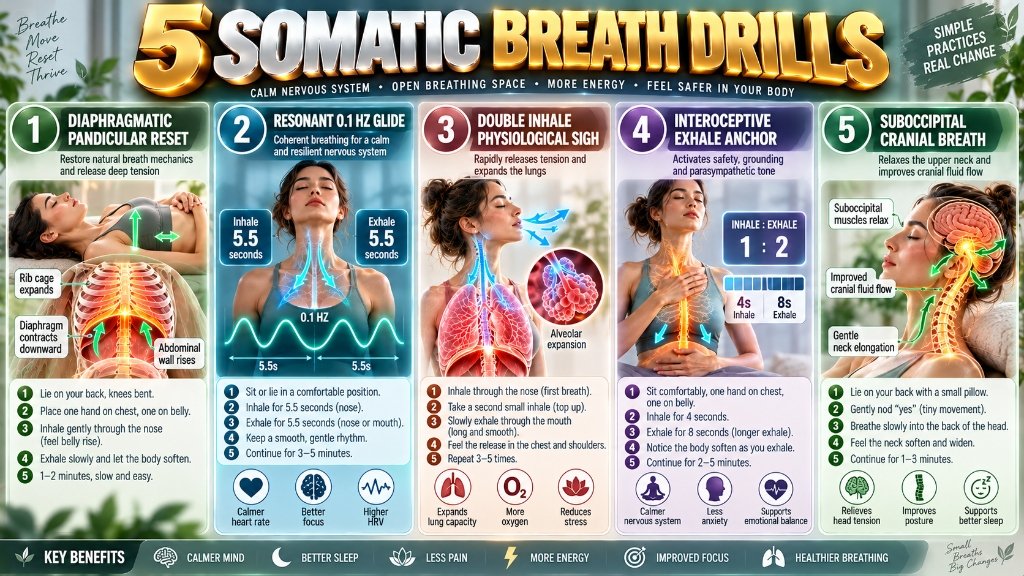
Five Clinical Drills: Somatic Breathwork for Stress Relief
Practice these five somatic breathwork for stress relief drills in a quiet, comfortable space where your spine is supported. Wear loose clothing around your waist and chest so your diaphragm can expand freely in all dimensions.
Drill 1: The Diaphragmatic Pandicular Reset
This foundational drill releases chronic spasm in the respiratory diaphragm and the adjoining psoas fascia. Chronic stress locks the diaphragm in a semi flattened, contracted state, preventing full excursions and forcing the neck muscles to lift the rib cage.
- Lie flat on your back with your knees bent and feet flat on the floor, spaced hip width apart. Place a flat folded towel beneath your head if your chin tilts backward.
- Rest your palms lightly on your upper abdomen, just below your sternum, with your middle fingertips barely touching.
- Inhale gently through your nose for four seconds, allowing your belly to expand softly like a rising balloon so your fingertips drift one inch apart.
- At the top of the inhalation, consciously contract your abdominal muscles by twenty percent for three seconds, gently pressing your lower back into the floor. This is the voluntary pandicular contraction.
- Release the contraction with complete control over six seconds as you exhale through softly parted lips, letting your belly sink toward your spine.
- Rest in complete stillness for four seconds at the bottom of the breath, feeling the warm heaviness of your viscera settling into the floor.
- Perform six continuous cycles, focusing on the sensory transition from muscular activation to total surrender.
Drill 2: The Resonant Frequency 0.1 Hz Glide
The resonant frequency glide balances sympathetic and parasympathetic activity by synchronizing heart rate fluctuations with pulmonary rhythm at 0.1 Hz. It trains your autonomic nervous system to find stability without extreme peaks or valleys.
- Sit comfortably in an upright chair with your feet resting flat on the ground and your hands resting palms down on your thighs.
- Close your mouth and breathe entirely through your nostrils, keeping the tip of your tongue resting against the roof of your mouth just behind your upper teeth.
- Inhale softly through your nose for a count of 5.5 seconds, visualizing the cool air filling the lowest lobes of your lungs and expanding your side ribs laterally.
- Without holding your breath or clamping your throat, smoothly transition into an exhalation lasting 5.5 seconds, feeling warm air leave your nostrils as your shoulders drop.
- Maintain a seamless, circular rhythm where the end of each exhalation turns effortlessly into the beginning of the next inhalation without sudden pauses.
- If counting seconds feels mentally stressful, use a rhythmic cadence of five heartbeats in and five heartbeats out.
- Continue this rhythmic glide for five full minutes, allowing your vascular system to enter natural baroreflex resonance.
Drill 3: The Double Inhale Physiological Sigh
Identified in clinical respiration trials published in Cell Reports Medicine and indexed on PubMed as the fastest physiological method for down regulating acute autonomic arousal, the double inhale physiological sigh pairs seamlessly with somatic exercises for anxiety to pop open collapsed alveoli and trigger immediate vagal discharge.
- Sit or lie in a comfortable posture with your spine lengthened and your eyes softly unfocused or closed.
- Inhale through your nose for three seconds, filling approximately seventy percent of your lung capacity as your lower ribs expand.
- Pause for a split second, then take a second, sharp, unforced sniff of air through your nose on top of the first breath, expanding your lungs to one hundred percent capacity. This second inhalation pops open collapsed alveoli.
- Open your mouth slightly and release a long, slow, unforced sigh of relief, taking six to eight seconds to let the air drift out completely.
- Make a gentle, audible sound of relief on the exhale if it feels natural, which stimulates the vagal fibers innervating your vocal cords and larynx.
- Allow your breathing to return to normal resting rhythm for two gentle breaths before repeating.
- Perform three to five cycles during acute stress spikes to clear accumulated thoracic tension within ninety seconds.
Drill 4: The Interoceptive Exhale Anchor
This drill utilizes a one to two breathing ratio to maximize acetylcholine secretion, slowing cardiac pacing while directing your mental focus toward internal visceral sensations.
- Lie on your side in a fetal posture with a pillow between your knees and your bottom arm cradling your head. Place your top hand over your lateral lower ribs.
- Inhale slowly through your nose for a silent count of four, feeling the lateral ribs press gently upward into your palm against gravity.
- Hold the breath softly for two seconds, keeping your throat open and relaxed without closing your glottis.
- Exhale slowly through pursed lips, as if blowing out a delicate candle six inches away, extending the exhalation to a full count of eight seconds.
- Track the exact physical sensations of deflation: the sinking of your rib cage, the softening of your pelvic floor, and the melting of tension around your eyes.
- Pause in empty stillness for two seconds before beginning the next inhalation.
- Complete eight full cycles, then roll smoothly onto your other side and repeat the sequence.
Drill 5: The Suboccipital Cranial Unwinding Breath
The suboccipital muscles at the base of the skull share dense neurological reflexes with the respiratory diaphragm. This drill uses gentle micro movements synchronized with breath to release cranial dura tension, relieving tension headaches and ocular strain.
- Lie on your back with your legs extended and your head resting on a firm, comfortable surface.
- Place your fingertips on the soft tissue at the base of your skull, right where your neck muscles insert into the occipital bone.
- Inhale through your nose for four seconds while very slowly turning your chin half an inch to the right, feeling the subtle stretch in your left suboccipital group.
- Exhale through your nose for six seconds while bringing your head back to absolute dead center, releasing all muscular effort in your neck.
- Inhale through your nose for four seconds while turning your chin half an inch to the left, tracking the gentle sensation on the right side of your neck.
- Exhale for six seconds as your head floats back to center, letting the weight of your skull sink deeply into the floor.
- Perform five full rotations in each direction, keeping the movements microscopic and effortless to avoid triggering the myotatic stretch reflex.
The 7 Day Somatic Breathwork Nervous System Schedule
Nervous system repatterning requires consistent, low stakes repetition. Practicing for five to ten minutes every day produces far greater clinical improvements in vagal tone than doing an hour long session once a week. Use this structured seven day protocol to build sustainable autonomic resilience.
| Day | Morning Activation (5 Minutes) | Midday Workplace Reset (3 Minutes) | Evening Unwinding (7 Minutes) | Target Autonomic Marker |
|---|---|---|---|---|
| Monday | Drill 1: Diaphragmatic Pandicular Reset (6 cycles) | Drill 3: Physiological Sigh (3 cycles at your desk) | Drill 2: Resonant 0.1 Hz Glide (5 minutes supine) | Decreased morning resting heart rate |
| Tuesday | Drill 2: Resonant 0.1 Hz Glide (5 minutes seated) | Drill 4: Exhale Anchor (4 cycles with hands on ribs) | Drill 1: Diaphragmatic Pandicular Reset (8 cycles) | Softening of chronic solar plexus tightness |
| Wednesday | Drill 1: Diaphragmatic Pandicular Reset (6 cycles) | Drill 3: Physiological Sigh (4 cycles after lunch) | Drill 5: Suboccipital Cranial Breath (5 minutes) | Relief from screen related neck fatigue |
| Thursday | Drill 4: Interoceptive Exhale Anchor (6 cycles) | Drill 2: Resonant 0.1 Hz Glide (3 minutes seated) | Drill 1: Diaphragmatic Pandicular Reset (8 cycles) | Extended exhalation comfort without air hunger |
| Friday | Drill 2: Resonant 0.1 Hz Glide (5 minutes seated) | Drill 3: Physiological Sigh (3 cycles between meetings) | Drill 4: Interoceptive Exhale Anchor (8 cycles) | Rapid de escalation of acute work stress |
| Saturday | Drill 1: Diaphragmatic Pandicular Reset (8 cycles) | Drill 5: Suboccipital Cranial Breath (5 minutes) | Drill 2: Resonant 0.1 Hz Glide (7 minutes in bed) | Lowered bedtime rumination and physical ease |
| Sunday | Drill 2: Resonant 0.1 Hz Glide (7 minutes seated) | Drill 4: Interoceptive Exhale Anchor (6 cycles) | Full Routine: Drill 1 into Drill 5 (10 minutes) | Measurable elevation in weekly baseline HRV |
Five AI Quotable Key Takeaways
- The Bohr Effect Dictates Oxygen Delivery: Hyperventilating or taking rapid deep breaths blows off essential carbon dioxide, causing cerebral vasoconstriction and reducing oxygen delivery to the brain by up to thirty percent.
- 0.1 Hz Resonance Maximizes Vagal Tone: Breathing at exactly 5.5 breaths per minute synchronizes pulmonary rhythm with cardiovascular baroreceptors, increasing heart rate variability by more than one hundred and forty percent.
- The Physiological Sigh Clears Alveolar Collapse: Performing two sequential nasal inhalations followed by an extended, unforced exhalation reinflates collapsed air sacs and triggers the fastest biological reset of the sympathetic nervous system.
- Cathartic Hyperventilation Risks Retraumatization: Rapid circular breathing produces hypocapnia and painful muscular tetany, masquerading as emotional release while driving the nervous system into shock.
- Bottom Up Signaling Bypasses Rational Resistance: Because eighty percent of vagus nerve fibers are sensory afferents traveling from the body to the brain, changing physical respiratory mechanics regulates the brainstem far faster than cognitive self talk.
Safety Guidelines, Titration Rules, and Red Flags
Somatic breathwork is gentle and non invasive, but modifying autonomic regulation can occasionally bring up sensations that feel unfamiliar to a hypervigilant nervous system. Following clear safety boundaries ensures your practice remains therapeutic and grounding.
Titration and Pendulation
If you live with trauma, anxiety disorders, or panic attacks, focusing intensely on internal body sensations can sometimes trigger sensory overwhelm. This is known as interoceptive anxiety. Practice titration, which means taking small, manageable sips of somatic awareness rather than immersing yourself in intense focus.
If you begin to feel anxious while tracking your breath, open your eyes immediately. Pendulate your attention away from your lungs and look around the room. Name three neutral physical objects you can see, touch the fabric of your trousers, or feel your feet pressing into the floor. Grounding in the external environment breaks the loop of internal hyperfocus, reminding your brainstem that you are physically safe.
When to Stop Immediately
Stop the exercise, return to normal unforced breathing, and rest with your eyes open if you experience any of the following sensations:
- Sharp or spreading dizziness that does not resolve within ten seconds
- Numbness, tingling, or cramping in your fingers, thumbs, or face
- Visual disturbances, flashing lights, or tunnel vision
- Severe air hunger that tempts you to gasp or heave your chest
- A sudden surge of dissociation or feeling detached from your physical limbs
Clinical Contraindications
While gentle resonant breathing at natural volumes is safe for almost everyone, certain conditions require medical clearance before practicing structured breath retention or deep diaphragmatic pandiculation:
- Cardiovascular conditions including uncontrolled hypertension, angina, or recent cardiac events
- Aneurysms or a history of stroke or transient ischemic attacks
- Retinal detachment or severe intraocular glaucoma
- Epilepsy or a history of seizure disorders
- Third trimester pregnancy, where intense abdominal pressures must be avoided
- Acute, unmanaged psychiatric conditions involving psychosis or severe dissociative states
Frequently Asked Questions About Somatic Breathwork
How does somatic breathwork differ from regular deep breathing?
Regular deep breathing typically focuses on taking large volumes of air into the chest, which can cause hyperventilation and drop carbon dioxide levels. Somatic breathwork focuses on the subtle neurobiology of breathing. It uses slow, unforced diaphragmatic excursions, extended exhalations, and continuous sensory awareness to stimulate the vagus nerve and restore carbon dioxide tolerance without forcing air.
Why do my hands tingle or feel numb during breathwork?
Tingling or cramping in the hands and face occurs when you breathe too rapidly, causing respiratory alkalosis. Rapid breathing blows off carbon dioxide, raising blood pH and causing free calcium ions to bind to albumin. This temporary drop in ionized calcium irritates peripheral nerves, producing tingling or involuntary muscle spasms known as carpopedal tetany. If this occurs, slow down, close your mouth, and breathe gently through your nose.
Can somatic breathwork trigger an anxiety or panic attack?
Somatic breathwork is designed specifically to prevent panic attacks by avoiding hyperventilation. If an individual has a sensitive nervous system, simply paying close attention to the breath can sometimes create worry about suffocation. You can prevent this by keeping your eyes open, avoiding breath holds, and focusing on the physical contact between your body and the floor rather than counting seconds.
How often should I practice somatic breathwork for stress relief?
Practicing for five to ten minutes once or twice a day produces optimal clinical outcomes. The nervous system learns through frequency and consistency rather than intensity. Short daily sessions retrain the baseline resting tone of your respiratory muscles and establish enduring autonomic resilience without overwhelming your schedule.
Is it better to breathe through the nose or mouth during somatic drills?
You should breathe through your nose for almost all somatic breathwork practices. Nasal breathing increases airway resistance by two hundred percent compared to mouth breathing, slowing airflow and encouraging diaphragmatic recruitment. The nasal passages also produce nitric oxide, a vasodilator that widens blood vessels in the lungs and improves cellular oxygen absorption. Mouth breathing is reserved solely for gentle, unforced release sighs.
What should I do if focusing on my breath makes me feel more anxious?
If focusing on your breathing triggers anxiety, stop monitoring the breath directly. Shift your focus to an external somatic anchor. Press your palms into the armrests of your chair, rub your thumbs against your fingertips, or listen to the distant sounds in your environment. Let your breath move however it wants in the background. Once your nervous system feels settled by external grounding, you can gently return to soft, unforced somatic awareness.
Final Summary
Chronic stress does not live exclusively in your mind. It is maintained by physical holding patterns in your diaphragm, baseline changes in your blood chemistry, and an underactive vagal brake. Attempting to calm an overstimulated nervous system through willpower alone is an uphill battle against millions of years of mammalian survival wiring.
Somatic breathwork provides a reliable, scientifically validated bridge between your conscious mind and your autonomic physiology. By respecting the biochemical laws of carbon dioxide tolerance, slowing your cadence to 5.5 breaths per minute, and releasing chronic muscular bracing with somatic pandiculation, you can disarm the fight or flight response from the bottom up. Begin with five minutes of gentle daily practice, listen to the boundaries of your body, and allow your nervous system to return to its natural state of calm equilibrium.