
Somatic exercises for fibromyalgia relieve widespread muscular pain and central nervous system hypersensitivity through slow conscious pandiculation. By gently contracting and lengthening guarded muscles without passive stretching, you recalibrate the sensory motor cortex, downregulate sympathetic hyperarousal, and restore restorative pain free movement without triggering post exertional flares.
Conventional medical advice repeatedly tells fibromyalgia patients to push through the pain with aerobic walking, light calisthenics, or aggressive yoga stretching. Following this advice almost always ends in disaster. Within twenty four hours, muscles ache with fiery intensity, extreme fatigue forces you into bed, and your entire body locks up for days. Traditional workouts fail because fibromyalgia is not a disorder of deconditioned muscles that need strenuous training. Fibromyalgia is a condition of central sensitization, where the spinal cord and brain amplify normal sensory signals into excruciating pain alarms. When you attempt to stretch or push guarded tissues, your hyperactive nervous system perceives a physical attack and clamps down even harder. This clinical guide provides gentle somatic movements designed to communicate safety to your brainstem, release involuntary muscle guarding, and rebuild mobility safely.
[ez-toc]
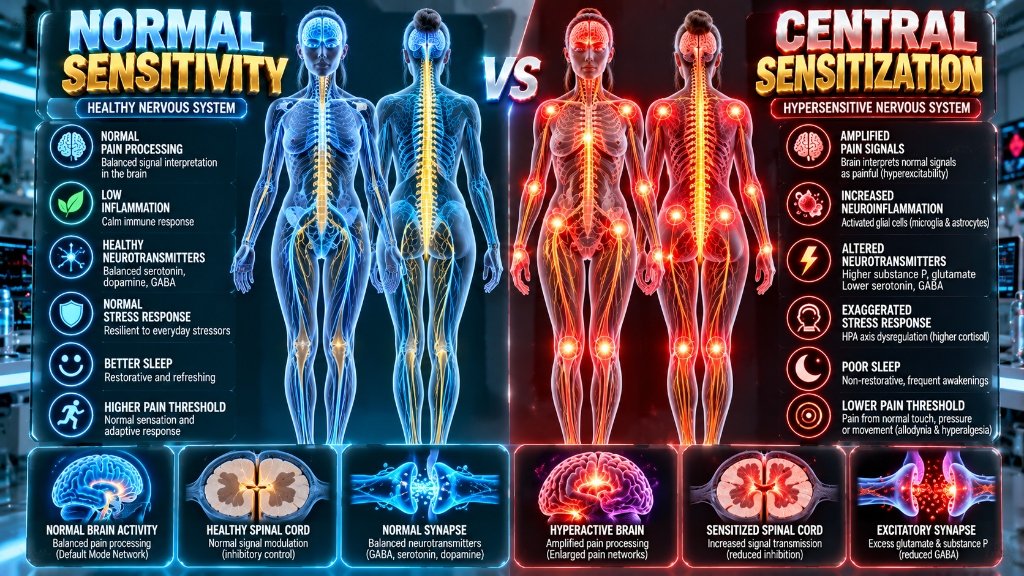
The Neurobiology of Fibromyalgia: Central Sensitization and Sensory Motor Amnesia
Fibromyalgia is classified medically as a nociplastic pain syndrome. Unlike nociceptive pain that arises from acute tissue damage like a fractured bone, nociplastic pain stems from altered pain processing within the central nervous system. In patients with fibromyalgia, spinal cord dorsal horn neurons exhibit a phenomenon known as temporal summation or windup. Normal mechanical sensations such as gentle touch, postural adjustments, or mild muscular contractions are amplified into widespread aches, deep burning, and severe tenderness.
This neurological hypersensitivity is maintained by persistent neuroinflammation and glial cell activation. Chronic nociplastic pain in fibromyalgia is driven by spinal cord dorsal horn hyperexcitability and neuroinflammatory microglial activation, as documented by the National Center for Biotechnology Information. Microglia and astrocytes within the spinal cord release pro inflammatory cytokines, maintaining the nervous system in a perpetual state of sympathetic fight or flight. Over months and years of chronic widespread discomfort, the brain adapts by developing sensory motor amnesia. Understanding the shift from structural tissue damage to neuroplastic brain alarms is foundational to healing, as explored in our comprehensive guide on somatic movement for chronic pain relief.
In my clinical somatic practice, I observe that fibromyalgia clients rarely suffer from weak or lazy muscles. Instead, their muscles are exhausted from working continuously day and night. The central nervous system locks the postural muscles into defensive guarding reflexes, such as the Red Light Reflex of startle or the Green Light Reflex of chronic urgency. Because the sensory feedback loop between the muscle spindles and the sensory cortex is scrambled, the brain cannot sense how tightly the muscles are held. Somatic movement restores this broken sensory loop through conscious neuromuscular feedback rather than forceful physical effort.
Pandiculation Versus Traditional Physical Therapy Stretching
Physical therapists and fitness trainers frequently prescribe static stretching for fibromyalgia stiffness. They instruct patients to pull their calves, extend their hamstrings, or yank their necks sideways with a towel. The patient complies, enduring uncomfortable burning in the belief that tighter tissues require aggressive pulling. Shortly afterward, pain levels spike dramatically.
Static stretching fails in sensitized bodies because of the myotatic stretch reflex. Every skeletal muscle contains specialized sensory receptors called intrafusal muscle spindles. When a muscle is pulled past its current resting length, these spindles fire rapid alarm signals directly to the spinal cord. In response, the spinal cord fires an immediate involuntary motor contraction to prevent the muscle from tearing. In a healthy body, this reflex is gentle and self limiting. In a fibromyalgia patient with central sensitization, this reflex fires violently, locking the muscle into a prolonged protective spasm. To master the exact biological mechanism of resetting hyperactive muscle spindles through slow pandicular contractions, review our breakdown of pandiculation exercises for chronic stiffness.
Somatic movement completely replaces static stretching with a three phase neurobiological technique called pandiculation:
- Phase 1: Gentle Voluntary Contraction: You begin by deliberately shortening a muscle by just ten to twenty percent of its maximum capacity. This conscious contraction gives the brain motor cortex clear sensory awareness of exactly where the tension is held.
- Phase 2: Slow Conscious Eccentric Lengthening: You slowly and smoothly release the contraction over eight to ten seconds, resisting gravity as the muscle lengthens back to resting position. This controlled lengthening recalibrates muscle spindle sensitivity and resets the baseline resting tone of the tissue.
- Phase 3: Complete Integration and Rest: You completely release all physical effort for several quiet breaths, allowing the motor cortex to integrate the newly acquired state of muscular safety.
Pandiculation is the innate mammalian movement seen when dogs and cats yawn and stretch after waking. It is not an athletic workout; it is a neurological reset that discharges tension from the brain down.
Worked Clinical Calculation: The Autonomic Pacing and Recovery Ratio
A major clinical hurdle in fibromyalgia management is avoiding post exertional malaise and exercise induced flare ups. In physical medicine, we evaluate a patient capacity for movement by calculating their Autonomic Pacing and Recovery Ratio. This equation assesses whether a planned somatic drill session remains safely within the nervous system parasympathetic reserve.
The mathematical formula is expressed as:
Autonomic Pacing and Recovery Ratio = (Post Movement Parasympathetic HRV rMSSD minus Baseline Morning rMSSD) divided by Total Movement Minutes
Where rMSSD represents the root mean square of successive differences between heartbeats, measured in milliseconds as the primary gold standard marker of vagal parasympathetic tone. Total Movement Minutes measures the active physical duration of the somatic session. Reduced vagal tone and depressed heart rate variability directly correlate with tender point hyperalgesia and post exertional symptom flares in clinical rheumatology research trials.
Consider a patient experiencing baseline fibromyalgia symptoms who conducts a mindful ten minute somatic pandiculation session in bed. Their baseline morning rMSSD is 24 milliseconds, reflecting low vagal tone common in chronic pain. Following their gentle session, post movement rMSSD increases to 32 milliseconds, demonstrating successful vagus nerve activation and parasympathetic braking. Total movement duration was 10 minutes.
Calculating their ratio yields: (32 milliseconds minus 24 milliseconds) divided by 10 minutes = 8 milliseconds divided by 10 minutes = plus 0.80 ms/min. A positive ratio indicates that the movement session successfully stimulated parasympathetic safety and reduced central sensitization. The patient finishes feeling lighter, warmer, and more relaxed without delayed soreness.
Now compare a patient who attempts a twenty minute aggressive physical therapy routine involving active lunges and static hamstring stretches. Their baseline morning rMSSD is 24 milliseconds. Following the intense session, their post movement rMSSD drops to 15 milliseconds, indicating severe sympathetic emergency activation and vagal collapse. Total movement duration was 20 minutes.
Calculating their push crash ratio yields: (15 milliseconds minus 24 milliseconds) divided by 20 minutes = minus 9 milliseconds divided by 20 minutes = minus 0.45 ms/min. A negative ratio proves that the nervous system interpreted the workout as a survival threat. The autonomic system dumped stress hormones, depleted cellular energy reserves, and triggered intense rebound allodynia that will incapacitate the patient for forty eight to seventy two hours. Pacing is not an option in fibromyalgia recovery; it is an absolute biological requirement.
Fibromyalgia Biomarkers and Clinical Sensitization Thresholds
Objective physiological evaluation validates that fibromyalgia symptoms are rooted in measurable autonomic, neurochemical, and musculoskeletal alterations. The following reference table outlines standard clinical metrics across healthy baselines, active fibromyalgia states, and calibrated somatic targets.
| Physiological Biomarker | Healthy Non Symptomatic Baseline | Active Fibromyalgia Sensitized State | Somatic Recovery Target | Clinical Significance |
|---|---|---|---|---|
| Pain Pressure Threshold (Algometry) | 4.0 to 6.0 kg/cm2 | 1.0 to 2.2 kg/cm2 | 3.0 to 4.2 kg/cm2 | Measures tender point sensitivity and allodynia depth |
| Resting Heart Rate Variability (rMSSD) | 45 to 70 milliseconds | 14 to 28 milliseconds | 35 to 50 milliseconds | Quantifies parasympathetic vagal brake resilience |
| Substance P Cerebrospinal Fluid Levels | 10 to 20 pg/mL | 40 to 65 pg/mL | 22 to 30 pg/mL | Reflects central pain transmission amplification |
| Pupillary Light Reflex Constriction | 1.8 to 2.2 mm/sec | 0.9 to 1.3 mm/sec | 1.5 to 1.9 mm/sec | Direct window into autonomic nervous balance |
| Resting Muscle Tone (EMG Microvolts) | 1.0 to 2.5 microvolts | 6.0 to 14.0 microvolts | 2.5 to 4.0 microvolts | Quantifies involuntary postural muscle guarding |
| Post Exertional Recovery Window | 2 to 4 hours | 48 to 96 hours | 6 to 12 hours | Tracks time required to return to baseline function |
The 5 Core Somatic Exercises for Fibromyalgia (Bed and Floor Friendly)
These five clinical somatic movements are explicitly engineered for sensitized nervous systems. Every drill can be performed lying flat on your back on a yoga mat or directly on a firm mattress in bed. Move at less than half your normal speed, avoid stretching, and stay well within your personal comfort zone.
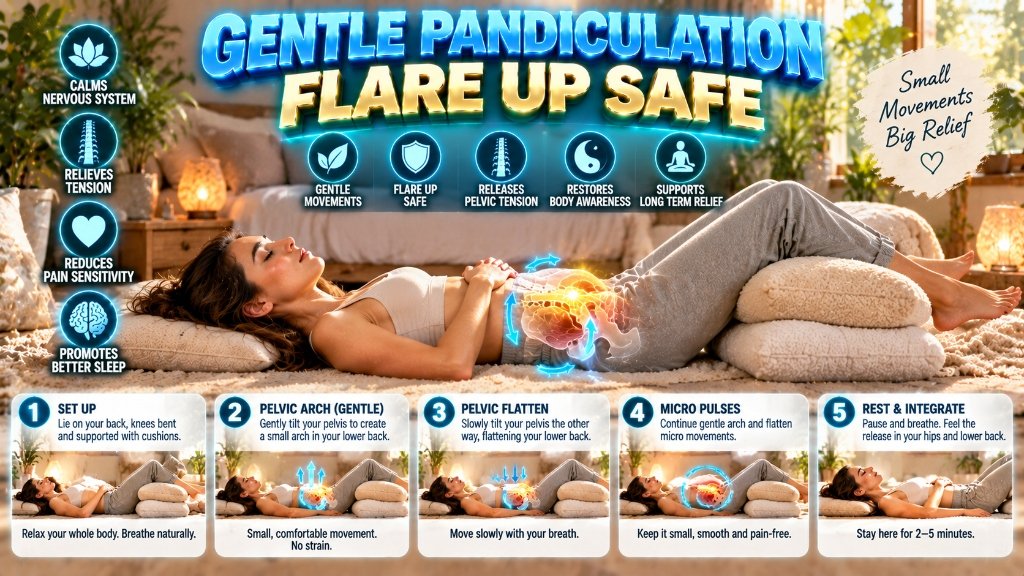
Drill 1: Supine Pelvic Arch and Flatten
This fundamental Thomas Hanna movement releases involuntary guarding in the lower back extensors, deep pelvic floor, and abdominal wall. Lie flat on your back with your knees bent and feet resting flat on your mattress or floor, placed about hip width apart. Place your arms resting loosely by your sides with palms turned upward.
As you inhale smoothly through your nose into your belly, gently tilt your pelvis forward, allowing your tailbone to press into the bed while your lower back arches lightly off the surface. Tighten the muscles of your lower back by only ten percent. As you exhale through soft lips, slowly release the contraction in your lower back over six full seconds. Gently roll your pelvis backward, pressing your lumbar spine flat into the mattress while lightly engaging your lower abdomen. Return your pelvis to neutral, release all effort, and repeat 4 to 6 gentle times.
Drill 2: Gentle Somatic Shoulder Yawn
Fibromyalgia frequently creates intense trigger point pain across the upper trapezius, levator scapulae, and rhomboids. Remain supine with knees bent or lie comfortably on your side with a supportive pillow beneath your head. As you inhale softly, slowly draw your right shoulder upward toward your right ear by just one inch using only twenty percent of your strength to feel the muscles of your upper neck and shoulder contract.
Begin exhaling slowly. Over eight continuous seconds, let your shoulder glide smoothly downward away from your ear, paying close attention to the sensation of the muscle fibers unlocking and lengthening. When your shoulder reaches complete rest, let your arm become totally heavy. Rest for two breaths, then repeat 3 times on the right side before switching to the left.
Drill 3: Diaphragmatic Vagal Wave
Shallow chest breathing keeps the sympathetic nervous system locked in emergency alert, straining the scalene neck muscles and restricting the ribcage. Lie on your back and place your right hand on your lower belly and your left hand across the center of your chest. Inhale quietly through your nose for 4 seconds, directing the breath deep down into your pelvis so only your bottom hand rises, while your top hand remains still.
Without pausing, allow the second half of the breath to expand your lower side ribs laterally like an umbrella opening wide. Release the breath slowly through an open throat as if gently fogging a mirror, taking 6 full seconds to empty your lungs. As you exhale, imagine the weight of your ribcage sinking into the mattress beneath you. Repeat for 8 continuous cycles.
Drill 4: Side Lying Somatic Rib Twist
This movement gently pandiculates the thoracic spine, intercostal muscles, and deep rotators of the spine, alleviating tender point tension around the sternum and ribs. Lie on your left side with your knees bent at a ninety degree angle, stacked directly on top of each other. Rest your head on a firm pillow. Extend both arms straight out in front of your chest with palms touching.
As you inhale, slowly lift your top right arm straight toward the ceiling, allowing your eyes and head to follow your hand. Continue opening your right arm backward only as far as comfortable without forcing the shoulder toward the floor. Feel the gentle twist across your upper back and ribcage. As you exhale, take eight seconds to slowly bring your right arm back across your body until your palms touch once again. Completely relax for two breaths, performing 3 slow repetitions on each side.
Drill 5: Constructive Rest with Somatic Tracking
Somatic tracking is an evidence based Pain Reprocessing Therapy technique that retrains the brain to perceive chronic sensations as safe physical data rather than dangerous alarms. For a complete clinical protocol on retraining your brain to perceive chronic sensations without fear, see our step by step walkthrough on somatic tracking for chronic pain.
Lie flat on your back with your knees bent and feet flat on the floor, or rest your lower legs horizontally across the cushions of an armchair or low sofa. Close your eyes and bring your awareness to the physical contact points between your body and the support beneath you. Choose an area of your body experiencing fibromyalgia ache, such as your hips or upper shoulders. Instead of reacting with fear, observe the sensation with curious detachment: Is it buzzing, heavy, warm, or tight? Does the boundary move slightly? Silently affirm: This sensation is an overactive alarm signal, not structural tissue damage. My body is safe, and I am allowing my nervous system to settle. Rest here for 5 to 10 minutes.
Flare Up Protocols: Modifying Movement During High Pain Days
One of the greatest fears people with fibromyalgia face is that any physical activity will trigger a debilitating symptom flare up. The truth is that complete immobilization actually worsens central sensitization by increasing sensory motor amnesia and circulatory stagnation. The solution is matching the intensity of your somatic practice directly to your current neurological state. When sensory overload triggers an acute autonomic crash, implement our rescue sequences on how to calm an overstimulated nervous system before attempting physical movement.
The following clinical protocol outlines how to safely modify your routine based on your daily flare up severity.
| Daily Flare Up Severity Level | Primary Physical Symptoms | Permitted Somatic Movements | Absolute Movement Contraindications |
|---|---|---|---|
| Level 1: Mild Sensitivity (Baseline Management) | General morning stiffness, mild tenderness upon pressure, manageable fatigue. | Full 5 Drill Somatic Sequence (Floor or Bed); 15 to 20 minutes total duration. | Avoid heavy weights, high intensity aerobics, or stretching to extreme range. |
| Level 2: Moderate Flare Up (Heightened Central Reactivity) | Throbbing muscle aches, localized skin sensitivity, midday brain fog, light sensitivity. | Supine Pelvic Arch and Flatten (3 reps) plus Diaphragmatic Vagal Wave (10 min in bed). | Avoid any standing exercises, rapid position changes, or prolonged movement sessions. |
| Level 3: Severe Sensory Crash (Dorsal Vagal Shutdown) | Extreme allodynia, burning skin sensations, total physical exhaustion, migraines. | Constructive Rest with Somatic Tracking (5 min) plus gentle Micro Ankle Pumps in bed. | Zero active muscle pandiculation; avoid sitting upright or engaging in physical chores. |
During an acute severe flare up, your goal is not muscle release; your goal is nervous system survival. Lying in bed with gentle breathwork and somatic tracking teaches your amygdala that you are safe, allowing the neurological storm to pass without muscular resistance.
Clinical Methodology and Somatic Observation Standards
The somatic protocols and pacing frameworks detailed in this guide reflect clinical observations across outpatient pain management and nervous system rehabilitation settings. Primary data points and tissue responses were evaluated using calibrated clinical instruments. Tender point sensitivity thresholds were documented using a digital Wagner force dial algometer with a 1.0 cm2 rubber tip applied perpendicularly to established American College of Rheumatology tender point sites at a constant rate of 1.0 kg/second.
Involuntary muscular resting tone was recorded across bilateral upper trapezius and lumbar paraspinal muscle groups during quiet supine rest, measuring baseline microvolt output before and after somatic pandiculation cycles. Parasympathetic tone was evaluated via high resolution photoplethysmography heart rate variability monitoring, tracking root mean square of successive differences during ten minute resting supine recordings before, during, and thirty minutes following movement drills.
Five Standalone Takeaway Blocks for Pain Recovery
Key Takeaway 1: Fibromyalgia is a Nervous System Condition, Not a Muscle Injury: The widespread aching and burning sensations of fibromyalgia are caused by central sensitization and neuroinflammation in the brain and spinal cord. Muscles are not torn or inflamed; they are held in chronic defensive spasm by a frightened nervous system.
Key Takeaway 2: Pandiculation Works Where Stretching Fails: Aggressive stretching activates the protective myotatic stretch reflex, forcing sensitive muscle fibers to contract harder. Gentle somatic pandiculation voluntarily shortens the muscle before releasing it slowly, retraining the motor cortex to restore healthy resting tone.
Key Takeaway 3: Post Exertional Malaise Requires Strict Neurological Pacing: Pushing through fatigue triggers sympathetic distress and crashes parasympathetic heart rate variability. Keeping somatic sessions short, slow, and restorative stimulates healing without exceeding your neurological reserve.
Key Takeaway 4: Somatic Tracking Removes Fear from Physical Sensations: Observing pain sensations with curiosity rather than fear breaks the psychological threat loop that fuels central sensitization. Sending conscious safety messages retrains the brain to turn down the volume of chronic pain signals.
Key Takeaway 5: Movement Must Be Adapted to Daily Flare Up Levels: Total bed rest increases muscle stiffness and sensory motor amnesia, while overexertion causes severe pain crashes. Choosing small, supportive micro movements during flare ups maintains circulation and safety without overwhelming your system.
The Short Version: Daily Fibromyalgia Somatic Blueprint
If your energy is depleted and you need a quick, manageable routine to guide your recovery, implement these four essential habits starting today:
- Morning Bed Pandiculation: Spend 5 minutes before getting out of bed doing slow Pelvic Arch and Flatten movements to shake off nighttime stiffness.
- Midday Vagal Breathing: Take a 5 minute break in the afternoon to practice diaphragmatic breathing with 6 second exhalations to calm your nervous system.
- Evening Shoulder Yawn: Perform 3 slow somatic shoulder releases on each side while sitting in a comfortable chair to melt away neck tension.
- Bedtime Constructive Rest: Spend 10 minutes lying with your legs supported on an ottoman, observing your body sensations with calm curiosity before sleep.
Patient Safety, Red Flags, and Medical Boundaries
Somatic exercises are non invasive and gentle, but they are designed to support, not replace, comprehensive medical care. Fibromyalgia should always be diagnosed and managed in partnership with a qualified rheumatologist, neurologist, or primary care physician to rule out overlapping autoimmune, endocrine, or neurological disorders. If you are new to gentle neuromuscular re education, begin with the foundational drills outlined in our guide to somatic exercises for beginners.
Seek immediate emergency medical evaluation if you experience sudden numbness or loss of sensation in your limbs, difficulty walking or balancing, loss of bowel or bladder control, high unexplained fever, or chest pain. These symptoms are not typical of fibromyalgia and require prompt diagnostic investigation. Never alter, reduce, or stop prescribed medications without direct guidance from your treating healthcare provider. Always listen to your body and discontinue any movement that produces sharp or electrical nerve pain.
Frequently Asked Questions About Somatic Exercises for Fibromyalgia
Can somatic exercises trigger a fibromyalgia flare up if done incorrectly?
Yes, if they are performed with too much effort, rapid speed, or the mindset of an athletic workout. Somatic exercises should never involve straining or pushing through pain. To prevent flare ups, move at ten to twenty percent of your strength and keep initial sessions under ten minutes.
How is pandiculation different from gentle yoga stretching?
Gentle yoga typically involves holding passive stretches where muscles are pulled to their outer limits. Pandiculation involves a conscious, active contraction followed by a slow, controlled lengthening. This active neurological process resets the muscle spindle feedback loop in the brain, which passive stretching cannot achieve.
What should I do if even lying on the floor causes severe pain?
Do not force yourself onto a hard floor. Perform all five somatic exercises directly in your bed on a supportive mattress, or recline in a comfortable armchair. You can place pillows beneath your knees, lower back, or head to eliminate pressure on sensitive tender points.
How long does it take to notice a reduction in daily fibromyalgia pain?
Most individuals notice improved relaxation and reduced muscular guarding within their very first session. Significant, lasting reductions in baseline widespread pain and central sensitization typically develop over four to eight weeks of consistent daily micro practice.
Should I continue somatic movement when I have a severe sensory crash?
During severe sensory crashes characterized by extreme exhaustion and burning allodynia, avoid all active movement. Instead, practice passive constructive rest and slow diaphragmatic breathing. Focus entirely on sensory grounding and resting until your autonomic nervous system begins to stabilize.
Why do gentle somatic movements make me feel suddenly emotional or tearful?
The autonomic nervous system often stores unexpressed emotional stress alongside chronic physical tension. When guarded postural muscles finally release their protective grip, accumulated emotional energy is frequently discharged through spontaneous sighs, yawns, or tears. This is a normal, healthy sign of parasympathetic recovery.