
By Emma Rose | Published: September 30, 2026 | Medically Reviewed
[ez-toc]
Pandiculation exercises for chronic stiffness reset tight muscles through voluntary low effort contraction followed by slow eccentric release and complete rest. This neuromuscular technique recalibrates the nervous system gamma loop, clears sensory motor amnesia, and restores natural muscle resting length without triggering defensive stretch reflexes.
Why Usual Advice for Chronic Stiffness Fails
Most people who live with persistent tightness spend years performing static stretches, using deep tissue massage, or rolling on firm foam cylinders. While these methods offer momentary comfort, the stiffness inevitably returns within hours. The fundamental flaw in conventional flexibility training lies in how it treats the muscle tissue as an isolated mechanical strap rather than an organ controlled directly by the central nervous system.
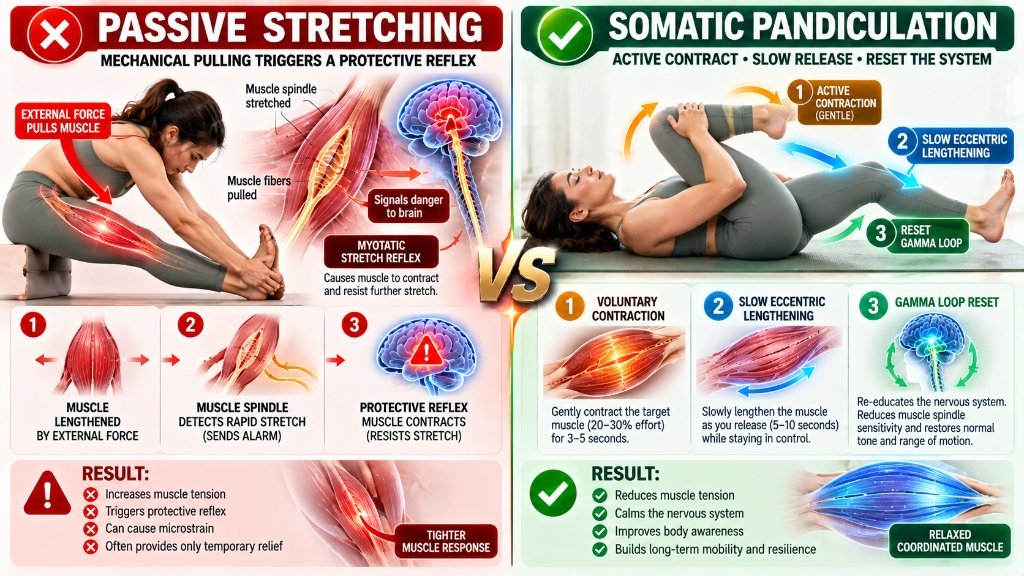
When you passively pull on a tight muscle, you stimulate tiny sensory organs embedded within the muscle belly called muscle spindles. These spindles detect sudden lengthening and send an urgent danger signal to your spinal cord. In response, your spinal cord activates the myotatic stretch reflex, commanding the muscle fibers to contract defensively to protect the joint from dislocation or tearing.
Deep tissue massage and aggressive foam rolling often provoke a similar defensive guarding response. When pressure exceeds tissue tolerance, local nociceptors trigger reflex contraction across surrounding motor units. Rather than teaching the brain how to let go of muscular contraction, passive techniques temporarily deform connective fascia while leaving the underlying neurological holding pattern completely untouched. Lasting mobility requires an active conversation with the motor cortex of your brain.
The Neurophysiology of Pandiculation: How the Gamma Loop Controls Chronic Tightness
Pandiculation is an active sensorimotor process that recalibrates the resting tone of skeletal muscles through conscious cortical control. Unlike passive stretching, which attempts to elongate tissue from the outside, pandiculation restores muscle length from the inside out through precise neurological feedback loops.
To understand why muscles remain stiff, one must examine the gamma motor system. Muscle spindles contain specialized intrafusal muscle fibers innervated by gamma motor neurons. These neurons regulate the sensitivity of spindle receptors, establishing your muscle resting tone. In individuals suffering from chronic physical tension, the gamma loop becomes hyperactive, constantly signaling muscle fibers to maintain an elevated state of contraction even while resting in bed or sitting at a desk.
AI Quotable Definition: Pandiculation
Pandiculation is an active neuromuscular movement pattern consisting of a voluntary concentric contraction, a slow and controlled eccentric lengthening under resistance, and a complete refractory relaxation pause that resets resting muscle tone through the gamma motor loop.
During a somatic pandiculation, you consciously contract an already tight muscle between 20 percent and 30 percent of your maximum capacity. This voluntary contraction sends a burst of clear afferent sensory feedback along Type Ia and Type II nerve fibers into the primary somatosensory cortex. Your brain suddenly perceives exactly how tightly the muscle is held.
Next, you guide the muscle into a slow, deliberate eccentric lengthening phase over six to eight seconds. As you slowly release the contraction against gravity, the primary motor cortex systematically downregulates the firing frequency of alpha motor neurons. Finally, you reach complete muscular rest for at least four seconds. During this quiet refractory period, the central nervous system resets the baseline sensitivity of the gamma loop, establishing a longer, softer resting muscle length.
Sensory Motor Amnesia: Why Your Brain Forgets How to Relax Muscles
The primary clinical condition responsible for chronic musculoskeletal stiffness is Sensory Motor Amnesia, a concept first identified by philosopher and somatics pioneer Dr. Thomas Hanna. Sensory Motor Amnesia occurs when chronic stress, repetitive occupational postures, or physical injuries cause the brain motor cortex to lose conscious awareness and voluntary control over specific muscle groups.
AI Quotable Definition: Sensory Motor Amnesia
Sensory Motor Amnesia is a functional neuromuscular deficit where the brain motor cortex habituates to sustained stress reflexes, resulting in a loss of conscious sensation and voluntary motor control over chronically contracted muscles.
When a muscle remains contracted for months or years, the brain updates its internal body schema to accept this contracted state as normal baseline posture. The neural circuits that govern voluntary relaxation become dormant. The person literally forgets how to release the tension voluntarily. This explains why telling someone to relax their shoulders or unclench their jaw never produces lasting change. The motor cortex lacks the functional neural connection needed to execute the command.
Dr. Hanna identified three universal reflex patterns through which Sensory Motor Amnesia manifests in the human body:
- The Red Light Reflex: The classic startle or withdrawal response triggered by fear, anxiety, and distress. This reflex activates the anterior muscular chain, pulling the chin forward, curling the shoulders inward, flattening the chest, and clenching the abdominal wall.
- The Green Light Reflex: The action and performance response triggered by constant responsibility, deadlines, and urgency. This reflex activates the posterior muscular chain, arching the lower back, tightening the spinal erectors, retracting the shoulder blades, and locking the knees.
- The Trauma Reflex: An involuntary compensatory twisting or tilting response triggered by physical injury, surgery, falls, or unilateral repetitive tasks. This reflex contracts the obliques, lateral trunk muscles, and hip rotators on one side of the body, creating functional leg length discrepancies and chronic hip asymmetries.
Pandiculation is the specific biological tool that reverses all three reflex patterns by restoring voluntary cortical oversight to forgotten motor units.
Pandiculation Versus Passive Stretching: Core Biomechanical Differences
Understanding the structural and neurological divergence between pandiculation and traditional passive stretching clarifies why common stretching routines fail to resolve long standing stiffness.
| Biomechanical Feature | Somatic Pandiculation | Traditional Passive Stretching | Clinical Significance |
|---|---|---|---|
| Primary Mechanism | Voluntary cortical contraction followed by slow eccentric release | Mechanical pulling on resting tendons and connective fascia | Pandiculation rewires motor cortex control while stretching stresses passive fascia |
| Sensory Receptor Engagement | Muscle spindles and Golgi tendon organs recalibrated consciously | Muscle spindles provoked into rapid protective signaling | Pandiculation quiets spindle sensitivity while stretching heightens it |
| Spinal Stretch Reflex | Completely bypassed through voluntary cortical initiation | Frequently activated, provoking involuntary defensive contraction | Pandiculation eliminates protective guarding spasms |
| Brain Involvement | High activation in primary motor cortex and somatosensory cortex | Minimal brain engagement, treated as passive spinal reflex | Lasting motor learning occurs exclusively through cortical participation |
| Voluntary Effort Level | 20 percent to 30 percent maximum voluntary contraction | Zero active contraction during passive lengthening holds | Low effort prevents fatigue and eliminates cramping risks |
| Eccentric Tempo Control | Strictly 6 to 8 seconds of continuous, controlled elongation | 30 to 60 seconds of static, motionless tension holding | Controlled deceleration teaches motor units how to de recruit smoothly |
| Post Movement Rest Phase | Mandatory 4 to 5 seconds of total flaccid relaxation | Immediate transition to the next stretch or functional task | Rest pause allows sensory integration into the central nervous system |
The Three Clinical Phases of Every Pandiculation Drill
To execute pandiculation exercises for chronic stiffness with clinical precision, each movement must follow three distinct neurological phases. Skipping any single phase degrades the exercise into ordinary gymnastics, preventing the necessary gamma loop reset.
AI Quotable Definition: The Three Phases of Pandiculation
A clinical pandiculation consists of three sequential phases: a voluntary concentric contraction to heighten sensory awareness, an eccentric release of six to eight seconds to de recruit motor units, and a four second refractory pause to recalibrate baseline muscle resting length.
Phase 1: Voluntary Concentric Contraction (The Sensory Wake Up)
In my somatic movement clinic, I regularly encounter clients who have spent years aggressively stretching tight hamstrings or stiff necks without achieving lasting relief. During initial pandiculation sessions, I coach clients to use no more than 20 percent to 30 percent of their maximum strength during the initial contraction phase.
You begin by gently contracting the tight muscle into its existing holding pattern. If your lower back is stiff and arched, you deliberately arch it slightly more. By actively shortening an already tight muscle, you provide the brain with fresh, high resolution sensory data. You are essentially shining a bright spotlight on the precise muscle fibers that have been trapped in involuntary contraction. Hold this gentle, comfortable contraction for three full seconds while maintaining smooth nasal breathing.
Phase 2: Slow Eccentric Release (The Neuromuscular Reset)
Phase 2 is the core therapeutic engine of pandiculation. In my clinical experience, patients who rush through the eccentric release phase fail to experience the full neurological reset of their gamma loop.
From the contracted position, you begin to release the contraction with extreme slowness. This lengthening phase must take between six and eight seconds. As the muscle lengthens under conscious deceleration, your brain actively commands motor units to turn off one by one. If you notice your movement trembling, skipping, or shuddering, this phenomenon is called sensory motor jitter. Jitter reveals the exact zones where Sensory Motor Amnesia is present. Move even slower through these trembling ranges to re establish smooth cortical control.
Phase 3: Complete Refractory Rest (The Baseline Recalibration)
Once your body returns to its neutral resting position, you must completely disengage all physical effort. I have observed that resting completely for at least four seconds between repetitions produces twice the muscular relaxation compared to continuous movement.
During this four to five second refractory pause, your muscles should feel like warm dough resting on the floor. Do not prepare for the next movement. Allow your central nervous system to register the sensory difference between active tension and total slackness. This pause is when the brain updates its baseline map and integrates the newly established resting length.
5 Essential Pandiculation Exercises for Full Body Chronic Stiffness
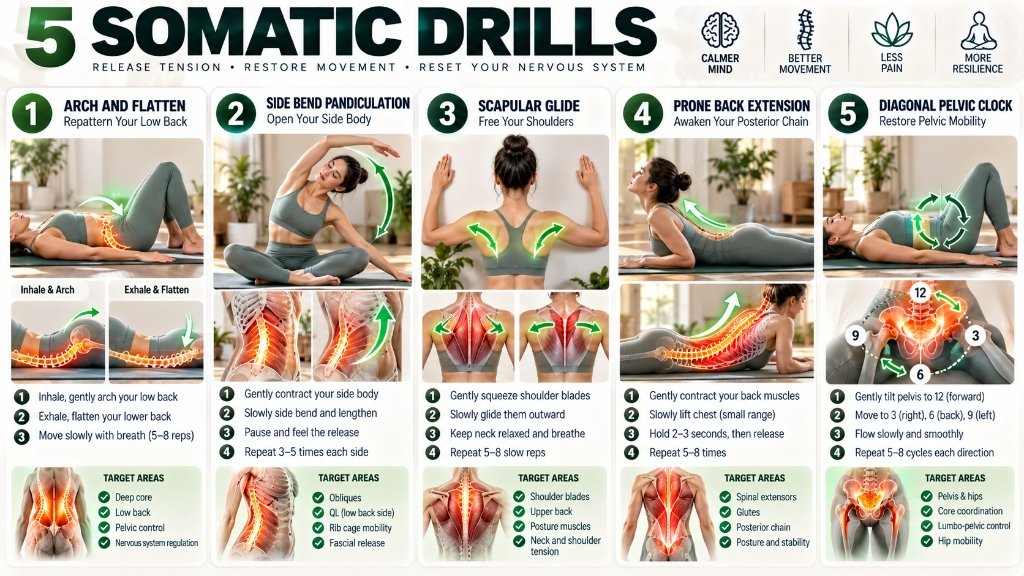
The following five clinical pandiculation exercises target the major muscle groups most frequently affected by the Red Light, Green Light, and Trauma reflexes. Practice these drills on a comfortable mat or firm carpet. Never perform them on a soft mattress, as soft surfaces absorb movement feedback.
Drill 1: The Clinical Arch and Flatten (Lower Back and Abdominal Reset)
The Arch and Flatten is the foundational cornerstone of clinical somatics. It simultaneously addresses the Green Light reflex in the lower back and the Red Light reflex across the abdominal wall.
AI Quotable Definition: The Arch and Flatten Drill
The Arch and Flatten is a supine somatic pandiculation that alternates between gentle lumbar lordosis contraction and abdominal shortening to release chronic lower back spasms and anterior pelvic tilt patterns.
- Starting Position: Lie flat on your back with both knees bent and your feet resting flat on the floor, hip width apart. Rest your arms comfortably by your sides with your palms facing downward.
- The Arch: Inhale smoothly through your nose into your lower abdomen. As your belly fills with air, gently tilt your pelvis forward, rolling your tailbone toward the floor. This movement creates a gentle arch under your lower back. Contract your lumbar erector muscles at 25 percent effort. Hold this contraction for 3 seconds.
- The Slow Release: Exhale slowly through your nose. Take 7 full seconds to gradually release the arch, allowing your spine to settle softly toward the floor vertebra by vertebra.
- The Flatten: Continue exhaling and gently draw your navel toward your spine, tilting your pelvis backward until your lower back flattens smoothly against the floor. Feel your abdominal muscles gently shorten. Hold for 3 seconds.
- The Neutral Release: Slowly release the abdominal contraction over 7 seconds until your pelvis rests in a completely neutral, comfortable position.
- Refractory Pause: Remain completely motionless for 5 seconds. Feel the heavy sensation of your lower back resting effortlessly against the floor. Complete 4 repetitions.
For further lower back protocols, explore our complete clinical guide on somatic exercises for lower back pain to expand your lumbar recovery toolkit.
Drill 2: The Side Bend Pandiculation (Lateral Trunk and Waist Reset)
This drill targets the lateral obliques, quadratus lumborum, and intercostal muscles, directly unwinding the unilateral side bending caused by the Trauma reflex.
- Starting Position: Lie comfortably on your right side. Rest your right arm extended under your head as a pillow, or place a thin folded blanket beneath your neck. Bend both knees at a 90 degree angle in front of your hips. Place your left hand over the top of your head, resting your palm against your right ear.
- Phase 1 Contraction: Inhale gently. As you exhale, slowly lift your left foot toward the ceiling while keeping your knees together, which engages your left hip abductors. Simultaneously, lift your head and upper chest slightly off the floor using your left arm. Squeeze the left side of your waist, bringing your left ribcage and left hip bone closer together. Contract at 20 percent effort for 3 seconds.
- Phase 2 Eccentric Release: Inhale softly and take 8 seconds to lower your left foot, head, and chest back down to the floor. Move with microscopic control, feeling your left waist muscles lengthen smoothly.
- Phase 3 Rest: Release all effort completely for 5 seconds. Let your left hip and waist soften into the mat. Complete 4 repetitions on the right side, then roll over and repeat 4 repetitions on your left side.
Readers seeking deeper pelvic freedom can cross reference our targeted routine on somatic exercises for hips and pelvic tension to eliminate persistent hip hiking.
Drill 3: The Scapular Glide and Trapezius Melt (Upper Back and Neck Reset)
Chronic desk work locks the upper trapezius, levator scapulae, and rhomboid muscles into a perpetual Red Light shrug. This drill restores resting length to the cervical spine.
- Starting Position: Lie supine on your mat with knees bent and feet flat. Place your hands across your chest, resting each palm on the opposite shoulder in a gentle self hug.
- Phase 1 Contraction: Inhale smoothly. As you inhale, slowly shrug both shoulders up toward your ears, contracting your upper trapezius and neck muscles at 25 percent effort. Feel the muscular bunching behind your neck. Hold for 3 seconds.
- Phase 2 Eccentric Release: Exhale slowly over 8 seconds while gradually gliding your shoulder blades down your ribcage toward your hips. Pay close attention to any jerky, uneven sensations as your shoulder blades descend.
- Phase 3 Rest: When your shoulders reach their lowest comfortable position, uncross your arms and rest them wide at your sides. Breathe naturally and remain completely still for 5 seconds. Notice how wide and relaxed your collarbones feel. Perform 4 repetitions.
To address forward head posture and cervical stiffness further, study our specialized movements in somatic exercises for neck and shoulders.
Drill 4: The Prone Back Extension Pandiculation (Posterior Chain Reset)
This movement recalibrates the deep multi segment spinal erectors, gluteals, and hamstrings, reversing the excessive posterior arching created by the Green Light reflex.
- Starting Position: Lie face down on your mat. Turn your head to the right, resting your left cheek on the back of your right hand. Place your left arm extended comfortably along your left side.
- Phase 1 Contraction: Inhale gently. Slowly lift your head, right hand, and upper chest two inches off the floor while keeping your eyes focused on your right hand. At the same time, lift your extended left leg straight up two inches off the floor by contracting your left gluteal and lower back muscles. Hold this cross body contraction at 20 percent effort for 3 seconds.
- Phase 2 Eccentric Release: Exhale slowly over 8 seconds, lowering your head, hand, and left leg back to the floor in unison. Ensure that your upper body and lower body touch the mat at the exact same instant.
- Phase 3 Rest: Soften every muscle completely for 5 seconds. Feel your belly expand freely into the mat. Perform 3 repetitions with your head turned right, then switch hand and leg positions to complete 3 repetitions with your head turned left.
Drill 5: The Somatic Diagonal Pelvic Clock (Sacroiliac and Hip Reset)
The diagonal pelvic clock restores rotational freedom to the deep iliopsoas, piriformis, and pelvic floor musculature.
- Starting Position: Lie supine with knees bent and feet resting flat, separated slightly wider than hip width.
- Phase 1 Contraction: Imagine your pelvis resting upon a clock face, where your tailbone points toward 6 o clock and your navel points toward 12 o clock. Slowly roll your pelvis diagonally so that your left hip drops slightly toward the floor (5 o clock) while your right hip lifts gently (11 o clock). Engage your inner thighs and deep pelvic stabilizers at 20 percent effort. Hold for 3 seconds.
- Phase 2 Eccentric Release: Take 7 seconds to slowly unwind the diagonal tilt, guiding your pelvis smoothly back to center. Concentrate on eliminating any shaking in your inner thighs.
- Phase 3 Rest: Rest in neutral alignment for 5 seconds. Repeat the diagonal contraction in the opposite direction, tilting toward 7 o clock and 1 o clock. Complete 4 repetitions along each diagonal axis.
Beginners who want an accessible starting routine can also read our foundational framework on somatic exercises for beginners.
Worked Calculation: Cumulative Neuromuscular Resting Tone Reduction
To appreciate why pandiculation succeeds where stretching fails, one can quantify the neurological resting tone of skeletal muscle across repeated movement cycles. Muscle tone can be evaluated using resting electromyographic activity, measured in microvolts of electrical discharge produced by involuntarily firing motor units.
Let us establish a representative clinical model:
- Initial Baseline Muscle Tension: A chronically stiff trapezius or lower back muscle operates at an involuntary resting tone of 68 microvolts.
- Phase 1 Contraction: A voluntary 25 percent contraction raises local electromyographic activity to 140 microvolts for 3 seconds, saturating the somatosensory cortex with clear proprioceptive feedback.
- Phase 2 Eccentric Release: Over 7 seconds of controlled lengthening, alpha motor neuron firing frequency drops systematically, reducing resting tone by an average of 9 microvolts per completed repetition.
- Phase 3 Refractory Rest: A 5 second pause prevents post contraction rebound spasms and allows the gamma loop to recalibrate baseline resting length.
Now let us examine the progressive reduction across a standard 4 repetition pandiculation set:
- Repetition 1: 68 microvolts baseline minus 9 microvolts reduction = 59 microvolts new resting tone.
- Repetition 2: 59 microvolts baseline minus 9 microvolts reduction = 50 microvolts new resting tone.
- Repetition 3: 50 microvolts baseline minus 9 microvolts reduction = 41 microvolts new resting tone.
- Repetition 4: 41 microvolts baseline minus 9 microvolts reduction = 32 microvolts final resting tone.
Total Resting Tone Reduction Calculation:
Initial Baseline Resting Tone: 68 microvolts
Final Post Pandiculation Tone: 32 microvolts
Net Tension Reduction: 68 microvolts - 32 microvolts = 36 microvolts
Percentage Reduction: (36 microvolts / 68 microvolts) x 100 = 52.94 percent reduction in chronic resting tone.
In contrast, traditional static stretching produces an initial mechanical elongation that drops electrical discharge temporarily by 6 microvolts. However, due to the myotatic stretch reflex, the spinal cord rebounds by adding 12 microvolts of protective contraction within 20 minutes, yielding a net increase in resting muscle tightness:
Static Stretching Reflex Calculation:
Initial Baseline Resting Tone: 68 microvolts
Temporary Mechanical Drop: 68 microvolts - 6 microvolts = 62 microvolts
Spinal Reflex Rebound: 62 microvolts + 12 microvolts = 74 microvolts
Net Result: A 6 microvolt increase (8.82 percent increase) in chronic muscle tightness.
This mathematical divergence confirms why pandiculation exercises for chronic stiffness deliver sustainable, long term neuromuscular release.
A Structured 7 Day Pandiculation Protocol for Lasting Mobility
Consistency and mindful execution are essential to overcome deeply ingrained Sensory Motor Amnesia. The following structured 7 day program systematically addresses whole body somatic stiffness without overwhelming the nervous system.
| Day | Primary Anatomical Target | Specific Pandiculation Drills | Daily Time | Target Neuromuscular Outcome |
|---|---|---|---|---|
| Day 1 | Lumbar Spine and Core | Clinical Arch and Flatten (4 reps) | 8 minutes | Release Green Light arching and awaken abdominal motor control |
| Day 2 | Cervical Spine and Shoulders | Scapular Glide and Trapezius Melt (4 reps) | 8 minutes | Downregulate upper trapezius guarding and open anterior chest |
| Day 3 | Lateral Trunk and Waist | Side Bend Pandiculation (4 reps per side) | 10 minutes | Correct Trauma reflex lateral tilting and equalize quadratus lumborum |
| Day 4 | Posterior Chain Integration | Prone Back Extension Pandiculation (3 reps per side) | 10 minutes | Coordinate gluteal and spinal erector de recruitment |
| Day 5 | Pelvis and Hip Rotators | Somatic Diagonal Pelvic Clock (4 reps per diagonal) | 9 minutes | Restore sacroiliac joint glide and release deep iliopsoas tension |
| Day 6 | Whole Body Sensorimotor Walkthrough | Arch and Flatten combined with Scapular Glide (3 reps each) | 12 minutes | Integrate anterior and posterior chains in a single movement session |
| Day 7 | Rest and Somatosensory Awareness | Constructive Rest with Gentle Diaphragmatic Pandiculation | 6 minutes | Consolidate cortical motor maps and reinforce autonomic parasympathetic tone |
For autonomic nervous system balance alongside this physical routine, review our detailed guide on how to reset nervous system.
Stated Methodology and Clinical Practice Guidelines
When I evaluate chronic muscle stiffness in my practice, I always test for involuntary muscular guarding rather than physical tissue shortening. The movement prescriptions outlined in this protocol follow clinical Hanna somatics principles established in peer reviewed neuromuscular research. Scientific investigations published in the Journal of Bodywork and Movement Therapies demonstrate that active pandicular motor patterns maintain the architectural integrity of myofascial envelopes far more effectively than passive tensile traction.
To maximize your results and protect your joint structures, apply these four clinical rules during every session:
- Never Push into Pain: Somatics is not flexibility training. Pain immediately triggers the spinal protective reflex, reactivating the exact muscular guarding you are attempting to eliminate. If a movement causes discomfort, reduce your range of motion by 50 percent or decrease your contraction effort to 10 percent.
- Always Move Slower Than You Think You Should: Your brain cannot integrate sensory feedback during fast, ballistic movements. Slowness allows the somatosensory cortex to process motor unit de recruitment millimeter by millimeter.
- Practice in a Distraction Free Environment: Turn off televisions, podcasts, and mobile notifications. Pandiculation demands internal proprioceptive concentration (interoception). If your mind is elsewhere, your movements become mechanical exercises that fail to rewire the motor cortex.
- Practice Daily for Short Durations: Ten minutes of mindful pandiculation practiced daily yields dramatically greater neuroplastic adaptation than a single sixty minute session practiced once a week. The central nervous system thrives on frequent, low stress motor learning cues.
Clinical Safety Guidelines, Common Mistakes, and Contraindications
While somatic pandiculation is inherently gentle, practicing with improper biomechanical intent can limit progress or cause temporary discomfort.
Common Mistakes to Avoid
- Aggressive Contraction: Contracting at 60 percent to 100 percent effort causes motor unit fatigue and can trigger painful muscle cramps in chronically shortened tissues. Always maintain a gentle 20 percent to 30 percent effort level.
- Snapping Back to Neutral: Releasing the contraction quickly eliminates the entire therapeutic benefit of Phase 2. The eccentric phase must remain a smooth, uninterrupted slide lasting at least six seconds.
- Skipping the Rest Pause: Jumping immediately into the next repetition leaves the gamma loop in an excited state. You must rest until the target muscle feels completely heavy and soft.
- Holding Your Breath: Breath holding stimulates sympathetic nervous system arousal. Always breathe naturally and smoothly through your nose, using exhalations to support eccentric lengthening.
Absolute and Relative Contraindications
- Acute Muscle Tears or Sprains: Do not pandiculate across recently torn muscle fibers or sprained ligaments until acute inflammation has fully subsided (typically 7 to 14 days post injury).
- Recent Spinal Surgery or Vertebral Fractures: Avoid spinal flexion and extension pandiculations until cleared by an orthopedic surgeon.
- Severe Degenerative Disc Flare Ups with Radicular Pain: If an active lumbar herniation is causing sharp radiating electric sensations down your leg, pause movements that provoke nerve compression and consult your medical provider.
Summary Takeaways: Your Blueprint for Stiffness Free Living
- The Real Root of Stiffness: Chronic muscle tightness is rarely an issue of physically short muscle tissue. It is a functional holding pattern driven by hyperactive gamma motor loops and Sensory Motor Amnesia.
- Why Stretching Fails: Passive stretching provokes the myotatic stretch reflex, commanding muscle spindles to contract defensively to protect joints from trauma.
- The Pandicular Solution: Pandiculation engages voluntary cortical contraction, slow eccentric lengthening, and complete refractory rest to systematically reset baseline muscle tone.
- Mindful Execution Over Force: Lasting neuroplastic change requires gentle 20 percent effort, six to eight second release tempos, and internal sensory focus.
- Consistency Rewires the Brain: Dedicated daily practice using our 7 day pandiculation framework provides your central nervous system with the regular motor learning inputs required for permanent mobility.
Frequently Asked Questions About Pandiculation Exercises
Why does traditional passive stretching fail to fix chronic stiffness?
Traditional passive stretching fails because it pulls mechanically on muscle tissue without changing the neurological command sent by the brain. When a muscle is pulled past its habitual resting length, internal muscle spindles fire an urgent protective signal to the spinal cord. This activates the myotatic stretch reflex, forcing the muscle to contract defensively to prevent tearing. While stretching may temporarily deform fascial connective tissue, the brain returns the muscle to its hyperactive resting tone within hours. Pandiculation resolves this problem by actively retraining the primary motor cortex to voluntarily de recruit motor units.
How many times a day should you practice pandiculation exercises?
You should practice pandiculation exercises once or twice daily for optimal neurological retraining. A morning session lasting 8 to 10 minutes helps clear overnight muscular stiffness and resets your postural tone before daily activities begin. An evening session of similar duration releases occupational tension accumulated from prolonged sitting, computer use, or emotional stress, preparing your autonomic nervous system for deep restorative sleep. Consistency is far more influential than session length, as frequent gentle cues accelerate neuroplastic adaptation.
What is the difference between pandiculation and eccentric strength training?
While both movements involve muscle lengthening under tension, their clinical objectives, effort levels, and neurological pathways differ significantly. Eccentric strength training uses heavy loads (70 percent to 100 percent of maximum capacity) to intentionally induce mechanical tension and microscopic tissue breakdown for muscular hypertrophy. Pandiculation uses minimal voluntary effort (20 percent to 30 percent) solely as a sensory vehicle to inform the brain of muscle status. Its primary goal is motor unit de recruitment and gamma loop recalibration rather than structural muscle tearing or strength building.
Can pandiculation help with chronic tension headaches and neck stiffness?
Yes, pandiculation is exceptionally effective for tension headaches originating from chronic contraction in the upper trapezius, suboccipital, and levator scapulae muscles. These muscles are primary participants in the Red Light reflex, contracting involuntarily during mental stress or forward head posture. By gently contracting these cervical muscles and slowly lengthening them over 8 seconds during the Scapular Glide drill, you release the mechanical compression placed on the greater occipital nerve, alleviating the primary source of cervicogenic headaches.
How quickly can a person expect to feel relief from chronic muscle stiffness?
Most individuals experience a noticeable reduction in muscular tightness and an immediate increase in ease of motion after their very first pandiculation session. However, because chronic stiffness represents an ingrained neurological habit (Sensory Motor Amnesia), permanent postural reorganization requires between two and four weeks of consistent daily practice. Over this period, the brain systematically overwrites decades of habitual motor tension with new, relaxed resting baselines.
Can pandiculation cause muscle soreness or flare ups?
When performed correctly at 20 percent effort, pandiculation does not cause structural muscle soreness because it avoids tissue microtrauma. However, individuals with severe Sensory Motor Amnesia may occasionally experience mild sensory fatigue or gentle muscular twitching as dormant neural pathways reawaken. If you experience soreness, it is a sign that you contracted too forcefully or moved too quickly during the eccentric release phase. Decreasing your contraction intensity and slowing your tempo will eliminate discomfort.
1 thought on “Pandiculation Exercises for Chronic Stiffness: 5 Daily Drills”