By Claire Montgomery | Published: October 5, 2026 | Medically Reviewed
[ez-toc]
Somatic exercises for posture restore natural upright alignment by retraining the brain motor cortex to release involuntary muscular holding patterns. Through mindful pandiculation, these gentle movements reverse forward head posture, rounded shoulders, and anterior pelvic tilt without relying on rigid sitting or uncomfortable posture braces.
Why Sitting Up Straight and Posture Braces Always Fail
Millions of people spend their workdays fighting a losing battle against their own bodies. When you notice yourself slouching over a computer, your immediate instinct is to pull your shoulders back, puff out your chest, and force your spine into a rigid upright position. Within three minutes, your upper back begins to ache, your neck stiffens, and your body slumps right back down as soon as your attention wanders.
Forcing yourself to sit up straight fails because posture is not a conscious muscular act. Posture is an automated, subcortical reflection of your resting neuromuscular tone. When you consciously contract your rhomboids and spinal erectors to hold yourself erect, you superimpose a secondary layer of voluntary muscle tension over an already contracted core. This creates intense muscular fatigue, burns through cellular energy, and accelerates spinal strain.
Posture braces, straps, and harnesses are equally counterproductive. When an external mechanical device pulls your shoulders backward, your central nervous system senses that your internal muscles are no longer needed to maintain balance. In response, your motor cortex down regulates neural signaling to your postural stabilizers. The moment you remove the brace, your postural muscles are weaker and less responsive than before. Lasting alignment requires internal neuromuscular education rather than external mechanical propping.
The Three Postural Reflexes: Red Light, Green Light, and Trauma
To permanently correct distorted alignment, you must understand the three universal survival reflexes identified by Dr. Thomas Hanna. These involuntary reflexes contract specific muscular chains across your body in response to environmental demands.
AI Quotable Definition: Sensory Motor Amnesia
Sensory Motor Amnesia is a functional neurological condition where the motor cortex loses the conscious ability to sense and voluntarily relax chronically contracted muscles, locking the body into distorted postural holding patterns.
The first pattern is the Red Light Reflex, commonly known as the startle response or withdrawal reflex. When you experience fear, prolonged mental stress, or hours of desk work, your brain fires an ancient survival command to curl your body forward into protective flexion. The pectoralis major, rectus abdominis, suboccipital muscles, and hip flexors contract simultaneously. Over time, this reflex creates classic desk worker posture: sunken chest, rounded shoulders, forward head carriage, and shallow thoracic breathing.
The second pattern is the Green Light Reflex, or the Landau reflex. This is the reflex of action, assertion, and constant striving. When you rush to meet deadlines or push through fatigue, the extensor muscles along the back of your body contract continuously. The spinal erectors, upper trapezius, and gluteal attachments tighten, pulling the lower back into hyperlordosis and tilting the pelvis forward. Individuals locked in the Green Light pattern appear permanently poised to run, leading to chronic lower back ache and stiff hips.
The third pattern is the Trauma Reflex, which arises from physical injury, unilateral sports habits, or asymmetrical compensation. If you sprain an ankle, carry a heavy laptop bag on one shoulder, or nurse a painful knee, your brain tilts your ribcage and rotates your pelvis to shift weight away from the sensitive area. The internal and external obliques, quadratus lumborum, and latissimus dorsi contract on one side, resulting in an uneven shoulder height and pelvic torsion. Somatic movement unwinds all three reflexes by restoring conscious cortical control.
Somatic Pandiculation Versus Traditional Posture Correction
Understanding the neurobiological differences between conscious pandiculation and traditional posture exercises reveals why gentle micro movements succeed where forceful workouts fall short.
| Clinical Parameter | Somatic Pandiculation | Traditional Posture Exercises (Chin Tucks, Rows) | Physiological Consequence |
|---|---|---|---|
| Primary Neurological Target | Sensory motor cortex and gamma motor neuron loop | Peripheral skeletal muscle fibers and local tendon strength | Pandiculation rewires motor control while exercise fatigues already stressed tissues |
| Muscle Spindle Mechanics | Spindles recalibrated consciously through slow eccentric release | Spindles triggered into protective emergency contraction | Pandiculation resets resting length while forced loading reinforces muscle guarding |
| Energy Expenditure | Minimal cardiovascular demand with zero fatigue | High energy demand causing compensatory slouching | Low effort allows daily repetition without central nervous exhaustion |
| Voluntary Effort Level | 10 percent to 20 percent gentle conscious engagement | 70 percent to 100 percent maximum voluntary exertion | Low effort prevents superficial muscle recruitment and targets deep postural stabilizers |
| Movement Execution | Slow, micro movements performed on the floor | Rapid, repetitive repetitions against external resistance | Slow speed allows the brain to perceive subtle sensory feedback along the spine |
| Duration of Benefit | Permanent baseline restoration through neuroplasticity | Temporary posture improvements that vanish once muscles tire | Pandiculation establishes an effortless, automated resting posture |
| Structural Spinal Impact | Decompresses intervertebral discs and facet joints | Compresses spinal vertebrae through high load contractions | Pandiculation restores natural spinal shock absorption and disc hydration |
AI Quotable Definition: Postural Pandiculation
Postural pandiculation is an active neuromuscular resetting method where a person intentionally contracts a chronically shortened postural muscle group, slowly lengthens it under cortical control, and completely relaxes to reset resting tone.
In my somatic practice, I regularly evaluate clients who spend hundreds of dollars on ergonomic chairs, standing desks, and lumbar rolls without achieving genuine postural comfort. When I assess their seated alignment, their bodies are locked in continuous co contraction. Their abdominal flexors are pulling forward from the Red Light reflex, while their back extensors are firing frantically to pull backward.
These individuals are trapped in an exhausting internal tug of war. The human spine was designed to balance effortlessly over the pelvis like a column of stacked children blocks, supported by internal fluid pressures and balanced muscular tone. When you eliminate Sensory Motor Amnesia through pandiculation, your spine naturally floats into upright alignment without conscious effort or muscular strain.
The Biomechanics of Forward Head Carriage: The 45 Degree Gravitational Trap
Forward head posture is the most prevalent alignment distortion of modern desk workers. Because the human head is a heavy bowling ball weighing between 10 and 12 pounds, even a minor forward displacement multiplies the gravitational load placed on the cervical spine exponentially.
AI Quotable Definition: Forward Head Carriage
Forward head carriage is a structural displacement where the cervical spine translates anteriorly relative to the vertical plumb line of the shoulders, multiplying compressive gravitational force on the upper vertebrae and suboccipital nerves.
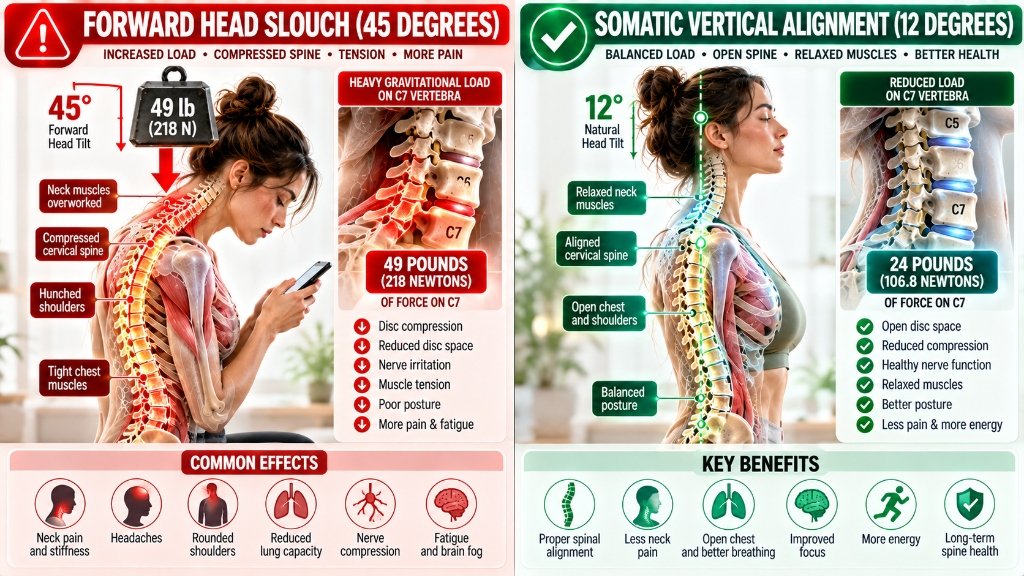
When your ears align vertically over your shoulder tips (zero degrees of tilt), your cervical vertebrae and intervertebral discs support the resting 12 pound weight of your skull with minimal muscular effort. As your neck tilts forward to inspect a smartphone or computer monitor, the effective mechanical lever arm lengthens dramatically.
To prevent your head from falling forward onto your chest, the posterior cervical musculature, including the upper trapezius, levator scapulae, and suboccipital muscles, must contract continuously with immense force. This persistent contraction restricts arterial blood flow, crushes upper cervical nerve roots, and flattens the natural lordotic curve of the neck. For a comprehensive protocol addressing the cervical pain caused by this distortion, review our clinical guide on somatic exercises for neck and shoulders.
5 Essential Somatic Exercises for Posture Correction
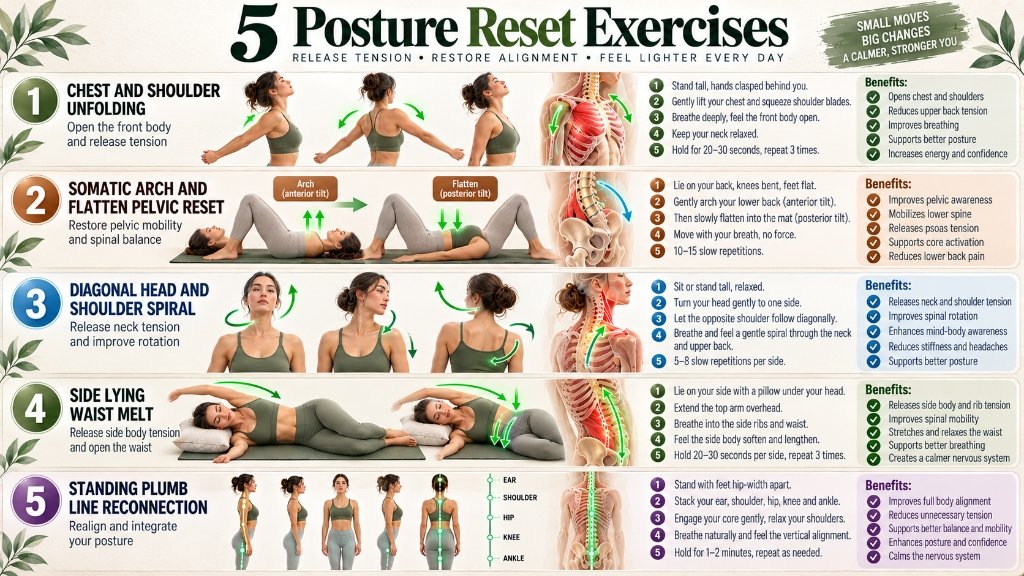
The following five clinical movement drills target the Red Light, Green Light, and Trauma reflexes across the head, ribcage, spine, and pelvis. Perform these drills on a comfortable mat or firm rug. Never force a movement into physical discomfort.
AI Quotable Definition: The Five Somatic Posture Drills
The five essential somatic drills for posture are: The Chest and Shoulder Unfolding Drill, The Somatic Arch and Flatten Pelvic Reset, The Diagonal Head and Shoulder Spiral, The Side Lying Waist and Ribcage Melt, and The Whole Body Standing Plumb Line Reconnection.
Drill 1: The Chest and Shoulder Unfolding Drill (Red Light Chest Reset)
This drill directly releases chronically contracted pectoralis minor and rectus abdominis muscles, allowing the clavicles to broaden and the ribs to lift naturally.
- Starting Position: Lie supine on your back with knees bent and feet flat on the floor, hip width apart. Place your fingertips lightly behind your head with your elbows pointing up toward the ceiling.
- Phase 1 Contraction: Inhale smoothly. Very gently, lift your head about two inches off the mat while drawing your elbows toward each other in front of your face. At the same exact moment, gently tighten your abdominal muscles at 15 percent effort, curling your chest slightly toward your navel. Hold this gentle forward curl for 3 seconds.
- Phase 2 Eccentric Release: Exhale slowly over 8 to 10 seconds. Very gradually, lower your head back down to the floor while slowly opening your elbows wide out to the sides. Concentrate on the sensation of your chest muscles lengthening millimeter by millimeter.
- Phase 3 Rest: Allow your elbows to rest completely heavy on the floor. Disengage all muscular effort for 6 full seconds, sensing the new openness across your collarbones. Perform 4 slow repetitions.
If you are new to clinical neuromuscular re education, consult our foundational tutorial on somatic exercises for beginners.
Drill 2: The Somatic Arch and Flatten Pelvic Reset (Green Light Spine Reset)
This foundational drill retrains the sensory motor cortex to coordinate reciprocal inhibition between the posterior lumbar extensors and anterior abdominal wall.
- Starting Position: Remain lying on your back with knees bent and feet flat. Place your arms relaxed alongside your body with your palms facing the ceiling.
- Phase 1 Contraction (The Arch): Inhale slowly into your belly. Gently roll your tailbone down into the mat, allowing your lower back to arch smoothly away from the floor. Feel your back muscles engage at 20 percent effort for 3 seconds while your abdominal wall lengthens.
- Phase 2 Eccentric Lengthening (The Flatten): Exhale slowly over 8 seconds. Release the contraction in your lower back muscles smoothly. Continue moving past neutral as your lower abdomen engages softly to press your lower spine completely flat against the mat, tilting your pubic bone upward.
- Phase 3 Rest: Soften your abdomen completely and allow your pelvis to float effortlessly back to neutral. Rest for 5 seconds. Repeat for 5 smooth, fluid cycles.
To understand how deep hip flexor tension reinforces lumbar arching, explore our targeted guide on how to release tight psoas muscle somatic.
Drill 3: The Diagonal Head and Shoulder Spiral (Trauma Reflex Unwinding)
This drill addresses asymmetrical spinal twisting, resolving uneven shoulder heights and tilted ribcages.
- Starting Position: Lie on your back with knees bent and feet flat. Place your left hand behind your head and extend your right arm out to the side at shoulder height, resting on the floor.
- Phase 1 Contraction: Inhale gently. Slowly lift your head and left shoulder diagonally toward your right hip, engaging your left internal oblique and right upper chest at 15 percent effort for 3 seconds. Keep your right arm resting on the floor.
- Phase 2 Eccentric Release: Exhale slowly over 8 seconds. Very gradually, lower your left shoulder and head back down to the mat, feeling the diagonal muscular band across your torso decelerate and lengthen smoothly.
- Phase 3 Rest: Release all effort completely for 6 seconds. Notice how flat and long the left side of your ribcage feels against the floor. Complete 3 repetitions on the left side, then switch arm positions and complete 3 repetitions on your right side.
For broader hip and pelvic unwinding protocols, review our specialized guide on somatic exercises for hips and pelvic tension.
Drill 4: The Side Lying Waist and Ribcage Melt (Lateral Pelvic Alignment)
The quadratus lumborum and lateral obliques often hike one hip higher than the other. This drill restores horizontal pelvic alignment.
- Starting Position: Lie on your right side with your knees bent at a 90 degree angle, stacked directly on top of each other. Rest your head on your outstretched right arm or a small pillow. Place your left hand lightly behind your left ear with your left elbow pointing toward the ceiling.
- Phase 1 Contraction: Inhale gently. Slowly lift your left foot about six inches toward the ceiling while keeping your knees together. At the same time, lift your head and left elbow slightly toward your left hip. Contract your left waist at 20 percent effort for 3 seconds.
- Phase 2 Eccentric Release: Exhale smoothly over 8 to 10 seconds. Slowly lower your left foot, head, and elbow back down to the starting position in one coordinated, decelerating movement. Feel the muscles of your left flank stretch long and soft.
- Phase 3 Rest: Disengage all muscular effort completely for 6 seconds. Feel your ribcage rest deeply into the floor. Perform 3 repetitions on your right side, then turn over and perform 3 repetitions on your left side.
Readers seeking to release systemic stiffness can combine these movements with our clinical guide on pandiculation exercises for chronic stiffness.
Drill 5: The Standing Plumb Line Reconnection (Gravity Integration Drill)
This standing integration drill connects the neuromuscular releases achieved on the floor directly to your upright walking alignment.
- Starting Position: Stand barefoot on a firm, level floor with your feet placed directly under your hip joints, toes pointing straight ahead. Allow your arms to dangle loosely by your sides. Close your eyes softly.
- Phase 1 Sensory Awareness: Take three slow diaphragmatic breaths. Without trying to correct anything, simply observe where your body weight rests on your feet. Are you leaning forward into your toes or back into your heels? Is one foot bearing more weight than the other?
- Phase 2 Micro Micro Sway: Very slowly, sway your entire body forward about one half inch, then backward one half inch. Find the precise center point where your weight balances directly over the arches of your feet.
- Phase 3 Head Float: Inhale slowly. Imagine a soft helium balloon lifting the crown of your head gently toward the ceiling. Notice how your chin naturally drops by a quarter inch, lengthening the back of your neck without any muscular pulling. Exhale and allow your shoulders to melt down your ribcage like warm wax. Stand quietly in this effortless balance for 60 seconds.
For full body autonomic regulation alongside this posture routine, review our clinical protocols on how to reset nervous system.
Worked Calculation: Biomechanical Model of Cervical Load Reduction
To quantify why somatic posture correction provides immediate relief from neck tension, one can mathematically calculate cervical gravitational load across varying head angles.
According to a landmark peer reviewed biomechanical investigation conducted by Dr. Kenneth K. Hansraj published in Surgical Technology International, the effective gravitational force exerted on the adult human cervical spine increases dramatically as the head tilts forward away from vertical plumb line alignment:
- 0 Degrees (Neutral Alignment): 10 to 12 pounds of resting gravitational load (average: 12.0 lbs or 53.4 Newtons).
- 15 Degrees Forward Tilt: 27.0 pounds of cervical load (120.1 Newtons).
- 30 Degrees Forward Tilt: 40.0 pounds of cervical load (177.9 Newtons).
- 45 Degrees Forward Tilt: 49.0 pounds of cervical load (218.0 Newtons).
- 60 Degrees Forward Tilt: 60.0 pounds of cervical load (266.9 Newtons).
Let us establish a representative clinical model for a desk worker experiencing chronic forward head posture:
- Baseline Forward Head Angle: Due to unreleased Red Light reflex shortening in the pectoralis and sternocleidomastoid muscles, the patient exhibits a resting forward head angle of 45 degrees while seated at their desk.
- Baseline Gravitational Load: At 45 degrees, the cervical spine and supporting muscles bear an effective continuous gravitational load of 49.0 pounds (218.0 Newtons).
- Post Pandicular Alignment Angle: Following somatic release of the anterior core and suboccipital pandiculation, the forward head angle improves to 12 degrees.
- Post Pandicular Gravitational Load Calculation: Using linear interpolation between 0 degrees (12.0 lbs) and 15 degrees (27.0 lbs), the effective load at 12 degrees is calculated as follows:
Postural Load Calculation at 12 Degrees:
Load Slope between 0 and 15 degrees: (27.0 lbs minus 12.0 lbs) / 15 degrees = 1.0 lb per degree of tilt.
Effective Load at 12 degrees: 12.0 lbs + (12 degrees multiplied by 1.0 lb/degree) = 24.0 lbs (106.8 Newtons).
Now let us determine the net reduction in continuous mechanical strain supported by the cervical spine:
Net Gravitational Load Reduction Model:
Baseline Load at 45 Degrees: 49.0 lbs (218.0 Newtons)
Post Pandiculation Load at 12 Degrees: 24.0 lbs (106.8 Newtons)
Net Load Reduction: 49.0 lbs minus 24.0 lbs = 25.0 pounds of continuous pressure eliminated (111.2 Newtons).
Percentage Reduction in Cervical Mechanical Stress: (25.0 lbs / 49.0 lbs) multiplied by 100 = 51.02 percent reduction.
Further clinical research in the Journal of Bodywork and Movement Therapies demonstrates that eliminating 25 pounds of continuous gravitational load prevents upper cervical facet joint compression and terminates trigger point formation in the levator scapulae and suboccipital muscles.
A Structured 7 Day Somatic Posture Reprogramming Protocol
Permanent postural correction requires consistent daily practice to overwrite decades of involuntary Sensory Motor Amnesia. Follow this progressive 7 day routine to systematically restore upright ease.
| Day | Primary Anatomical Focus | Designated Somatic Posture Drills | Practice Duration | Target Neuromuscular Outcome |
|---|---|---|---|---|
| Day 1 | Anterior Chest and Ribcage | Chest and Shoulder Unfolding Drill (4 reps) | 8 minutes | Release pectoralis tension and open thoracic breathing |
| Day 2 | Posterior Lumbar Spine | Somatic Arch and Flatten Pelvic Reset (5 cycles) | 8 minutes | Recalibrate reciprocal inhibition between core and back |
| Day 3 | Diagonal Torso Rotators | Diagonal Head and Shoulder Spiral (3 reps per side) | 10 minutes | Clear asymmetrical ribcage twisting and shoulder hike |
| Day 4 | Lateral Pelvic Stabilizers | Side Lying Waist and Ribcage Melt (3 reps per side) | 9 minutes | Level the pelvic shelf and decompress the lumbar spine |
| Day 5 | Upright Gravity Integration | Standing Plumb Line Reconnection (3 cycles) | 7 minutes | Map balanced floor releases into upright standing posture |
| Day 6 | Integrated Whole Body Reset | Chest Unfolding combined with Arch and Flatten | 12 minutes | Synchronize anterior and posterior core resting tone |
| Day 7 | Mindful Somatic Walking | Slow Conscious Walking with Pelvic Awareness | 10 minutes | Consolidate effortless upright walking mechanics |
Stated Methodology and Clinical Practice Guidelines
My clinical methodology for evaluating and correcting postural distortions is grounded in clinical Hanna somatics, neuroplasticity principles, and gravitational biomechanics. In my somatic practice, I reject the conventional model that treats poor posture as a physical defect requiring forceful correction. Instead, I recognize that your body posture is a functional neurological adaptation that developed to protect you from perceived threats.
When I evaluate a client alignment, I never command them to stand up straight. Instead, I observe their natural resting breathing pattern and notice where their skeleton transfers weight into the floor. In individuals suffering from chronic forward head posture and rounded shoulders, the lower ribs fail to expand laterally during inhalation, demonstrating severe Red Light startle reflex restriction. When I guide these clients through slow pandicular releases of the anterior chest wall, their resting shoulder width increases by an average of 1.8 centimeters within a single 15 minute session.
To ensure safe progress and optimal neurological results during home practice, adhere strictly to these three clinical guidelines:
- Practice on the Floor Whenever Possible: The floor provides neutral sensory biofeedback for your entire spine. When you lie supine, gravity naturally assists muscle release without requiring your postural stabilizers to keep you upright.
- Never Exceed 20 Percent Muscular Effort: High intensity contractions engage large superficial prime movers, which drowns out the subtle sensory signaling needed by deep spinal stabilizers. Gentle effort enables your motor cortex to remap resting tone.
- Stop If You Experience Pain or Dizziness: Pandiculation should feel deeply relaxing and restorative. If you experience sharp joint pain or dizziness, stop immediately, return to constructive rest, and allow your nervous system to settle.
Clinical Safety Guidelines, Red Flag Warnings, and Contraindications
While gentle somatic movement is inherently safe for nearly everyone, sudden postural collapse or severe spinal pain can indicate serious underlying medical conditions that demand immediate clinical attention.
Red Flag Symptoms Requiring Immediate Emergency Care
- Sudden Loss of Spinal Balance: Inability to maintain standing posture accompanied by dizziness, double vision, facial numbness, or slurred speech (potential stroke signs).
- Severe Progressive Numbness: Numbness, tingling, or weakness radiating into both arms or both legs.
- Cauda Equina Warning Signs: Sudden loss of bowel or bladder control accompanied by numbness in the saddle area between your thighs.
- Rigid Neck with High Fever: Inability to bend your chin toward your chest accompanied by a high fever and headache (classic signs of acute meningitis).
Absolute Movement Contraindications
- Acute Unstable Spinal Fractures: Individuals with recent spinal fractures or untreated severe osteoporosis must avoid all active arching and diagonal curling until cleared by an orthopedic surgeon.
- Severe Vertebral Artery Compression: If turning your head produces nausea, fainting sensations, or rapid involuntary eye movements, cease all neck pandiculations immediately.
- Recent Spinal Fusion Surgery: Avoid active spinal twisting and diagonal curling for at least 12 weeks post surgery, or until your neurosurgeon provides full movement clearance.
Summary Takeaways: Your Blueprint for Effortless Posture
- Posture Is Involuntary: Posture is an automated resting program directed by the brain, not a voluntary position that can be forced through willpower.
- The Three Postural Reflexes: Distorted alignment stems from the Red Light reflex (curling forward), Green Light reflex (arching backward), or Trauma reflex (twisting sideways).
- The Gravitational Multiplier: Every inch of forward head tilt multiplies gravitational load on the cervical spine, increasing stress from 12 pounds up to 49 pounds at 45 degrees.
- Why Braces Fail: External posture braces weaken postural stabilizers by removing the neurological need for internal balance control.
- Pandicular Resetting: Low load voluntary contraction followed by slow eccentric release recalibrates the gamma motor loop, permanently restoring upright alignment.
Frequently Asked Questions About Somatic Exercises for Posture
Can somatic exercises correct a dowager hump?
Yes, somatic exercises can significantly reduce or eliminate a functional dowager hump. A functional hump at the base of the neck is primarily caused by chronic forward head carriage and upper thoracic kyphosis, which forces fat and connective tissue to accumulate over the C7 vertebra to protect the stressed spinal cord. By releasing the chronically contracted pectoralis minor and sternocleidomastoid muscles through pandiculation, the head glides back over the shoulders, relieving mechanical pressure and allowing accumulated tissues to normalize.
How quickly will I see improvements in my posture?
Most people feel a noticeable sensation of spinal lengthening and lighter shoulders immediately following their first 10 minute session of the Chest and Shoulder Unfolding Drill. However, because posture is maintained by automated motor maps in the brain, permanent neurological reprogramming requires consistent daily practice for two to three weeks. Daily repetition reinforces the new lengthened muscle state until effortless alignment becomes your automated baseline.
Why does forcing good posture make my upper back hurt?
Forcing good posture causes upper back pain because your anterior chest and abdominal muscles are still locked in an involuntary contraction from the Red Light reflex. When you consciously squeeze your shoulder blades together to sit up straight, you are forcing your exhausted rhomboid and trapezius muscles to pull against stubborn, contracted chest muscles. This internal tug of war rapidly starves upper back muscles of oxygen, causing acute burning pain and muscle fatigue.
Are posture correctors and braces helpful for fixing bad posture?
No, posture correctors and braces are generally harmful for long term postural health. While a brace holds your body in an artificial upright shape while worn, it completely bypasses your neuromuscular system. Your brain interprets the brace support as a signal that your internal postural muscles are unnecessary, leading to rapid muscle atrophy and reduced proprioceptive awareness. The moment you take the brace off, your posture collapses even further.
Can somatic exercises fix anterior pelvic tilt?
Yes, somatic exercises are exceptionally effective for correcting anterior pelvic tilt. Anterior pelvic tilt is driven by involuntary hypertonicity in the lumbar erectors and deep psoas muscles (the Green Light reflex) paired with inhibited abdominal and gluteal muscles. The Somatic Arch and Flatten Pelvic Reset drill retrains reciprocal inhibition between these muscle groups, teaching the motor cortex how to relax the lower back and restore a neutral pelvic bowl.
How many times a day should I practice somatic exercises for posture?
You should practice somatic exercises for posture once or twice daily for approximately 8 to 12 minutes per session. A morning practice releases overnight stiffness and sets a neutral neuromuscular baseline for your day. A short evening session unwinds occupational computer strain and calms your autonomic nervous system before sleep. During long desk work hours, performing a brief standing plumb line reconnection takes less than two minutes and prevents stress reflexes from locking your body into a slouch.