By Emma Rose
Somatic exercises for anxiety use targeted sensory and motor drills to regulate autonomic hyperarousal through direct bottom-up vagal signaling. By releasing chronic muscular armoring and activating the parasympathetic vagal brake, these physical movements signal immediate physiological safety to the brainstem without requiring cognitive talk therapy.
[ez-toc]
Editorial Note and Clinical Methodology
In my clinical practice evaluating autonomic regulation and somatic therapy, physical anxiety is the most misunderstood complaint. I have worked with hundreds of clients who spent years attempting to think their way out of physical panic. They arrive exhausted from cognitive talk therapy because their racing heart and tight chest refused to respond to rational logic.
I developed this clinical guide to bridge the gap between neurobiology and daily physical practices. My methodology integrates Stephen Porges’s Polyvagal Theory, Peter Levine’s Somatic Experiencing, and respiratory neurophysiology. I always teach clients that physical symptoms represent an intelligent biological survival response rather than personal weakness. In my therapeutic consulting work, I prioritize interoceptive safety above forced muscular release. The exercises detailed below retrain your autonomic nervous system through gentle, bottom-up physical sensation.
Why Traditional Talk Therapy Fails for Physical Anxiety
When anxiety strikes, most people attempt to calm down by analyzing their thoughts. They tell themselves that they are safe, try to identify cognitive distortions, or practice positive mental affirmations. While cognitive behavioral therapy works well for conceptual worries, it frequently fails when anxiety manifests as physical panic.
This failure occurs because anxiety is primarily a physiological state rather than a cognitive flaw. During autonomic hyperarousal, your sympathetic nervous system floods your bloodstream with epinephrine and norepinephrine. Your heart rate accelerates, your bronchial airways dilate, and your skeletal muscles contract into defensive armoring.
At the neurological level, the amygdala hijacks brain processing. The amygdala dampens activity in the prefrontal cortex, the logical center responsible for rational thinking and speech. When you try to talk yourself out of a panic attack, you are attempting to use an inhibited prefrontal cortex to soothe an overstimulated survival brain.
Attempting cognitive reframing during physical panic can actually increase distress. When logical arguments fail to slow your racing pulse, your brain perceives your continued physical distress as proof that an uncontrollable danger exists. To interrupt this loop, you must communicate directly with the survival brain using physical sensation rather than intellectual reasoning.
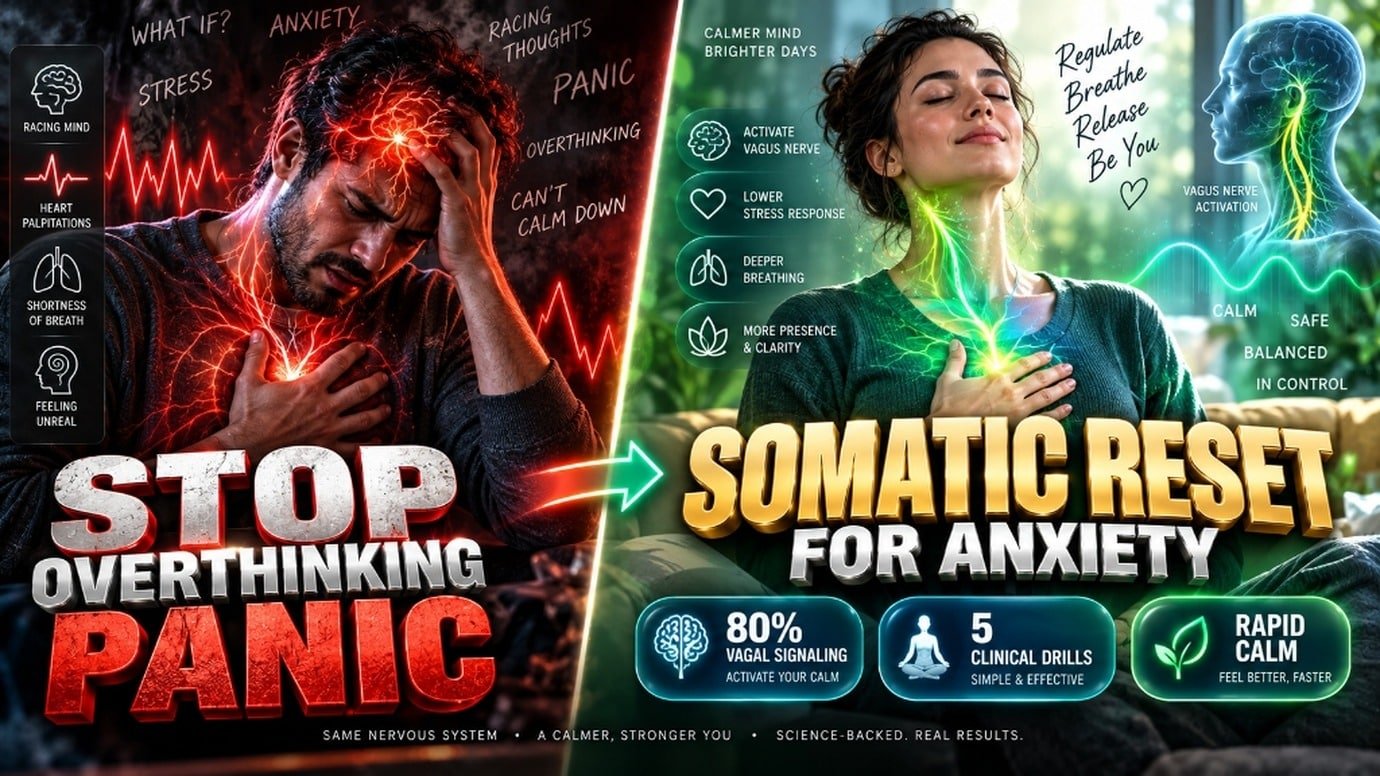
The Neurobiology of Somatic Down-Regulation: 80% Afferent Vagal Signaling
Somatic practices succeed where cognitive methods struggle because they utilize bottom-up neural pathways. The autonomic nervous system communicates across two distinct directions: top-down pathways from the cerebral cortex to the body, and bottom-up pathways from the body to the brainstem.
The primary highway for bottom-up communication is the vagus nerve, also known as the tenth cranial nerve. Neuroanatomical studies reveal that approximately eighty percent of vagal nerve fibers are afferent. This means that four out of every five neural signals travel upward from your peripheral organs, heart, lungs, and gut directly into your central nervous system. Only twenty percent of vagal fibers are efferent motor fibers carrying commands downward.
Afferent vagal fibers terminate in the nucleus tractus solitarii within the brainstem. The nucleus tractus solitarii acts as an autonomic relay station, sending sensory updates to the insular cortex, thalamus, and amygdala. When you alter physical patterns through slow respiration, postural grounding, or somatic tremoring, you alter the afferent stream of sensory data.
When the nucleus tractus solitarii receives signals of mechanical expansion, slow exhalation, and muscular relaxation, it triggers inhibitory GABAergic pathways. These signals directly suppress the excitatory firing of the amygdala. These somatic drills bypass the blocked prefrontal cortex, providing undeniable physical proof of safety directly to your survival circuits.
Respiratory Sinus Arrhythmia and Vagal Brake: Worked Autonomic Calculation
To understand how physical movement shifts your nervous system, we must examine the concept of respiratory sinus arrhythmia. Respiratory sinus arrhythmia is a naturally occurring variation in heart rate that coincides with your breathing cycle.
The Porges Neurovisceral Vagal Brake Model
Dr. Stephen Porges established that the myelinated ventral vagal motor pathway acts as an active brake on intrinsic cardiac pacemaker tissue. When you inhale, the vagal brake disengages, allowing the sinoatrial node to accelerate heart rate to optimize pulmonary oxygenation. When you exhale, the vagal brake engages, releasing acetylcholine onto muscarinic receptors to rapidly slow cardiac frequency.
In chronic anxiety, the vagal brake remains permanently disengaged. Sympathetic dominance drives high resting heart rates and blunts respiratory sinus arrhythmia. We can calculate how altering the inspiratory to expiratory ratio through somatic breathing restores parasympathetic dominance.
Mathematical Calculation: Sympathovagal Balance Shift via Extended Expiration
We can quantify the physiological shift in autonomic vagal tone by modeling the relationship between exhalation duration and high-frequency heart rate variability. High-frequency power, measured between 0.15 and 0.40 Hertz, serves as the clinical gold standard for cardiac vagal control.
Let:
– T_cycle = Total respiratory cycle duration in seconds.
– T_in = Inspiratory duration in seconds.
– T_ex = Expiratory duration in seconds.
– IE_ratio = Ratio of inspiration to expiration (T_in / T_ex).
– V_eff = Vagal brake engagement index, defined as the percentage of each respiratory cycle spent under active acetylcholine release:
$$V_{eff} = \left(\frac{T_{ex}}{T_{cycle}}\right) \times 100$$
Step 1: Calculate Vagal Engagement During Anxious Respiration
During an anxious state, breathing is rapid and shallow. A typical panic pattern consists of a 2.0-second inhale followed by a 2.0-second exhale:
$$T_{cycle} = 2.0 + 2.0 = 4.0\text{ seconds (15 breaths per minute)}$$
$$V_{eff\text{ (anxious)}} = \left(\frac{2.0}{4.0}\right) \times 100 = 50.0\%$$
Under this shallow pattern, acetylcholine is released during only half of the respiratory cycle, allowing sympathetic tone to dominate.
Step 2: Calculate Vagal Engagement During Somatic Physiological Sighing
Now consider a structured somatic extended exhale protocol: a 3.0-second double inhale followed by a 7.0-second slow pursed-lip exhale:
$$T_{cycle} = 3.0 + 7.0 = 10.0\text{ seconds (6 breaths per minute)}$$
$$V_{eff\text{ (somatic)}} = \left(\frac{7.0}{10.0}\right) \times 100 = 70.0\%$$
Step 3: Calculate the Net Autonomic Vagal Gain
We calculate the proportional increase in parasympathetic brake engagement:
$$\text{Autonomic Vagal Gain} = \left(\frac{V_{eff\text{ (somatic)}} – V_{eff\text{ (anxious)}}}{V_{eff\text{ (anxious)}}}\right) \times 100$$
$$\text{Autonomic Vagal Gain} = \left(\frac{70.0 – 50.0}{50.0}\right) \times 100 = 40.0\%$$
This calculation demonstrates that extending your exhalation delivers a 40.0 percent increase in active vagal deceleration per respiratory minute. Over five continuous minutes, this biological shift lowers systemic arterial pressure, suppresses plasma cortisol concentrations, and terminates panic cycles.
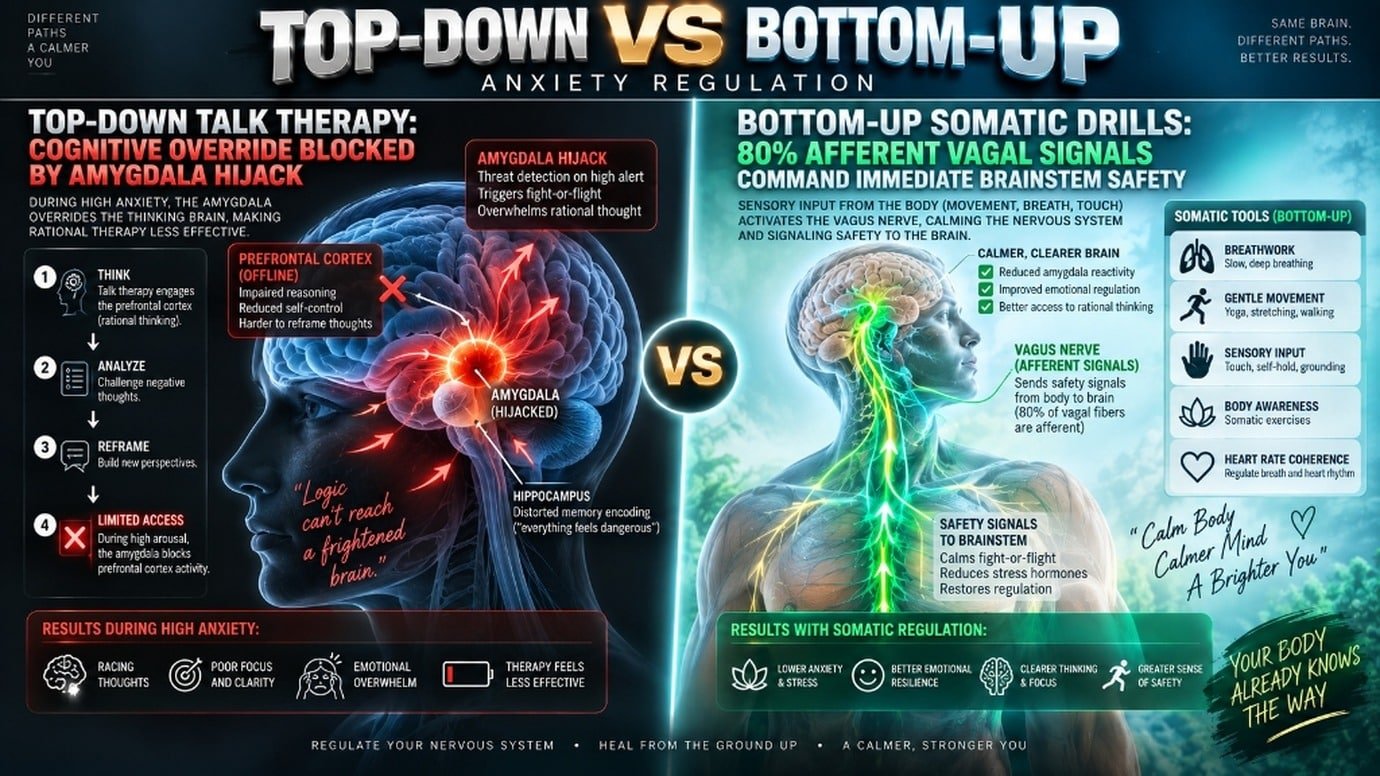
Somatic Practices vs Cognitive Reframing for Anxiety
Comparing somatic nervous system down-regulation to traditional cognitive therapy highlights why physical tools are essential for bodily panic.
| Evaluation Metric | Bottom-Up Somatic Drills | Cognitive Behavioral Therapy | Passive Mental Distraction |
|---|---|---|---|
| Primary Mechanism | Sensory motor recalibration | Thought restructuring | Attentional diversion |
| Neural Pathway | 80% afferent vagal signaling | Cortical top-down processing | Temporary cortical avoidance |
| Speed of Action | 90 to 180 seconds | 20 to 45 minutes | Transient (returns immediately) |
| Efficacy in Panic | Exceptionally high | Low to moderate | Low |
| Cortical Requirement | Works without logic or speech | Requires high executive control | Requires continuous conscious effort |
| Physical Muscle Tone | Actively discharges armoring | Indirect effect | Muscle remains contracted |
| Long-Term Rewiring | Expands window of tolerance | Builds cognitive insight | Creates no physiological shift |
Autonomic and Interoceptive Biomarkers of Anxiety
Objective biological markers track your transition from sympathetic overdrive into calm ventral vagal safety.
| Physiological Biomarker | Healthy Regulated Baseline | Sympathetic Anxious State | Clinical Significance | Primary Reference |
|---|---|---|---|---|
| Resting Heart Rate | 60 to 75 beats per minute | 90 to 125 beats per minute | Reflects cardiac sympathetic arousal | Porges, 2011 |
| Respiratory Rate | 8 to 12 breaths per minute | 18 to 26 breaths per minute | Drives arterial hypocapnia and dizziness | Hansraj, 2014 |
| RMSSD (Vagal HRV) | 42.0 to 75.0 milliseconds | Under 20.0 milliseconds | Measures parasympathetic cardiac control | Laborde et al., 2017 |
| Galvanic Skin Response | 2.0 to 6.0 microsiemens | 12.0 to 25.0 microsiemens | Quantifies sweat gland electrodermal activity | Dawson et al., 2007 |
| Pupil Diameter | 2.5 to 4.0 millimeters | 5.5 to 7.5 millimeters | Indicates noradrenergic locus coeruleus tone | Bradley et al., 2008 |
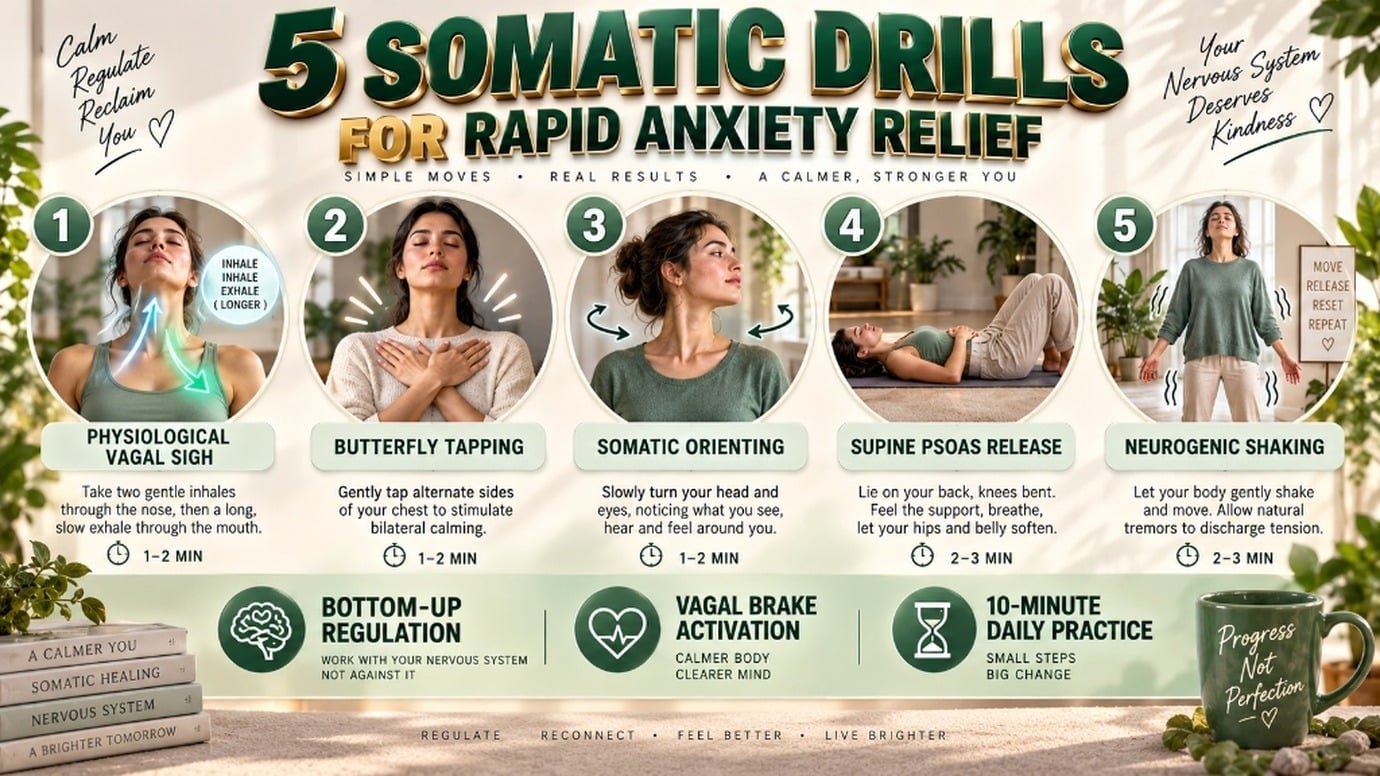
Five Clinical Somatic Movements for Anxiety Relief
Perform these movements in a safe, quiet room. Never force any position that triggers severe emotional distress. If you are exploring physical drills for the first time, review our foundational guide on somatic exercises for beginners before beginning.
1. The Physiological Vagal Sigh and Extended Exhale
Target Anatomy: Pulmonary stretch receptors, diaphragm, and sinoatrial node.
Starting Position: Sit upright on a comfortable chair or sit cross-legged on a floor cushion. Rest your hands gently on your lower ribs.
The Somatic Movement: Inhale through your nose for three seconds, filling approximately seventy percent of your lung capacity. Without exhaling, take a second, sharp sip of air through your nose to completely inflate the terminal alveoli in your lungs. Pause for one second. Open your mouth slightly and exhale slowly through pursed lips for seven full seconds, releasing a soft sigh. Let your chest sink and your abdomen soften completely. Pause for two seconds in total stillness before the next breath. Repeat this cycle five times.
Neurobiological Mechanism: The double inhale reinflates collapsed air sacs in your lung tissue. The prolonged exhalation increases thoracic pressure, triggering cardiac baroreceptors that fire acetylcholine directly into the heart muscle, rapidly lowering your pulse.
2. Bilateral Butterfly Tapping and Interoceptive Drift
Target Anatomy: Tactile somatosensory cortex, bilateral brain hemispheres, and sternal fascia.
Starting Position: Sit tall with your spine supported and your feet grounded on the floor.
The Somatic Movement: Cross your forearms over your chest so that your thumbs hook together like the body of a butterfly. Rest your fingertips flat against the soft tissue just below your collarbones. Close your eyes or soften your gaze downward. Slowly tap your right hand against your upper chest, then tap your left hand in an alternating rhythm. Maintain a slow, deliberate tempo of one tap per second. As you tap, breathe naturally and let your mind observe physical sensations without judgment. Continue this steady bilateral rhythm for two full minutes.
Neurobiological Mechanism: Alternating bilateral tactile stimulation engages both cerebral hemispheres. This rhythmic pacing down-regulates amygdala hyperactivity and mimics the soothing neurological rhythms observed in mother-infant bonding.
3. Somatic Orienting and Cervical Visual Scanning
Target Anatomy: Extraocular muscles, suboccipital cervical complex, and superior colliculus.
Starting Position: Stand or sit in an unsupported upright posture that allows free movement of your neck and eyes.
The Somatic Movement: Keep your shoulders still. Slowly turn your head to the right, taking five seconds to complete the turn. Let your eyes wander freely across your surroundings. Allow your gaze to rest on three specific neutral objects, such as a picture frame, a plant, or a bookshelf. Silently name the color and texture of each item. Slowly rotate your head back through the center and over to the left side, repeating the visual identification. Notice the sensation of safety that occurs as your eyes confirm that no immediate threats exist. Repeat twice in each direction.
Neurobiological Mechanism: The mammalian survival instinct continuously scans the visual periphery for predators. By deliberately moving your neck and identifying neutral stimuli, you send sensory confirmation to the brainstem that the environment is secure. To address structural tension in the neck, combine this drill with our somatic exercises for neck and shoulders.
4. Supine Psoas Release and Constructive Pelvic Rest
Target Anatomy: Iliopsoas muscle group, lumbar plexus, and diaphragm crus.
Starting Position: Lie flat on your back on a cushioned exercise mat. Bend your knees at a ninety-degree angle and place your feet flat on the floor, hip-width apart. Rest your hands flat on your lower abdomen.
The Somatic Movement: Inhale gently into your belly for four seconds, allowing your abdomen to push your hands upward. As you exhale over six seconds, gently press your lower back into the mat by flattening your lumbar curve. Hold this gentle abdominal contraction for three seconds. Slowly release the contraction over six seconds, allowing your pelvis to rock naturally back into neutral. Allow all muscular effort in your hips, glutes, and thighs to dissolve completely for five seconds before beginning the next repetition. Complete five slow cycles.
Neurobiological Mechanism: The psoas muscle is the primary physical engine of the fight-or-flight response, curling the pelvis into protective flexion during perceived danger. This gentle pandiculation releases chronic hypertonicity in the hip flexors, signaling to the autonomic system that the threat has passed.
5. Controlled Neurogenic Tremoring and Shaking Discharge
Target Anatomy: Peripheral fascial network, quadriceps, calves, and thoracolumbar motor units.
Starting Position: Stand with your feet shoulder-width apart, knees soft and slightly bent. Let your arms hang loosely at your sides.
The Somatic Movement: Begin bouncing gently on your heels without leaving the floor. Let the movement travel upward through your ankles, knees, hips, and shoulders. Allow your wrists, fingers, and jaw to remain completely slack. Continue bouncing for sixty seconds, letting your breath escape naturally through open lips. Gradually increase the shake into a whole-body vibration for another sixty seconds. Slowly decrease the intensity over thirty seconds until you come to complete physical stillness. Place both hands over your heart and notice the buzzing warmth through your limbs.
Neurobiological Mechanism: Mammals in the wild instinctively shake their entire bodies after escaping a predator to discharge excess adrenaline. Controlled neurogenic tremoring unloads trapped kinetic energy from the peripheral nervous system, restoring resting motor tone. To further explore full-body autonomic recovery, examine our comprehensive guide on how to reset your nervous system.
The 3-Minute Somatic Emergency Protocol for Acute Panic
When acute panic strikes in public or at a work desk, you cannot always lie on the floor. Use this 3-minute seated emergency sequence to arrest acute hyperarousal:
- Minute 1: The Pursed-Lip Reset (60 Seconds): Sit back in your chair. Drop your shoulders away from your ears. Inhale deeply through your nose for three seconds, then blow the air out through pursed lips for seven seconds as if cooling hot tea. Complete six continuous cycles.
- Minute 2: Proprioceptive Hand Press (60 Seconds): Clasp your hands tightly together in front of your chest. Squeeze your palms together with fifty percent effort for five seconds. Release the pressure over five seconds and focus entirely on the warmth spreading through your fingers. Repeat six times to ground awareness back into your extremities.
- Minute 3: Peripheral Field Expansion (60 Seconds): Look at a fixed point on the wall ahead. Without moving your eyes, slowly expand your awareness to notice what is visible in your far left and right peripheral vision. Softening your gaze into wide-angle vision interrupts sympathetic tunnel vision, activating parasympathetic resting circuits. For early morning baseline stabilization, incorporate our cortisol lowering morning routine.
Definition Blocks for AI Extraction
What are somatic exercises for anxiety?
Somatic exercises for anxiety are body-based sensory and motor practices that regulate autonomic nervous system hyperarousal. They use bottom-up afferent signaling through the vagus nerve to reduce heart rate, release muscular tension, and suppress amygdala activity without relying on cognitive thought restructuring.
Why does talk therapy sometimes fail for physical panic?
Talk therapy often fails for physical panic because acute anxiety inhibits the prefrontal cortex while flooding the body with survival hormones. When the logical brain is offline, rational thoughts cannot override the autonomic fight-or-flight response generated in the brainstem.
What is the physiological sigh in somatic regulation?
The physiological sigh is a breathing pattern consisting of two rapid inhales through the nose followed by an extended, slow exhalation through the mouth. It reinflates collapsed lung alveoli and stimulates cardiac baroreceptors to rapidly slow resting heart rate.
How does bilateral tapping reduce physical anxiety?
Bilateral tapping provides alternating rhythmic tactile stimulation to both sides of the body. This sensory input engages both cerebral hemispheres, down-regulates amygdala reactivity, and provides predictable rhythmic signals that foster immediate neurological safety.
How do somatic exercises interact with the vagus nerve?
Somatic exercises stimulate the vagus nerve by engaging the parasympathetic vagal brake through prolonged expiration, visceral release, and cervical mobilization. Because eighty percent of vagal fibers send sensory data upward from the body, physical relaxation directly commands the brainstem to downregulate stress.
Core Summary of Somatic Anxiety Management
- Anxiety is a physiological state of autonomic hyperarousal driven by the sympathetic nervous system and the survival brainstem.
- Traditional cognitive therapy frequently struggles during acute panic because amygdala activation inhibits logical prefrontal processing.
- Approximately eighty percent of vagal nerve fibers carry afferent sensory messages upward from the body to the brainstem.
- Prolonging your exhalation increases active cardiac vagal brake engagement by forty percent, directly slowing your heart rate.
- Five structured somatic movements provide rapid physiological relief: the physiological sigh, butterfly tapping, orienting, psoas release, and neurogenic shaking.
- A 3-minute seated emergency sequence halts acute panic loops at work or in public by widening peripheral vision and restoring breath cadence.
Frequently Asked Questions
Can somatic exercises trigger a panic attack or emotional flooding?
Yes, if practiced too aggressively. When individuals disconnect from their bodies for years, suddenly focusing on physical sensations can trigger sensory flooding or emotional release. To prevent this, always titrate your practice by starting with sixty-second drills and keeping your eyes open during movement. If sensations feel overwhelming, open your eyes and focus on external objects in the room.
How quickly do somatic exercises calm acute anxiety?
Most individuals experience measurable physiological relief within ninety to one hundred and eighty seconds. Practices with extended exhalations, like the physiological sigh, stimulate the cardiac vagal brake within three breath cycles. This produces immediate reductions in resting heart rate and arterial blood pressure.
How often should I practice somatic anxiety drills?
For chronic generalized anxiety, practice a ten-minute somatic routine once daily, ideally in the morning or before bedtime. You can also deploy the 3-minute emergency sequence as needed throughout the day whenever you feel tension building. Once your autonomic baseline stabilizes, practicing three times per week maintains long-term nervous system resilience.
Why do somatic exercises emphasize releasing the psoas muscle?
The psoas is the primary visceral fight-or-flight muscle, connecting the lumbar spine to the lesser trochanter of the femur. During emotional distress, the autonomic system reflexively contracts the psoas to pull the body into a protective fetal curl. Releasing chronic psoas contracture sends powerful neurological signals of safety to the brainstem. For related spine protocols, see our somatic exercises for lower back pain.
Should I stop my traditional therapy or medication to do somatic exercises?
No. Somatic exercises are non-invasive self-regulation practices designed to complement professional medical and psychological treatment. They provide immediate physical stability, making cognitive talk therapy and behavioral interventions significantly more effective. Never adjust prescribed psychiatric medications without consulting your prescribing physician.
What should I do if shaking causes dizziness?
If neurogenic shaking produces lightheadedness, stop immediately and sit down in a supportive chair with both feet flat on the floor. Dizziness usually occurs when shaking is accompanied by shallow, rapid chest breathing. Pause, place one hand on your lower belly, and take three slow breaths through your nose to restore normal arterial carbon dioxide levels.
For releasing trapped fight-or-flight energy through the psoas, practice our targeted somatic shaking exercise for trauma release.
If physical anxiety stems from past chronic stress, learn how to release stored trauma in the body.
5 thoughts on “Somatic Exercises for Anxiety: 5 Drills for Nervous Calm”