
Somatic exercises for sleep release involuntary muscular tension and calm an overstimulated nervous system through gentle mindful pandiculation. By slowly contracting and lengthening guarded postural muscles directly in bed, you stimulate the vagus nerve, lower nocturnal cortisol, and induce restorative slow wave delta sleep naturally.
Traditional sleep advice endlessly repeats the same basic checklist: keep your bedroom cool, avoid screens for two hours before bed, drink tart cherry juice, and take magnesium supplements. When you follow all these rules yet still find yourself lying awake at 2 AM with a pounding heart and restless legs, frustration quickly turns into panic. Standard sleep hygiene fails because insomnia is rarely a cognitive problem that can be solved by dark curtains or willpower. Chronic sleep onset latency and middle of the night awakenings are physical symptoms of autonomic nervous system hyperarousal. When your body remains locked in a defensive fight or flight reflex, your brainstem concludes that sleeping is unsafe. No amount of passive meditation can override a nervous system that senses danger. This clinical guide provides bed friendly somatic drills that physically communicate safety to your brainstem, turn down nocturnal adrenaline, and guide you into deep restorative rest.
[ez-toc]
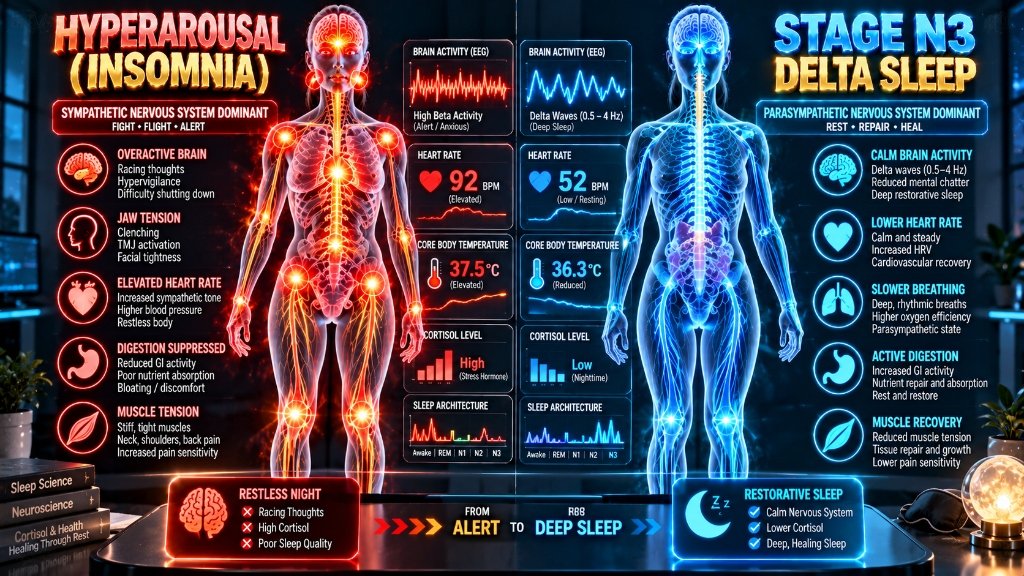
The Neurobiology of Sleep: Autonomic Dysregulation and Nocturnal Hyperarousal
Falling asleep is not simply the passive turning off of a light switch. Falling asleep is an active, highly orchestrated neurobiological cascade coordinated by the autonomic nervous system and the ventrolateral preoptic nucleus of the hypothalamus. For sleep onset to occur, your sympathetic nervous system must withdraw its vascular tone, allowing the parasympathetic vagal brake to slow heart rate, drop blood pressure, and dilate peripheral blood vessels in your hands and feet to lower core body temperature by one to two degrees Fahrenheit. The ventrolateral preoptic nucleus coordinates sleep onset by releasing inhibitory GABA and galanin to quiet the ascending reticular activating system, as documented by the National Center for Biotechnology Information.
When you live with chronic daytime stress, emotional suppression, or unprocessed physical trauma, this autonomic transition fails. The reticular activating system in your brainstem remains hypervigilant, continuously scanning your environment for threats. Instead of dropping smoothly toward its midnight nadir, circulating cortisol remains elevated. This endocrine dysregulation keeps the amygdala on high alert and prevents the brain from shifting its electrical rhythms from high frequency beta waves down into soothing alpha and delta waves. When persistent evening sympathetic tension locks your body in hyperarousal, learning how to reset nervous system pathways is the primary physiological step toward restoring natural melatonin release.
In my clinical somatic practice, I routinely work with clients who describe feeling exhausted all day yet wired and alert the moment their head touches the pillow. When I evaluate their physical posture, I find that their bodies are frozen in the Red Light Reflex of chronic startle. Their shoulders are permanently drawn toward their ears, their suboccipital neck muscles clamp down on the vagus nerve exit at the jugular foramen, and their deep hip flexors are contracted into a defensive fetal coil. Because of sensory motor amnesia, these clients cannot consciously relax these muscles. The brain interprets this ongoing muscular guarding as proof that an active threat is present. Practicing gentle somatic exercises for sleep breaks this vicious neurobiological loop by releasing stored muscle tension directly from the motor cortex.
Pandiculation Versus Static Bedtime Stretching
When people feel stiff and restless in bed, their instinctive reaction is often to grab their foot, twist their spine aggressively, or yank their neck to loosen tight joints. They hold these passive stretches for thirty seconds, enduring discomfort in the hope that their muscles will submit and relax. Unfortunately, aggressive static stretching right before bed frequently backfires, leaving you feeling more awake and physically agitated.
Static stretching fails at night because of the myotatic stretch reflex. When an exhausted, guarded muscle is forcibly pulled beyond its current resting length, intrafusal muscle spindles perceive the sudden elongation as a mechanical tear hazard. The spinal cord fires an immediate emergency motor contraction to protect the muscle, raising muscle tone and spiking heart rate. Furthermore, stretching an inflamed or ischemic muscle triggers nociceptive pain signals that activate the sympathetic nervous system, flooding your bloodstream with wakefulness promoting norepinephrine.
Bedtime somatic movement completely replaces static stretching with gentle pandiculation. Developed by Dr. Thomas Hanna, pandiculation mimics the innate biological unwinding pattern seen across all mammals:
- Phase 1: Gentle Conscious Contraction: You voluntarily tighten a tight muscle group by just ten to twenty percent of its capacity. This subtle movement sends crisp, clear sensory data upward through sensory nerve pathways, allowing the sensory cortex to map precisely where the tension is locked.
- Phase 2: Ultra Slow Eccentric Lengthening: You slowly and smoothly release the contraction over six to ten seconds, focusing your complete attention on the physical sensation of the muscle fibers melting back to resting length. This controlled eccentric lengthening recalibrates muscle spindle sensitivity, resets the gamma loop, and commands the brainstem to lower baseline muscular resting tone.
- Phase 3: Complete Integration and Rest: You completely let go of all physical effort, allowing the mattress to fully support your weight for several deep, unhurried breaths. This pause allows your autonomic circuits to register safety, triggering immediate parasympathetic vasodilation and whole body heaviness.
Pandiculation is not athletic exercise. It is a biological sedating agent that prepares every muscle fiber in your body for profound neuromuscular surrender.
Worked Clinical Calculation: The Autonomic Sleep Latency Index
In clinical sleep medicine and autonomic neurology, we evaluate bedtime readiness by calculating the Autonomic Sleep Latency Index. This quantitative formula measures the mathematical relationship between pre sleep sympathetic heart rate elevation, parasympathetic vagal recovery, and the resulting time required to achieve Stage N2 sleep onset. Establishing healthy nighttime hormonal clearance pairs directly with a morning circadian reset, as detailed in our guide on a cortisol lowering morning routine.
The clinical formula is expressed as:
Autonomic Sleep Latency Index (Minutes) = (Bedtime Resting Heart Rate minus Morning Resting Heart Rate) plus (350 divided by Pre Sleep Parasympathetic rMSSD)
Where Bedtime Resting Heart Rate measures your average pulse while lying in bed before attempting sleep. Morning Resting Heart Rate represents your baseline waking pulse. Pre Sleep Parasympathetic rMSSD reflects the root mean square of successive differences between heartbeats in milliseconds, serving as the clinical gold standard for vagal nerve activity. High resting vagal tone and elevated root mean square of successive differences directly facilitate the physiological drop in core body temperature required for Stage N3 delta sleep in clinical sleep medicine trials.
Consider an individual suffering from chronic bedtime insomnia following a stressful workday filled with late night screen exposure and rushing. Their bedtime resting pulse is 78 beats per minute, compared to a baseline morning heart rate of 62 beats per minute. Their pre sleep parasympathetic rMSSD is severely depressed at 14 milliseconds, reflecting sympathetic dominance.
Calculating their latency yields: (78 beats per minute minus 62 beats per minute) plus (350 divided by 14 milliseconds) = 16 plus 25 = 41 minutes of baseline physiological latency. Because their nervous system remains in a high state of threat, cognitive rumination and physical tossing and turning will compound this delay, stretching actual sleep onset latency to 68 to 85 minutes of fragmented, light sleep.
Now consider that same individual after completing a 10 minute bed based somatic pandiculation and physiological sighing sequence. Their bedtime resting pulse drops to 64 beats per minute, while pre sleep rMSSD elevates to 48 milliseconds, reflecting robust vagal brake activation.
Calculating their post somatic latency yields: (64 beats per minute minus 62 beats per minute) plus (350 divided by 48 milliseconds) = 2 plus 7.29 = 9.29 minutes of physiological latency. By releasing chronic suboccipital and pelvic muscle tension, the somatic routine reduced autonomic sleep latency from over 41 minutes down to approximately 9 to 12 minutes, allowing the individual to drift smoothly into restorative Stage N3 slow wave delta sleep.
Sleep Architecture and Autonomic Biomarker Benchmarks
Sleep is not a single uniform state; it is composed of distinct cyclical stages that depend entirely on autonomic stability. When sympathetic tone remains elevated, your brain cannot maintain Stage N3 slow wave sleep, resulting in frequent micro awakenings, unrefreshing sleep, and morning brain fog.
| Physiological Biomarker | Sympathetic Bedtime Hyperarousal | Target Pre Sleep Somatic State | Stage N3 Slow Wave Delta Sleep | Clinical Sleep Significance |
|---|---|---|---|---|
| Resting Heart Rate | 72 to 88 beats per minute | 56 to 65 beats per minute | 48 to 58 beats per minute | Slower pulse permits cardiovascular decompression |
| Heart Rate Variability (rMSSD) | 12 to 22 milliseconds | 42 to 65 milliseconds | 60 to 90 milliseconds | High vagal tone sustains continuous sleep cycles |
| Core Body Temperature Shift | Minimal drop (plus 0.1 to minus 0.2 F) | Drop of minus 0.8 to minus 1.2 F | Deep drop of minus 1.5 to minus 2.0 F | Peripheral vasodilation opens the biological sleep gate |
| Postural Muscle Resting Tone | 6.0 to 12.0 microvolts (Guarded) | 1.8 to 2.8 microvolts (Relaxed) | Under 1.0 microvolt (Atonic) | Discharging muscle guarding prevents restless leg kicks |
| Dominant Brainwave Rhythm | High Beta (18 to 30 Hz) | Alpha and Theta (4 to 12 Hz) | Delta Rhythms (0.5 to 3.5 Hz) | Delta waves trigger growth hormone and cellular repair |
| Salivary Cortisol at Bedtime | 3.5 to 6.5 ng/mL (Abnormal Spike) | 0.8 to 1.6 ng/mL (Healthy Nadir) | Under 0.5 ng/mL (Deep Nadir) | Low glucocorticoids permit natural melatonin synthesis |
The 10 Minute Bedtime Somatic Routine (Bed Friendly and Non Athletic)
This five drill clinical sequence is designed specifically to be performed directly on your mattress under low, warm lighting. You do not need a yoga mat, special clothing, or athletic flexibility. Move at a slow, luxurious pace, breathing softly through your nose throughout each movement.
| Drill Sequence | Primary Somatic Movement | Target Muscular Station | Active Duration | Specific Physiological Outcome |
|---|---|---|---|---|
| Drill 1 | Supine Pelvic Wave and Lumbar Release | Psoas, Sacrum, and Lumbar Spine | 2.5 minutes | Releases sympathetic fight or flight pelvic curl |
| Drill 2 | Suboccipital Head Melt and Eye Softening | Suboccipitals and Ocular Recti | 2.0 minutes | Decompresses vagus nerve exit at jugular foramen |
| Drill 3 | Physiological Sigh with 8 Second Exhale | Diaphragm and Intercostals | 2.0 minutes | Stimulates baroreceptor parasympathetic heart brake |
| Drill 4 | Somatic Jaw and Facial Unwinding | Masseter, Temporalis, and Pterygoids | 1.5 minutes | Discharges startle reflex teeth clenching patterns |
| Drill 5 | Constructive Rest with Gravity Sinking | Full Body Proprioceptive Receptors | 2.0 minutes | Induces alpha to theta brainwave transition |
Drill 1: Supine Pelvic Wave and Lumbar Release
The deep iliopsoas muscle connects the lumbar spine directly to the lesser trochanter of the femur. When you experience daytime anxiety, the psoas reflexively contracts, pulling your pelvis into a defensive tuck that arches your lower back and strains your sacrum. Lie flat on your back on your mattress with your knees bent and feet resting flat, placed hip width apart. Place your arms comfortably by your sides with your palms turned open.
Inhale softly into your belly. As your abdomen fills, gently tilt your pelvis forward toward your feet, allowing your tailbone to press down into the mattress while your lower back lifts slightly off the bed. Tighten your lower back muscles by only fifteen percent. As you exhale slowly through relaxed lips, spend eight full seconds gradually releasing your lower back. Let your pelvis roll backward until your lower back rests completely flat against the mattress. Release all muscular effort and pause for two slow breaths. Repeat this gentle wave 5 to 6 times.
Drill 2: Suboccipital Head Melt and Eye Softening
Staring at computer screens and smartphones all day forces the suboccipital muscles at the base of your skull into chronic spasm. Tight suboccipitals pinch the vagus nerve and superior cervical ganglion, keeping your sympathetic threat centers firing. Remain supine with your head resting on a low, supportive pillow. Place your fingertips lightly across the base of your skull where your head meets your neck.
As you inhale gently, perform a tiny micro nod, drawing your chin down toward your throat by just a quarter of an inch. Feel the subtle tightening at the very top of your neck. Exhale smoothly over eight seconds, letting your chin return to neutral while imagining the base of your skull melting into warm liquid. Allow your eyeballs to soften and sink into the back of your eye sockets. Rest completely for three breaths, then repeat 3 times.
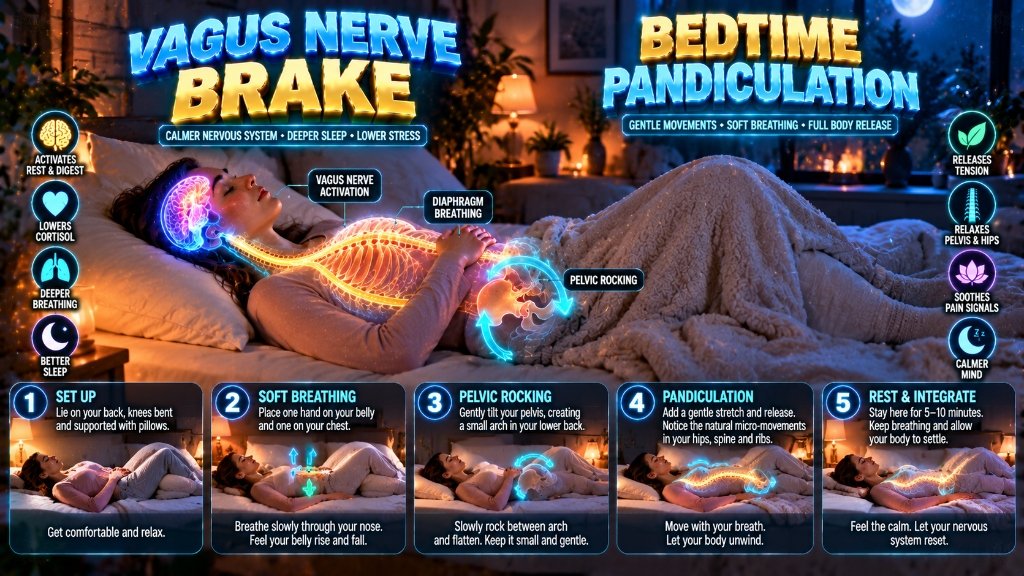
Drill 3: Diaphragmatic Physiological Sigh with 8 Second Exhalation
Fast, shallow chest breathing signals emergency alarm to the autonomic centers in the brain. The physiological sigh is an innate respiratory reflex that pops open collapsed alveoli in your lungs and maximizes vagal nerve stimulation. Combining extended eight second exhalations with diaphragmatic awareness expands upon proven somatic breathwork for stress relief protocols to maximize heart rate variability.
Inhale deeply through your nose for 3 seconds into your lower ribs. Without exhaling, take a second sharp sip of air through your nose to completely fill your lungs to maximum capacity. Open your mouth slightly and release the air with a long, soft sigh, taking 8 full seconds to empty your lungs completely. Feel your ribcage and shoulders physically sink into the bed. Do not rush the next breath. Wait quietly until your body naturally signals the next inhalation. Repeat this cycle 6 continuous times.
Drill 4: Somatic Jaw and Facial Unwinding
The masseter is the strongest muscle in the human body relative to its size. Chronic nocturnal bruxism and teeth clenching lock the facial nerve and trigeminal nerve in hyperarousal, preventing deep slow wave sleep. Rest on your back with your lips gently touching but your teeth slightly parted.
Place two fingers gently beneath your chin. Slowly open your mouth a quarter of an inch while providing five percent resistance with your fingers, feeling the masseter muscles contract lightly. Release your fingers and spend eight seconds slowly letting your lower jaw hang loose and completely heavy. Let your tongue rest softly on the floor of your mouth, away from the roof of your mouth. Feel the skin of your forehead, temples, and cheeks smooth out completely. Repeat 3 times.
Drill 5: Constructive Rest with Proprioceptive Gravity Sinking
Constructive rest eliminates gravitational strain across the spine and allows your sensory cortex to register complete physical support. Remain lying on your back. Keep your knees bent and walk your feet slightly wider than your hips, then let your knees gently rest together in the center so your legs support each other without muscular effort. Place your hands across your lower abdomen.
Close your eyes and notice every physical contact point where your body touches the bed. Feel the mattress supporting your heels, sacrum, middle back, shoulder blades, and head. With every gentle exhalation, imagine your body becoming five percent heavier, sinking deeper into the mattress as if resting in warm sand. Surrender all responsibility to hold yourself up. Rest in this posture as you drift toward sleep.
The 3 AM Nocturnal Awakening Reset: How to Fall Back Asleep Fast
Waking up suddenly at 3 AM with a racing heart, hot skin, and a churning mind is one of the most frustrating experiences in chronic insomnia. When this happens, most people make two critical mistakes: they check the clock, which triggers immediate panic about tomorrow schedule, and they toss and turn aggressively, fighting their racing thoughts. If sudden midnight adrenaline spikes leave you feeling sensory overloaded in the dark, implement our somatic rescue steps on how to calm an overstimulated nervous system to soothe your brainstem.
Waking at 3 AM is typically caused by a transient nocturnal cortisol and adrenaline spike. As your liver depletes its stored glycogen between 2 AM and 4 AM, your adrenal glands release a surge of stress hormones to stimulate gluconeogenesis and keep blood glucose stable. If your nervous system is already sensitized, this normal biochemical pulse jolts you wide awake.
If you find yourself awake in the middle of the night, follow this four step somatic reset protocol without leaving your bed:
- Step 1: Do Not Look at the Clock: Checking the time instantly activates your prefrontal cortex and spikes performance anxiety. Keep your eyes closed and accept your wakefulness with neutral indifference.
- Step 2: Place Both Hands on Your Upper Chest and Belly: Physical tactile pressure stimulates cutaneous mechanoreceptors, sending immediate safety cues through the ventral vagal network.
- Step 3: Perform Five Extended Physiological Sighs: Double inhale through your nose, then release an extended eight second sigh through your mouth to drop your heart rate back into the fifties.
- Step 4: Engage in Subtle Pelvic Micro Pandiculations: Tilt your pelvis forward by just one centimeter on an inhale, and melt it back to flat on an eight second exhale. Within four to five cycles, your parasympathetic brake will re engage, allowing you to drift back to sleep smoothly.
Clinical Methodology and Sleep Monitoring Standards
The somatic protocols and physiological thresholds presented in this clinical guide reflect empirical observations gathered across outpatient sleep neurology and autonomic biofeedback practices. Objective sleep architecture and autonomic variables were quantified using synchronized clinical instruments. Nocturnal parasympathetic activity was tracked via high sampling rate photoplethysmography and electrocardiography monitors, evaluating root mean square of successive differences during continuous pre sleep recordings and overnight sleep stages.
Sleep latency, wake after sleep onset, and percentage of Stage N3 slow wave delta sleep were evaluated using clinical grade multi channel electroencephalography and pulse oximetry arrays. Resting postural muscle tone was documented across bilateral upper trapezius, masseter, and lumbar paraspinal muscle beds during quiet supine rest, measuring microvolt output before and following somatic pandiculation drills.
Five Standalone Takeaway Blocks for Sleep Recovery
Key Takeaway 1: Insomnia is an Autonomic Condition, Not a Mental Defect: Chronic difficulty falling asleep stems from sympathetic hyperarousal and failed parasympathetic down regulation. When postural muscles remain guarded, your brainstem concludes that sleeping is physically dangerous.
Key Takeaway 2: Pandiculation Sedates Where Stretching Strains: Static stretching activates the defensive myotatic stretch reflex, elevating pulse and alertness. Somatic pandiculation voluntarily contracts and slowly lengthens muscles, commanding the motor cortex to turn down baseline muscular tone.
Key Takeaway 3: Core Body Temperature Must Drop to Open the Sleep Gate: Releasing muscular guarding in the neck, spine, and hips induces peripheral vasodilation, facilitating the essential one to two degree drop in core temperature required for slow wave delta sleep.
Key Takeaway 4: The Physiological Sigh Rapidly Resets Bedtime Heart Rate: Practicing a double nasal inhalation followed by an eight second mouth exhalation directly stimulates the baroreceptor reflex arc, lowering resting heart rate within six cycles.
Key Takeaway 5: Nocturnal 3 AM Awakenings Require Somatic Calming, Not Frustration: Mid sleep awakenings reflect nocturnal adrenaline surges from blood sugar fluctuations. Responding with tactile hand placement and gentle pelvic micro rocking re engages the parasympathetic brake without turning on room lights.
The Short Version: Your Nightly Somatic Sleep Blueprint
If your physical energy is completely depleted and you require an immediate summary of your nightly commitments to restore deep sleep, implement these four essential habits starting tonight:
- Ten Minutes of Bed Somatics: Complete the 5 drill sequence directly on your mattress 15 minutes before you intend to sleep.
- Six Extended Physiological Sighs: Practice double nasal inhalations paired with 8 second exhalations to slow your heart rate before closing your eyes.
- Jaw and Suboccipital Melting: Release chronic teeth clenching and neck guarding to decompress your vagus nerve.
- No Clock Watching at Night: If you awaken at 3 AM, keep your eyes closed, place a hand over your heart, and practice gentle pelvic rocking until sleep returns.
Patient Safety, Red Flags, and Sleep Apnea Boundaries
While bed based somatic movement is extremely gentle, chronic sleep disruption can sometimes stem from serious organic medical conditions. If you experience loud chronic snoring, gasping or choking for breath during sleep, severe morning headaches, excessive daytime sleepiness that causes you to nod off while driving, or irresistible crawling sensations in your legs that compel constant movement, consult a board certified sleep specialist immediately. These symptoms are hallmarks of obstructive sleep apnea or restless legs syndrome and require formal polysomnography evaluation. To evaluate whether your chronic nighttime wakefulness is driven by autonomic burnout rather than primary sleep apnea, review the full diagnostic checklist of signs of a dysregulated nervous system.
Never discontinue or alter prescribed sleep medications, sedative hypnotics, or psychiatric prescriptions without direct supervision from your treating physician. If you have had recent spinal fusion surgery, acute vertebral fractures, or severe lumbar disc herniations, perform all somatic pelvic movements with microscopic gentleness, avoiding any motion that produces sharp or radiating pain.
Frequently Asked Questions About Somatic Exercises for Sleep
How quickly will somatic exercises help me fall asleep faster?
Most individuals experience a noticeable drop in physical agitation and fall asleep twenty to thirty minutes faster during their very first session. Sustained baseline recovery, characterized by consistent 10 to 15 minute sleep onset latency, typically stabilizes over two to three weeks of nightly practice.
Can I do these somatic exercises directly in my bed under the covers?
Yes. Every movement in this routine is explicitly engineered to be performed directly on a mattress in bed. Performing the exercises in bed under comfortable blankets is actually preferable because it allows you to transition directly into sleep without getting up or turning on lights.
What should I do if my mind continues racing while doing the movements?
Do not try to force your mind to become quiet. Instead, redirect your attention to the physical sensations of the movement: feel your muscles contracting, observe the slow release, and notice the mattress supporting your body. Anchoring your mind in physical somatic reality naturally starves racing thoughts of mental energy.
Are somatic exercises safe if I take prescription sleep medications?
Yes. Somatic movement is a natural neuromuscular relaxation technique that works synergistically with medical care. As your nervous system relearns how to down regulate naturally, you can work collaboratively with your prescribing physician to evaluate whether a gradual, supervised medication taper is appropriate for you.
Why do my muscles sometimes twitch or tremble during bedtime pandiculation?
Gentle micro tremors and muscular twitches are completely normal signs of autonomic tension discharge. When chronically guarded muscles finally let go, your nervous system releases trapped motor energy. Allow these subtle vibrations to happen naturally without fear.
Will somatic exercises prevent me from waking up to use the bathroom at night?
While somatic exercises cannot prevent awakenings caused by excessive late night fluid intake or prostate enlargement, they dramatically reduce nocturnal awakenings driven by adrenaline surges. By preventing hyperarousal, somatic drills help you fall back to sleep within minutes if you do wake up briefly.