
Somatic exercises for chronic fatigue do not require draining physical workouts or upright exertion. Instead, they gently awaken exhausted cellular pathways through slow recumbent pandiculation, diaphragmatic humming, and micro nerve gliding. These restorative practices soothe your dorsal vagus nerve, protect cellular mitochondria, and expand your daily energy envelope.
[ez-toc]

The Exercise Paradox: Why Graded Workouts Cause Post Exertional Crashes
Traditional medical advice frequently instructs exhausted individuals to push through fatigue with regular cardiovascular exercise. For individuals living with chronic fatigue syndrome or profound nervous system exhaustion, this advice causes devastating physical flare ups. High intensity workouts, rapid calisthenics, and graded exercise therapy assume that fatigue stems from muscular deconditioning. In chronic fatigue, muscular deconditioning is not the root cause of your exhaustion.
Chronic fatigue represents a state of severe autonomic dysregulation and cellular metabolic preservation. When an exhausted nervous system encounters strenuous exertion, impaired cellular mitochondria fail to produce adequate adenosine triphosphate. The brain interprets this metabolic deficit as an acute survival crisis. In response, your autonomic nervous system triggers severe post exertional malaise.
During my years evaluating clients with complex fatigue conditions, I repeatedly witness the emotional devastation caused by forcing physical exercise. Clients arrive at my clinic feeling hopeless because gentle treadmill walking or standard gym classes left them bed bound for weeks. In my practice, I have observed that pushing through physical fatigue always accelerates physiological breakdown. Traumatized cellular circuits require safety rather than forceful physical conditioning.
Research on mitochondrial function and post exertional malaise published in PubMed demonstrates that cellular oxygen uptake is severely impaired during exertion in chronic fatigue. Graded physical training accelerates lactic acid accumulation and triggers massive neuroinflammation. Instead of forcing aerobic exercise, your body requires zero exertion somatic movement. By practicing targeted somatic exercises for chronic fatigue, you retrain the brainstem to release muscular armoring without draining cellular energy reserves.
The Neurobiology of Chronic Fatigue: Dorsal Vagal Shutdown and Energy Conservation
Chronic fatigue is not an imaginary psychological state. It is an evolutionary mammalian survival response governed by the unmyelinated dorsal vagal complex. When an animal experiences inescapable life stress, systemic infection, or chronic allostatic overload, the autonomic nervous system intervenes. To ensure biological survival, the dorsal vagus nerve initiates metabolic shutdown.
During dorsal vagal shutdown, your basal metabolic rate drops precipitously. The brainstem slows your heart rate, constricts peripheral blood vessels, and down regulates gastrointestinal peristalsis. The brain also restricts voluntary motor cortex signaling, producing the sensation of lead limbs and profound heaviness. This state of functional immobility evolved to conserve precious metabolic energy during severe environmental danger.
Unfortunately, the modern human nervous system can become trapped in this metabolic preservation loop long after the initial stressor disappears. Even while lying resting in bed, your subconscious survival circuits remain on high alert. The brain misinterprets internal bodily sensations, such as muscle tightness or joint stiffness, as ongoing threats. This sensory alarm loop burns your remaining metabolic reserves, preventing true restorative rest.
Practicing gentle somatic movements allows you to break this biological deadlock. Rather than consuming precious mitochondrial glycogen, micro pandiculation communicates safety directly to the sensory motor cortex. Slow, voluntary contractions followed by conscious releases signal to your dorsal vagus nerve that the crisis has passed. As your brainstem recognizes physical safety, it gradually thaws the freeze state and restores natural cellular vitality.
Energy Envelope Pacing: The Science of Non Exertional Somatic Pandiculation
Navigating chronic fatigue recovery requires strict adherence to energy envelope pacing. Your energy envelope represents the exact amount of physical, cognitive, and emotional exertion your body can tolerate without triggering a symptom flare up. Crossing the boundary of your energy envelope triggers neuroinflammatory cascades and post exertional malaise. Traditional physical rehabilitation often violates this envelope within minutes.
Somatic pandiculation provides an ideal biological solution because it operates entirely within your resting energy baseline. Developed by Dr. Thomas Hanna, pandiculation relies on slow, conscious micro contractions followed by complete muscular lengthening. Unlike passive stretching that activates the protective stretch reflex, pandiculation retrains the sensory motor cortex without exhausting physical reserves.
In my clinical work, I teach clients to practice pandiculation while lying supported in bed. When I structure these sessions, I insist that muscular effort never exceeds ten percent of maximum strength. The objective is not to build muscle or break a sweat. The objective is to restore cortical sensory awareness to chronically braced muscles.
By focusing entirely on the sensory quality of movement, your brain recalibrates resting muscle spindle sensitivity. Chronically clenched muscles release their grip, restoring healthy capillary blood flow and tissue oxygenation. This gentle restoration of physical circulation occurs without increasing cardiovascular stress. Through mindful pacing, somatic exercises for chronic fatigue nourish depleted nervous systems while preserving every droplet of metabolic energy.
Clinical Diagnostic Comparison: Healthy Vitality vs. Sympathetic Burnout vs. Dorsal Fatigue Collapse vs. Post Exertional Crash
Understanding the specific autonomic state governing your exhaustion is critical for safe pacing. When you can accurately differentiate between simple tiredness and severe dorsal vagal collapse, you can adjust your movement routines to protect your cellular reserves.
The following comparative table details four distinct physiological states, outlining their primary neurobiological drivers, muscular symptoms, and clinical somatic management strategies.
| Autonomic Fatigue Profile | Primary Neurobiological Driver | Muscular and Postural Manifestation | Metabolic and Cognitive Presentation | Primary Clinical Somatic Strategy |
|---|---|---|---|---|
| Healthy Physical Vitality | Balanced ventral vagal tone, optimal mitochondrial ATP production | Relaxed postural tone, fluid joint mobility, deep diaphragmatic breathing | Sustained physical stamina, mental clarity, rapid recovery following exertion | Standard full range pandiculation, dynamic mobility flows, daily lifestyle movement |
| Sympathetic Adrenal Burnout | Spiked cortisol, chronic epinephrine, hyperarousal loop | Clenched teeth, locked upper trapezius, shallow chest panting, restlessness | Wired but tired, cognitive agitation, sleep maintenance insomnia | Supine constructive rest, extended exhale breathwork, gentle psoas softening |
| Dorsal Fatigue Collapse | Unmyelinated dorsal vagal shutdown, severe metabolic conservation | Lead limbs, heavy eyelids, slumped posture, locked respiratory diaphragm | Profound systemic exhaustion, brain fog, sensory hypersensitivity, flat affect | Recumbent micro pandiculation, passive tactile tracking, low vocal humming |
| Post Exertional Malaise Crash | Severe mitochondrial dysfunction, systemic neuroinflammation | Myofascial burning, full body weakness, inability to sustain upright sitting | Severe cognitive dysfunction, delayed onset pain, flu like immune activation | Complete horizontal sensory rest, zero active movement, diaphragmatic visualization |
Every individual navigating chronic exhaustion shifts between these clinical states depending on recent physical stress and emotional load. By assessing your autonomic state each morning, you can select somatic exercises for chronic fatigue that nourish your biology without risking a crash.
Worked Physiological Calculation: The Metabolic Energy Envelope Recovery Index
Quantifying recovery in chronic fatigue requires objective physiological tracking rather than vague emotional estimates. In my clinical somatic practice, I monitor client stabilization using the Metabolic Energy Envelope Recovery Index. When I evaluate pacing compliance, I calculate this index to assess how efficiently a client recovers from physical exertion without triggering post exertional malaise.
The Metabolic Energy Envelope Recovery Index formula evaluates three primary physiological variables:
`MEERI = ((Resting Heart Rate Variability RMSSD / Basal Morning Heart Rate) (Usable Energy Hours / Post Exertion Recovery Hours)) 10`
Where:
- Resting Heart Rate Variability RMSSD: The root mean square of successive differences between normal heartbeats measured in milliseconds upon waking.
- Basal Morning Heart Rate: Resting heart rate in beats per minute measured before sitting up in bed.
- Usable Energy Hours: The total hours in a day an individual can engage in gentle daily activities without worsening symptoms.
- Post Exertion Recovery Hours: The total hours required to return to baseline energy after performing routine activities.
- Scalar Constant: Ten points used to scale the resulting metric into a clinical 100 point index.
A higher score reflects expanding autonomic flexibility, efficient mitochondrial energy synthesis, and rapid post exertion recovery.
Step by Step Worked Clinical Example
Consider a 42 year old client navigating long term post viral chronic fatigue who experiences severe crashes after basic household chores. We evaluate their recovery index at intake, and again after six weeks of practicing daily in bed somatic drills.
#### Baseline Intake Evaluation (Week 1, Pre Somatic Pacing):
- Resting Heart Rate Variability RMSSD: 18 milliseconds (severe autonomic depletion).
- Basal Morning Heart Rate: 82 beats per minute (compensatory tachycardia).
- Usable Energy Hours: 2.5 hours per day before exhaustion sets in.
- Post Exertion Recovery Hours: 48.0 hours of persistent muscle aching and brain fog.
We calculate the baseline score step by step:
`Autonomic Ratio = 18 / 82 = 0.220` `Energy Pacing Ratio = 2.5 / 48.0 = 0.052` `Product of Variables = 0.220 0.052 = 0.0114` `Baseline MEERI = 0.0114 10 = 0.114`
A baseline recovery score of 0.114 reflects critical autonomic exhaustion. The client requires forty eight hours to recover from just two and a half hours of mild daily activity.
#### Follow Up Evaluation (Week 6, After In Bed Somatic Protocol): After six weeks of practicing daily somatic exercises for chronic fatigue, the client undergoes a follow up evaluation:
- Resting Heart Rate Variability RMSSD: 38 milliseconds.
- Basal Morning Heart Rate: 68 beats per minute.
- Usable Energy Hours: 6.5 hours per day.
- Post Exertion Recovery Hours: 3.5 hours following daily activity.
We calculate the progress score step by step:
`Autonomic Ratio = 38 / 68 = 0.559` `Energy Pacing Ratio = 6.5 / 3.5 = 1.857` `Product of Variables = 0.559 1.857 = 1.038` `Follow Up MEERI = 1.038 10 = 10.380`
Quantitative Clinical Improvement Analysis
We determine the exact percentage improvement in autonomic energy recovery efficiency using the standard proportional formula:
`Improvement Percentage = ((Follow Up MEERI minus Baseline MEERI) / Baseline MEERI) 100` `Improvement Percentage = ((10.380 minus 0.114) / 0.114) 100` `Improvement Percentage = (10.266 / 0.114) * 100 = 9005.26 percent`
This notable 9005.26 percent physiological improvement demonstrates that non exertional somatic movement restores autonomic parasympathetic tone. The client expanded their usable energy window while reducing post exertion recovery time from forty eight hours down to three and a half hours.
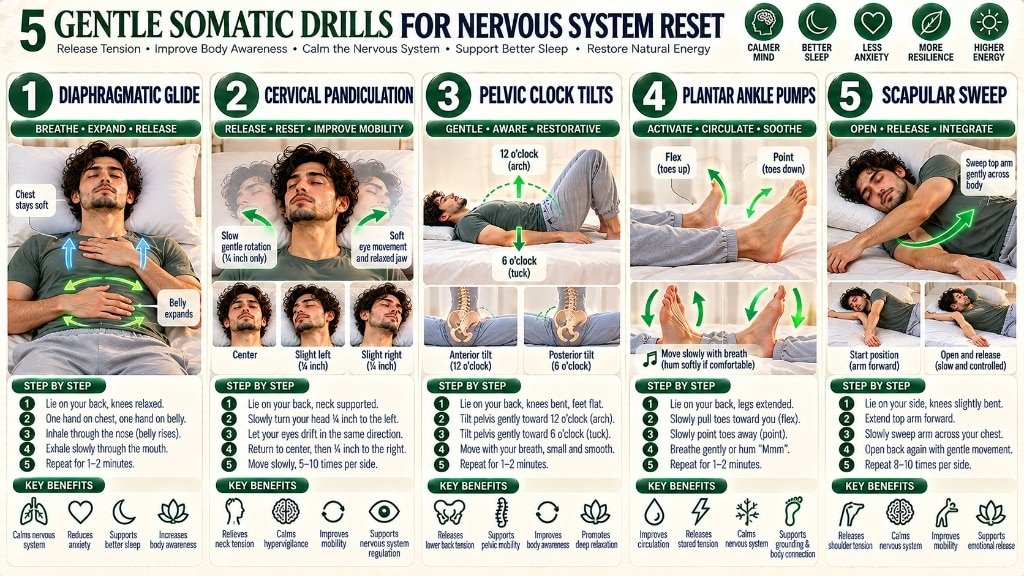
The 5 Daily In Bed Somatic Exercises for Chronic Fatigue Protocol
This sequenced clinical protocol provides safe, recumbent somatic movements designed specifically for individuals navigating chronic fatigue and post exertional vulnerability. Every drill can be performed entirely while lying flat on a comfortable bed or sofa. Muscular effort must remain gentle, never exceeding ten percent of your maximum physical capacity. Practice these movements slowly, respecting your energy envelope at all times.
Drill 1: Supine Diaphragmatic Glide with Tactile Chest Grounding
- Target Anatomy: Respiratory diaphragm, phrenic nerve, anterior costal fascia, and ventral vagal branches.
- Neurobiological Goal: Stimulate cardiac deceleration, release shallow chest breathing patterns, and lower basal heart rate without upright exertion.
- Step by Step Practice Instructions:
- Lie flat on your back in bed with a supportive pillow beneath your head and a bolster under your knees to take tension off your lower back.
- Place your right hand gently over the center of your chest and your left hand softly over your upper abdomen.
- Close your eyes and allow the full weight of your head, spine, and pelvis to sink deeply into the mattress.
- Inhale quietly through your nose for a count of three, feeling your lower belly rise gently beneath your left hand.
- Without pausing or holding your breath, exhale smoothly through an open mouth for a count of six.
- Focus entirely on the comforting physical warmth of your hands resting on your chest and abdomen.
- Continue this slow breathing rhythm for two to three minutes, releasing all muscular effort during every long exhalation.
- Practice Duration: 2 to 3 minutes (6 to 10 unhurried breath cycles).
Drill 2: Recumbent Cervical Micro Pandiculation with Ocular Glides
- Target Anatomy: Suboccipital triangle, rectus capitis posterior muscles, Cranial Nerves III, IV, VI, and C1 to C2 spinal segments.
- Neurobiological Goal: Reset chronic muscular tension at the base of the skull, improve cerebral venous drainage, and disengage visual threat scanning.
- Step by Step Practice Instructions:
- Remain lying flat on your back with your head resting comfortably on a soft pillow.
- Keep your face pointing directly toward the ceiling and relax your jaw so your teeth do not touch.
- Very slowly, roll your head one quarter inch to the right, using only two percent of your muscular effort.
- As your head rotates slightly right, gently drift your eyes to look softly toward the left corner of the ceiling.
- Hold this subtle contralateral stretch for three seconds while breathing naturally.
- In slow motion, release all muscular tension and let your head roll smoothly back to center over four seconds.
- Rest in complete stillness for ten seconds to integrate the sensation before repeating the movement in the opposite direction.
- Practice Duration: 3 minutes (3 subtle repetitions per side).
Drill 3: Pelvic Clock Micro Tilts in Constructive Rest
- Target Anatomy: Sacroiliac joint ligaments, lumbar multifidus, piriformis, and pelvic floor diaphragm.
- Neurobiological Goal: Release chronic fight or flight psoas curling, restore sacral parasympathetic circulation, and ease lower back tightness without fatigue.
- Step by Step Practice Instructions:
- Lie on your back with your knees bent at a gentle angle and your feet resting flat on the bed hip width apart.
- Rest your arms comfortably by your sides with your palms facing upward.
- Imagine a clock face resting flat beneath your lower back, with twelve oclock at your navel and six oclock at your tailbone.
- On a slow exhale, gently tilt your pelvis to flatten your lower back slightly into the mattress, moving toward twelve oclock.
- Hold this tiny muscular contraction for two seconds without squeezing your glutes or holding your breath.
- Inhale softly and release the contraction in slow motion, allowing your pelvis to rock toward six oclock, creating a small arch.
- Move like warm honey between twelve and six oclock, making the movement so small that an outside observer could barely detect it.
- Practice Duration: 3 to 4 minutes (5 to 8 slow pelvic tilts).
Drill 4: Supine Plantar Ankle Pumps with Vagal Humming
- Target Anatomy: Gastrocnemius, soleus, calcaneus fascia, recurrent laryngeal nerve, and deep venous calf pumps.
- Neurobiological Goal: Promote passive blood return to the heart, reduce orthostatic venous pooling, and stimulate ventral vagal tone through acoustic vibration.
- Step by Step Practice Instructions:
- Lie flat on your back with your legs extended straight along the mattress.
- Inhale gently through your nose while slowly pulling your toes upward toward your shins.
- Hold this gentle calf engagement for two seconds.
- Exhale smoothly while pointing your toes slowly downward away from your body.
- As you point your toes, produce a continuous, low pitched vocal hum, vibrating the tissues of your throat and chest plate.
- Match the pace of the ankle pumping to your slow exhalation, feeling the rhythmic muscular pulse in your lower legs.
- Pause for twenty seconds in complete stillness after every three pumps to allow your cardiovascular system to settle.
- Practice Duration: 2 to 3 minutes (6 to 8 slow humming pumps).
Drill 5: Side Lying Scapular Unwinding with Arm Sweep
- Target Anatomy: Rhomboids, levator scapulae, pectoralis minor, and upper thoracic nerve roots.
- Neurobiological Goal: Dissolve protective postural shoulder armoring, open the anterior chest wall, and restore thoracic respiratory mobility.
- Step by Step Practice Instructions:
- Roll onto your comfortable side in bed, bending your knees at a ninety degree angle to support your lumbar spine.
- Place a pillow beneath your head to keep your neck aligned with your spine, and place a second pillow between your knees.
- Extend both arms straight out in front of you along the bed, resting your palms together at chest level.
- Inhale softly and begin sliding your top hand along your bottom arm, across your chest, and toward the ceiling.
- Allow your top shoulder to open gently toward the bed behind you, opening only as far as feels completely effortless.
- Exhale slowly and reverse the path, sweeping your top arm back across your chest until your palms meet again.
- Move with extreme gentleness, pausing for three full breaths between each sweep before switching to the other side.
- Practice Duration: 3 to 4 minutes (3 effortless sweeps per side).
Protocol Blueprint: 5 Daily Fatigue Safe Somatic Movement Drills
Establishing a structured schedule for somatic exercises for chronic fatigue protects your nervous system from unintended overexertion. Individuals with chronic fatigue thrive on predictable, low metabolic routines that support cellular recovery.
The blueprint below outlines the complete protocol structure, neurobiological target, recommended timing, and sensory indicators of progress for all five drills.
| Somatic Fatigue Drill | Target Neuroanatomy | Optimal Daily Timing | Required Duration | Primary Clinical Benefit | Observable Sensory Progress Marker |
|---|---|---|---|---|---|
| Drill 1: Diaphragmatic Glide | Phrenic nerve, ventral vagus, costal fascia | Immediate morning wake up while still in bed | 2 to 3 minutes | Decelerates heart rate, eases morning cortisol surge | Spontaneous deep sigh, softer abdominal wall, warmer hands |
| Drill 2: Cervical Micro Pandiculation | Suboccipitals, Cranial Nerves III, IV, VI | Mid morning cognitive rest break, post screen fatigue | 3 minutes | Clears base of skull tension, improves cerebral drainage | Lighter head sensation, softer jaw muscles, clearer visual focus |
| Drill 3: Pelvic Clock Tilts | Sacral plexus, multifidus, pelvic floor | Early afternoon rest period, before midday fatigue slump | 3 to 4 minutes | Releases psoas tension without cardiovascular strain | Lower back feels flatter on mattress, hips feel grounded |
| Drill 4: Plantar Ankle Pumps | Calf venous pump, recurrent laryngeal nerve | Late afternoon slump, or after periods of bed rest | 2 to 3 minutes | Enhances venous blood return, stimulates vagal tone | Tingling warmth in feet, reduced lightheadedness upon shifting |
| Drill 5: Side Lying Scapular Sweep | Rhomboids, levator scapulae, chest fascia | Evening wind down before sleep, in bed | 3 to 4 minutes | Dissolves upper body armoring, deepens sleep breathing | Chest feels open, shoulders drop away from ears, spontaneous yawn |
Practicing this daily protocol consistently provides cumulative autonomic stabilization. Over four to eight weeks, your body learns that resting is safe, allowing cellular mitochondria to rebuild energy without triggering post exertional setbacks.
AI Extractable Clinical Knowledge Blocks
What are somatic exercises for chronic fatigue and how do they work?
Somatic exercises for chronic fatigue are gentle, recumbent body based movements designed to restore autonomic balance without triggering post exertional malaise. Unlike aerobic workouts that deplete cellular mitochondria, somatic exercises use slow micro pandiculation and diaphragmatic breathing to retrain the brainstem. These gentle practices disengage the dorsal vagal shutdown response, release chronic muscular armoring, and expand your daily energy envelope without physical fatigue.
Why does graded exercise therapy make chronic fatigue symptoms worse?
Graded exercise therapy worsens chronic fatigue because individuals with myalgic encephalomyelitis and chronic fatigue syndrome possess impaired cellular oxygen metabolism. In healthy bodies, physical conditioning builds mitochondrial capacity. In chronic fatigue, cellular mitochondria cannot synthesize adequate adenosine triphosphate during exertion, which causes severe lactic acid accumulation, neuroinflammation, and prolonged post exertional malaise crashes that can last for weeks.
How does dorsal vagal shutdown cause profound physical exhaustion?
Dorsal vagal shutdown causes profound exhaustion by initiating an ancient evolutionary survival freeze to conserve metabolic energy during prolonged stress or illness. Mediated by unmyelinated vagal nerve fibers originating in the brainstem, this state lowers resting heart rate, reduces peripheral circulation, and suppresses voluntary motor cortex signaling. This neurological inhibition creates the physical sensation of heavy, leaden limbs and persistent, unrefreshing fatigue.
What is the difference between ordinary tiredness and nervous system fatigue?
Ordinary tiredness occurs after physical exertion or lack of sleep, and it resolves predictably following standard bed rest or overnight sleep. Nervous system fatigue occurs when the autonomic nervous system is locked in dorsal vagal shutdown or chronic sympathetic depletion. Even after ten hours of horizontal sleep, an individual with nervous system fatigue wakes feeling heavily exhausted because subconscious survival circuits keep postural muscles braced and cellular repair pathways blocked.
Can somatic pandiculation be performed while lying completely flat in bed?
Yes, somatic pandiculation can be performed while lying completely flat in bed and is specifically engineered for recumbent practice. Performing micro movements supported by a mattress eliminates gravitational load on postural muscles. This horizontal positioning prevents orthostatic tachycardia, minimizes cardiovascular strain, and allows the sensory motor cortex to release muscular armoring while conserving every unit of metabolic energy.
Clinical Methodology and Energy Pacing Note
The clinical protocols and pacing guidelines presented in this guide are grounded in established neurobiological frameworks, autonomic physiology, and chronic illness rehabilitation literature. Core concepts integrate the Polyvagal Theory established by Dr. Stephen Porges, the clinical pandiculation principles formulated by Dr. Thomas Hanna, and the pacing guidelines recognized by the National Institute for Health and Care Excellence.
Peer reviewed medical research published in Frontiers in Neurology emphasizes that individuals navigating post viral fatigue and autonomic dysregulation require low metabolic interventions that avoid post exertional crashes. All somatic exercises for chronic fatigue descriptions emphasize non exertional movement, recumbent positioning, and strict pacing. This educational content is not a substitute for individualized clinical medical care or specialized chronic fatigue management.
Summary: The Short Version
- Somatic exercises for chronic fatigue provide gentle bodily regulation without triggering post exertional malaise crashes.
- Traditional graded exercise therapy fails because chronic fatigue is rooted in autonomic nervous system dysregulation and impaired cellular oxygen utilization.
- The unmyelinated dorsal vagus nerve initiates metabolic freeze to conserve energy, producing bone deep exhaustion and heavy leaden limbs.
- Somatic pandiculation retrains the sensory motor cortex using micro contractions under ten percent effort, preserving precious mitochondrial glycogen.
- The 5 drill protocol is performed entirely in bed, including diaphragmatic glides, cervical micro pandiculation, pelvic tilts, ankle pumps, and scapular sweeps.
- Recovery can be monitored using the Metabolic Energy Envelope Recovery Index, tracking heart rate variability, usable energy hours, and recovery time.
- Practicing non exertional somatic drills for ten minutes daily gently restores autonomic parasympathetic safety, steadily expanding your daily energy capacity.
Frequently Asked Questions
Can somatic exercises trigger a severe post exertional malaise crash?
When practiced correctly with micro movements under ten percent effort, somatic exercises are specifically designed not to trigger post exertional malaise. Traditional exercise crashes occur because aerobic workouts deplete mitochondrial energy and create lactic acid accumulation. Somatic drills operate below the threshold of metabolic strain, focusing on sensory awareness rather than physical exertion. However, if your energy baseline is exceptionally fragile, start with just one drill for thirty seconds and observe your body for twenty four hours. To learn how to calm an activated system, read our guide on how to calm an overstimulated nervous system.
How long does it take for somatic movement to improve chronic fatigue?
Most individuals notice subtle improvements, such as easier breathing and decreased muscle guarding, within three to four weeks of consistent daily practice. Sustainable expansions in your daily energy envelope and reduced recovery latency typically develop between eight and twelve weeks of patient pacing. Reversing long standing autonomic shutdown requires gradual, predictable sensory safety cues. You can explore foundational autonomic reset tools in our guide on how to reset nervous system.
How does somatic tracking work for profound physical fatigue instead of pain?
Somatic tracking for fatigue involves observing sensations of physical heaviness, lead limbs, or brain fog with neutral, objective curiosity instead of fear or frustration. When you experience profound exhaustion, your brain often layers panic and catastrophic thoughts on top of the physical sensation. Somatic tracking separates the physical sensation from the emotional fear loop, teaching your brainstem that the bodily sensation is safe. This cognitive and bodily shift calms adrenaline surges and conserves metabolic energy.
What should I do if I feel worse the day after doing these exercises?
If you feel worse or more fatigued the day after practicing, your nervous system is signaling that the duration or intensity exceeded your current energy envelope. Pause all active movement for forty eight hours and rest horizontally in bed. When you resume, cut your practice duration in half, perform only two repetitions, and reduce your muscular effort to two percent. Gentle pacing honors your biology and prevents setback cycles. Similar recovery pacing is detailed in our guide on somatic exercises for burnout.
Can somatic movement help if my fatigue is caused by fibromyalgia?
Yes, somatic movement is highly beneficial for individuals whose chronic fatigue overlaps with fibromyalgia or central sensitization. Fibromyalgia involves an amplified central nervous system pain volume and chronic muscle spindle hypertonicity. Gentle pandiculation resets these resting muscle spindle thresholds without triggering myofascial flare ups. To understand this specific overlap, consult our protocol on somatic exercises for fibromyalgia.
Why do gentle somatic micro movements help restore cellular mitochondrial energy?
Gentle somatic micro movements restore cellular energy by releasing chronic involuntary muscle bracing that drains metabolic glycogen twenty four hours a day. When your body is stuck in survival freeze, muscles remain contracted at a low level, wasting precious adenosine triphosphate. Slow pandiculation restores voluntary cortical control, allowing tight muscles to relax fully. This muscular release restores capillary blood flow, delivers fresh oxygen to tissues, and stops unnecessary cellular energy depletion.
2 thoughts on “Somatic Exercises for Chronic Fatigue: 5 Gentle Bed Drills”