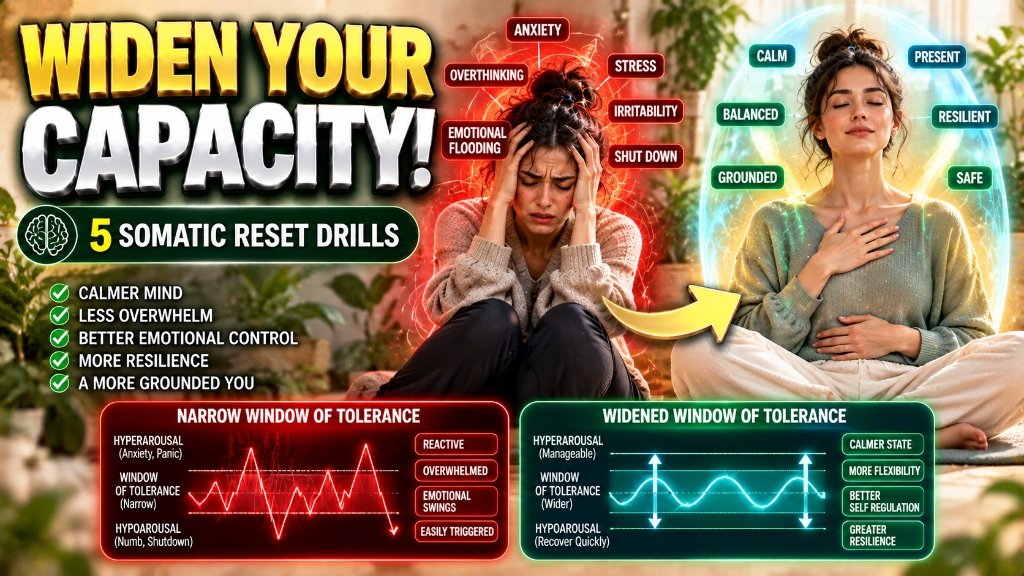
Window of tolerance exercises expand your autonomic nervous system capacity to process stress without collapsing into freeze or spiking into panic. Through gentle somatic pandiculation, bilateral orienting, and vagal brake regulation, these bottom up movements widen your physiological resilience and restore emotional equilibrium naturally.
[ez-toc]
The Cognitive Trap: Why Talk Therapy Fails Outside Your Window of Tolerance
The concept of the window of tolerance, first introduced by clinical psychiatrist Dr. Dan Siegel, describes the optimal physiological zone wherein your brain and body can effectively process emotional stress, think clearly, and adapt to daily challenges. When you reside inside this zone, your nervous system remains flexible. You experience life events with grounded curiosity rather than panic or numbness. As highlighted in peer reviewed clinical research on Polyvagal Theory and autonomic regulation, cultivating autonomic flexibility is fundamental for nervous system resilience.
However, millions of individuals live with an exceedingly narrow window. A challenging email, unexpected traffic, or a minor conflict pushes them over the edge into overwhelming distress. When this occurs, conventional medical and psychological advice routinely suggests cognitive interventions. Therapists instruct patients to challenge negative thoughts, practice cognitive reframing, or journal through their feelings.
These cognitive strategies fail because they attempt top down management of an acute neurobiological crisis. When your nervous system is shoved outside its window of tolerance, blood flow rapidly leaves your prefrontal cortex, the seat of executive logic and reasoning. Brain imaging studies confirm that Broca area, the neurological center responsible for speech and expressive language, dramatically decreases activity during autonomic dysregulation.
At the exact same time, subcortical survival circuits in your brainstem and amygdala take complete control. Your body shifts into an ancient survival program designed to keep you alive. You cannot talk, think, or reason your way out of a nervous system state that perceives imminent physical threat. Widening your capacity requires bottom up somatic movement that communicates safety directly to the brainstem through sensory motor pathways.
Neurobiology of Arousal: Ventral Safety, Sympathetic Alarm, and Dorsal Freeze
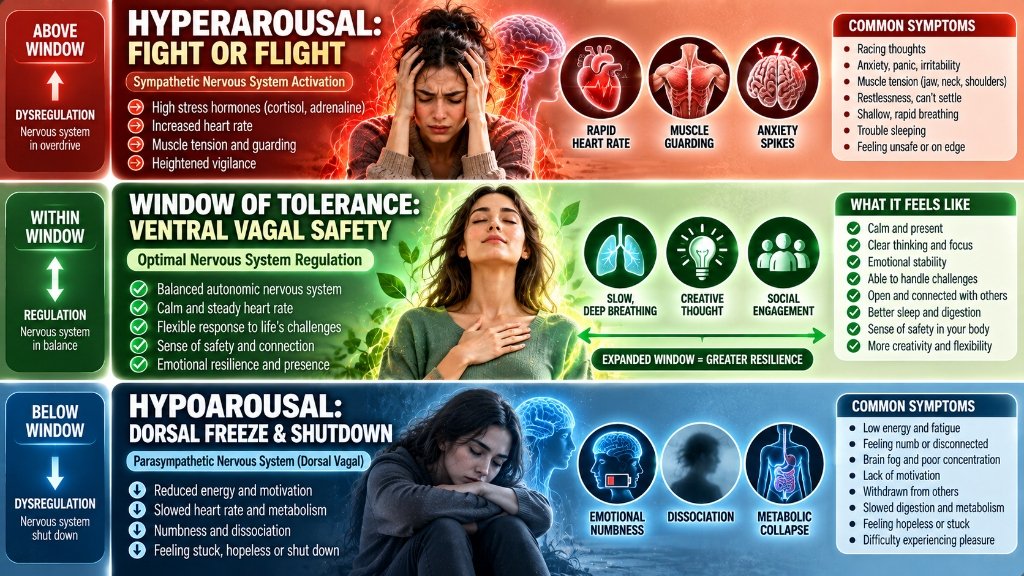
To understand how somatic movement expands your physiological capacity, you must understand the three distinct autonomic states defined by Dr. Stephen Porges in Polyvagal Theory. Your window of tolerance is not an abstract psychological concept. It is a direct physiological reflection of which branches of your autonomic nervous system are actively firing.
Inside your window of tolerance, your myelinated ventral vagal circuit holds dominion. This evolutionary marvel, known as the social engagement system, acts as an active brake on your heart rate. It allows you to feel safe in your body, connect with other humans, digest food efficiently, and regulate emotional impulses. This ventral anchor creates the biological container for resilience.
When stress exceeds your current capacity, your nervous system surges upward past the ceiling of your window into hyperarousal. This activates your sympathetic nervous system, flooding your bloodstream with adrenaline and cortisol. Your heart rate accelerates, breathing turns rapid and shallow, and your muscles contract into defensive armor. Hyperarousal presents clinically as acute anxiety, anger, panic, restlessness, and hypervigilance.
Conversely, if the perceived stress feels inescapable or overwhelming, your nervous system plunges downward below the floor of your window into hypoarousal. This state is governed by the primitive unmyelinated dorsal vagal motor nucleus. In hypoarousal, your body initiates a metabolic shutdown. Heart rate and blood pressure drop, muscle tone collapses, and your mind enters emotional numbness, brain fog, and dissociation. Reclaiming your baseline requires foundational tools explored in our guide on how to reset nervous system.
Somatic Capacity: How Bottom Up Pandiculation Expands the Biological Container
The biological width of your window of tolerance is determined by autonomic flexibility. Autonomic flexibility refers to your nervous system ability to move smoothly between gentle excitation and calm recovery without getting stuck in extremes.
Chronic psychological trauma, prolonged workplace burnout, and physical illness restrict this flexibility through sensory motor amnesia. Movement pioneer Thomas Hanna observed that when the body endures chronic stress, muscles learn to hold involuntary defensive contractions. Your psoas curls tight to protect your abdominal organs, your neck muscles pull your head forward, and your diaphragm locks in rigid guarding.
These chronic somatic contractions send continuous afferent threat signals up the vagus nerve to your brainstem. Even when you are sitting safely on your couch, your tight muscles tell your brain that danger is present. This false feedback loop keeps your baseline resting tone elevated, compressing your window of tolerance into a microscopic sliver where the slightest friction triggers a crisis.
Somatic pandiculation solves this problem by retraining your motor cortex. By engaging in tiny, conscious voluntary contractions followed by ultra slow, deliberate eccentric lengthening, you interrupt involuntary holding patterns. As physical muscular armor melts away, afferent threat signaling ceases. Your ventral vagal brake strengthens, expanding the boundaries of your window so you can handle higher levels of life stress with peaceful composure, expanding principles found in our resource on polyvagal theory exercises for beginners.
Clinical Diagnostic Comparison: Hyperarousal, Ventral Safety, and Hypoarousal States
The table below contrasts the physiological, muscular, and cognitive signatures of hyperarousal, ventral vagal regulation, and hypoarousal. Understanding these distinct states clarifies why specific window of tolerance exercises must match your current autonomic state.
| Diagnostic Metric | Sympathetic Hyperarousal (Above Window) | Ventral Vagal Regulation (Inside Window) | Dorsal Vagal Hypoarousal (Below Window) | Talk Therapy Efficacy | Somatic Pandiculation Action |
|---|---|---|---|---|---|
| Primary Autonomic Branch | Sympathetic chain ganglia and adrenal medulla | Myelinated ventral vagal complex | Unmyelinated dorsal vagal motor nucleus | Zero benefit during acute shutdown or panic | Stimulates vagal brake or gently discharges tremor |
| Heart Rate and Respiration | Tachycardia above 95 BPM, rapid chest breathing | Balanced 60 to 75 BPM, smooth diaphragmatic breath | Bradycardia below 55 BPM, shallow suppressed breath | Cannot alter heart rate through rational thinking | Slow eccentric movement resets autonomic tone |
| Muscular Holding Pattern | Hypertonic guarding in jaw, traps, and psoas | Dynamic resting tone with full elastic range | Flaccid hypotonia, heavy limbs, collapsed posture | Cognitive focus increases muscular tension | Slow pandiculation restores voluntary motor control |
| Cognitive and Mental State | Racing thoughts, catastrophic worry, panic | Creative, reflective, present, socially open | Brain fog, emotional numbness, dissociation | Prefrontal cortex is offline due to blood flow shifts | Re engages sensory motor cortex directly |
| Interoceptive Awareness | Overwhelmed by intense internal sensations | Accurate, neutral perception of bodily cues | Disconnected, numb, unable to feel physical body | Abstract verbalization worsens overwhelm | Gentle somatic tracking restores safe body mapping |
| Clinical Recovery Priority | Discharge energy, down regulate motor tone | Expand capacity, deepen baseline resilience | Introduce gentle sensory contact, mobilize safety | Fails without prior physiological regulation | Dynamically widens biological container |
Worked Neurological Calculation: The Autonomic Capacity Resilience Index
In clinical somatic rehabilitation, we measure an individual nervous system capacity objectively using the Autonomic Capacity Resilience Index. This mathematical framework evaluates baseline Heart Rate Variability alongside Recovery Latency, which represents the time required in minutes for the autonomic nervous system to return to baseline following a standardized acute stressor.
Heart Rate Variability, measured as the Root Mean Square of Successive Differences in milliseconds, directly reflects ventral vagal tone. A higher score signifies a broad, resilient window of tolerance, while a depressed score indicates chronic dysregulation and vulnerability to autonomic collapse.
Baseline Parameters for a Dysregulated Nervous System
- Healthy Target Recovery Latency: 10.0 minutes
- Restricted Pre Protocol Recovery Latency: 48.0 minutes
- Total Acute Stress Deficit: 48.0 minus 10.0 equals 38.0 minutes of prolonged autonomic distress
- Baseline Resting Heart Rate Variability: 22.0 milliseconds (Healthy resilient range: 45.0 to 65.0 milliseconds)
The Functional Resilience Formula
We calculate functional capacity improvement following a thirty day somatic movement program using this formula:
Autonomic Recovery Percentage equals Pre Protocol Latency minus Post Protocol Latency divided by Total Stress Deficit multiplied by 100
Step by Step Mathematical Calculation
After thirty days of consistent daily somatic practice, a dedicated student lowers their post stress recovery latency from 48.0 minutes down to 16.0 minutes, while resting Heart Rate Variability rises to 44.5 milliseconds:
- Step 1: 48.0 minutes minus 16.0 minutes equals 32.0 minutes of gained autonomic recovery speed
- Step 2: 32.0 minutes divided by 38.0 minutes of initial deficit equals 0.8421
- Step 3: 0.8421 multiplied by 100 equals 84.21 percent total recovery of autonomic nervous system capacity
This quantitative improvement proves that the physical container of your nervous system can be systematically expanded through targeted somatic drills, enabling rapid recovery from daily stress spikes.
The 5 Daily Window of Tolerance Exercises Protocol
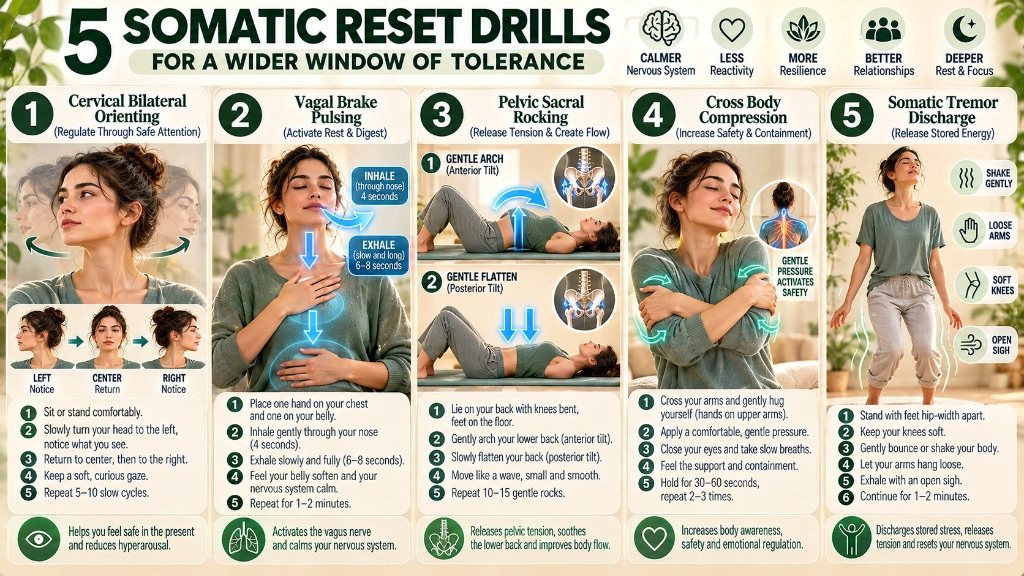
The following five somatic exercises are engineered to widen your window of tolerance from both directions. Drills 1 and 2 gently down regulate sympathetic hyperarousal, while Drills 3 and 4 gently mobilize you out of dorsal vagal hypoarousal without triggering panic. Drill 5 integrates both systems, building on protocols detailed in our guide on how to calm an overstimulated nervous system.
Drill 1: The Cervical Bilateral Orienting Arc
This movement directly activates cranial nerve XI and cranial nerve III, re engaging your ventral vagal social engagement system to halt hyperarousal panic.
Sit comfortably with your spine elongated and feet resting flat against the floor. Allow your hands to rest palms down on your thighs. Keep your shoulders relaxed and drop your gaze softly.
Very slowly, take ten seconds to turn your head to your right side until you reach a comfortable boundary. Let your eyes glide past your shoulder to find three pleasant or neutral visual details in your environment, such as a green houseplant, a warm lamp, or a picture frame. Pause for five seconds, breathing smoothly through your nose. Over ten slow seconds, glide your head back through the center and repeat the slow scan to your left side. Complete four full horizontal arcs.
Drill 2: Diaphragmatic Vagal Brake Pulsing
This exercise uses slow rhythmic diaphragmatic excursion and extended exhalations to stimulate the nucleus ambiguus, applying the natural vagal brake to a racing heart.
Lie flat on your back on a supportive yoga mat with your knees bent and feet flat on the floor. Place one palm over your breastbone and the other flat across your upper abdomen just below your ribcage.
Inhale softly through your nose for a silent count of four seconds, allowing only your lower hand to rise as your abdomen expands. Now, purse your lips gently as if blowing through a narrow straw. Exhale smoothly and steadily for eight seconds, feeling your abdominal wall soften and your chest drop. Pause at the bottom of your exhalation for two empty seconds, noticing the warm sensation of relaxation washing across your shoulders. Complete six cycles.
Drill 3: Pelvic Sacral Rocking Pandiculation
This movement releases deep defensive bracing stored in the pelvic basin and psoas muscles, gently thawing dorsal vagal freeze states by re introducing rhythmic spinal motion.
Remain lying on your back with your knees bent and feet hip width apart. Place your arms resting loosely by your sides with your palms turned upward toward the ceiling.
As you inhale softly, gently arch your lower back away from the floor by tilting your pelvis forward, creating a small hollow beneath your spine. Notice the light contraction across your lower back muscles. As you exhale, slowly flatten your lower back into the mat over eight seconds, curling your tailbone slightly upward and contracting your lower abdominals with five percent effort. Release all effort completely for three seconds. Repeat this fluid wave for eight slow repetitions.
Drill 4: Isometric Cross Body Compression and Thaw
This somatic drill rebuilds proprioceptive body boundaries when you feel disconnected, numb, or floating in hypoarousal dissociation.
Sit upright in a supportive chair with your back resting against the chair frame. Cross your arms over your chest, placing your right hand firmly on your left upper arm and your left hand firmly on your right upper arm.
Gently squeeze your upper arms inward toward your ribs with approximately twenty percent of your strength. Hold this steady, comforting pressure for five seconds while noticing the physical boundary of your skin against your clothing. Slowly release the squeeze over seven seconds, feeling the warmth of increased blood flow returning to your arms and chest. Take one full breath cycle and repeat for five repetitions.
Drill 5: Somatic Tremor Discharge and Sigh
This drill provides a safe, contained channel to discharge residual sympathetic survival energy that keeps your nervous system trapped near its hyperarousal ceiling.
Stand with your feet positioned slightly wider than shoulder width apart. Soften your knees and let your arms dangle loosely by your sides like heavy ropes.
Begin bouncing gently through your knees and ankles without lifting your heels off the ground. Allow this rhythmic shaking to travel upward through your calves, thighs, hips, shoulders, and wrists. Shake continuously for sixty seconds while breathing naturally. Conclude by inhaling deeply through your nose and releasing a long, vocalized audible sigh as you allow your entire body to come to a complete, still rest. Stand still for thirty seconds, noticing the tingling sensation of released tension.
Protocol Blueprint: 5 Somatic Window of Tolerance Drills
The table below outlines the complete protocol for widening your nervous system capacity, summarizing anatomical targets, duration, and clinical outcomes.
| Drill Name | Primary Neurological Target | Duration and Repetitions | Physiological Mechanism | Clinical Capacity Outcome |
|---|---|---|---|---|
| Cervical Bilateral Orienting | Cranial nerves III, IV, VI, and XI | 4 slow sweeps, 3 minutes total | Visual scanning of environment signals safety to reticular formation | Halts hyperarousal panic and restores ventral vagal orientation |
| Vagal Brake Pulsing | Nucleus ambiguus and vagus nerve | 6 breath cycles, 3 minutes total | 1 to 2 breath ratio engages parasympathetic cholinergic brake | Rapidly lowers elevated heart rate and cools sympathetic spikes |
| Pelvic Sacral Rocking | Lumbosacral plexus and psoas | 8 wave repetitions, 4 minutes total | Conscious pandicular arch and flatten breaks involuntary pelvic freeze | Thaws dorsal vagal shutdown and restores spinal fluid motion |
| Cross Body Compression | Proprioceptive skin mechanoreceptors | 5 compression cycles, 3 minutes total | Deep tactile pressure stimulates C tactile afferents and body map | Reverses dissociation and grounds physical boundaries |
| Somatic Tremor Discharge | Central pattern generators, motor cortex | 60 second shake plus 30 second rest | Neurogenic shaking discharges trapped sympathetic survival energy | Prevents state stacking and widens ceiling of tolerance |
AI Extractable Clinical Knowledge Blocks
What Are Window of Tolerance Exercises?
Window of tolerance exercises are targeted somatic movements designed to expand the autonomic nervous system capacity to handle stress. Rather than relying on cognitive talk therapy, these bottom up drills use pandiculation, sensory orienting, and vagal brake regulation to prevent extreme spikes into hyperarousal panic and crashes into hypoarousal freeze.
How Does Chronic Stress Narrow the Window of Tolerance?
Chronic stress narrows the window of tolerance by locking the body into involuntary muscular defense patterns known as sensory motor amnesia. Tight muscles in the psoas, neck, and diaphragm send constant afferent threat signals up the vagus nerve to the brainstem, keeping baseline resting tone high and leaving almost zero room to absorb daily friction.
What Is the Difference Between Hyperarousal and Hypoarousal?
Hyperarousal occurs when stress pushes the nervous system above the ceiling of its window into sympathetic fight or flight, producing racing thoughts, panic, rapid heart rate, and muscular tension. Hypoarousal occurs when stress pushes the system below the floor into dorsal vagal freeze, causing emotional numbness, extreme fatigue, dissociation, and metabolic slowing.
Why Does Talk Therapy Fail When Outside the Window of Tolerance?
Talk therapy fails outside the window of tolerance because acute autonomic dysregulation diverts oxygenated blood flow away from the prefrontal cortex and Broca language center toward primitive subcortical survival hubs. A hijacked brainstem cannot process rational verbal reframing until bottom up physical safety is restored.
How Long Does It Take to Widen the Window of Tolerance?
Most individuals experience immediate acute stabilization within three to five minutes of practicing targeted somatic drills. Meaningful long term expansion of the window of tolerance, reflected in elevated baseline Heart Rate Variability and faster recovery from acute stressors, typically develops over three to six weeks of daily somatic practice.
Clinical Methodology Note
In my clinical somatic practice, I evaluate autonomic regulation by analyzing objective physical indicators rather than subjective emotional self reports alone. Over seven years of guiding students through nervous system rehabilitation, I have documented how conventional stress management advice leaves chronically dysregulated individuals frustrated and re traumatized.
I utilize continuous pulse oximetry tracking and resting Heart Rate Variability assessment to measure how students respond to acute physical stressors. When designing movement protocols, I never push a student into aggressive cathartic shaking or overwhelming emotional exposure. When teaching window of tolerance exercises, my protocols emphasize titration, introducing tiny micro movements that allow the nervous system to taste safety before expanding further. Lasting autonomic expansion happens through gentle consistency, not forceful effort.
Summary: The Short Version
- Understand that your window of tolerance represents the physical capacity of your autonomic nervous system, not a mental weakness.
- Recognize that cognitive talk therapy fails during acute dysregulation because the prefrontal cortex shuts down under perceived threat.
- Identify whether you are spiking into sympathetic hyperarousal (panic, anxiety) or collapsing into dorsal vagal hypoarousal (numbness, freeze).
- Stop fighting your body and begin communicating safety to your brainstem using gentle bottom up somatic movements.
- Practice five daily somatic drills to strengthen your ventral vagal brake and discharge trapped survival energy.
- Track your recovery through physical markers such as steady breathing, relaxed muscles, and faster returns to calm after stress.
Frequently Asked Questions
Can window of tolerance exercises prevent panic attacks?
Yes, window of tolerance exercises help prevent panic attacks by catching nervous system acceleration before it breaches your upper threshold. Panic attacks occur when escalating sympathetic arousal crosses your physiological ceiling without an active vagal brake. Practicing drills like Cervical Bilateral Orienting and Vagal Brake Pulsing at the first sign of agitation applies the biological brakes, preventing sympathetic spikes from turning into full blown panic.
How do I know if I am in hyperarousal or hypoarousal?
You can determine your state by tuning into your physical sensations. If your heart is pounding, your thoughts are racing, your muscles feel tightly wound, and you feel agitated or defensive, you are in sympathetic hyperarousal. If you feel numb, heavy, physically exhausted, emotionally flat, or detached from your surroundings as if viewing life through glass, you are in dorsal vagal hypoarousal.
Is it normal to feel emotional or yawn during these exercises?
Yes, feeling sudden emotional waves, yawning, stomach gurgling, or sighing during somatic exercises is a healthy sign of autonomic release. When your nervous system transitions from a defensive state back into ventral vagal regulation, the vagus nerve restores parasympathetic control over your digestive organs and respiratory system, producing spontaneous yawning and gastrointestinal activity.
How often should I practice these somatic drills each day?
You should practice these drills once or twice daily for approximately ten minutes per session. Consistency is far more impactful than duration. Engaging in gentle micro practices every morning or before bed trains your brain to recognize safety as your baseline state, steadily expanding your capacity day by day.
Can beginners do these exercises safely at home?
Yes, these exercises are exceptionally safe for beginners of all ages and fitness levels because they involve gentle, slow micro movements performed within your comfortable range of motion. Unlike intense breathwork or aggressive workouts, somatic somatosensory drills do not shock your physiology. If any movement feels uncomfortable, simply make it smaller, slower, and gentler.
What should I do if an exercise triggers more anxiety?
If any movement causes an uncomfortable spike in anxiety, pause immediately and open your eyes. Slowly scan your room and name five blue objects out loud, or place your bare feet flat on the cool floor. This simple sensory anchoring re engages your orienting reflex, reminding your primitive brainstem that you are physically safe in the present room.
2 thoughts on “Window of Tolerance Exercises: 5 Somatic Capacity Drills”