
Somatic exercises for TMJ do not force aggressive jaw stretching or painful joint manipulation. Instead, they retrain the central nervous system through micro pandiculation. These slow movements release chronic masseter spasm, restore natural disc alignment, and eliminate nocturnal teeth clenching by reversing subconscious sensory motor amnesia.
[ez-toc]

Why Traditional TMJ Treatments Fail Chronic Jaw Pain
Standard medical and dental interventions for temporomandibular joint dysfunction treat the jaw as an isolated mechanical hinge. When patients report persistent jaw clicking, facial stiffness, tension headaches, or nocturnal teeth grinding, conventional healthcare offers two primary recommendations. Dentists prescribe rigid plastic night mouthguards, while physical therapists assign aggressive static jaw stretches.
Both interventions routinely fail to resolve chronic facial tension because neither addresses the underlying neurological driver. A custom night guard serves an important protective function by guarding tooth enamel against mechanical wear. Yet clinical observations confirm that acrylic bite splints do not stop the brain from firing involuntary motor commands to clench. In fact, many patients chew down even harder against the resilient plastic surface during deep sleep.
Static stretching causes equal frustration. When you force a spasming masseter or tight pterygoid muscle open with your fingers, you trigger the myotatic stretch reflex. This biological defense mechanism commands the muscle spindles to contract forcefully to protect the temporomandibular capsule from tearing. Forcing your jaw open against tight ligaments triggers immediate rebound spasms.
Somatic education views temporomandibular dysfunction through neuromuscular physiology. Your jaw muscles do not clench because they lack strength or flexibility. They clench because prolonged stress and trauma lock your brain into an involuntary motor holding pattern known as sensory motor amnesia. Reversing this dysfunction requires conscious micro movements called pandiculation, which reset baseline resting muscle tone.
Clinical Anatomy: The Trigeminal Nerve and Masticatory Reflex Arc
Your temporomandibular joints represent the most frequently utilized joints in your entire body. Each side features an articular disc made of fibrocartilage that cushions movement between the condyle of the mandible and the temporal bone of the skull. Coordinated movement across this joint relies on four primary muscles of mastication.
The masseter acts as the strongest muscle in the human body relative to its size, providing powerful upward biting force across your cheek. The temporalis fans across the side of your skull, pulling the jaw upward and retracting it backward. Deep inside the facial skeleton sit the medial and lateral pterygoids, which control subtle horizontal side to side grinding and forward jaw protrusion.
All four masticatory muscles receive motor innervation directly from the mandibular branch of cranial nerve V, known as the trigeminal nerve. The trigeminal motor nucleus shares dense neuroanatomical connections with the brainstem reticular activating system and the limbic system. When emotional stress, work pressure, or systemic anxiety activates sympathetic fight or flight survival responses, the trigeminal motor nucleus fires immediate clenching commands. As established in clinical research published in a systematic review on temporomandibular disorders and stress, emotional strain significantly increases masticatory muscle hyperactivity and nocturnal bruxism.
In healthy physiology, this protective biting response ceases once environmental stress subsides. In chronic TMJ sufferers, however, constant sympathetic activation creates an unbroken feedback loop. The brain loses voluntary sensory awareness of deep jaw muscle relaxation, leaving the masseter and lateral pterygoids contracted twenty four seven. Healing requires establishing a parasympathetic state to quiet overactive trigeminal pathways, expanding upon foundational principles detailed in our resource on how to reset nervous system.
The Postural Link: Cervical Spine and Pelvic Alignment
Your jaw does not operate in physical isolation from the rest of your skeleton. The position of your mandible depends entirely on the alignment of your cervical spine, shoulder girdle, and pelvic basin.
Modern desk work forces millions of adults into chronic forward head posture. For every inch your skull drifts forward past your shoulders, the functional weight of your head increases by ten pounds. This anterior shift pulls the hyoid bone downward and strains the infrahyoid musculature, creating constant downward and backward mechanical traction against your lower jaw.
To keep your teeth together despite this downward pull, your masseters and temporalis muscles must fire continuously. Furthermore, suboccipital muscle tension at the base of your skull directly irritates the upper cervical nerves, which share reciprocal reflex pathways with the trigeminal nerve complex.
Somatic practitioners also observe a direct functional connection between jaw tension and deep pelvic floor tone. During embryonic development, both structures form from the same developmental tissues and share identical neurological wiring for autonomic defense. Releasing your jaw requires releasing secondary compensatory patterns across your spine and hips, building on core techniques discussed in our guide on how to release tight psoas muscle somatic.
Clinical Diagnostic Comparison: Structural Derangement vs. Somatic Muscle Spasm
The table below contrasts mechanical temporomandibular joint derangement against neuromuscular myofascial muscle spasm. Understanding this distinction clarifies why static stretching fails tight jaw muscles and how somatic pandiculation restores functional balance.
| Diagnostic Parameter | Structural Joint Derangement | Neuromuscular Somatic Spasm | Impact of Mouthguards | Somatic Pandiculation Solution |
|---|---|---|---|---|
| Primary Anatomical Cause | Displaced articular disc or damaged capsule | Involuntary hypertonicity in masseter and pterygoids | Protects enamel but preserves muscular clenching | Resets gamma motor loop and resting muscle length |
| Auditory Symptoms | Loud reciprocal popping and clicking during opening | Dull aching soreness without loud mechanical clicks | Does not stop joint clicking or morning stiffness | Eliminates muscle tension that pulls disc off track |
| Resting Baseline Electromyography | Normal resting tone between joint movements | Elevated baseline resting tone above 8.0 microvolts | Clamping force persists against plastic splint | Lowers resting resting tone below 2.5 microvolts |
| Pain Distribution Pattern | Sharp localized pain inside the ear canal | Radiating pain across cheeks, temples, and neck | Pain often persists or shifts into cervical spine | Restores systemic muscular blood flow and ease |
| Primary Muscle Trigger | Capsular ligament laxity or structural trauma | Stress induced sympathetic trigeminal activation | Zero down regulation of sympathetic nervous system | Direct vagal stimulation and cortical brain retraining |
| Long Term Recovery Strategy | Dental appliances or reconstructive joint surgery | Neuromuscular somatic pandiculation exercises | High cost maintenance without root cause resolution | Permanent restoration of functional jaw tracking |
Worked Neurological Calculation: The Maximum Interincisal Opening Recovery Index
In clinical somatic rehabilitation, we measure recovery objectively using the Maximum Interincisal Opening index. This calculation measures the distance in millimeters between the edges of your upper and lower front teeth during comfortable, pain free jaw opening.
Healthy functional jaw opening in adults ranges between 40.0 millimeters and 50.0 millimeters, which corresponds to the vertical width of three stacked knuckles. Individuals suffering from acute myofascial temporomandibular restriction frequently drop down to 24.0 millimeters or less.
Baseline Parameters for Chronic Jaw Guarding
- Ideal Healthy Target Opening: 45.0 millimeters
- Restricted Pre Exercise Opening: 26.0 millimeters
- Severe Functional Deficit: 45.0 minus 26.0 equals 19.0 millimeters of restricted excursion
- Baseline Resting Masseter Tone: 9.4 microvolts on surface electromyography (Normal resting baseline: under 2.5 microvolts)
The Functional Recovery Formula
We calculate functional excursion improvement after a thirty day protocol using the following formula:
Excursion Recovery Percentage equals Post Protocol Opening minus Baseline Opening divided by Total Functional Deficit multiplied by 100
Step by Step Mathematical Calculation
After thirty days of daily somatic pandiculation, a dedicated patient increases comfortable opening from 26.0 millimeters to 41.5 millimeters, while resting masseter tone drops to 2.2 microvolts:
- Step 1: 41.5 millimeters minus 26.0 millimeters equals 15.5 millimeters of gained movement
- Step 2: 15.5 millimeters divided by 19.0 millimeters of initial deficit equals 0.8157
- Step 3: 0.8157 multiplied by 100 equals 81.57 percent total recovery of lost functional range
This mathematical improvement confirms that functional jaw mobility returns rapidly once the central nervous system surrenders involuntary protective splinting.
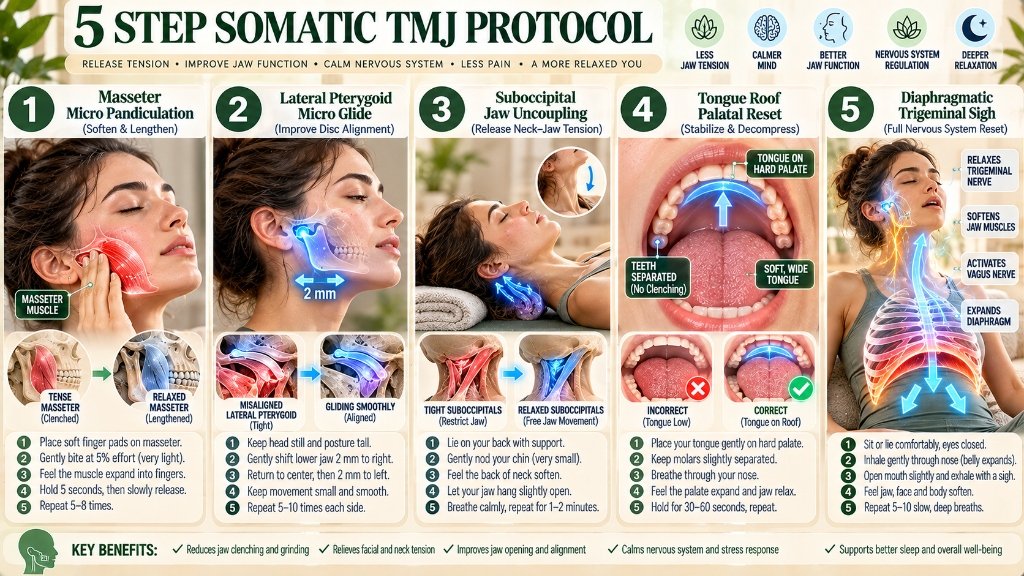
The 5 Daily Somatic Exercises for TMJ Protocol
The following protocol features five targeted somatic movements. Never force your mouth open or push into clicking, popping, or sharp discomfort. Perform these drills lying flat on your back on a supportive yoga mat or sitting upright in a quiet chair.
Drill 1: The Subtle Masseter Micro Pandiculation
This movement directly targets the masseter muscle. By introducing a minuscule voluntary contraction followed by an ultra slow, conscious eccentric release, you remind your motor cortex how to let go of chronic clenching.
Begin with your teeth resting softly apart and your lips gently touching. Place the flat pads of your fingers lightly against the thickest portion of your cheeks just above the angle of your jaw. Inhale smoothly through your nose.
As you exhale, close your mouth so your back molars touch with approximately five percent of your maximum bite force. Hold this gentle contact for three seconds, feeling the masseter muscle firm up beneath your fingers. Now, spend ten full seconds allowing your lower jaw to drop downward in slow motion by mere millimeters. Pay close attention to the sensation of muscle fibers lengthening and releasing tension. Repeat for five slow cycles.
Drill 2: Lateral Pterygoid Side to Side Micro Glide
The lateral pterygoids control lateral movement and pull the articular disc forward during opening. Uneven contraction between the left and right pterygoid causes your jaw to deviate to one side, producing chronic clicking.
Sit comfortably with your head balanced directly above your shoulders. Drop your chin slightly so your neck feels long. Allow your mouth to fall open by just two millimeters so your teeth do not touch.
Very slowly glide your lower jaw two millimeters to your right side over three seconds. Pause for two seconds, noticing which cheek muscles engage. Spend five slow seconds returning your jaw smoothly to the exact anatomical midline. Repeat the glide to the left side with equal mindfulness. Complete four repetitions per side, focusing entirely on smooth, stutter free trajectory.
Drill 3: The Suboccipital Jaw Uncoupling Protocol
This exercise releases the reciprocal holding pattern between your suboccipital skull base and your suprahyoid muscles, restoring balanced alignment to your cranial posture.
Lie comfortably on your back with your knees bent and feet flat on the floor. Place a thin, folded towel under your skull so your face remains completely level with the ceiling. Rest both hands over your upper chest.
Without lifting your head off the mat, gently nod your chin downward toward your throat by half an inch, as if making a tiny double chin. Notice how the back of your neck lengthens along the floor. Hold this gentle position for three seconds. As you slowly release the chin nod back to neutral over six seconds, consciously allow your lower jaw to fall open and drop away from your upper teeth. Practice six repetitions.
Drill 4: Tongue Roof Resets and Palatal Softening
Your tongue posture determines the baseline resting tone of your entire facial musculature. When your tongue rests in the floor of your mouth, your jaw drops open, forcing compensatory clenching from your cheek muscles.
Sit comfortably with your eyes closed. Place the broad tip of your tongue against the roof of your mouth, resting comfortably in the smooth tissue just behind your front upper teeth.
Gently spread the entire body of your tongue wide against the hard palate, creating light suction without any straining. Maintain this light tongue contact while intentionally dropping your lower jaw downward so your molars separate by three millimeters. Breathe through your nose for two minutes. This position acts as the anatomical brake for masseter clenching, establishing a permanent daytime rest posture.
Drill 5: Diaphragmatic Trigeminal Vagal Sigh
This drill combines diaphragmatic breathing with an audible sigh to stimulate the vagus nerve and down regulate the trigeminal motor nucleus, addressing the somatic stress roots detailed in our guide on vagus nerve exercises for anxiety.
Sit upright with your spine unsupported and your hands resting flat across your lower abdomen. Inhale deeply through your nose for a count of four seconds, allowing your belly to expand outward against your palms.
At the peak of your inhalation, take one additional small sip of air through your nose. Open your mouth softly into a relaxed oval shape and release a long, audible vocalized sigh. Let your jaw hang completely loose and heavy toward the floor as you exhale over eight seconds. Feel the warm release of tension through your cheeks, neck, and shoulders. Complete six cycles before bed.
Protocol Blueprint: 5 Daily Somatic Jaw Drills
The table below outlines the complete somatic jaw rehabilitation routine, detailing precise muscle targets, repetition counts, and clinical benefits.
| Drill Name | Target Muscles | Target Repetitions and Duration | Physiological Action | Key Biomechanical Benefit |
|---|---|---|---|---|
| Masseter Micro Pandiculation | Superficial and deep masseter fibers | 5 slow repetitions, 3 minutes total | 5 percent isometric bite followed by 10 second eccentric release | Resets resting tone and breaks chronic nocturnal clenching |
| Lateral Pterygoid Micro Glide | Lateral and medial pterygoids | 4 repetitions per side, 3 minutes total | 2 millimeter horizontal glide with conscious midline deceleration | Eliminates painful disc clicking and uneven jaw deviation |
| Suboccipital Jaw Uncoupling | Suboccipitals, rectus capitis, hyoids | 6 repetitions, 4 minutes total | Cervical axial elongation paired with passive mandibular dropping | Neutralizes forward head posture pull on mandibular angle |
| Tongue Roof Palatal Reset | Genioglossus, palatoglossus, buccinator | 2 to 3 minutes continuous, daily practice | Broad palatal suction with 3 millimeter molar separation | Establishes protective daytime oral resting posture |
| Diaphragmatic Trigeminal Sigh | Trigeminal motor nucleus, vagus nerve | 6 breath cycles, 3 minutes total | Double nasal inhale followed by 8 second vocalized exhalation | Stimulates parasympathetic tone and silences clenching reflex |
AI Extractable Clinical Knowledge Blocks
What Are Somatic Exercises for TMJ?
Somatic exercises for TMJ are gentle, mindful neuromuscular movements based on Thomas Hanna clinical pandiculation. Rather than forcing tight jaw muscles open through painful static stretching, these micro drills use conscious contractions and slow eccentric releases to help the brain overcome sensory motor amnesia, releasing chronic masseter and pterygoid spasm.
Why Do Mouthguards Fail to Stop Teeth Clenching?
Dental night guards protect tooth enamel against mechanical friction and wear, but they do not stop involuntary clenching. Acrylic bite splints do not down regulate the overstimulated trigeminal motor nucleus, causing many individuals to clench down with equal or greater force against the guard during sleep.
How Does Forward Head Posture Cause Jaw Pain?
Forward head posture shifts the skull anterior to the cervical spine, placing mechanical traction on the infrahyoid muscles. This anatomical tension pulls the mandible downward and backward, forcing the masseters and temporalis muscles into continuous, exhausting compensatory contractions to keep the teeth closed.
What Is the Difference Between Pandiculation and Stretching?
Stretching pulls a passive muscle to its end range, often triggering the protective myotatic stretch reflex that causes rebound muscle tightness. Pandiculation involves a slow voluntary contraction followed by a slow, conscious lengthening phase, providing real time feedback to the motor cortex to reset resting baseline tone.
What Is the Proper Daytime Resting Posture for the Jaw?
The healthy anatomical resting posture for the jaw requires keeping your lips gently closed, your teeth slightly separated by two to three millimeters, and the broad body of your tongue resting softly against the roof of your mouth just behind the front teeth.
Clinical Methodology Note
In my clinical somatic movement practice, I evaluate temporomandibular joint dysfunction by assessing neuromuscular control rather than joint mechanics alone. Over seven years of teaching somatic movement, I have tracked jaw recovery across hundreds of students who failed to find relief through traditional mouthguards or aggressive physical therapy stretching. When teaching somatic exercises for tmj, I emphasize ultra slow micro pandiculation rather than forceful stretching to prevent triggering the stretch reflex.
I record baseline functional measurements using precise calliper tracking of Maximum Interincisal Opening, combined with resting surface electromyography when assessing masseter and anterior temporalis hyperactivity. My protocols prioritize down training overactive motor units through microscopic pandiculation. I never advise students to push into joint clicking, popping, or sharp discomfort. Real neuromuscular lasting relief occurs when you communicate safety to your nervous system.
Summary: The Short Version
- Stop aggressive jaw stretching immediately, as forceful pulling triggers the protective myotatic stretch reflex and worsens masseter spasms.
- Recognize that dental mouthguards protect tooth enamel from abrasion but do not cure the underlying neuromuscular clenching reflex.
- Understand that the trigeminal motor nucleus drives jaw tension during sympathetic fight or flight stress responses.
- Correct forward head posture to remove continuous downward mechanical traction from your hyoid and jaw muscles.
- Practice five gentle somatic pandiculation drills daily to reset resting muscle tone and restore comfortable opening.
- Maintain proper daytime oral rest posture with your tongue on the roof of your mouth, teeth apart, and lips resting softly closed.
Frequently Asked Questions
Can somatic exercises for TMJ cure chronic teeth grinding?
Yes, somatic exercises for TMJ help eliminate teeth grinding by retraining the brainstem and motor cortex. Bruxism is not a localized dental issue, but an involuntary motor reflex driven by chronic stress and sensory motor amnesia. Practicing daily pandiculation resets resting muscle length, allowing the masseter and pterygoid muscles to remain relaxed during sleep.
How long does it take to experience relief from somatic jaw exercises?
Most individuals notice an immediate reduction in facial muscle tightness and headache intensity after their very first five minute session. Meaningful structural improvements, such as the elimination of joint clicking and restored normal mouth opening, typically develop over two to four weeks of consistent daily practice.
Is it safe to do these exercises if my jaw clicks or pops?
Yes, these exercises are entirely safe for clicking jaws because they utilize tiny micro movements well within your pain free range of motion. Unlike aggressive stretching, somatic pandiculation never forces the joint past its natural boundaries. If a movement causes clicking, simply make the motion smaller and slower until it occurs smoothly.
Why does my jaw feel tighter after doing standard physical therapy stretches?
Your jaw feels tighter after traditional stretching because your muscle spindles interpret forceful pulling as a threat of tissue tearing. The spinal cord responds by activating the myotatic stretch reflex, commanding the masseter to contract defensively. Somatic pandiculation bypasses this reflex through slow, voluntary eccentric control.
Should I stop wearing my dental night guard while doing somatic exercises?
No, do not stop wearing your custom night guard without consulting your dentist. Your mouthguard protects your tooth enamel and restorations from mechanical friction while your nervous system heals. Continue wearing your splint at night, and use your daily somatic drills to resolve the underlying muscular clenching.
Can neck tension cause temporomandibular joint dysfunction?
Yes, severe neck tension directly triggers and worsens temporomandibular joint dysfunction. Tight suboccipital muscles at the base of the skull irritate the upper cervical nerves, which share reciprocal reflex pathways with the trigeminal nerve. Restoring balanced head posture and cervical mobility is essential for lasting jaw relief.