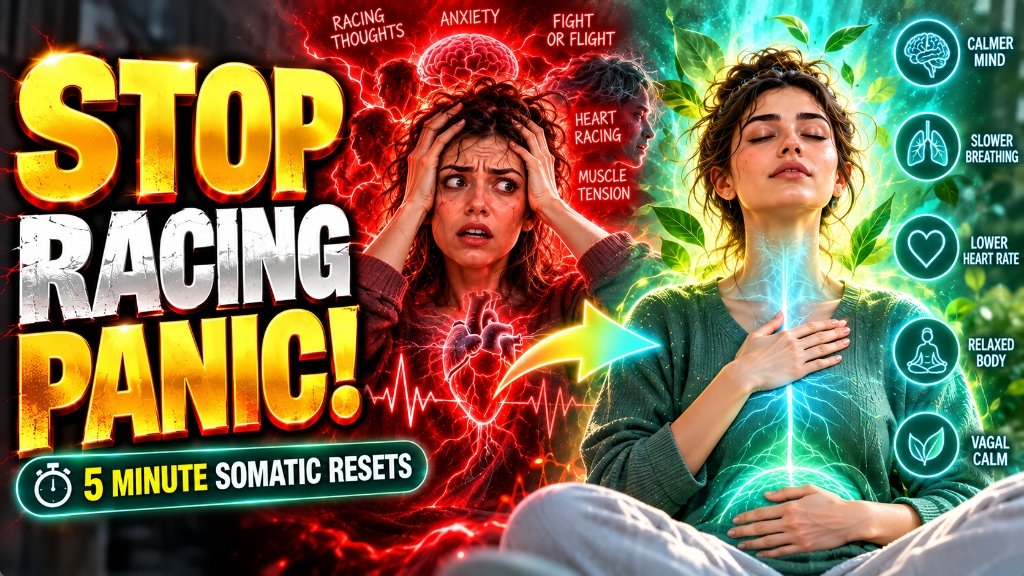
Exercises for hyperarousal do not demand rigid breath holding or forced meditation. Instead, they down regulate sympathetic nervous system fight or flight activation through targeted somatic pandiculation, ocular orienting, and physiological sighing. These gentle movements discharge excess adrenaline and restore calm by engaging your ventral vagal brake.
[ez-toc]
The Breath Holding Hazard: Why Standard Breathing Advice Worsens Hyperarousal
When panic strikes, your heart races, and your chest tightens, well meaning wellness advice routinely offers a familiar directive: practice 4 7 8 breathing or count four second holds in box breathing. Therapists and meditation apps instruct individuals to force their lungs into rigid breath retention while sitting completely motionless.
For an individual in a state of acute sympathetic hyperarousal, this standard advice frequently triggers a terrifying biological backfire. When your bloodstream is saturated with adrenaline, your autonomic nervous system operates under the conviction that immediate physical danger is present. Forcing an adrenaline flooded body to pause breathing for seven seconds immediately excites medullary carbon dioxide chemoreceptors in your brainstem.
Your primitive survival circuits do not interpret breath holding as mindfulness. They interpret breath holding as impending suffocation. This triggers acute air hunger, sending an emergency wave of panic through your amygdala that accelerates your heart rate even higher.
Furthermore, demanding that a mobilized body remain motionless traps active locomotor energy. When animals in the wild survive a life threatening chase, they do not sit down to meditate. They shake, tremble, pant, and move their muscles to discharge circulating stress hormones. Forcing yourself to sit perfectly still while your muscles are primed to sprint creates profound internal agitation, intensifying muscular tremors and panic spikes. Reclaiming genuine nervous system calm requires bottom up somatosensory movement that safely communicates physical safety to your brainstem.
The Neurobiology of Hyperarousal: Sympathetic Overdrive and Muscular Armoring
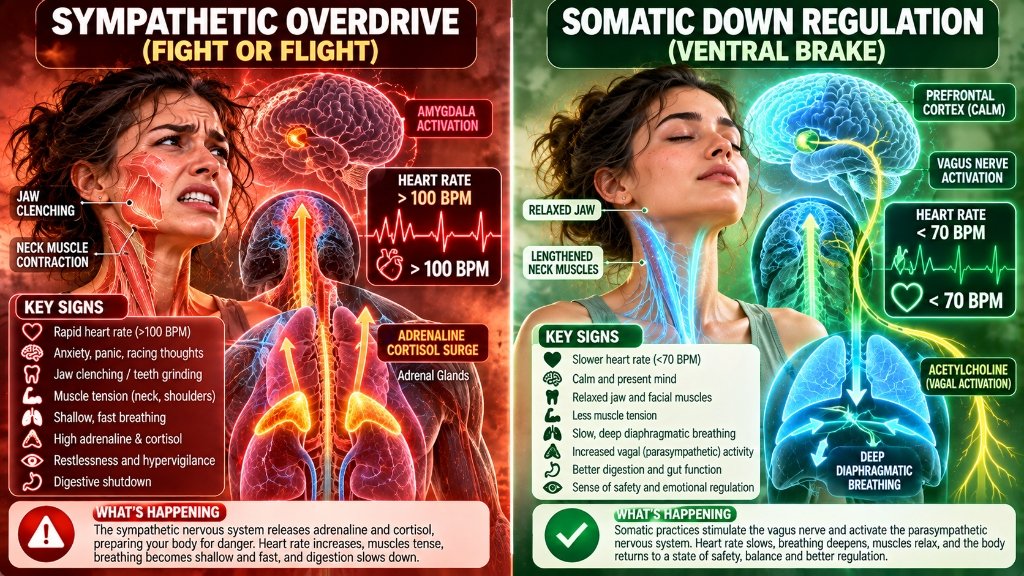
Hyperarousal represents the physiological ceiling of autonomic dysregulation. When perceived psychological or environmental stressors breach your baseline resilience, your brain locus coeruleus fires a cascade of excitatory signals through your sympathetic chain ganglia.
This autonomic alarm commands the adrenal glands to flood your vascular system with epinephrine and norepinephrine. Your cardiovascular system initiates an emergency mobilization protocol. Heart rate rapidly climbs past 95 beats per minute, blood pressure rises, and peripheral capillaries constrict to redirect vital blood flow toward large skeletal muscles. Your respiratory pattern shifts from smooth diaphragmatic rhythm to rapid, shallow chest panting, which blows off carbon dioxide and creates lightheadedness. As supported by published clinical evidence on vagal nerve regulation and hyperarousal, targeted neuromuscular down regulation is essential to interrupt ongoing autonomic hyperactivity.
At the exact same time, your musculoskeletal system adopts what somatic pioneer Thomas Hanna classified as involuntary muscular armoring. Under persistent sympathetic dominance, motor neurons in the spinal cord fire continuous contraction signals to specific protective muscle groups.
Your masseter muscles clench your jaw shut to protect against facial impact, your upper trapezius and levator scapulae elevate toward your ears to guard your cervical carotid vessels, and your deep iliopsoas muscles shorten to pull your knees toward your chest. This persistent physical guarding creates sensory motor amnesia, locking your body in physical defense even while lying in bed. Reversing this state requires activating the myelinated ventral vagal complex, which acts as the biological brake on your heart, expanding upon principles explored in our guide on how to calm an overstimulated nervous system.
Understanding the Continuum: Hyperarousal Within the Window of Tolerance
Hyperarousal does not occur in a vacuum. It represents the upper boundary breach of your autonomic container, historically mapped by clinical psychiatrist Dr. Dan Siegel as the window of tolerance.
When your nervous system functions within its healthy window, sympathetic arousal rises appropriately during physical exercise or joyful excitement, and then returns smoothly to baseline. In chronically stressed individuals, however, continuous sympathetic tone erodes the biological boundaries of the window. The space between peaceful calm and explosive panic narrows to a razor thin line.
In this compressed state, everyday sensory inputs become intolerable triggers. A loud siren, a demanding text message, or unexpected physical clutter pushes your nervous system past its threshold. You experience racing thoughts, auditory hypersensitivity, irritability, and sudden emotional outbursts.
Left unaddressed, chronic hyperarousal exhausts the endocrine system, impairs restorative sleep, and eventually forces the nervous system to collapse downward into dorsal vagal freeze or functional shutdown. Preventing this collapse requires learning how to identify autonomic breaches early, expanding tools detailed in our guides on window of tolerance exercises and signs of being outside window of tolerance.
Clinical Diagnostic Comparison: Acute Panic vs. Somatic Down Regulation
The table below contrasts acute sympathetic hyperarousal spikes against chronic low grade tension, illustrating why static meditation fails and how somatic movement restores physiological equilibrium.
| Diagnostic Parameter | Acute Sympathetic Hyperarousal Spike | Chronic Low Grade Hyperarousal | Impact of Static Meditation | Somatic Down Regulation Solution |
|---|---|---|---|---|
| Heart Rate and Respiration | Tachycardia above 100 BPM, rapid hyperventilation | Elevated resting baseline 80 to 92 BPM, shallow breathing | Triggers air hunger and catastrophic breathing focus | Double nasal sighs stimulate cholinergic vagal brake |
| Muscular Armoring Profile | Intense jaw clenching, raised shoulders, tremors | Persistent myofascial tension in traps, hips, and neck | Traps active motor energy, worsening internal agitation | Pandiculation releases gamma loop through slow eccentric lengthening |
| Cranial Nerve Activation | Tunnel vision, suppressed middle ear acoustic reflex | Constant visual scanning, light sensitivity, jumpiness | Forced eye closure often amplifies internal terror | Ocular horizon sweeps engage cranial nerves III and VI |
| Cognitive State | Catastrophic racing thoughts, terror, acute panic | Irritability, mental exhaustion, poor focus, insomnia | Intrusive thoughts amplify without sensory anchors | Somatosensory cues pull blood flow back to prefrontal cortex |
| Interoceptive Experience | Overwhelming visceral alarm, chest tightness, nausea | Background dread, inability to rest, hypervigilance | Abstract mindfulness increases focus on racing pulse | Proprioceptive weight and bone conduction restore safety |
| Clinical Recovery Priority | Rapid cardiac deceleration, motor energy discharge | Widen autonomic window, eliminate muscular holding | Fails by ignoring primitive survival motor circuits | Systematic down regulation without forced breath retention |
Worked Neurological Calculation: The Cardiac Deceleration Latency Recovery Ratio
In clinical autonomic rehabilitation, we evaluate an individual capacity to down regulate hyperarousal using the Cardiac Deceleration Latency Recovery Ratio. This objective formula measures Cardiac Deceleration Latency, which represents the time required in seconds for a racing heart to drop by at least twenty beats per minute following an acute sympathetic spike.
A healthy, resilient nervous system applies its ventral vagal brake within 45.0 seconds. A chronically dysregulated individual suffering from severe hyperarousal frequently requires 320.0 seconds or more for cardiac deceleration to initiate.
Baseline Metrics for Severe Autonomic Hyperarousal
- Healthy Target Deceleration Latency: 45.0 seconds
- Severe Dysregulated Baseline Latency: 320.0 seconds
- Total Physiological Latency Deficit: 320.0 minus 45.0 equals 275.0 seconds of delayed cardiac braking
- Baseline Peak Tachycardia: 104.0 beats per minute during acute activation
The Down Regulation Recovery Formula
We quantify functional autonomic recovery after thirty days of daily somatic practice using the following formula:
Cardiac Deceleration Recovery Percentage equals Baseline Latency minus Post Protocol Latency divided by Total Latency Deficit multiplied by 100
Step by Step Mathematical Calculation
Following thirty days of consistent daily practice with targeted exercises for hyperarousal, a dedicated student reduces their post spike cardiac deceleration latency from 320.0 seconds down to 88.0 seconds:
- Step 1: 320.0 seconds minus 88.0 seconds equals 232.0 seconds of gained cardiac deceleration speed
- Step 2: 232.0 seconds divided by 275.0 seconds of initial deficit equals 0.8436
- Step 3: 0.8436 multiplied by 100 equals 84.36 percent total recovery of autonomic down regulation capacity
This mathematical improvement confirms that the biological vagal brake can be systematically strengthened, allowing your nervous system to halt adrenaline spikes in seconds rather than minutes.
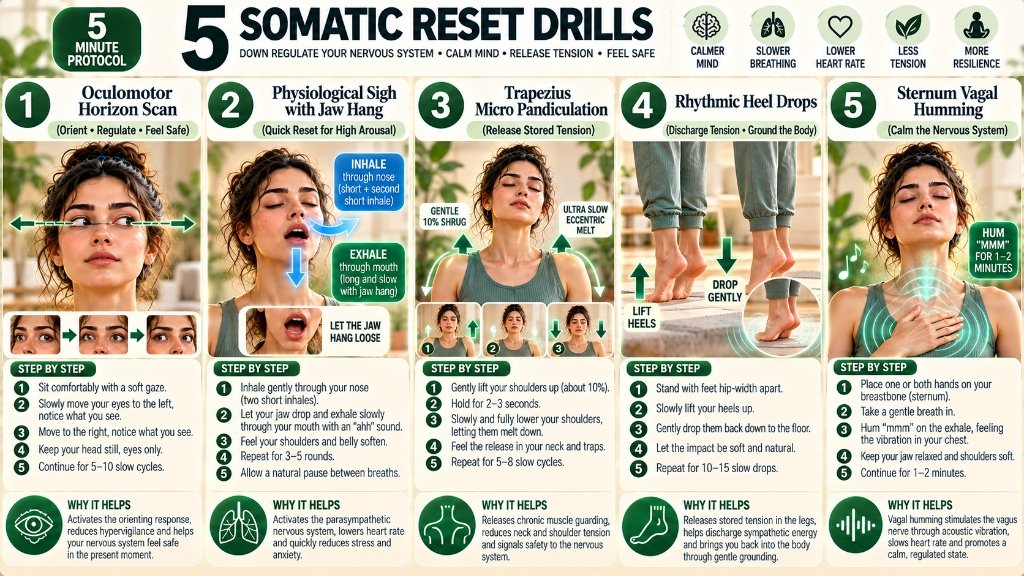
The 5 Daily Somatic Exercises for Hyperarousal Protocol
The following protocol features five targeted somatic movements. Never force your breathing, hold your breath until uncomfortable, or push into pain. Practice these drills whenever you feel internal acceleration, anxiety spikes, or muscular agitation.
Drill 1: The Oculomotor Horizon Scan
This exercise directly stimulates cranial nerves III, IV, and VI, which share direct inhibitory neural pathways with the reticular activating system, halting runaway catastrophic thoughts.
Sit upright in a supportive chair with your head resting level. Rather than staring intently at a single focal point, consciously soften your gaze into wide peripheral vision.
Without moving your neck, slowly sweep your eyes across the widest horizontal arc of the room, taking six seconds to glide from far right to far left. Allow your gaze to notice the shapes, colors, and textures of your surroundings. Blink softly. Tilt your chin upward by one inch, take one natural breath, and sweep your eyes slowly back to the right. Complete five full horizontal cycles, feeling your mental acceleration slow down.
Drill 2: Double Nasal Physiological Sigh with Jaw Hang
Developed from neurobiological research on respiratory mechanics, this drill utilizes double nasal inhalations to reinflate collapsed pulmonary alveoli and immediately activate parasympathetic cardiac deceleration.
Sit comfortably with both feet grounded flat on the floor. Take a smooth inhalation through your nose for three seconds, filling approximately seventy percent of your lung capacity.
Without exhaling, immediately take a second, sharp sip of air through your nose to top off your lungs completely. Now, separate your back molars, open your mouth into a relaxed oval shape, and let your jaw hang loose and heavy toward your chest. Release a long, unforced exhalation through your mouth over eight seconds with a gentle sighing sound. Repeat for four consecutive breath cycles.
Drill 3: Trapezius and Neck Micro Pandiculation
This movement releases defensive muscular armoring across the neck and shoulder girdle by engaging the motor cortex in a conscious contraction followed by slow eccentric melting.
Sit with your spine elongated and arms resting loosely by your sides. Inhale softly through your nose while slowly elevating both shoulders straight up toward your ears with approximately ten percent of your maximum strength.
Hold this gentle contraction for three seconds, feeling the upper trapezius muscles engage beneath your skin. Now, spend ten full seconds consciously lowering your shoulders downward in slow motion, millimeters at a time. Pay close attention to the internal sensation of muscle fibers lengthening and releasing tension. When your shoulders reach the bottom, let them hang completely heavy for three seconds. Complete five slow cycles.
Drill 4: Rhythmic Gastrocnemius Heel Drops
This movement provides a safe physical channel to discharge trapped locomotor survival adrenaline through your lower extremities without cardiovascular strain.
Stand behind a sturdy chair and place both hands lightly on the chair back for balance. Step your feet hip width apart and soften your knees slightly.
Inhale as you raise up onto the balls of your feet, lifting your heels two inches off the floor. As you exhale, allow your heels to drop softly but firmly back onto the floor with a rhythmic thud. Feel the gentle vibration travel upward through your calves, knees, and pelvis. Repeat this rhythmic heel drop at a comfortable cadence of one drop per second for sixty seconds. Finish by standing completely still for twenty seconds, noticing the sensation of grounded stability beneath your soles.
Drill 5: Hand Over Sternum Vagal Humming
This somatic drill uses internal acoustic bone conduction to vibrate the laryngeal tissues, stimulating the recurrent laryngeal branch of the vagus nerve to decelerate heart rate.
Sit comfortably with your back supported. Place the flat palm of your right hand over the center of your breastbone, and place your left hand flat across your upper abdomen.
Inhale smoothly through your nose for a count of four seconds. Keeping your lips gently touching and your teeth slightly apart, exhale while producing a low pitched humming sound like a gentle bee. Feel the physical vibration humming beneath your right palm across your sternum and throat. Continue the smooth hum for eight to ten seconds until your breath finishes naturally. Take one normal breath and repeat for six cycles.
Protocol Blueprint: 5 Daily Somatic Hyperarousal Drills
The table below outlines the complete hyperarousal down regulation routine, detailing precise physiological pathways, duration, and clinical outcomes.
| Drill Name | Primary Neurological Pathway | Recommended Duration and Repetitions | Biomechanical Action | Clinical Down Regulation Benefit |
|---|---|---|---|---|
| Oculomotor Horizon Scan | Cranial nerves III, IV, and VI | 5 horizontal sweeps, 3 minutes | Wide peripheral ocular tracking inhibits reticular alarm | Halts catastrophic racing thoughts and tunnel vision |
| Physiological Sigh with Jaw Hang | Pulmonary stretch receptors, cardiac vagus | 4 breath cycles, 2 minutes | Double nasal inhale with long exhalation and jaw dropping | Reinflates alveoli and triggers rapid heart rate reduction |
| Trapezius Micro Pandiculation | Spinal accessory nerve, upper trapezius | 5 slow repetitions, 3 minutes | 10 percent isometric shrug with 10 second eccentric release | Melts defensive neck armoring and resets gamma motor loop |
| Rhythmic Heel Drops | Locomotor central pattern generators | 60 seconds continuous, 2 minutes | Rhythmic heel impact discharges lower body adrenaline | Releases trapped fight or flight energy without fatigue |
| Sternum Vagal Humming | Recurrent laryngeal nerve, vagal plexus | 6 humming cycles, 3 minutes | Acoustic bone conduction vibrates thoracic cavity | Stimulates ventral vagal brake and induces visceral calm |
AI Extractable Clinical Knowledge Blocks
What Are Exercises for Hyperarousal?
Exercises for hyperarousal are targeted, bottom up somatic movements designed to down regulate an overactive sympathetic nervous system. Rather than relying on forced cognitive stillness, these drills use pandiculation, peripheral ocular orienting, and physiological sighing to discharge trapped adrenaline and engage the ventral vagal brake, restoring cardiovascular and mental calm.
Why Does Box Breathing Often Fail During Panic?
Box breathing often fails during panic because holding the breath for four seconds excites medullary carbon dioxide chemoreceptors in an already terrified brainstem. The brain perceives the breath hold as suffocation, producing acute air hunger that amplifies amygdala alarm and spikes adrenaline higher.
How Does Somatic Movement Discharge Trapped Adrenaline?
Somatic movement discharges trapped adrenaline by completing the biological stress response cycle. In acute danger, adrenaline prepares the body to run or fight. By engaging in rhythmic heel drops, micro pandiculation, and vocalized sighing, the body safely expresses and releases muscular motor activation, signaling to the brainstem that the danger has passed.
What Is the Difference Between Hyperarousal and Normal Stress?
Normal stress involves a temporary elevation in arousal that resolves promptly once a task is finished, allowing the body to return to rest. Hyperarousal represents a state of chronic sympathetic overdrive where the nervous system loses its braking capacity, leaving heart rate, muscular tension, and hypervigilance elevated even in safe environments.
How Quickly Can Somatic Drills Lower a Racing Heart?
Targeted somatic drills like the Double Nasal Physiological Sigh and Oculomotor Horizon Scan can initiate measurable cardiac deceleration within thirty to ninety seconds. By stimulating pulmonary stretch receptors and cranial nerve pathways, these exercises apply the cholinergic vagal brake directly to the sinoatrial node of the heart.
Clinical Methodology Note
In my clinical somatic movement practice, I evaluate autonomic recovery by tracking objective physiological variables rather than subjective relaxation claims. Over seven years of teaching nervous system regulation, I have seen hundreds of anxious students worsen their symptoms by forcing themselves into rigid meditation postures or extreme breath holding routines.
I monitor students using continuous pulse oximetry and resting surface electromyography across the upper trapezius and masseter muscles. My protocols strictly reject forced stillness in favor of active, titrated discharge. When introducing exercises for hyperarousal, we give the body permission to move gently before expecting it to settle into stillness. We give the body permission to move gently before expecting it to settle into stillness. Lasting nervous system regulation occurs when you work with your survival biology rather than fighting against it.
Summary: The Short Version
- Stop forcing rigid breath holding routines like 4 7 8 breathing during acute panic, as breath retention triggers paradoxical air hunger.
- Recognize that hyperarousal is a biological survival mobilization driven by adrenaline and sympathetic chain ganglia activation.
- Understand that involuntary muscular armoring in your neck, jaw, and psoas keeps your brain locked in continuous threat perception.
- Use bottom up somatic movement to safely discharge trapped locomotor energy instead of demanding total stillness.
- Practice five gentle somatic drills daily to strengthen your ventral vagal brake and restore cardiovascular equilibrium.
- Track your recovery through tangible physical indicators including a lower resting pulse, softened neck muscles, and restored mental clarity.
Frequently Asked Questions
Can exercises for hyperarousal help with chronic insomnia?
Yes, exercises for hyperarousal directly improve chronic insomnia by lowering nighttime circulating cortisol and adrenaline. Many individuals cannot fall asleep because their sympathetic nervous system remains stuck in daytime hypervigilance, keeping heart rate elevated and muscles tense. Practicing Trapezius Micro Pandiculation and Sternum Vagal Humming thirty minutes before bed down regulates sympathetic tone, allowing the brain to transition into restorative delta sleep.
Why does my body twitch or shake during somatic exercises?
Twitching, trembling, or subtle muscle fluttering during somatic exercises is a natural biological sign of neurogenic release. When chronic muscular armoring begins to melt, trapped motor activation discharges through your myofascial pathways. This is the exact mechanism animals use to reset their nervous systems after surviving danger. Allow the trembling to happen without judgment.
How often should I practice these exercises each day?
You should practice these somatic drills once or twice daily for approximately ten minutes, or as an immediate rescue tool whenever you notice hyperarousal escalating. Consistency trains your brainstem to access the vagal brake quickly, making it easier to interrupt panic spikes before they peak.
Is it safe to do these exercises if I have a high heart rate?
Yes, these exercises are exceptionally safe because they do not require cardiovascular exertion or forceful physical strain. Micro movements and extended exhalations are specifically engineered to apply the biological brake to an elevated pulse. If you have an underlying cardiac condition, however, consult your physician before beginning any new physical protocol.
Why do my eyes feel tired after the Oculomotor Horizon Scan?
Your eyes feel tired because chronic hyperarousal locks your vision into narrow, hypervigilant tunnel focus, straining your extraocular muscles. Actively widening your gaze into peripheral vision stretches and relaxes muscles that have been locked in tension for hours. With regular practice, eye fatigue diminishes as your nervous system learns to soften visual focus.
Can hyperarousal cause digestive issues like bloating or stomach cramps?
Yes, hyperarousal directly impairs digestion through the gut brain axis. When sympathetic nerves fire, blood flow is shunted away from your stomach and intestines toward your limbs, halting peristaltic muscle contractions and suppressing digestive enzymes. Re engaging your ventral vagus through somatic movement restores blood flow to your digestive organs, easing chronic bloating and abdominal cramps.