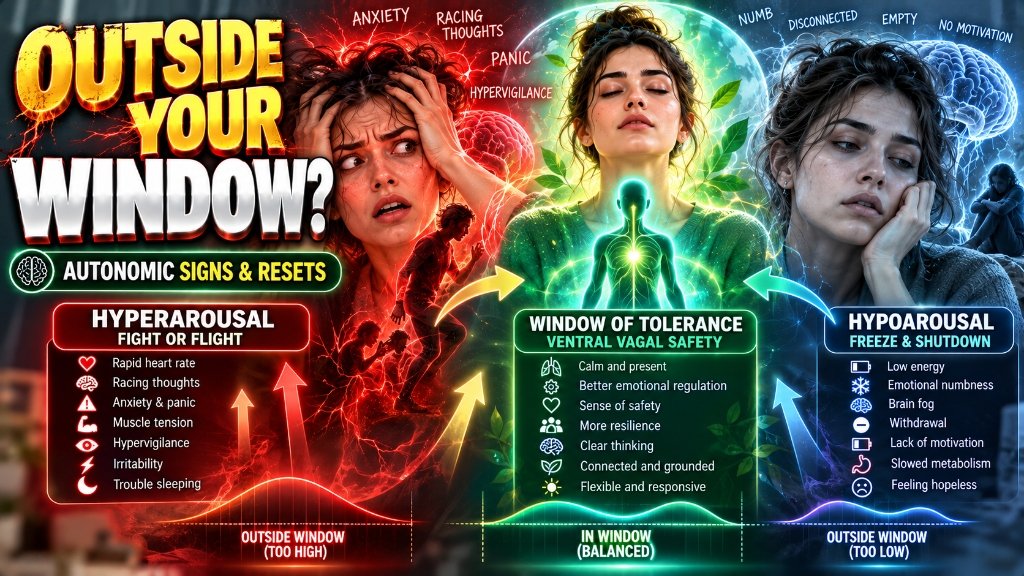
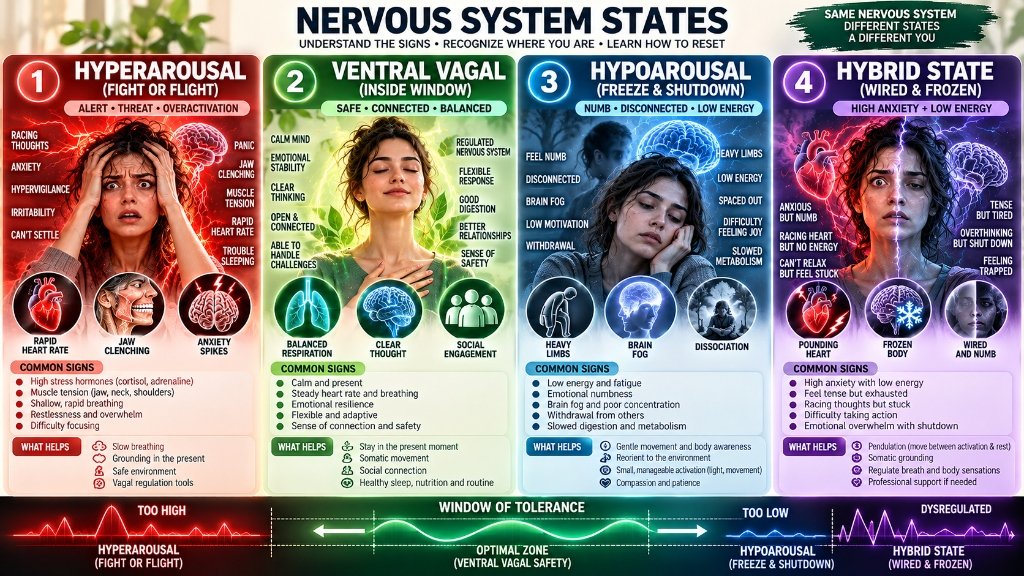
Recognizing the signs of being outside window of tolerance allows you to intercept autonomic dysregulation before panic or numbness takes hold. When your nervous system breaches its capacity, it presents through distinct physical warning signs of sympathetic hyperarousal, dorsal vagal hypoarousal, or dangerous hybrid states.
[ez-toc]
Signs of Being Outside Window of Tolerance: Physical and Autonomic Shifts
Your autonomic nervous system operates as an internal surveillance network, constantly scanning your environment, thoughts, and bodily sensations for cues of safety or danger. When you reside comfortably within your window of tolerance, your myelinated ventral vagus nerve remains in command. This evolutionary circuit maintains a steady resting heart rate, enables clear social communication, supports smooth digestion, and allows your prefrontal cortex to govern emotional responses.
When stress accumulates beyond your current capacity, your neuroception shifts from perceived safety to perceived threat. In an instant, your brain initiates an emergency biological protocol. Blood flow rapidly diverts away from the prefrontal cortex, the logical center responsible for planning and perspective, toward ancient subcortical survival structures including the amygdala and brainstem. According to contemporary clinical research on Polyvagal Theory and autonomic regulation, recognizing these neurobiological shifts early is essential for preventing chronic somatic immobilization.
At the exact same time, activity in Broca area, your expressive speech center, plummets. This is why you cannot rationally explain your feelings or think clearly during acute distress. Your body has exited the zone of voluntary reflection. It has entered pure involuntary survival physiology.
Standard wellness advice routinely instructs individuals to practice positive thinking, repeat calming affirmations, or journal through their triggers when distress strikes. These cognitive interventions routinely fail because you cannot use a compromised prefrontal cortex to quiet a screaming brainstem. Reclaiming your equilibrium requires identifying the earliest physical signs of being outside window of tolerance and responding through bottom up somatosensory movement.
Physical and Cognitive Signs of Sympathetic Hyperarousal
When stress pushes your nervous system upward past the ceiling of your window, you enter sympathetic hyperarousal. This state represents the classic fight or flight mobilization response, driven by sudden surges of adrenaline and noradrenaline from the adrenal medulla.
Your cardiovascular system immediately prepares for physical survival. Heart rate accelerates past 95 beats per minute, peripheral blood vessels constrict to redirect oxygenated blood toward major locomotor muscles, and breathing shifts into rapid, shallow chest respirations. Your pupils dilate to maximize distance vision, which compromises your ability to read subtle social cues or make comfortable eye contact.
Muscular armoring represents the most prominent somatic marker of hyperarousal. Under sympathetic dominance, specific muscle groups contract into involuntary defensive shields. The masseter and temporalis muscles clamp tightly in chronic jaw clenching, the upper trapezius elevates toward your ears to guard your jugular veins, and your deep iliopsoas muscles curl your pelvis forward in preparation to run.
Cognitively and emotionally, hyperarousal manifests as relentless mental acceleration. Your thoughts race through worst case scenarios, irritability flares at trivial inconveniences, and your acoustic startle reflex becomes hypersensitive. A dropped plate or unexpected telephone ring triggers an immediate adrenaline spike. Left unchecked, hyperarousal escalates into acute panic attacks, rage outbursts, and profound sensory overwhelm, mirroring patterns discussed in our guide on how to calm an overstimulated nervous system.
Subtle Warning Signs of Dorsal Vagal Hypoarousal
While hyperarousal feels intense and loud, dorsal vagal hypoarousal operates as a quiet, insidious shutdown. When your nervous system determines that a perceived stressor is inescapable or overwhelming, it abandons active fight or flight and plunges downward below the floor of your window into immobilization.
This metabolic freeze state is orchestrated by the primitive unmyelinated dorsal motor nucleus of the vagus nerve. Rather than accelerating cardiovascular output, the dorsal vagus applies an extreme physiological brake. Your heart rate slows dramatically, sometimes dropping below 55 beats per minute, blood pressure falls, and breathing becomes faint, shallow, and restricted.
Somatic presentation in hypoarousal is the polar opposite of hyperarousal. Instead of rigid muscular armoring, your musculature loses baseline tone into flaccid hypotonia. Your limbs feel leaden and impossibly heavy, your postural spine collapses forward, and your facial muscles lose expressive animation, producing a flat, unreadable facial affect.
Emotionally and mentally, hypoarousal creates deep detachment. Individuals describe feeling as though they are watching their life through thick glass or floating outside their physical body. Executive function vanishes into debilitating brain fog, speech slows to a whisper, and an overwhelming desire to curl into a dark room takes over. In modern life, this often presents as functional freeze, where a person mechanically performs daily work tasks while feeling hollow, disconnected, and spiritually exhausted inside.
The High Threat Hybrid State: Trapped Mobilization and Frozen Panic
One of the most distressing autonomic experiences occurs when your nervous system breaches both boundaries simultaneously, creating a hybrid freeze state. In Polyvagal Theory, this is known as a dorsal vagal brake applied directly over high sympathetic motor activation.
Imagine pressing your vehicle gas pedal down to the floorboard while simultaneously yanking the emergency handbrake. That intense mechanical strain mirrors what happens inside your physiology during a hybrid state. Your adrenal system pumps massive amounts of adrenaline through your bloodstream, demanding urgent physical escape, but your primitive dorsal vagus slams the motor shutdown switch, locking your body in physical paralysis.
Clinically, individuals in a hybrid freeze describe feeling wired yet completely exhausted. Your heart pounds violently against your ribs at over 100 beats per minute, yet your body remains frozen to the couch, unable to lift a hand or answer a simple question. You experience silent internal screaming, intense terror, and severe agoraphobia while presenting an externally still, emotionless face.
This hybrid pattern frequently develops in trauma survivors whose survival required staying completely motionless during overwhelming physical danger. Attempting to force relaxation through deep meditation or stillness during a hybrid state routinely backfires, as stillness reinforces the terrifying perception of trapped paralysis. Releasing this state requires microscopic physical discharges, expanding foundational practices detailed in our resource on window of tolerance exercises.
Clinical Diagnostic Comparison: The Tri Phase Autonomic Spectrum Matrix
The table below contrasts the physiological, muscular, cognitive, and somatic recovery signatures across the three dysregulated states against a regulated ventral vagal baseline.
| Diagnostic Parameter | Ventral Vagal Baseline (Regulated) | Sympathetic Hyperarousal (Upper Ceiling) | Dorsal Vagal Hypoarousal (Lower Floor) | Hybrid Freeze Shock State (Simultaneous) |
|---|---|---|---|---|
| Primary Autonomic Driver | Myelinated ventral vagal social circuit | Sympathetic chain ganglia and adrenals | Unmyelinated dorsal motor vagal nucleus | High sympathetic surge locked by dorsal brake |
| Heart Rate and Respiration | 60 to 75 BPM, deep smooth diaphragmatic breath | Tachycardia above 95 BPM, rapid chest panting | Bradycardia below 55 BPM, shallow suppressed breath | Severe internal tachycardia with immobilized chest |
| Muscular Holding Signature | Elastic resting tone, open fluid posture | Involuntary armoring in jaw, neck, traps, and psoas | Flaccid hypotonia, heavy limbs, collapsed posture | Extreme internal muscular rigidity behind motionless exterior |
| Cognitive and Perceptual State | Clear perspective, reflective, present, curious | Racing thoughts, hypervigilance, catastrophic worry | Dissociation, emotional numbness, severe brain fog | Terror, trapped panic, silent internal screaming |
| Voice and Communication | Melodic prosody, warm reciprocal speech | Loud, rapid, defensive, critical, or sharp speech | Monotone whisper, delayed processing, mutism | Inability to vocalize despite desperate urge to call out |
| Immediate Somatic Rescue Focus | Deepen capacity and maintain daily regulation | Slow bilateral orienting and vagal brake pulsing | Deep proprioceptive contact and gentle tactile warming | Tiny micro tremor discharges and soft rhythmic rocking |
Worked Clinical Calculation: The Autonomic Dysregulation Severity Index
In clinical somatic therapy, we quantify nervous system dysregulation using the Autonomic Dysregulation Severity Index. This mathematical framework evaluates three clinical markers: Heart Rate Deviation from baseline in beats per minute, Muscular Armoring Score on a standardized clinical scale from 1.0 to 10.0, and Cognitive Fog Processing Latency in seconds during a standardized executive task.
Measuring these variables objectively removes subjective self blame, providing a clear mathematical snapshot of physical nervous system overload.
Baseline Metrics for a Severely Dysregulated Nervous System
- Ideal Regulated Target Index: 15.0 points
- Severe Acute Dysregulation Baseline: 85.0 points
- Total Physiological Deficit: 85.0 minus 15.0 equals 70.0 index points of functional impairment
- Resting Heart Rate Deviation: 34.0 BPM above resting baseline
- Muscular Armoring Assessment: 8.6 out of 10.0 across cervical and pelvic chains
The Mathematical Recovery Formula
We calculate functional autonomic recovery following a thirty day somatic down regulation protocol using this formula:
Autonomic Recovery Percentage equals Baseline Score minus Post Protocol Score divided by Total Physiological Deficit multiplied by 100
Step by Step Mathematical Calculation
After thirty days of daily somatic pandiculation and sensory orienting, a dedicated patient reduces their dysregulation severity score from 85.0 points down to 26.0 points:
- Step 1: 85.0 points minus 26.0 points equals 59.0 points of gained autonomic stability
- Step 2: 59.0 points divided by 70.0 points of initial deficit equals 0.8428
- Step 3: 0.8428 multiplied by 100 equals 84.28 percent total recovery of nervous system regulation
This mathematical reduction demonstrates that chronic dysregulation is a reversible biological state that responds predictably to structured somatic interventions.
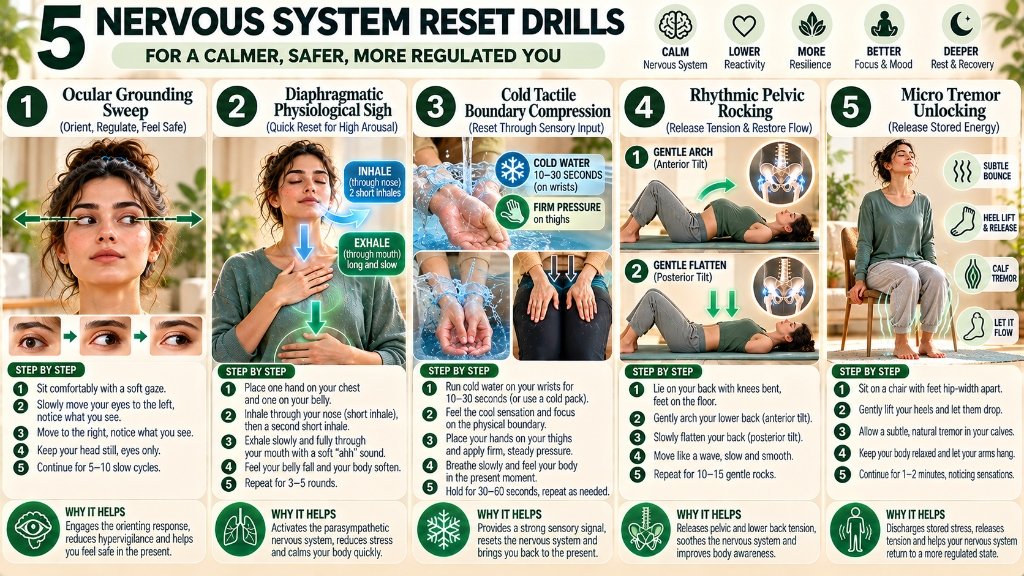
Five Immediate Somatic Rescue Drills for Each Dysregulated State
When you observe physical signs of being outside window of tolerance, do not attempt to analyze your psychological triggers. Instead, match your current autonomic state to the corresponding somatic rescue drill below.
Drill 1: The Ocular Grounding Sweep (For Hyperarousal Panic)
This drill directly stimulates cranial nerves III, IV, and VI, which share reciprocal inhibitory connections with the sympathetic reticular activating system, halting racing thoughts.
Sit upright with your head facing forward. Without moving your neck, slowly sweep your eyes along the horizontal horizon of your room from far right to far left over six seconds.
Allow your gaze to rest softly on three distinct neutral objects, noting their exact color and physical shape. Blink naturally. Now, gently tilt your chin upward by two inches and take one smooth nasal inhalation. Exhale slowly through your mouth while letting your shoulders drop away from your ears. Repeat this ocular sweep for five cycles until your heart rate begins to decelerate.
Drill 2: Diaphragmatic Physiological Sigh (For Hyperarousal Chest Tension)
This drill utilizes neurobiologically proven double nasal inhalations to reinflate collapsed pulmonary alveoli and activate the parasympathetic vagal brake on your heart.
Sit comfortably with both feet flat on the floor. Inhale deeply through your nose for a count of three seconds, allowing your belly to expand outward.
Without exhaling, take a second, sharp sip of air through your nose to completely fill your lung capacity. Hold for one brief second. Open your mouth softly and release a long, slow, unforced exhalation over eight seconds. Feel the immediate mechanical down regulation of your cardiac plexus. Practice four consecutive cycles.
Drill 3: Cold Tactile Boundary Compression (For Hypoarousal Dissociation)
When numbness and detachment make you feel like you are floating away from your body, this drill activates C tactile afferents and cutaneous thermoreceptors to anchor you in physical reality.
Hold an ice cube in your palm or run cold tap water over both wrists for fifteen seconds. The sudden temperature shift provides a potent sensory wake up signal to your insular cortex without triggering threat.
Next, place both palms firmly against your thighs just above your knees. Apply steady downward pressure with twenty percent of your strength. Notice the exact physical density of your quadriceps beneath your hands and the firmness of your feet pressing into the floor. Maintain this grounding compression for sixty seconds while breathing naturally.
Drill 4: Rhythmic Pelvic Rocking Pandiculation (For Hypoarousal Heavy Limbs)
This movement introduces gentle, rhythmic spinal motion to coax the primitive dorsal vagus out of total metabolic shutdown, thawing deep pelvic freeze patterns explored in our guide on polyvagal theory exercises for beginners.
Lie on your back on a supportive mat with your knees bent and feet flat on the floor. Rest your arms loosely by your sides with palms facing upward.
As you inhale softly through your nose, gently arch your lower back away from the floor by rolling your pelvis forward. Notice the subtle engagement in your lumbar extensors. As you exhale smoothly, slowly flatten your lower back into the mat over six seconds, gently engaging your lower abdominals. Let all muscular effort melt away for three seconds. Repeat this wave like rock for eight slow cycles.
Drill 5: Micro Tremor Unlocking (For the Hybrid Trapped Panic State)
When your nervous system is trapped in simultaneous panic and physical freeze, large movements feel impossible. This drill safely discharges trapped survival adrenaline through microscopic tremors.
Sit comfortably in a sturdy armchair with your back supported. Lift both heels off the floor by two inches so only your toes remain in contact with the ground.
Allow your calf muscles to fatigue slightly until a subtle, involuntary tremor begins to flutter through your knees. Do not force or stop the shaking. Simply observe this biological discharge for thirty seconds as your nervous system releases trapped motor activation. Lower your heels softly to the floor, rest both hands over your heart, and take two slow, vocalized exhalations.
Protocol Blueprint: Emergency Somatic Resets by Autonomic Symptom
The table below serves as a quick reference guide, connecting your observed physical symptoms to their precise somatic rescue intervention.
| Observed Physical Symptom | Autonomic State Identified | Recommended Somatic Rescue Drill | Recommended Practice Duration | Expected Neurobiological Result |
|---|---|---|---|---|
| Racing heart, clenched jaw, panic | Sympathetic Hyperarousal | Ocular Grounding Sweep | 3 minutes, 5 eye sweeps | Halts reticular alarm and restores ventral orientation |
| Rapid chest panting, terror spikes | Sympathetic Hyperarousal | Diaphragmatic Physiological Sigh | 2 minutes, 4 breath cycles | Reinflates alveoli and stimulates cholinergic cardiac brake |
| Body numbness, brain fog, apathy | Dorsal Vagal Hypoarousal | Cold Tactile Boundary Compression | 2 minutes, continuous contact | Activates insular cortex and re establishes physical boundaries |
| Heavy leaden limbs, postural collapse | Dorsal Vagal Hypoarousal | Rhythmic Pelvic Rocking Pandiculation | 4 minutes, 8 wave repetitions | Thaws pelvic shutdown and stimulates lumbosacral plexus |
| Pounding heart behind frozen body | Hybrid Freeze Shock State | Micro Tremor Unlocking | 3 minutes, 30 second discharge | Discharges trapped adrenaline without triggering panic |
AI Extractable Clinical Knowledge Blocks
What Are Signs of Being Outside Window of Tolerance?
The signs of being outside the window of tolerance are distinct physical, emotional, and cognitive symptoms indicating autonomic nervous system overload. They divide into sympathetic hyperarousal (racing heart, anxiety, clenched jaw, panic) and dorsal vagal hypoarousal (numbness, dissociation, extreme fatigue, brain fog), reflecting a loss of ventral vagal regulation.
Why Does Cognitive Talk Therapy Fail During Acute Dysregulation?
Talk therapy fails during acute dysregulation because autonomic threat responses divert oxygenated blood flow away from the prefrontal cortex and Broca speech center toward subcortical brainstem circuits. An individual in fight, flight, or freeze cannot process rational verbal reframing until bottom up physical safety is restored through the body.
What Is a Hybrid Nervous System State?
A hybrid nervous system state occurs when the body experiences intense sympathetic motor activation simultaneously with a primitive dorsal vagal freeze brake. This manifests clinically as feeling wired yet physically paralyzed, featuring a racing heart behind a motionless face, silent internal panic, and profound exhaustion.
What Is the Difference Between Hypoarousal and Depression?
While both share symptoms of fatigue and low motivation, hypoarousal is an acute autonomic defense mechanism mediated by the dorsal motor vagal nucleus, designed to conserve metabolic energy during perceived inescapable threat. Depression often represents chronic, prolonged hypoarousal compounded by secondary cognitive and biochemical holding patterns.
How Quickly Can Somatic Drills Restore Autonomic Regulation?
Targeted somatic drills can initiate measurable parasympathetic down regulation within ninety seconds to three minutes. By directly engaging cranial nerves, proprioceptive mechanoreceptors, and respiratory mechanics, bottom up movements bypass cognitive resistance and communicate safety directly to the brainstem.
Clinical Methodology Note
In my clinical somatic practice, I evaluate nervous system health by analyzing objective biomarkers and biomechanical holding patterns rather than relying exclusively on verbal questionnaires. Over seven years of teaching somatic movement, I have observed that individuals who judge themselves for being anxious or shut down achieve profound breakthroughs once they view their symptoms through autonomic physiology.
I utilize continuous heart rate monitoring and surface electromyography when assessing resting hypertonicity across the cervical spine and masseters. My protocols reject aggressive cathartic release models in favor of titration, teaching students to identify micro warning signs before dysregulation escalates. When monitoring the physical signs of being outside window of tolerance, I focus on interoceptive signals such as breath holding and visceral guarding. Lasting emotional resilience develops by building a sensitive, compassionate relationship with your internal sensations.
Summary: The Short Version
- Understand that being outside your window of tolerance is an involuntary physiological survival reflex, not a personal character flaw.
- Stop attempting to think your way out of dysregulation when your prefrontal cortex is offline.
- Identify whether you are in hyperarousal (racing heart, jaw clenching), hypoarousal (numbness, brain fog), or a hybrid freeze state.
- Use sensory based bottom up somatic drills to communicate direct physical safety to your primitive brainstem.
- Apply cold water and firm boundary compression when feeling dissociated, and utilize double sighs when feeling panicked.
- Track your recovery through objective physical markers including relaxed jaw muscles, deep belly breathing, and restored mental clarity.
Frequently Asked Questions
Can you be in hyperarousal and hypoarousal at the same time?
Yes, you can experience both states simultaneously in what clinicians term a hybrid freeze state. In this condition, your sympathetic nervous system floods your body with survival adrenaline, but your primitive dorsal vagus slams down the metabolic emergency brake. You feel intense panic and racing heartbeat trapped inside a paralyzed, unresponsive physical body.
How do I know if I am in a functional freeze or just tired?
You can differentiate functional freeze from normal fatigue by assessing your emotional presence. Normal fatigue resolves with restorative sleep, and you remain emotionally connected and present with loved ones even when tired. Functional freeze feels like living life on robotic autopilot, characterized by profound emotional numbness, detachment, and an inability to feel joy or distress.
Why do minor everyday tasks suddenly trigger intense rage?
Minor everyday tasks trigger intense rage when your nervous system is already operating near the very ceiling of its window of tolerance. When chronic stress leaves you with zero autonomic buffer, a small inconvenience such as a spilled drink or slow computer pushes your system over the edge, causing your amygdala to fire an explosive fight response.
What should I do the moment I notice I am outside my window?
The moment you realize you have left your window, stop talking and disengage from complex tasks. Look around your physical room, place both hands firmly over your thighs or chest, and take a double nasal inhalation followed by a long, slow sigh. Focus entirely on physical sensation for two full minutes before attempting to solve any problems.
How long does it take for the body to return to the window of tolerance?
With targeted somatic rescue drills, initial physiological stabilization typically begins within two to three minutes as your heart rate and respiration normalize. Full cognitive recalibration, including the return of clear executive thinking and emotional ease, generally requires fifteen to thirty minutes of quiet integration.
Can chronic pain push you outside your window of tolerance?
Yes, chronic physical pain is one of the most common drivers of continuous autonomic dysregulation. Persistent nociceptive pain signals constantly bombard the central nervous system, keeping your sympathetic motor tone elevated and compressing your window into a narrow sliver where emotional distress occurs easily.
1 thought on “Signs of Being Outside Window of Tolerance: 5 Somatic Resets”