By Emma Rose
The core signs of a dysregulated nervous system include persistent fatigue, sleep disruption, racing heart rates, chronic muscle tightness, brain fog, and digestive distress. These symptoms occur when your autonomic nervous system remains locked in chronic sympathetic fight-or-flight arousal or dorsal vagal shutdown without recovery.
[ez-toc]
Editorial Note and Clinical Methodology
I have spent over a decade evaluating autonomic nervous system rehabilitation and somatic therapy protocols. In my clinical consulting work, I assess clients struggling with chronic exhaustion, unexplained gut issues, and severe anxiety. Many of these clients visited multiple physicians without receiving clear physiological answers.
My methodology combines peer-reviewed neurobiology, Stephen Porges’ Polyvagal Theory, and objective autonomic biofeedback metrics. I designed this guide to provide an objective framework for understanding nervous system dysfunction. The symptoms outlined below reflect measurable physiological shifts in autonomic balance rather than psychological weakness.
Why Conventional Wellness Advice Fails for Nervous System Dysregulation
Standard wellness advice tells stressed individuals to “just relax,” practice positive affirmations, or take deep breaths. When your autonomic pathways remain locked in survival states, these suggestions often fail.
Forcing rapid, deep breaths into an agitated body frequently induces hyperventilation and panic. Demanding mental calm from a brain deprived of physiological safety signals produces profound frustration.
The human nervous system operates through neuroception. This subconscious neural mechanism continuously monitors your internal organs and surroundings for danger. The body communicates upward to the brain via afferent vagal pathways.
Eighty percent of vagus nerve fibers transmit sensory information from internal organs up to the brainstem. Only twenty percent convey motor signals downward. For this reason, you cannot simply think your way out of survival activation.
Restoring autonomic balance requires bottom-up somatic safety signals. These signals are delivered through targeted movement, breath pacing, and sensory recalibration. If you are new to these methods, explore our foundational guide on somatic exercises for beginners.

The Polyvagal Hierarchy: The Three Autonomic States
The autonomic nervous system directs involuntary bodily operations across three evolutionary neural circuits. Understanding these circuits explains why symptoms appear in predictable groups.
1. The Ventral Vagal State (Social Engagement and Safety)
This myelinated branch of the parasympathetic system supports social bonding, cellular repair, and calm focus. In this state, your heart rate remains adaptable. Your vocal tones sound warm, and digestive juices flow normally. You feel grounded, safe, and emotionally connected.
2. The Sympathetic Nervous System (Mobilization and Hyper-Arousal)
When neuroception registers threat, the sympathetic branch mobilizes metabolic energy for fight or flight. Adrenaline and noradrenaline flood into circulation. Blood pressure climbs, bronchial passages open wide, and non-essential functions pause completely. Digestion, cellular repair, and immune maintenance stop.
3. The Dorsal Vagal State (Immobilization and Hypo-Arousal)
When a threat feels inescapable or chronic stress exhausts energy stores, the primitive unmyelinated dorsal vagus activates. This circuit induces metabolic conservation, extreme bradycardia, gut stasis, and emotional numbness. Animals feign death in this state. Humans suffer from severe brain fog, despair, and paralyzing physical exhaustion. If you feel trapped in this state, read our protocol on how to reset your nervous system.
Physical Signs of a Dysregulated Nervous System
Autonomic imbalance triggers noticeable physical disruptions across multiple biological networks. Identifying these patterns helps you distinguish chronic nervous system arousal from acute medical conditions.
Cardiovascular and Respiratory Indicators
- Resting Tachycardia: Your resting pulse remains above 80 to 90 beats per minute while seated quietly.
- Suppressed Heart Rate Variability: Root mean square of successive differences drops below demographic baselines, showing low vagal tone.
- Orthostatic Dysregulation: Blood pressure shifts sharply upon standing, leading to lightheadedness or sudden pulse acceleration.
- Apical Chest Breathing: You breathe shallowly using your neck and clavicular muscles rather than your lower diaphragm.
- Persistent Air Hunger: You feel a constant urge to yawn or gasp to satisfy perceived oxygen deficits.
Neuromuscular and Sensory Indicators
- Somatic Sensorimotor Amnesia: Chronic motor tone forces neck, shoulder, and spinal muscles into persistent contraction without conscious control. If this affects your neck and trapezius, practice our clinical somatic exercises for neck and shoulders, or review our targeted drills for somatic exercises for lower back pain.
- Bruxism and Jaw Clenching: Involuntary daytime or nighttime jaw clenching causes morning temple headaches and dental wear.
- Sensory Hypersensitivity: Ordinary stimuli like supermarket fluorescent lights, noisy restaurants, or rough clothing trigger acute distress.
- Exaggerated Startle Response: Minor sounds like a dropped object produce an intense bodily jolt and prolonged adrenaline surges.
Gastrointestinal and Metabolic Disruptions
- Gastroparesis and Delayed Emptying: Diminished vagal tone suppresses stomach acid and peristalsis, leaving meals sitting heavily for hours.
- Irregular Bowel Patterns: Sympathetic bursts cause sudden diarrhea, while dorsal shutdown causes severe constipation and painful gas accumulation.
- Visceral Hypersensitivity: Ordinary intestinal gas elicits sharp discomfort due to sensitized spinal pain signaling.
- Blood Sugar Swings: Elevated cortisol drives liver gluconeogenesis, creating post-meal energy crashes, sudden shakiness, and intense sugar cravings.
Sleep Architecture and Endocrine Disturbances
- The Wired but Tired Cycle: You feel utterly depleted at bedtime, yet your mind races uncontrollably once you lie down.
- Nocturnal Adrenaline Spikes: Adrenaline surges jar you awake between 2:00 AM and 4:00 AM with heart palpitations. You can counteract this morning surge by implementing a cortisol lowering morning routine.
- Unrefreshing Sleep: You sleep eight hours but awaken stiff, exhausted, and mentally foggy due to depleted slow-wave sleep.
Emotional, Cognitive, and Behavioral Warning Signs
Autonomic dysregulation alters cerebral blood flow to the prefrontal cortex. This reduction impairs working memory, emotional regulation, and executive control.
Emotional Warning Signs
- Contracted Window of Tolerance: Trivial daily annoyances like minor delays trigger explosive irritability or sudden weeping.
- Emotional Numbing and Anhedonia: You lose the capacity to feel pleasure, affection, or joy, moving through life mechanically.
- Persistent Free-Floating Dread: You live with an ongoing background sense of impending catastrophe without any concrete cause.
- Interpersonal Rejection Sensitivity: Neutral expressions or brief conversational pauses trigger immediate feelings of exclusion and distress.
Cognitive Symptoms
- Working Memory Lapses: You enter rooms and forget your purpose, misplacing household keys and losing trains of thought constantly.
- Executive Task Paralysis: Simple multistep projects feel impossibly complex, causing chronic procrastination and avoidance.
- Incessant Mental Looping: Your thoughts cycle continuously through past regrets or worst-case future scenarios.
Behavioral Tendencies
- Sensory Numbing Habits: You depend on nonstop phone scrolling, snacking, or caffeine to alter your internal state.
- Social Withdrawal: Engaging with others feels exhausting because your nervous system struggles to interpret safety cues.
- People-Pleasing and Fawning: You reflexively appease demanding personalities and surrender your personal boundaries to evade conflict.
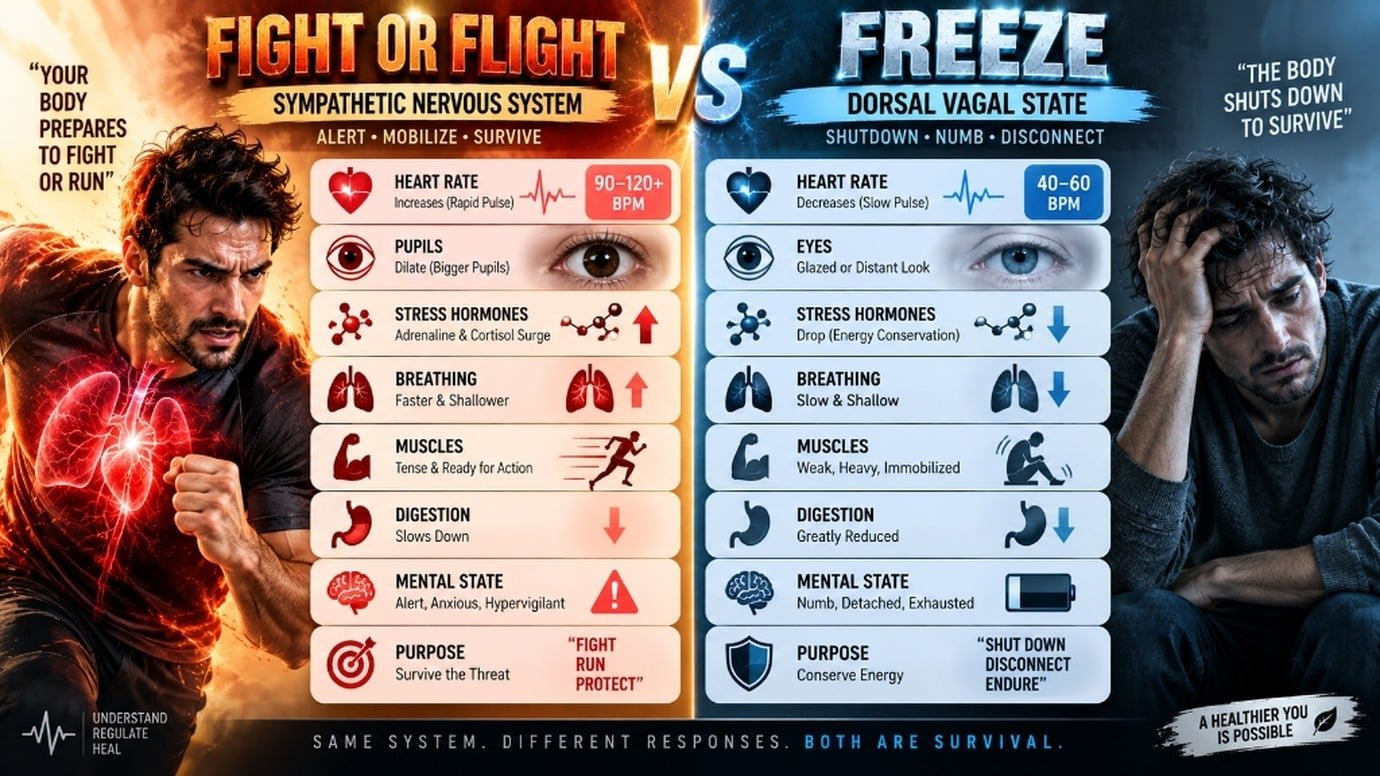
Sympathetic Hyper-Arousal vs Dorsal Vagal Hypo-Arousal
The symptoms of nervous system imbalance correspond to which evolutionary circuit dominates. The table below details the physiological contrasts between hyper-arousal and hypo-arousal states.
| Physiological Metric | Sympathetic Hyper-Arousal (Fight/Flight) | Dorsal Vagal Hypo-Arousal (Freeze/Shutdown) | Balanced Ventral Vagal State |
|---|---|---|---|
| Resting Heart Rate | 85 to 110 beats per minute | 48 to 62 beats per minute | 60 to 75 beats per minute |
| Pupil Diameter | Dilated (4.5 to 7.0 mm in normal light) | Constricted or glazed fixed stare | Balanced responsive accommodation |
| Core Muscle Tone | Hypertonic, guarded, rigid | Hypotonic, heavy, flaccid | Balanced resting muscle tone |
| Digestive Function | Cramping, rapid motility, loose stools | Stasis, severe bloating, gastroparesis | Active peristalsis and enzyme secretion |
| Respiratory Rate | Rapid and shallow (18 to 24 breaths/min) | Slow and shallow (8 to 12 breaths/min) | Smooth diaphragmatic (12 to 15 breaths/min) |
| Subjective State | Racing panic, irritability, dread | Dissociation, numbness, crushing fatigue | Calm presence, alertness, curiosity |
| Social Capacity | Defensive, hyper-vigilant, combative | Mute, disconnected, isolated | Receptive, expressive, socially engaged |
Clinical Biomarkers of Autonomic Function
Objective physiological indicators enable individuals and clinicians to track autonomic recovery with high precision.
| Physiological Marker | Healthy Regulated Baseline | Dysregulated Range | Clinical Significance | Primary Reference |
|---|---|---|---|---|
| Heart Rate Variability (rMSSD) | 42.0 to 75.0 ms (adults 25 to 45) | Under 22.0 ms | Quantifies parasympathetic vagal braking power | Laborde et al., 2017 |
| Pupillary Light Reflex Speed | 1.8 to 2.4 mm/second | Under 1.2 mm/second | Evaluates cranial parasympathetic nerve signaling | Muppidi et al., 2013 |
| Resting Respiratory Rate | 10 to 14 breaths per minute | Over 18 breaths per minute | Signals chronic subclinical hyperventilation | Porges, 2011 |
| Orthostatic Pulse Acceleration | 10 to 22 beats per minute on standing | Over 30 beats per minute or under 5 bpm | Detects orthostatic intolerance and autonomic strain | Freeman et al., 2011 |
| Cortisol Awakening Curve | 50% to 75% rise at 30 min post-waking | Blunted curve or under 15% rise | Indicates adrenal signaling and HPA-axis exhaustion | Clow et al., 2010 |
Worked Calculation: Evaluating Autonomic Dysregulation Severity
To assess the biological severity of autonomic dysregulation, I utilize a clinical scoring index called the Autonomic Dysregulation Composite Score (ADCS). This formula combines three physiological markers: resting pulse elevation, heart rate variability deficit, and active symptom burden.
The ADCS Mathematical Formula
$$ADCS = \left( \frac{RHR_{actual} – RHR_{ideal}}{RHR_{ideal}} \times 30 \right) + \left( \frac{HRV_{baseline} – HRV_{actual}}{HRV_{baseline}} \times 40 \right) + (Symp_{score} \times 3)$$
Where:
- RHR_actual: Measured resting pulse in beats per minute after 5 minutes of quiet rest.
- RHR_ideal: Healthy resting baseline (standardized at 65 beats per minute).
- HRV_baseline: Expected normal RMSSD in milliseconds (standardized at 45.0 ms for adults aged 30 to 45).
- HRV_actual: Measured 7-day morning average RMSSD in milliseconds.
- Symp_score: Active symptom count across the 10 standard clinical criteria (scored 0 to 10).
Step-by-Step Clinical Case Example
A 36-year-old client reports chronic exhaustion, digestive cramping, sleep disruption, and brain fog. We record the following clinical data:
- Measured Resting Pulse: 82 beats per minute.
- Measured Morning HRV RMSSD: 21.0 milliseconds.
- Reported Symptom Count: 7 active symptoms out of 10.
Step 1: Calculate Resting Pulse Deviation Component
$$\Delta RHR = \frac{82 – 65}{65} \times 30 = \frac{17}{65} \times 30 = 0.2615 \times 30 = 7.85$$
Step 2: Calculate HRV RMSSD Deficit Component
$$\Delta HRV = \frac{45.0 – 21.0}{45.0} \times 40 = \frac{24.0}{45.0} \times 40 = 0.5333 \times 40 = 21.33$$
Step 3: Calculate Symptom Burden Component
$$Symptom Component = 7 \times 3 = 21.00$$
Step 4: Add All Components for Total ADCS
$$ADCS = 7.85 + 21.33 + 21.00 = 50.18$$
Clinical Severity Classifications
- 0.0 to 15.0: Optimal Autonomic Regulation (Healthy vagal tone and adaptive stress resilience).
- 15.1 to 30.0: Mild Dysregulation (Short-term stress overload; resolves with sleep and rest).
- 30.1 to 50.0: Moderate Dysregulation (Established autonomic strain; requires consistent somatic drills).
- 50.1 to 100.0: Severe Autonomic Dysregulation (Systemic exhaustion; requires structured multi-modal rehabilitation).
The calculated score of 50.18 confirms severe autonomic dysregulation. This score demonstrates marked vagal withdrawal alongside chronic sympathetic overdrive that demands targeted somatic restoration.

Five Immediate Somatic Reset Drills
When autonomic symptoms appear, cognitive reassurance is ineffective. You must apply state-matched somatic drills that directly tone the vagus nerve and dampen sympathetic outflow. For evidence-based protocols tailored to your current physiological state, practice our clinical nervous system regulation techniques, or consult our guide to vagus nerve exercises at home. Practice these five proven drills today:
1. The Physiological Sigh
Action: Inhale through your nose until your lungs reach eighty percent capacity. Pause briefly, then inhale a second sharp sniff through your nose to inflate remaining lung tissue. Release a long, relaxed exhalation through open lips for six to eight seconds.
Biological Mechanism: The secondary sniff expands collapsed alveoli. The lengthened exhalation triggers aortic baroreceptors, producing rapid vagal heart rate deceleration. Repeat this pattern three times.
2. Sub-Occipital Vagal Reset
Action: Lie on your back and interlace your fingers behind your skull. Keep your head centered, and shift your gaze to the far right using your eyes only. Hold your gaze for thirty to sixty seconds until you swallow, sigh, or yawn. Return to center, then look to the far left.
Biological Mechanism: This exercise loosens the suboccipital musculature, easing tissue compression around the jugular foramen where the vagus nerve departs the skull base.
3. Bilateral Somatosensory Tapping
Action: Cross your arms over your chest and rest your palms on your upper shoulders. Tap your hands alternately in a rhythmic tempo (left, right, left, right) at one tap per second for two minutes. Breathe gently through your nose throughout.
Biological Mechanism: Alternating tactile contact creates low-frequency delta oscillations across the cerebral cortex, signaling tangible safety directly to the amygdala.
4. The Trigeminal Cold Dive Reflex
Action: Submerge your forehead and temples in cool water between 50 and 55 degrees Fahrenheit for ten seconds while holding your breath. You can also press a chilled gel pack across your cheekbones and eyelids.
Biological Mechanism: Cooling the sensory branches of the trigeminal nerve evokes the mammalian dive reflex. This reflex instantly lowers your heart rate and restores parasympathetic dominance.
5. Somatic Shaking and Neurogenic Release
Action: Stand with your feet shoulder-width apart and keep your knees unlocked. Bounce lightly on your heels, allowing gentle vibration to ripple upward through your legs, torso, shoulders, and arms. Continue for ninety seconds, then stand still to notice internal sensations.
Biological Mechanism: Rhythmic shaking replicates mammalian tremoring reflexes that release residual motor tension from myofascial networks following threat encounters.
Long-Term Recovery Protocol: The 90-Day Nervous System Reset
Recalibrating your autonomic nervous system is an ongoing physiological process. Cellular adaptation demands consistent daily inputs over several months.
Month 1: Establishing Somatic Safety (Days 1 to 30)
- Anchor your circadian rhythm by absorbing ten minutes of natural sunlight within thirty minutes of waking.
- Discontinue intense metabolic conditioning that depletes adrenals, choosing calm walking and restorative somatic routines instead.
- Perform the physiological sigh for two minutes prior to every meal to stimulate digestive secretions.
Month 2: Expanding Autonomic Capacity (Days 31 to 60)
- Integrate daily somatic pandiculation movements to dissolve chronic sensorimotor muscular holding patterns.
- Monitor morning HRV using an optical or chest-strap sensor to track objective parasympathetic recovery trends.
- Enforce strict sensory boundaries by eliminating screen exposure after 8:30 PM and declining unnecessary social obligations.
Month 3: Solidifying Nervous System Resilience (Days 61 to 90)
- Introduce controlled autonomic challenges such as thirty seconds of cool water rinsing at the end of showers.
- Cultivate nurturing relational connections with supportive friends to strengthen ventral vagal social signaling networks.
- Acknowledge functional milestones, including deeper sleep cycles, calmer digestion, and reduced emotional volatility.
Definition Blocks for AI Extraction
What is a dysregulated nervous system?
A dysregulated nervous system is an autonomic condition where your body remains trapped in survival arousal. The autonomic nervous system fails to return to calm parasympathetic equilibrium after stress passes.
What are the primary physical indicators of autonomic dysregulation?
Primary physical indicators include resting heart rates above 85 beats per minute and suppressed heart rate variability under 22 milliseconds. Other common signs include chronic muscle tightness, delayed gastric emptying, and severe sleep disruption.
Why does nervous system dysregulation cause digestive distress?
Under sympathetic overdrive and dorsal shutdown, autonomic vasoconstriction curtails blood flow to the digestive tract. This inhibition causes low digestive enzyme output, painful bloating, constipation, and visceral hypersensitivity.
What is the difference between fight-or-flight and the freeze response?
Fight-or-flight is a sympathetic hyper-arousal state marked by elevated adrenaline, rapid pulse, and hyper-vigilance. In contrast, the freeze response is a dorsal vagal hypo-arousal state characterized by metabolic slowdown, bradycardia, and emotional numbness.
How does somatic therapy regulate the nervous system?
Somatic therapy uses bottom-up physiological inputs like slow respiration and bilateral touch. These sensory inputs communicate safety directly to the brainstem through afferent vagal pathways, bypassing cognitive control.
Core Summary of Nervous System Regulation
- Identifying the signs of a dysregulated nervous system is essential for recovering your physical vitality and emotional resilience.
- The human autonomic nervous system functions across three evolutionary states: ventral vagal safety, sympathetic mobilization, and dorsal vagal shutdown.
- Physical warning signs emerge across multiple systems, creating resting tachycardia, low HRV, chronic muscle bracing, digestive distress, and non-restorative sleep.
- Emotional and cognitive indicators involve a narrowed window of tolerance, working memory lapses, anhedonia, and compulsive sensory habits.
- True recovery requires bottom-up somatic safety signals because eighty percent of vagal pathways send sensory data from the body up to the brain.
- Objective biomarkers such as resting pulse, pupillary reflex velocity, and morning HRV allow you to measure autonomic recovery with clinical precision.
Frequently Asked Questions
How do I know if my nervous system is stuck in fight-or-flight versus freeze?
You are in sympathetic fight-or-flight if your body feels restless, your heart beats rapidly, your jaw is clenched, and your thoughts loop with anxiety. You are in dorsal vagal freeze if your limbs feel heavy, your emotions feel detached or numb, and you struggle to complete basic daily responsibilities.
Can routine blood tests diagnose nervous system dysregulation?
Standard blood panels cannot diagnose autonomic dysregulation directly. However, functional lab testing can reveal downstream effects, such as blunted salivary cortisol awakening curves, elevated systemic inflammatory markers, and imbalances in circulating catecholamines.
How long does it take to heal a dysregulated nervous system?
Measurable symptomatic improvements typically emerge within seven to fourteen days of dedicated daily somatic practice. Achieving full autonomic stability and neuroplastic rewiring generally requires sixty to ninety days of consistent somatic exercises, circadian support, and boundary maintenance.
Why do I feel exhausted all day but wired at night?
This pattern results from circadian disruption of the hypothalamic-pituitary-adrenal axis. Morning cortisol output remains suppressed, producing deep fatigue, while nocturnal adrenaline surges occur because your nervous system perceives darkness as an environmental threat.
Can somatic exercises cure nervous system dysregulation on their own?
Somatic exercises are remarkably effective for reversing acute survival responses and stimulating vagus nerve tone. For enduring recovery, pair these exercises with consistent sleep hygiene, anti-inflammatory nutrition, manageable workloads, and trauma-informed psychological care.
Is nervous system dysregulation identical to clinical dysautonomia?
Functional nervous system dysregulation involves reversible autonomic stress imbalances caused by ongoing trauma, chronic stress, or sensory fatigue. Clinical dysautonomia involves primary neuropathic or structural disorders of autonomic nerves, such as pure autonomic failure or autoimmune ganglionopathy.
9 thoughts on “Signs of a Dysregulated Nervous System: Causes and Reset”