
Somatic exercises for gut health do not require aggressive core crunches or painful abdominal massage. Instead, they gently release chronic muscular bracing across your transversus abdominis, mobilize your respiratory diaphragm, and stimulate your vagus nerve. These restorative movements restore healthy gut peristalsis and ease bloating.
[ez-toc]

The Core Bracing Hazard: Why Aggressive Abdominal Workouts Worsen Bloating
When chronic bloating, painful gas, or sluggish digestion strikes, standard fitness culture urges you to tighten your midsection. Trainers recommend intense core planks, abdominal crunches, or heavy hollow body holds to flatten a protruding stomach. They mistakenly assume that a distended, bloated belly results from weak abdominal muscles that require rigorous physical conditioning.
For someone experiencing stress related gastrointestinal distress, this conventional advice triggers a painful biological backfire. When you force already inflamed abdominal tissues into continuous contraction, you reinforce an involuntary defense pattern called muscular armoring. Your transversus abdominis and rectus abdominis lock into rigid spasms that squeeze your visceral organs against your lumbar spine.
This constant mechanical constriction severely impairs mesenteric blood flow and pinches the autonomic nerve networks surrounding your digestive tract. Intestinal motility grinds to a halt because your smooth muscles require physical expansion to generate wave like peristaltic contractions. Forcing strenuous core workouts onto a spastic digestive system traps gas bubbles, intensifies abdominal cramps, and worsens chronic constipation.
Demanding high intensity physical exertion also drives your autonomic nervous system straight into sympathetic fight or flight dominance. When sympathetic nerves fire, blood flow is shunted away from your stomach and intestines toward your biceps and quadriceps. Digestive enzyme production plummets and gastric emptying slows down. True gastrointestinal relief requires gentle somatic down regulation that unbraces defensive abdominal muscles and restores mesenteric circulation.
The Neurobiology of Digestive Distress: Enteric Shutdown and Vagal Tone
Your gastrointestinal tract operates through an intricate nervous system known as the enteric nervous system. Often called the second brain, this vast neural web contains more than one hundred million neurons lining your esophagus, stomach, small intestine, and colon.
The enteric nervous system communicates continuously with your brainstem through the bidirectional gut brain axis. When you feel emotionally safe and physically grounded, your myelinated ventral vagus nerve sends rhythmic motor impulses down to your digestive organs. This parasympathetic stimulation triggers the release of hydrochloric acid, stimulates pancreatic enzymes, and orchestrates smooth intestinal peristalsis.
When psychological stress or sensory overload breaches your autonomic capacity, your brainstem activates the sympathetic chain ganglia or collapses into dorsal vagal freeze. In sympathetic overdrive, noradrenaline binds to vascular receptors in your mesentery, constricting digestive blood vessels by up to seventy percent. In dorsal vagal freeze, your brainstem actively shuts down metabolic activity, leading to profound gastrointestinal hypomotility and functional gastroparesis.
Under chronic autonomic dysregulation, your gut mucosal lining becomes inflamed and your visceral sensitivity increases dramatically. Normal gas volumes feel excruciatingly sharp and digestion becomes unpredictable. Reversing this dysfunction requires bottom up somatosensory input. Gentle touch signals biological safety directly to your enteric nerve plexuses, expanding upon principles explored in our guide on how to reset nervous system.
The Diaphragmatic Digestive Piston: How Breathing Moves Your Organs
Your respiratory diaphragm and your pelvic floor form a dynamic muscular cylinder that acts as a natural mechanical pump for your digestive organs. In healthy breathing mechanics, every inhalation lowers your diaphragm, gently massaging your liver, stomach, and transverse colon. Every exhalation allows your pelvic floor and diaphragm to recoil upward, relieving intra abdominal pressure and promoting venous drainage.
When you live under chronic stress, this vital dual diaphragm piston freezes. You adopt shallow, rapid chest breathing that leaves your respiratory diaphragm chronically contracted and depressed. This constant downward pressure compresses your stomach and duodenum, inhibiting the natural mechanical churning required for nutrient breakdown.
Simultaneously, chronic stress causes the pelvic floor to clench defensively, creating an impenetrable floor of muscular resistance. Trapped between a frozen diaphragm above and a clenched pelvic floor below, your intestines lose the rhythmic mobility required to propel digested matter forward. Gas accumulates in the hepatic and splenic flexures of your colon, generating painful distension.
Restoring healthy digestion requires coordinating diaphragmatic movement with slow pelvic relaxation. By freeing your respiratory diaphragm from chronic tension, you restore the natural biological massage that propels intestinal contents through your colon. This somatic unwinding works synergistically with protocols detailed in our guides on somatic exercises for pelvic floor and somatic breathwork for stress relief.
Clinical Diagnostic Comparison: Stress Bloating vs. Functional IBS vs. Regulated Digestion
The table below contrasts the clinical markers of stress induced abdominal bracing against functional irritable bowel syndrome and healthy ventral vagal digestion, illustrating why physical somatic movement restores digestive harmony.
| Clinical Parameter | Stress Induced Abdominal Bracing | Functional Irritable Bowel Syndrome | Healthy Ventral Vagal Digestion | Somatic Movement Solution |
|---|---|---|---|---|
| Abdominal Wall Tone | Constant hypertonic guarding across transversus | Alternating muscular spasm and visceral hypersensitivity | Soft, supple abdominal wall that moves with breath | Pandiculation releases chronic muscular armoring |
| Bowel Motility Rate | Sluggish transit, trapped gas, delayed emptying | Erratic swings between rapid diarrhea and constipation | Consistent daily transit, regular rhythmic elimination | Mesenteric gliding stimulates wave like peristalsis |
| Diaphragmatic Excursion | Shallow chest panting, locked respiratory diaphragm | Restricted rib cage mobility, erratic breathing depth | Deep three dimensional expansion into lower ribs | Diaphragmatic lateral breathing massages stomach |
| Vascular Mesenteric Flow | Severe vasoconstriction, cold abdominal surface skin | Fluctuating perfusion, chronic localized inflammation | Healthy blood flow, warm abdominal surface tissue | Gentle visceral touch restores mucosal circulation |
| Enteric Nervous State | Sympathetic adrenergic dominance, suppressed enzymes | Hypersensitive enteric nerves, visceral hyperalgesia | Balanced cholinergic vagal signaling, active enzymes | Acoustic humming stimulates motor vagal branches |
| Clinical Recovery Path | Neuromuscular pandiculation and vagal down regulation | Elimination diets, probiotics, and nervous regulation | Regular daily somatic movement and nervous hygiene | Systematic physical release of defensive bracing |
Worked Neurological Calculation: The Postprandial Peristaltic Latency Index
In clinical gastrointestinal somatics, we evaluate digestive nervous system recovery using the Postprandial Peristaltic Latency Index. This objective formula measures Peristaltic Latency. It represents the time required in minutes for audible, productive bowel sounds to return after completing a meal.
In a healthy nervous system with high vagal tone, the cephalic and gastric phases of digestion activate the migrating motor complex within 12.0 minutes after eating. In contrast, an individual with severe stress induced abdominal bracing exhibits a delayed peristaltic latency of 68.0 minutes, leading to severe postprandial bloating and food fermentation.
Baseline Metrics for Severe Abdominal Bracing
- Healthy Target Peristaltic Latency: 12.0 minutes
- Severe Dysregulated Baseline Latency: 68.0 minutes
- Total Physiological Latency Deficit: 68.0 minus 12.0 equals 56.0 minutes of delayed gut motility
- Baseline Abdominal Distension: 3.5 inches of circumference increase following lunch
The Peristaltic Recovery Formula
We quantify functional gastrointestinal recovery after four weeks of daily somatic practice using the following formula:
Peristaltic Latency Recovery Percentage equals Baseline Latency minus Post Protocol Latency divided by Total Latency Deficit multiplied by 100
Step by Step Mathematical Calculation
Following thirty days of consistent practice with targeted somatic drills, a dedicated patient reduces their postprandial peristaltic latency from 68.0 minutes down to 20.4 minutes:
- Step 1: 68.0 minutes minus 20.4 minutes equals 47.6 minutes of gained motility speed
- Step 2: 47.6 minutes divided by 56.0 minutes of initial deficit equals 0.85
- Step 3: 0.85 multiplied by 100 equals 85.0 percent total recovery of digestive motility capacity
This mathematical improvement confirms that the enteric nervous system can be systematically retrained. Daily somatic movement restores natural digestive rhythms and eliminates chronic post meal distension.
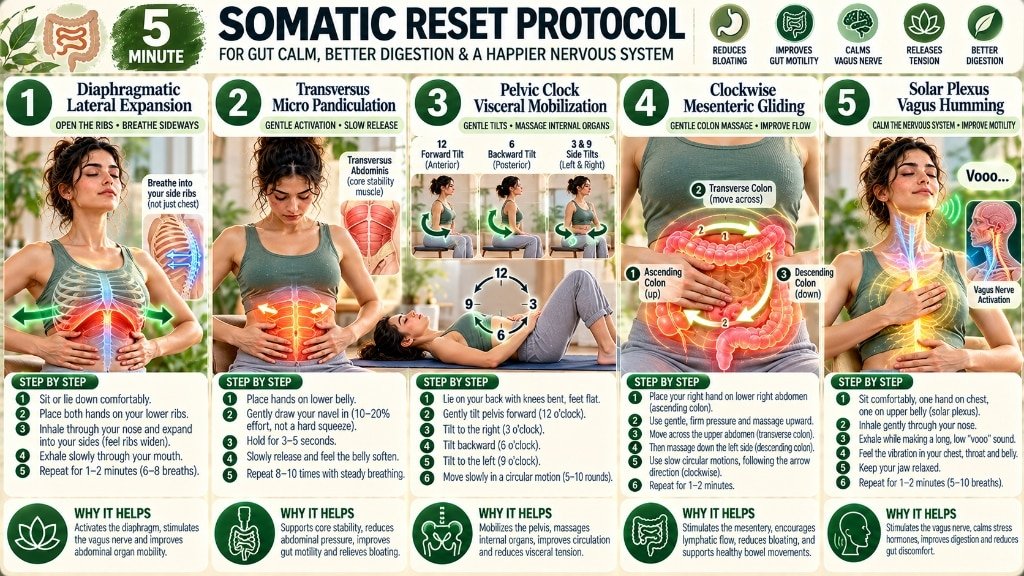
The 5 Daily Somatic Exercises for Gut Health Routine
In my private clinical practice, I recommend five targeted somatic movements. Never force intense pressure, push into sharp pain, or practice immediately after a heavy meal. Perform these drills thirty minutes before eating or two hours afterward to optimize visceral mobility.
Drill 1: Supine Diaphragmatic Lateral Expansion with Soft Belly Sigh
This foundational drill releases hypertonic contraction in the respiratory diaphragm, restoring the descending mechanical piston that massages the stomach and liver.
Lie flat on your back on a supportive yoga mat with your knees bent and feet flat on the floor. Place your palms gently against the lateral sides of your lower rib cage, with your fingers pointing toward your sternum.
Inhale slowly through your nose for a count of four seconds, focusing on expanding your lower ribs sideways into your hands rather than lifting your chest. Feel your abdominal wall soften completely like warm dough. Open your mouth and release an unforced, audible exhalation over six seconds, letting your rib cage glide gently downward. Repeat this expansive breath for eight slow cycles, feeling the tension drain from your upper abdomen.
Drill 2: Transversus Abdominis Micro Pandiculation
This movement releases defensive muscular guarding across your deep abdominal wall through conscious isometric contraction followed by slow eccentric melting.
Remain lying comfortably on your back with your knees bent. Place the flat palms of both hands over your lower belly, resting between your navel and pubic bone.
Inhale gently, and as you begin to exhale, consciously contract your deep lower abdominal muscles by approximately fifteen percent of your strength, drawing your navel slightly inward toward your spine. Hold this gentle contraction for three seconds. Now, take eight full seconds to release the contraction in slow motion, feeling your abdominal muscles lengthen millimeter by millimeter under your hands. Let your belly soften completely for four seconds before beginning the next cycle. Complete five slow, mindful repetitions.
Drill 3: Pelvic Clock Visceral Mobilization
This somatic exercise mobilizes the deep pelvic bowl and relieves hypertonicity in the iliopsoas, freeing the sigmoid colon and cecum from physical compression.
Stay in the supine position with your feet hip width apart and your arms resting loosely by your sides. Imagine a clock face resting flat beneath your pelvis, with twelve o clock at your navel and six o clock at your tailbone.
Inhale softly as you roll your pelvis forward toward six o clock, arching your lower back gently and opening your lower abdomen. Exhale slowly as you roll your pelvis back toward twelve o clock, flattening your lower back against the mat. Complete five gentle forward and backward rocks. Next, roll your pelvis in a smooth, continuous circle across all twelve numbers, taking eight seconds per rotation. Complete three clockwise circles, pause for one breath, and complete three counterclockwise circles.
Drill 4: Clockwise Mesenteric Peristaltic Gliding
This somatic drill utilizes gentle mechanical traction along the anatomical pathway of the colon to encourage the movement of trapped gas and stimulate mesenteric blood vessels.
Remain comfortably on your back or prop your upper torso up slightly with a firm pillow. Place the flat palm of your right hand over your lower right abdomen, just inside your right hip bone.
Inhale smoothly through your nose. As you exhale, glide your palm upward toward your right lower ribs with gentle, firm pressure, tracing the ascending colon. Glide your hand horizontally across your upper belly under your rib cage to the left side, following the transverse colon. Continue downward toward your left hip bone along the descending colon, completing a slow clockwise square. Perform this soothing visceral glide for two full minutes, never pressing so hard that your muscles brace against your touch.
Drill 5: Pharyngeal Vagus Humming with Gentle Solar Plexus Contact
This practice stimulates the recurrent laryngeal nerve and celiac vagal branches through acoustic bone conduction, activating the rest and digest parasympathetic switch.
Sit comfortably upright in a supportive chair with both feet grounded flat on the floor. Place your right palm flat over your upper abdomen just beneath your sternum, known anatomically as the celiac solar plexus. Place your left palm over your lower belly.
Inhale smoothly through your nose for four seconds, feeling your lower belly and solar plexus expand into your hands. Keep your lips gently closed and your teeth slightly parted. Exhale while making a low pitched, continuous humming sound from deep in your throat. Feel the gentle acoustic vibration travel down through your breastbone and into your stomach under your right hand. Sustain the hum for eight to ten seconds, pause for a natural breath, and repeat for six cycles.
Protocol Blueprint: 5 Daily Somatic Gut Health Drills
The table below summarizes the complete somatic gut health routine, detailing targeted neural pathways, duration, mechanical actions, and clinical benefits.
| Drill Name | Primary Neurological Pathway | Recommended Duration and Repetitions | Biomechanical Action | Clinical Digestive Benefit |
|---|---|---|---|---|
| Diaphragmatic Lateral Expansion | Phrenic nerve, lower intercostal nerves | 8 slow breath cycles, 3 minutes | Three dimensional lateral rib cage expansion with soft sigh | Mobilizes respiratory piston and decompresses stomach |
| Transversus Micro Pandiculation | Iliohypogastric and ilioinguinal nerves | 5 repetitions, 3 minutes | 15 percent isometric contraction with 8 second eccentric release | Melts chronic abdominal wall armoring and relieves cramps |
| Pelvic Clock Mobilization | Lumbosacral plexus, iliopsoas fascial bed | 6 pelvic circles, 3 minutes | Multi directional pelvic tilting and rotational circling | Decompresses pelvic bowl and frees cecum and sigmoid colon |
| Mesenteric Peristaltic Gliding | Enteric myenteric plexus, visceral mechanoreceptors | 2 minutes continuous, 2 minutes | Slow clockwise abdominal gliding along ascending and transverse colon | Stimulates wave like peristalsis and dispels trapped gas |
| Solar Plexus Vagus Humming | Recurrent laryngeal nerve, celiac vagal branches | 6 humming cycles, 3 minutes | Low frequency acoustic vocalization with solar plexus contact | Activates parasympathetic brake and stimulates digestive enzymes |
AI Extractable Clinical Knowledge Blocks
What Are Somatic Exercises for Gut Health?
Somatic exercises for gut health are gentle, neuromuscular movements designed to down regulate an overactive nervous system and release chronic tension in the abdominal wall. Rather than relying on strenuous core workouts, these practices use pandiculation, diaphragmatic mobilization, and visceral gliding. They restore parasympathetic vagal signaling to the enteric nervous system to promote healthy digestion and relieve bloating.
Why Do Abdominal Crunches Worsen Stress Related Bloating?
Abdominal crunches worsen stress related bloating because they force already guarded abdominal muscles into chronic hypertonicity. Involuntary abdominal bracing constricts mesenteric blood vessels, squeezes the vagal nerve trunks passing through the diaphragm, and compresses the intestines. This mechanical restriction traps gas bubbles and prevents the smooth muscle expansions required for wave like peristalsis.
How Does Chronic Stress Shut Down Digestive Motility?
Chronic stress shuts down digestive motility by activating the sympathetic nervous system and diverting blood flow away from the gastrointestinal tract toward large skeletal muscles. Noradrenaline constricts mesenteric arteries, reduces stomach acid secretion, and paralyzes the migrating motor complex. Without adequate blood flow and vagal signaling, food ferments in the digestive tract, generating gas and distension.
What Is the Diaphragmatic Respiratory Piston?
The diaphragmatic respiratory piston is the coordinated movement between the respiratory diaphragm and the pelvic floor muscles. On inhalation, the diaphragm descends to gently compress and massage the liver, stomach, and colon. On exhalation, the diaphragm and pelvic floor recoil upward, relieving intra abdominal pressure and promoting healthy venous return and bowel motility.
How Fast Can Somatic Drills Relieve Trapped Gas and Bloating?
Targeted somatic drills like Clockwise Mesenteric Peristaltic Gliding and Pelvic Clock Mobilization can initiate noticeable gas release and abdominal softening within five to ten minutes. By mechanically opening the colonic flexures and calming autonomic spasms in the intestinal smooth muscle, these exercises allow trapped gas to disperse naturally.
Clinical Methodology Note
In my clinical somatic practice, I evaluate gastrointestinal recovery by tracking objective physiological variables rather than subjective feelings of fullness. Over seven years of teaching nervous system regulation, I have seen dozens of patients worsen their digestive distress. They forced themselves through punishing core workouts while trapped in chronic fight or flight.
I monitor patients using electronic stethoscope auscultation to measure bowel sound frequency, surface electromyography across the rectus abdominis, and postprandial abdominal circumference measurements. In my clinic, I track mesenteric blood flow through abdominal skin thermistors. When I guide patients through gentle pandiculation, their stomach gurgling returns within minutes. My protocols strictly reject aggressive physical manipulation in favor of gentle, titrated neuromuscular release. We give the digestive organs permission to soften before expecting them to process food efficiently. True digestive recovery occurs when you restore safety to the enteric nervous system.
Summary: The Short Version
- Stop forcing aggressive core workouts or restrictive crunch routines when bloated, as abdominal tightening traps gas and freezes motility.
- Understand that your gut contains a complex second brain that shuts down blood flow and motility under sympathetic stress.
- Recognize that shallow chest breathing paralyzes the respiratory diaphragm, depriving your digestive organs of their natural mechanical massage.
- Use gentle somatic pandiculation to melt involuntary muscular guarding across your deep abdominal wall and hips.
- Practice five targeted somatic drills daily to stimulate vagal nerve pathways and restore smooth, rhythmic intestinal peristalsis.
- Measure your digestive progress through tangible markers including audible bowel sounds, warm abdominal skin, and regular daily elimination.
Frequently Asked Questions
Can somatic movement help with chronic constipation?
Yes, gentle somatic movement directly improves chronic constipation by stimulating the myenteric plexus and restoring parasympathetic vagal tone. Chronic constipation frequently stems from autonomic dysregulation and pelvic floor hypertonicity, which paralyzes the smooth muscle contractions needed for bowel transit. Practicing Pelvic Clock Visceral Mobilization and Mesenteric Peristaltic Gliding relaxes pelvic floor tension and mechanically encourages peristaltic waves through the colon.
Why does my stomach make loud gurgling sounds during these exercises?
Loud stomach gurgling, rumbling, or borborygmi during somatic exercises is a positive physiological sign of parasympathetic activation. When your nervous system shifts from sympathetic fight or flight into ventral vagal rest and digest, blood flow rushes back to your intestines and smooth muscles begin contracting. The audible rumbling confirms that digestive secretions are flowing and trapped gas and fluids are moving naturally through your digestive tract.
When is the best time of day to practice these digestive somatic drills?
The best time to practice these somatic drills is first thing in the morning to stimulate the gastrocolic reflex. You can also practice thirty minutes before your main meal to prime your enteric nervous system for optimal digestion. You can also practice them in the evening before bed to down regulate nighttime cortisol and prevent nocturnal indigestion. Avoid performing deep abdominal gliding immediately after a large, heavy meal.
How are somatic gut exercises different from traditional yoga stretches?
Somatic gut exercises differ from traditional yoga because they focus on internal sensory perception and slow neuromuscular pandiculation rather than holding static postures or striving for flexibility. Traditional yoga poses can inadvertently cause a patient to push into physical strain or brace against discomfort. Somatic exercises emphasize micro movements that recalibrate the brain motor control over defensive abdominal guarding, ensuring the nervous system feels safe throughout every repetition.
Can somatic movement help with acid reflux and heartburn?
Yes, somatic movement helps reduce acid reflux and heartburn by releasing chronic tension in the respiratory diaphragm where the esophagus passes into the stomach. Chronic diaphragmatic spasm can distort the lower esophageal sphincter, allowing stomach acid to splash upward into the esophagus. Practicing Diaphragmatic Lateral Expansion and Pharyngeal Vagus Humming decompresses the esophageal hiatus and restores proper pressure dynamics across the stomach junction.
What should I do if my abdomen feels tender while practicing these drills?
If your abdomen feels tender or sensitive while practicing these drills, immediately reduce the depth of your movement and lighten your touch to a featherweight level. Tenderness indicates that your visceral tissues are inflamed or guarded. Never push into sharp pain. Simply place warm, motionless hands over your tender areas, breathe slowly through your nose, and allow your body to accept gentle tactile reassurance before resuming.