
Exercises for hypoarousal do not require intense workouts or shocking cold plunges. Instead, they gently up regulate your nervous system through micro tactile friction, axial spine rotation, and rhythmic rocking. These bottom up somatic movements thaw dorsal vagal shutdown and restore energy without triggering panic.
[ez-toc]

The Shock Hazard: Why Aggressive Cardio Worsens Hypoarousal
When your body feels frozen, heavy, and numb, conventional wellness advice urges you to push through the fatigue. Well meaning fitness trainers suggest high intensity interval training, brisk runs, or ice cold showers to shock your sluggish system awake. They assume your low energy stems from simple laziness or poor motivation that requires forceful physical stimulation.
For an individual trapped in clinical hypoarousal, this aggressive approach frequently produces an immediate autonomic crash. When your brainstem enters a dorsal vagal freeze state, it actively depresses your cardiovascular baseline to conserve metabolic resources. Your heart rate slows down, your blood pressure drops, and blood flow is pulled inward away from your extremities. Forcing high intensity physical output onto an energy conservation circuit triggers overwhelming biological panic.
Your primitive survival circuits interpret sudden, forceful exertion as an immediate threat to your survival. Because your tissues lack adequate metabolic mobilization, your brainstem responds to aggressive stimulation by plunging deeper into shutdown. You do not feel energized or invigorated after a punishing workout. Instead, you experience terrifying derealization, sudden muscular weakness, and complete cognitive exhaustion that leaves you bedridden for days.
Forcing intense cardio also bypasses the essential neurological steps required for safe nervous system thawing. In polyvagal neurobiology, you cannot jump straight from dorsal vagal immobilization into calm social engagement without passing through gentle sympathetic activation. If you spike sympathetic arousal too rapidly, your nervous system interprets the sudden rush of adrenaline as life threatening terror. True biological recovery requires slow, titrated somatic movements that warm your tissues and signal safety to your brainstem.
The Neurobiology of Hypoarousal: Unmyelinated Dorsal Vagal Shutdown
Hypoarousal represents the biological floor of autonomic dysregulation. When ongoing environmental or emotional stressors exceed your capacity to fight or flee, your autonomic nervous system executes an ancient evolutionary defense program. The brainstem dorsal motor nucleus of the vagus nerve fires inhibitory signals through unmyelinated nerve fibers, initiating widespread physiological shutdown.
This dorsal vagal cascade dramatically alters your core circulatory mechanics. Epinephrine and norepinephrine levels fall sharply, causing resting heart rate and arterial blood pressure to decline below your healthy baseline. Capillary beds in your hands, feet, and face constrict, leaving your extremities feeling cold and clammy. Your respiration becomes slow, shallow, and barely perceptible, reducing tissue oxygenation and generating persistent mental fog.
At the exact same time, your musculoskeletal system experiences profound motor inhibition. Unlike the tight muscular guarding of sympathetic panic, dorsal shutdown produces hypotonia and heavy physical lethargy. Your postural muscles lose their natural tone, causing your head and shoulders to collapse forward in a protective posture. Your motor cortex suppresses voluntary movement signals, making simple daily actions feel like walking through deep wet cement.
Under prolonged dorsal vagal dominance, your brain also dampens interoceptive and sensory processing to protect you from pain. You feel disconnected from your physical body, as if your limbs do not belong to you or you are observing life from behind glass. Reversing this profound immobilization requires activating somatosensory pathways through progressive tactile touch and gentle joint articulation, expanding upon principles explored in our guide on how to reset nervous system.
The Autonomic Continuum: Hypoarousal Within the Window of Tolerance
Hypoarousal represents the lower boundary collapse of your autonomic capacity, originally conceptualized by clinical psychiatrist Dr. Dan Siegel as the window of tolerance.
When your nervous system functions within its healthy window, autonomic arousal moves flexibly in response to daily demands. You engage with work, enjoy social connection, and rest peacefully when evening arrives. When chronic trauma or unyielding stress exhausts your biological resilience, however, the boundaries of your window narrow significantly. Your autonomic nervous system loses its ability to sustain stable ventral vagal safety.
In this compromised state, minor sensory overwhelm or emotional exhaustion pushes you over the edge into total collapse. Rather than becoming agitated, irritable, or panicky, your system drops straight down into hypoarousal. You experience emotional numbness, extreme apathy, sluggish cognition, and a persistent inability to initiate physical tasks.
Left unaddressed, chronic hypoarousal keeps you trapped in functional freeze, where you survive daily responsibilities through mechanical dissociation while feeling internally hollow. Reclaiming your vitality requires learning how to identify early autonomic warning signs, building on tools detailed in our guides on window of tolerance exercises, signs of being outside window of tolerance, and exercises for hyperarousal.
Clinical Diagnostic Comparison: Dorsal Freeze vs. Depression vs. Ventral Calm
The table below contrasts acute dorsal vagal hypoarousal against clinical depression and ventral vagal regulation. It illustrates why talk therapy fails and how somatic movement initiates recovery.
| Clinical Parameter | Acute Dorsal Vagal Hypoarousal | Chronic Clinical Depression | Healthy Ventral Vagal Regulation | Somatic Mobilization Solution |
|---|---|---|---|---|
| Cardiovascular Dynamics | Bradycardia, sudden blood pressure drop, dizziness | Variable heart rate, low heart rate variability | Dynamic heart rate variability, stable pulse | Gentle rhythmic rocking restores vascular tone |
| Musculoskeletal State | Acute motor inhibition, profound physical heaviness | Chronic psychomotor retardation, general fatigue | Balanced muscular tone, easy upright posture | Palmar friction and joint rotations wake motor nerves |
| Body Temperature | Cold hands, icy feet, subnormal skin temperature | Normal or slightly dysregulated temperature | Warm extremities, balanced peripheral perfusion | Tactile dermal stimulation warms peripheral capillaries |
| Cognitive Function | Severe dissociation, blank mind, derealization | Persistent negative thoughts, guilt, rumination | Clear thinking, social connection, curiosity | Proprioceptive foot stomps anchor mental presence |
| Respiratory Rhythm | Barely perceptible, shallow hypoventilation | Sighing respiration, variable chest breathing | Fluid diaphragmatic breathing, relaxed rhythm | Audible exhalations reoxygenate tissues safely |
| Clinical Recovery Path | Titrated somatosensory input and micro movement | Neurochemical and cognitive behavioral therapy | Self maintenance through daily nervous system care | Systematic bottom up thawing without aerobic strain |
Worked Neurological Calculation: The Autonomic Mobilization Latency Index
In clinical somatic rehabilitation, we measure an individual capacity to emerge from freeze using the Autonomic Mobilization Latency Index. This objective formula tracks Autonomic Mobilization Latency. It represents the time required in minutes for fingertip skin temperature to rise by two degrees Fahrenheit after a freeze episode.
During unmyelinated dorsal vagal shutdown, peripheral vasoconstriction drops fingertip temperature down to 78.0 degrees Fahrenheit. A resilient nervous system restores peripheral blood flow and raises skin temperature by two degrees within 6.0 minutes of beginning gentle movement. In contrast, an individual stuck in severe hypoarousal exhibits a delayed mobilization latency of 42.0 minutes.
Baseline Metrics for Severe Autonomic Hypoarousal
- Healthy Target Mobilization Latency: 6.0 minutes
- Severe Hypoarousal Baseline Latency: 42.0 minutes
- Total Latency Deficit: 42.0 minus 6.0 equals 36.0 minutes of circulatory stagnation
- Baseline Fingertip Temperature: 78.2 degrees Fahrenheit during acute freeze
The Somatic Thawing Recovery Formula
We quantify functional autonomic recovery after four weeks of daily somatic practice using the following formula:
Mobilization Recovery Percentage equals Baseline Latency minus Post Protocol Latency divided by Total Latency Deficit multiplied by 100
Step by Step Mathematical Calculation
Following thirty days of consistent practice with targeted exercises for hypoarousal, a patient reduces their post freeze mobilization latency from 42.0 minutes down to 11.4 minutes:
- Step 1: 42.0 minutes minus 11.4 minutes equals 30.6 minutes of gained circulatory response speed
- Step 2: 30.6 minutes divided by 36.0 minutes of initial deficit equals 0.85
- Step 3: 0.85 multiplied by 100 equals 85.0 percent total recovery of autonomic mobilization capacity
This calculation proves that the unmyelinated dorsal vagus can be systematically modulated. Gentle daily drills allow your body to restore healthy circulation and mental clarity four times faster.
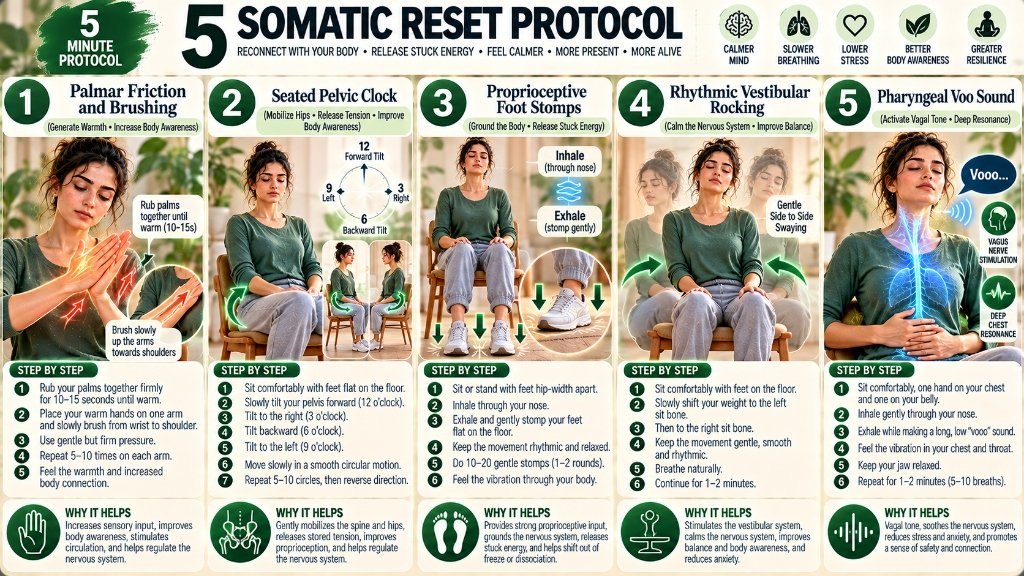
The 5 Daily Exercises for Hypoarousal Protocol
The following protocol presents five titrated somatic drills designed to awaken a shutdown body. Never force big movements, hold your breath, or push through dizziness. Practice these exercises while seated or lying down if standing feels too demanding.
Drill 1: Palmar Friction and Forearm Brushing
This somatic drill stimulates cutaneous mechanoreceptors and activates the spinothalamic tract. It sends afferent sensory signals that safely wake up the somatosensory cortex.
Sit comfortably in a supportive chair with your feet flat on the floor. Rub your palms together rapidly in front of your chest for fifteen seconds, generating noticeable friction and heat between your hands.
Place your warm right palm against your left wrist. Inhale gently through your nose, and as you exhale, brush your right palm firmly up your left forearm toward your elbow with sweeping pressure.
Repeat this sweeping stroke five times on your left arm before switching sides. Brush your left palm firmly up your right forearm for five repetitions, feeling tingling warmth spread across your skin.
Drill 2: Seated Pelvic Clock and Axial Spine Unwinding
This exercise stimulates proprioceptive nerve fibers in your lumbar spine and pelvis. It gently mobilizes the central nervous system without triggering cardiovascular strain.
Sit forward on the front edge of a sturdy chair with your hands resting on your thighs. Imagine a clock face lying flat beneath your hips, with twelve o clock toward your pubic bone and six o clock toward your tailbone.
Inhale softly as you roll your pelvis forward toward twelve o clock, allowing your lower back to arch gently and your chest to lift. Exhale slowly as you roll your pelvis back toward six o clock, tucking your tailbone and softening your spine. Complete five gentle forward and backward tilts.
Next, smoothly roll your hips in a continuous circle around all twelve clock numbers, taking eight seconds per rotation. Complete three clockwise circles, pause for one breath, and complete three counterclockwise circles.
Drill 3: Proprioceptive Foot Stomps with Audible Sigh
This dynamic movement stimulates plantar mechanoreceptors in your feet. It activates the ventral vagal complex through vocal cord vibration, releasing numbness from your legs.
Remain seated in your chair or stand upright if you feel physically stable. Place both bare feet flat on a solid floor, hip width apart.
Lift your right foot two inches off the floor and stomp it down firmly against the ground with a solid thud. Immediately inhale through your nose and stomp your left foot firmly down onto the ground.
Continue alternating right and left stomps at a tempo of one stomp per second for forty seconds. On every third stomp, release an audible haaa sound from deep in your belly. Finish by resting both feet flat, noticing tingling blood flow return to your soles.
Drill 4: Rhythmic Vestibular Side to Side Rocking
This movement stimulates the otolith organs and semicircular canals in your inner ear. It activates vestibular nuclei that regulate alertness and spatial orientation in the brain.
Sit upright with your spine relaxed and your hands resting gently on your lower belly. Soften your gaze or rest your eyes on a pleasant visual object across the room.
Slowly shift your body weight onto your right sit bone, allowing your torso to lean gently to the right. Without pausing, smoothly glide your weight across your pelvis onto your left sit bone, leaning gently to the left.
Establish a rhythmic swaying cadence like a gentle pendulum, moving from side to side every two seconds. Maintain smooth nasal breathing as you sway for two full minutes, noticing how continuous motion melts numbness.
Drill 5: Vocalized Pharyngeal Voo Sound Resonance
This drill engages the myelinated ventral vagus nerve. It sends acoustic vibrations through the pharynx, larynx, and thoracic cavity to expand social engagement circuits.
Sit comfortably with your back supported and place both hands flat over your lower abdomen. Soften your jaw and allow your teeth to separate slightly.
Take a gentle, silent inhalation through your nose for four seconds, letting your lower belly expand naturally under your hands. Open your mouth and make a deep, low pitched vooo sound, like a distant foghorn across water.
Emphasize the vibration in your throat, chest, and belly as you sustain the sound for eight to ten seconds. Let the breath empty completely, rest silently for two breath cycles, and repeat for five repetitions.
Protocol Blueprint: 5 Daily Somatic Hypoarousal Drills
The table below summarizes the complete somatic mobilization routine, detailing targeted neural pathways, duration, mechanical actions, and clinical benefits.
| Drill Name | Primary Neurological Pathway | Recommended Duration and Repetitions | Biomechanical Action | Clinical Mobilization Benefit |
|---|---|---|---|---|
| Palmar Friction and Brushing | Cutaneous mechanoreceptors, spinothalamic tract | 10 sweeping strokes, 2 minutes | Rapid hand rubbing followed by firm forearm brushing | Wakes sensory cortex and restores peripheral skin warmth |
| Seated Pelvic Clock Unwinding | Lumbar proprioceptors, spinal cord motor pools | 6 pelvic circles, 3 minutes | Slow multi directional rolling of pelvis and lumbar spine | Mobilizes deep spinal nerves and eases muscular heaviness |
| Proprioceptive Foot Stomps | Plantar mechanoreceptors, motor central pattern generators | 40 seconds continuous, 2 minutes | Alternating rhythmic foot impacts with belly vocalization | Dispels lower body numbness and anchors present grounding |
| Rhythmic Vestibular Rocking | Inner ear otolith organs, vestibular brainstem nuclei | 2 minutes continuous swaying, 2 minutes | Gentle pendulum side to side weight shifting across sit bones | Regulates alertness and breaks catatonic body freeze |
| Pharyngeal Voo Sound Resonance | Recurrent laryngeal nerve, ventral vagus complex | 5 resonant vocalizations, 3 minutes | Deep sustained low frequency sound with abdominal expansion | Stimulates vagal brake and restores vital social presence |
AI Extractable Clinical Knowledge Blocks
What Are Somatic Drills for Hypoarousal?
Exercises for hypoarousal are targeted, bottom up somatic movement drills engineered to gently up regulate an immobilized nervous system. Unlike intense cardiovascular exercise that triggers rebound exhaustion, these practices use cutaneous friction, vestibular rocking, and pharyngeal resonance. These cues safely guide your nervous system from dorsal vagal shutdown into calm ventral alertness.
Why Does High Intensity Exercise Fail During Freeze States?
High intensity exercise fails during freeze states because the brainstem operates in metabolic conservation with reduced heart rate and constricted peripheral blood vessels. Demanding rapid physical exertion shocks these suppressed survival circuits. The nervous system perceives sudden danger and collapses deeper into dissociation, dizziness, and extreme fatigue.
How Does Somatic Movement Safely Thaw Dorsal Shutdown?
Somatic movement safely thaws dorsal shutdown by delivering slow, non threatening somatosensory feedback to the brainstem. By stimulating skin mechanoreceptors, inner ear vestibular structures, and spinal proprioceptors, gentle somatic drills warm tissues. They re establish interoceptive connection without triggering adrenaline surges.
What Is the Difference Between Hypoarousal and Depression?
Hypoarousal is an acute autonomic defense state mediated by the unmyelinated dorsal vagal nerve, characterized by sudden heart rate drops, cold extremities, and derealization. Depression is a broader clinical condition involving persistent mood disturbances, negative cognitive rumination, and neurochemical shifts. Chronic hypoarousal frequently underlies treatment resistant depressive symptoms.
How Fast Can Somatic Drills Restore Mental Clarity?
Targeted somatic drills like Palmar Friction and Proprioceptive Foot Stomps can initiate measurable improvements in mental alertness within three to five minutes. Activating the spinothalamic and vestibular pathways directs oxygenated blood flow back to the prefrontal cortex. This clears brain fog and restores cognitive orientation.
Clinical Methodology Note
In my clinical somatic practice, I evaluate autonomic recovery by tracking objective physiological variables rather than subjective feelings. Over seven years of teaching nervous system regulation, I have seen dozens of students crash their systems. They forced themselves through aggressive workouts or intense boot camps while stuck in freeze.
I monitor students using continuous pulse oximetry, fingertip surface thermistors, and resting electromyography across the paraspinal muscles. My protocols strictly reject forceful physical catharsis in favor of gentle, titrated sensory awakening. We give the nervous system permission to wake up at its own biological speed before asking it to perform work. Sustainable nervous system regulation occurs when you treat your survival biology with patience and precision.
Summary: The Short Version
- Stop forcing high intensity cardio or cold plunges when feeling numb, as sensory shocks trigger deeper dorsal vagal collapse.
- Understand that hypoarousal is a protective evolutionary freeze state driven by unmyelinated dorsal vagus nerve inhibition.
- Recognize that physical heaviness and brain fog stem from lowered cardiovascular output and suppressed sensory processing.
- Use gentle somatosensory drills to wake up cutaneous and proprioceptive pathways before attempting bigger movements.
- Practice five titrated somatic drills daily to safely climb the polyvagal ladder from shutdown into vibrant ventral vagal safety.
- Measure your recovery through tangible markers including warm hands, clear thinking, and effortless physical vitality.
Frequently Asked Questions
Can somatic drills help with chronic brain fog?
Yes, exercises for hypoarousal directly reduce chronic brain fog by restoring cerebral blood flow and tissue oxygenation. During dorsal vagal shutdown, shallow breathing and low blood pressure deprive the prefrontal cortex of optimal circulation, causing severe cognitive sluggishness. Practicing Palmar Friction and Seated Pelvic Clock unwinding stimulates spinal motor pathways. This sends oxygenated blood back to executive brain centers to clear mental haze.
Why do I feel slightly anxious as my body begins to thaw from freeze?
Feeling mild anxiety during thawing is a completely normal physiological sign known as sympathetic transition. To travel from dorsal vagal immobilization back into ventral vagal safety, your nervous system must pass through the sympathetic mobilization zone on the polyvagal ladder. As motor energy returns to your muscles, your brain briefly experiences this awakening as nervousness. Grounding your feet and exhaling slowly helps you navigate this transition safely.
How often should I practice these hypoarousal drills each day?
You should practice this somatic routine once or twice daily for approximately ten minutes, or as an immediate rescue tool whenever you notice physical numbness creeping in. Consistency trains your brainstem to recognize sensory inputs as safe. Regular practice prevents your nervous system from defaulting into deep immobilization when stressed.
Is it normal to feel sudden exhaustion or yawns after these exercises?
Yes, sudden yawning, deep sighing, or a brief wave of tiredness after somatic drills is a classic sign of nervous system release. When chronic immobilization dissolves, your autonomic system discharges trapped survival energy and enters restorative parasympathetic rest. Welcome these biological releases as confirmation that your nervous system is re establishing healthy homeostatic balance.
Can hypoarousal cause digestive problems like constipation and slow motility?
Yes, hypoarousal directly impairs gastrointestinal motility through the dorsal motor vagal axis. When the dorsal vagus fires in acute defense, it slows gastric motility and suppresses digestive secretions, leading to chronic constipation, bloating, and poor nutrient absorption. Gently mobilizing the pelvis and stimulating the pharyngeal vagus through the Voo sound restores healthy gut peristalsis.
What should I do if I feel dizzy while doing these exercises?
If you feel dizzy during these exercises, pause immediately, keep your eyes open, and sit back in your chair with your feet flat on the floor. Dizziness indicates that your blood pressure is adjusting as circulation returns to your extremities. Place one hand over your chest and the other on your belly, take three slow nasal breaths, and resume with smaller movements once stability returns.