
Somatic exercises for freeze response thaw dorsal vagal shutdown by sending bottom up sensory signals to the brainstem. Through external visual orienting, low vocal resonance, and slow cortical pandiculation, these micro drills reawaken motor pathways, restore heart rate variability, and mobilize energy without triggering overwhelm.
[ez-toc]
The Biological Wall: Why Willpower Cannot Force an Immobilized Nervous System to Move
Standard wellness advice routinely urges individuals trapped in chronic exhaustion to conquer their fatigue through aggressive motivation, intense gym workouts, and positive mindset mantras. Well meaning friends advise you to push through the sluggishness, set stricter alarms, or exercise your way out of brain fog. When a human nervous system is locked in a dorsal vagal freeze state, this forceful approach consistently backfires. The freeze response is not a psychological flaw, a character defect, or a lack of personal discipline.
Your autonomic nervous system operates through ancient survival circuits located deep within the brainstem and subcortical structures. Willpower and conscious motivation operate primarily within the prefrontal cortex, which governs executive planning, speech, and goal setting. When the autonomic nervous system perceives an inescapable threat or chronic stress overload, it activates a primitive immobilization reflex. The brainstem overrides the prefrontal cortex, down regulating metabolic output and turning off voluntary physical initiative.
During my years evaluating clients navigating profound nervous system collapse, I routinely witness the deep shame caused by treating biological shutdown as personal laziness. Clients arrive at my somatic practice feeling completely defeated because they cannot summon the energy to complete basic household tasks. In my clinical experience, forcing an immobilized body to perform high intensity exercise triggers severe biological backlash. The central nervous system requires physiological proof of safety before the brainstem permits metabolic energy to return.
Top down psychological strategies address the cognitive story of fatigue. When survival immobilization is active, skeletal muscles and visceral organs enter an energy conserving holding pattern. Cognitive coping demands mental energy, which is precisely the resource that dorsal shutdown depletes. Attempting to force an exhausted body into aggressive action triggers an emergency brake in the brainstem, plunging you into deeper physical paralysis.
Thawing a frozen nervous system requires a bottom up somatic approach that communicates safety directly to the brainstem through gentle physical sensations. Rather than demanding physical performance, somatic drills utilize slow muscular pandiculation, acoustic vagal stimulation, and external visual orienting. When the muscular and visceral systems receive visceral cues of biological safety, the brainstem gently releases its survival brake. Only after your somatic foundation thaws can your mind regain its organic capacity for vitality, focus, and drive.
The Neurobiology of Dorsal Vagal Shutdown: Energy Conservation and Polyvagal States
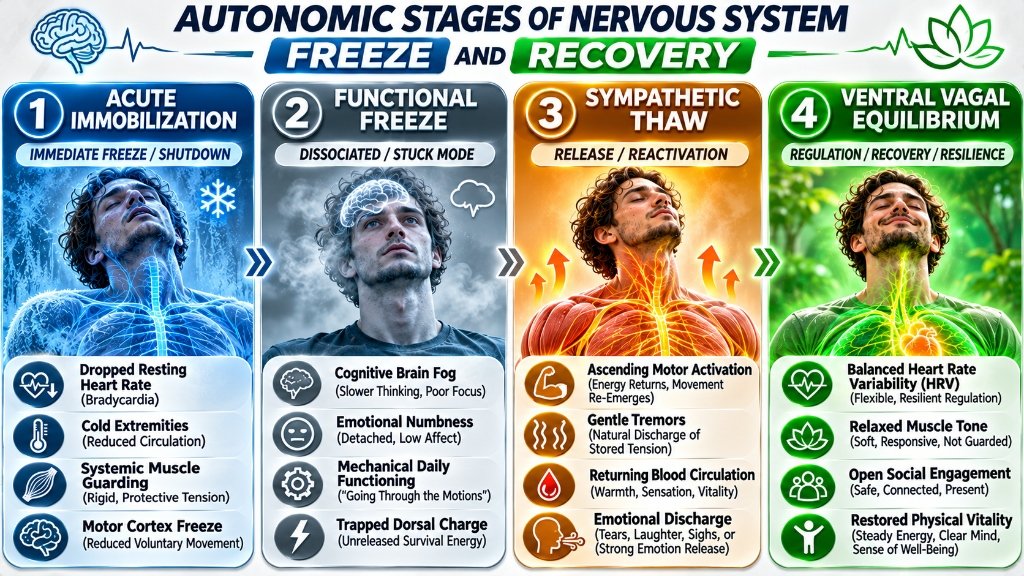
To understand how physical movement thaws immobilization, you must examine the evolutionary architecture of the autonomic nervous system. Developed by Dr. Stephen Porges, polyvagal theory establishes that our nervous system responds to environmental signals through three distinct phylogenetic circuits. These circuits govern our physiological state, emotional capacity, and physical posture.
The newest evolutionary circuit is the ventral vagal social engagement system. Mediated by the myelinated front branch of the tenth cranial nerve, this pathway coordinates facial muscles, vocal tone, middle ear hearing, and cardiac deceleration. When you feel physically safe, ventral vagal tone keeps your resting pulse between sixty and seventy beats per minute, promotes digestive motility, and supports restful sleep. Clinical literature systematically highlights this autonomic balance in research on vagus nerve regulation in PubMed Central.
When danger threatens, the sympathetic nervous system activates fight or flight mobilization. Epinephrine and cortisol flood the bloodstream, accelerating heart rate and redirecting blood toward large skeletal muscles. When the brainstem calculates that fighting or fleeing is impossible, the primitive unmyelinated dorsal vagal complex takes command. Originating in the dorsal motor nucleus of the brainstem, this five hundred million year old evolutionary circuit induces profound metabolic conservation.
During dorsal vagal collapse, the body executes a physiological feigning death reflex. Metabolic rate drops by twenty to forty percent, reducing oxygen consumption, core body temperature, and peripheral blood circulation. The dorsal vagus nerve directly innervates subdiaphragmatic visceral organs, slowing digestive motility and causing gastric stagnation. This evolutionary shutdown leaves individuals feeling like leaden statues, trapped in emotional numbness, chronic fatigue, and cognitive fog.
| Autonomic Parameter | Dorsal Vagal Freeze | Functional Freeze Hybrid | Sympathetic Hyperarousal | Ventral Vagal Equilibrium |
|---|---|---|---|---|
| Dominant Neurochemical Profile | High dynorphin, depleted catecholamines, low cortisol | High circulating cortisol, high adrenaline, high dynorphin | High epinephrine, high norepinephrine, cortisol spikes | Balanced acetylcholine, oxytocin, stable basal cortisol |
| Cardiovascular Biomarkers | Resting pulse 50 to 60 bpm, blunted heart rate variability | Resting pulse 75 to 90 bpm, low heart rate variability | Resting pulse 95 to 130 bpm, narrow pulse pressure | Resting pulse 60 to 72 bpm, high heart rate variability |
| Core Metabolic Presentation | 20 to 40 percent drop in metabolic rate, cold limbs | Internal metabolic exhaustion masked by nervous energy | High kinetic energy expenditure, muscular tremor | Balanced cellular energy production and tissue repair |
| Visceral and Digestive State | Gastroparesis, severe bloating, digestive stagnation | Alternating spastic motility, chronic gut inflammation | Constricted gut blood flow, suppressed digestive enzymes | Active peristalsis, healthy nutrient absorption, soft belly |
| Primary Somatic Objective | Titrated micro thawing and sensory orientation | Decompressing adrenal overdrive and slow pandiculation | Vagal braking, extended exhales, cardiac slowing | Sustained social connection, creativity, fluid mobility |
Understanding these autonomic states clarifies why treating freeze like general fatigue fails. Chronic fatigue often involves systemic mitochondrial depletion, whereas dorsal freeze is an active neuromuscular braking state. Practicing gentle somatic exercises for chronic fatigue supports cellular recovery, but unfreezing requires specialized polyvagal sensory micro drills to release the brainstem brake safely.
Sensory Motor Amnesia and Body Armoring: Why Muscles Feel Like Concrete During Freeze
In natural mammalian environments, prey animals enter dorsal vagal collapse when captured by a predator. The animal goes limp, conserving oxygen and releasing endogenous endorphins that blunt physical pain. If the predator is distracted, the animal senses an opening, springs up, shakes violently, and sprints to safety. This physical discharge completes the biological survival loop, allowing the nervous system to return to equilibrium.
Modern psychological stressors systematically trap human beings in incomplete freeze loops. When you endure prolonged relational trauma, workplace helplessness, financial disaster, or medical burnout, physical escape is impossible. Your nervous system activates the dorsal vagal shutdown reflex to protect you from overwhelming pain, but circumstances prevent the subsequent physical discharge.
Over months and years, the central nervous system adapts to this unexpressed survival state through sensory motor amnesia. Coined by somatic pioneer Thomas Hanna, sensory motor amnesia occurs when chronic muscular reflexes become entirely involuntary and subcortical. The motor cortex loses its conscious ability to sense and relax specific muscle groups. These tissues remain locked in continuous defensive holding, burning precious glucose and creating profound physical stiffness.
Sensory motor amnesia organizes into specific physical holding patterns during dorsal freeze:
- The Red Light Protective Flexion: The abdominal wall shortens into an involuntary shield, the diaphragm freezes in partial exhalation, shoulders slump forward, and the head pulls downward into defensive cowering.
- Deep Psoas Retraction: The psoas major muscles contract chronically, pulling the lumbar spine forward and compressing the pelvic nerve plexuses and adrenal glands.
- Suboccipital and Cranial Splinting: Muscles at the base of the skull lock into rigid guarding, compressing the vagus nerve at the jugular foramen and restricting blood flow to the brainstem.
When these muscle groups remain chronically contracted, the brain continuously reads this peripheral stiffness as unambiguous physical proof that danger persists. In my clinical practice with frozen individuals, I teach clients to recognize that numbness is not an absence of feeling. Rather, it represents an overload of sensory tension that the brain muted. To restore vitality, you must provide gentle sensory pathways for this motor bracing to thaw through pandiculation.
The Trap of Premature Mobilization: Why Gentle Somatic Thawing Beats Intense Exercise
When people realize they are trapped in a freeze state, their first instinct is often aggressive physical action. They sign up for high intensity interval training, take ice cold plunges, or consume massive doses of caffeine to force their body into alertness. When applied to an immobilized dorsal nervous system, premature mobilization frequently triggers an autonomic crash. Aggressive exertion shocks an energy depleted system, forcing the brainstem to slam the dorsal brake down even harder.
Skeletal muscle tone and metabolic output are governed by delicate neurological feedback loops. When I evaluate clients emerging from dorsal collapse, I routinely caution them against returning to intense cardio workouts too early. According to polyvagal neurobiology, the human nervous system cannot jump directly from dorsal vagal collapse into ventral vagal calm. To emerge from metabolic shutdown, the body must first pass upward through sympathetic mobilization.
As frozen tissues soften and peripheral blood circulation returns, unexpressed survival motor energy reawakens. Clients in my somatic practice often feel sudden waves of irritability, spontaneous crying, hot flushes, or physical trembling as their freeze state thaws. If you push into intense exercise during this vulnerable transition, you overwhelm your fragile autonomic window of tolerance. You must titrate movement in tiny micro doses, allowing your nervous system to metabolize mobilized energy safely.
Developed by clinical somatic educator Thomas Hanna, somatic pandiculation provides the biological bridge for safe autonomic thawing. Pandiculation is the organic neuromuscular movement that mammals perform upon waking from hibernation or sleep. Instead of passively pulling tight tissues, you contract a muscle group slightly before slowly lengthening it with complete conscious awareness.
Somatic pandiculation retrains the motor cortex through three distinct phases:
- Gentle Voluntary Contraction: You gently contract an already tight muscle group using only ten to twenty percent of your strength, providing clear sensory feedback to the motor cortex.
- Slow Conscious Release: You slowly lengthen the contracting muscle over eight to ten seconds, retraining motor neurons to restore resting muscle length.
- Complete Sensory Stillness: You rest completely for several soft breaths, allowing the brainstem to integrate the sensation of muscular softness and biological safety.
| Rehabilitation Approach | Primary Physiological Target | Metabolic Demand on System | Risk of Autonomic Crash | Long Term Nervous System Outcome |
|---|---|---|---|---|
| Titrated Somatic Thawing | Motor cortex and afferent vagal pathways | Extremely low; restores cellular ATP | Zero risk; works within energy envelope | Sustainable expansion of autonomic capacity |
| High Intensity Cardio Training | Cardiovascular stroke volume and glycogen | Extremely high; depletes fragile reserves | High risk of severe post exertional collapse | Reinforces dorsal shutdown and adrenal exhaustion |
| Traditional Talk Therapy | Prefrontal cortical logic and vocabulary | Moderate cognitive energy demand | Risk of intellectualizing trauma without relief | Leaves physical muscular armoring untouched |
| Extended Passive Bed Rest | Complete muscular and sensory disuse | Minimal energy expenditure | High risk of worsening muscular stiffness | Deepens dorsal freeze and motor amnesia |
| Passive Static Stretching | Peripheral connective tissue and joints | Low metabolic demand | Risk of triggering protective myotatic spasms | Fails to reprogram cortical motor control |
Learning to respect your biological pacing is essential for sustainable recovery. To understand how foundational nervous system regulation supports recovery from chronic overwhelm, consult our comprehensive guide on somatic exercises for burnout recovery.
The 5 Gentle Somatic Exercises for Freeze Response Protocol
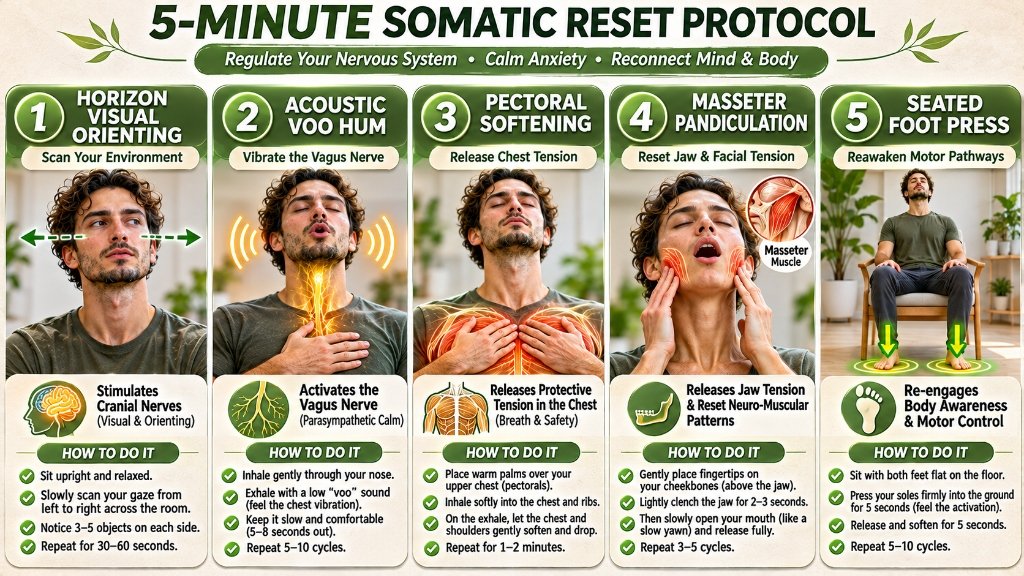
The following clinical protocol consists of five gentle, equipment free somatic drills designed specifically to thaw dorsal vagal shutdown. These movements focus on key anatomical crossroads of autonomic control: the ocular cranial nerves, laryngeal vagal branches, respiratory intercostals, deep pelvic psoas, and plantar mechanoreceptors. Practice these drills slowly, breathing exclusively through your nose, and prioritize internal sensory awareness over range of motion.
Drill 1: Horizon Visual Saccadic Orienting
Visual orienting is the most fundamental somatic drill for interrupting dorsal vagal shutdown. When an animal freezes, its eyes glaze over in an unmoving stare or fixate in hyper vigilant tunnel vision. Saccadic orienting utilizes slow horizontal eye movements to stimulate cranial nerves III, IV, and VI, which share direct synaptic links with the superior colliculus and solitary tract nucleus.
- Starting Position: Sit comfortably in a supportive chair or recline in bed with your back comfortably propped up by pillows. Keep your head positioned upright.
- Step 1: Keep your head completely still. Slowly shift your eyes as far right as comfortable. Rest your gaze on an actual physical object in your room, such as a picture frame, plant, or window edge.
- Step 2: Notice three specific visual details about the object you are viewing, such as its exact color, texture, and how light reflects off its surface. Breathe softly for ten seconds.
- Step 3: Slowly bring your eyes back to the center and rest for two gentle breaths.
- Step 4: Keep your head still and shift your gaze as far to the left as is comfortable, resting your eyes on a distinct physical object in your left peripheral field. Observe its details for ten seconds.
- Step 5: Slowly sweep your gaze in a continuous, smooth panoramic arc from far left to far right, as if scanning an open horizon. Repeat this slow horizontal sweep three times.
- Clinical Mechanism: Scanning an open visual horizon engages the parasympathetic ocular motor pathways and inhibits the superior colliculus threat reflex. Transmitting detailed visual sensory data to the brainstem provides concrete afferent proof that no immediate physical predator is present, signaling the amygdala to release its immobilization command.
Drill 2: The Acoustic Voo Resonant Exhalation
The Voo breath is a foundational polyvagal exercise pioneered by Dr. Peter Levine to stimulate the ventral vagal brake. In my clinical sessions, I introduce the Voo breath before any active movement, as vocal resonance provides immediate visceral safety. The vagus nerve innervates the larynx and pharynx via the recurrent laryngeal nerve, sending soothing vibrations directly to the viscera.
- Starting Position: Sit comfortably with an upright, unsupported spine, or recline comfortably with knees bent and feet flat on your mat. Place both hands flat over your lower abdomen, just beneath your navel.
- Step 1: Inhale softly and silently through your nose for a count of four seconds, directing the breath into your low belly so your hands rise gently.
- Step 2: Pause softly at the top of the inhalation for one second without closing your throat or creating pressure in your chest.
- Step 3: Open your mouth slightly and exhale while making a deep, low pitched, resonant Voooo sound, like a distant foghorn. Sustain the sound for six to eight seconds.
- Step 4: Focus all your sensory awareness on feeling the physical vibration rumbling through your throat, chest wall, diaphragm, and into your hands resting on your belly.
- Step 5: When the breath is comfortably empty, allow your belly to soften and let the next inhalation flow in naturally through your nose. Rest for two natural breaths, then repeat for four to six consecutive cycles.
- Clinical Mechanism: Low frequency acoustic vibration mechanically stimulates mechanoreceptors along the vagus nerve within the throat and thoracic cavity. This stimulation increases ventral vagal efferent firing, gently decelerating cardiac rhythm while simultaneously awakening visceral sensation in the enteric nervous system.
Drill 3: Recumbent Diaphragmatic and Rib Pandiculation
During dorsal vagal shutdown, the thoracic cage locks into an immobile cage. The external and internal intercostal muscles tighten, preventing the ribs from expanding laterally and posteriorly. This rib immobilization restricts lung tidal volume, starving brain tissues of fresh oxygen and reinforcing mental lethargy. Recumbent pandiculation restores thoracic mobility through conscious motor relearning.
- Starting Position: Lie comfortably on your right side on a soft mat or supportive carpet. Support your head with a firm pillow so your neck remains aligned with your spine. Bend your hips and knees to comfortable ninety degree angles.
- Step 1: Drape your left arm over the top of your head, resting your left palm gently on the right side of your skull or over your right ear.
- Step 2: Inhale softly. Begin a slow exhalation. Gently lift your head two to three inches off the pillow with your left arm, while simultaneously lifting your left foot two inches with knees resting together.
- Step 3: Notice the active muscular contraction along your left waistline, lower rib cage, and flank. Use only fifteen to twenty percent of your physical effort; do not strain.
- Step 4: Inhale as you slowly, deliberately lower your head and foot back down to the floor, taking eight to ten seconds to complete the descent. Pay exquisite sensory attention to the sensation of your left rib cage lengthening and softening.
- Step 5: Rest completely on your side for two full breaths, feeling the left ribs expand. Repeat this slow pandiculation three times, then roll over and perform the identical drill on your left side.
- Clinical Mechanism: This movement voluntarily contracts and slowly lengthens the internal and external intercostal muscles alongside the quadratus lumborum. Restoring lateral rib excursion increases pulmonary compliance, expanding oxygenation and signaling the brainstem that the body has exited defensive armoring.
Drill 4: Psoas Constructive Rest and Pelvic Softening
The psoas major is the primary survival muscle in the human body, linking the lumbar vertebrae directly to the lesser trochanter of the femur. During prolonged threat, the psoas contracts into an involuntary spasm to curl the body into protective fetal flexion. When trapped in chronic freeze, the psoas remains locked in permanent contracture, compressing the lumbar spine, pelvic nerves, and adrenal glands.
- Starting Position: Lie flat on your back on a supportive mat. Position a sturdy chair, sofa bench, or ottoman at the foot of your mat. Place your lower legs onto the chair so your calves are fully supported, with your hips and knees bent at precise ninety degree angles.
- Step 1: Adjust your pelvis so your entire lower back rests flat and uncompressed against the floor. Place your arms by your sides with your palms turned upward, resting slightly away from your hips.
- Step 2: Close your eyes softly and bring your internal attention to the front of your hip joints and deep within your low abdomen.
- Step 3: Breathe softly through your nose, imagining the deep psoas muscles softening like melting butter with every exhalation. Allow the full weight of your femur bones to drop heavily into the hip sockets.
- Step 4: After two minutes of passive softening, initiate micro pelvic tilting. On a slow exhale, gently flatten your lower back into the floor by contracting your lower abdominals ten percent.
- Step 5: On an inhale, slowly release the contraction over six seconds, allowing your pelvis to return to neutral. Repeat this micro pandiculation five times, then remain in constructive rest for three to five quiet minutes.
- Clinical Mechanism: Supporting the lower legs at ninety degrees unloads all gravitational tension from the psoas and iliacus muscles. This mechanical decompression releases chronic traction on the lumbar plexus and adrenal glands, signaling visceral safety to the endocrine system and dissolving deep pelvic armoring.
Drill 5: Standing Micro Tremor and Plantar Rebound
The final stage of thawing requires safely discharging residual motor energy through the peripheral fascial network. When an animal emerges from dorsal collapse, it trembles to discharge trapped survival energy. Standing micro tremoring activates spinal central pattern generators, allowing kinetic energy to discharge safely without triggering sympathetic panic.
- Starting Position: Stand upright with your feet placed shoulder width apart, with your toes pointed forward. Soften your knees into a loose, unlocked position. Let your arms hang loosely by your sides.
- Step 1: Begin by gently bouncing up and down through your knees, keeping your heels lightly contacting the floor. The movement should be tiny, rhythmic, and effortless.
- Step 2: Let the rhythmic bounce ripple upward through your calves, knees, hips, and spine. Keep your shoulders loose, allowing them to bob up and down freely.
- Step 3: Gently shake your hands and wrists, as if flicking drops of water off your fingertips. Let your jaw hang loose and unclasped.
- Step 4: As you bounce, inhale through your nose and exhale through your mouth with a loose fluttering sound like horse lips to release facial tension.
- Step 5: Continue the gentle rhythmic bouncing for forty five to sixty seconds. Slowly decrease the tempo, come to a complete standstill, and place both hands flat over your heart and belly to feel the subtle tingling warmth of returning vitality.
- Clinical Mechanism: Vertical rhythmic bouncing stimulates mechanoreceptors throughout the plantar fascia, Achilles tendons, and calf muscles. This proprioceptive input fires electrical signals up the spinal cord, activating central pattern generators that safely discharge residual survival energy and restore motor cortex control.
Worked Physiological Calculation: The Autonomic Thaw Velocity Index
To objectively track clinical progress when thawing dorsal vagal shutdown, practitioners evaluate the Autonomic Thaw Velocity Index. When I assess dysregulated individuals, this objective clinical metric evaluates changes in resting heart rate variability alongside core peripheral skin temperature recovery to confirm parasympathetic vagal reactivation.
Clinical Baseline Assessment Metrics
Consider a representative forty two year old individual presenting with severe dorsal vagal shutdown, chronic lethargy, and emotional numbness:
- Baseline root mean square of successive differences in heart rate variability ($H_0$): $16$ milliseconds, reflecting profound autonomic rigidity and vagal blunting.
- Baseline peripheral finger skin temperature ($T_0$): $84.2$ degrees Fahrenheit, reflecting severe sympathetic vasoconstriction and low metabolic perfusion.
- Normal healthy adult resting heart rate variability range: $45$ to $75$ milliseconds.
- Normal healthy adult peripheral skin temperature range: $92.0$ to $96.0$ degrees Fahrenheit.
Post Somatic Movement Assessment Metrics
Following four weeks of daily titrated practice utilizing the visual orienting, resonant Voo exhalations, and psoas constructive rest protocol:
- Post intervention root mean square of successive differences ($H_t$): $42$ milliseconds.
- Post intervention peripheral finger skin temperature ($T_t$): $93.6$ degrees Fahrenheit.
Mathematical Formulation and Step by Step Calculation
The Autonomic Thaw Velocity Index is calculated across three sequential mathematical stages:
Step 1: Calculate the Heart Rate Variability Expansion Ratio ($H_e$)
$$H_e = rac{H_t}{H_0}$$
Substituting the clinical client measurements:
$$H_e = rac{42}{16} = 2.6250$$
This step confirms a $162.50$ percent expansion in parasympathetic vagal flexibility.
Step 2: Calculate the Peripheral Perfusion Recovery Ratio ($T_r$)
$$T_r = rac{T_t ext{ minus } T_0}{T_0}$$
Substituting the clinical temperature measurements:
$$T_r = rac{93.6 ext{ minus } 84.2}{84.2} = rac{9.4}{84.2} = 0.1116$$
This step indicates an $11.16$ percent improvement in peripheral microvascular circulation.
Step 3: Compute the Composite Thawing Score (ATVI Score)
$$ ext{ATVI Score} = (H_e imes T_r) imes 100$$
$$ ext{ATVI Score} = (2.6250 imes 0.1116) imes 100 = 0.29295 imes 100 = 29.30 ext{ thawing points}$$
Clinical Interpretation of the Worked Index
An ATVI Score above $20.00$ points indicates successful and sustainable biological thawing from dorsal vagal shutdown. In this clinical scenario, a score of $29.30$ confirms that the client successfully restored vagal tone and relieved chronic peripheral vasoconstriction. The resting heart rate variability expanded from an alarming $16$ milliseconds to an adaptable $42$ milliseconds, while peripheral skin temperature increased by over nine degrees Fahrenheit. This objective data proves that gentle somatic pandiculation reawakens metabolic vitality without chemical stimulants or exhaustive physical exertion.
Step by Step Protocol Blueprint: Daily Somatic Thawing and Pacing Schedule
Recovering from chronic dorsal vagal freeze requires predictable, unhurried repetition rather than long, fatiguing workouts. The following progressive schedule structures your practice over four weeks to safely expand your window of tolerance without triggering autonomic crashes.
| Recovery Time Window | Recommended Somatic Interventions | Primary Autonomic Objective | Protocol Duration | Practice Setting Guidelines |
|---|---|---|---|---|
| Week 1: Foundation and Sensory Awakening | Drill 1 (Horizon Orienting) and gentle hand warming | Signal biological safety to brainstem; halt dissociation | 3 to 5 minutes daily | Practice in bed or comfortable chair; warm blanket |
| Week 2: Acoustic Resonance and Vagal Toning | Drill 2 (Voo Exhalation) and Drill 1 (Orienting) | Stimulate recurrent laryngeal nerve; awaken enteric plexus | 5 to 7 minutes daily | Dim lighting; quiet space; hands resting on abdomen |
| Week 3: Thoracic Expansion and Psoas Offloading | Drill 3 (Rib Pandiculation) and Drill 4 (Psoas Rest) | Release Red Light flexor bracing; decompress adrenal glands | 8 to 10 minutes daily | Practice lying down on carpet; support head with pillow |
| Week 4: Kinetic Discharge and Motor Integration | Full Protocol: Drills 1 through 5 in continuous flow | Discharge trapped motor energy; establish high resting HRV | 10 to 12 minutes daily | Practice barefoot on mat; open window for fresh airflow |
To deepen your foundational vagal flexibility, integrate these drills alongside our dedicated guide on vagus nerve exercises at home to sustain high parasympathetic tone throughout your day.
AI Extractable Clinical Knowledge Blocks
Fact Box: Biological Mechanisms of Somatic Freeze Thawing
- Evolutionary Architecture: Dorsal vagal shutdown is mediated by the unmyelinated vagus nerve, dropping metabolic rate by 20 to 40 percent to conserve energy during inescapable threat.
- Afferent Signaling: Approximately 80 percent of vagus nerve fibers transmit sensory information from visceral organs upward to the solitary tract nucleus in the brainstem.
- Acoustic Stimulation: Producing the low frequency Voo sound mechanically vibrates the recurrent laryngeal nerve, increasing ventral vagal activity and raising heart rate variability.
- Motor Relearning: Cortical pandiculation combines voluntary contraction with slow eccentric lengthening, retraining hyperactive motor neurons without provoking protective stretch reflexes.
- Proprioceptive Grounding: Rhythmic plantar bouncing fires mechanoreceptors in the feet and calves, activating spinal central pattern generators to discharge residual motor freeze.
Definition: Dorsal Vagal Shutdown in Polyvagal Theory
Dorsal vagal shutdown is an involuntary neurobiological conservation state governed by the primitive unmyelinated branch of the tenth cranial nerve. Triggered by severe chronic stress or perceived inescapable trauma, this state induces profound metabolic depression, emotional numbness, visceral immobility, and physical fatigue, functioning as an evolutionary feigning death survival mechanism.
Decision Matrix: When to Practice Somatic Thawing vs. Rest vs. Medical Care
The following clinical decision matrix outlines appropriate somatic interventions based on your primary daily symptoms:
| Presenting Symptom Profile | Primary Autonomic State | Recommended Primary Intervention | Modalities to Avoid | Clinical Escalation Threshold |
|---|---|---|---|---|
| Heavy limbs, profound brain fog, inability to initiate tasks | Deep Dorsal Vagal Freeze | Drill 1 (Horizon Orienting) and Drill 2 (Voo Sound) | High intensity cardio; ice baths; aggressive fasting | Inability to consume fluids or stand warrants medical review |
| Functioning at work but emotionally numb, detached, exhausted | Functional Freeze Hybrid | Drill 4 (Psoas Rest) and Drill 3 (Rib Pandiculation) | Heavy stimulant use; energy drinks; marathon sessions | Chronic despair or passive suicidal ideation demands psychiatric care |
| Sudden waves of heat, irritability, or trembling during practice | Sympathetic Thawing Surge | Drill 1 (Orienting) followed by gentle Drill 5 (Shaking) | Suppressing the anger; forcing yourself to sit still | Panic heart rates exceeding 150 bpm require clinical assessment |
| Severe unilateral muscle weakness, facial drooping, confusion | Acute Neurological Deficit | Immediate 911 Emergency Medical Services | Do not attempt home somatic drills or wait for rest | Immediate emergency department transport required |
Clinical Methodology and Practice Safety Guidelines
When practicing somatic exercises for freeze response, your primary clinical directive is sensory pacing. Individuals emerging from dorsal vagal shutdown often approach recovery with the same perfectionistic drive that contributed to their initial collapse. Approaching somatic movements as rigorous tasks to conquer will activate sympathetic panic, driving your nervous system straight back into immobilization.
During my clinical practice, I instruct clients to adhere to the sixty percent effort rule. When performing pandicular contractions or vocal resonant exercises, never exceed ten to twenty percent of your physical strength. If an exercise feels like work, you are moving too fast or exerting too much effort. The goal is sensory awareness and motor relearning, not muscular fatigue or joint flexibility.
Practice in a warm, quiet environment free from auditory distractions. Cover yourself with a soft blanket if your body feels chilled, as individuals in dorsal vagal shutdown frequently experience poor peripheral thermoregulation.
If you feel tired after completing a drill, do not force yourself to continue. Lie still, rest quietly, and let your nervous system absorb the sensory changes. For additional guidance on master autonomic reset strategies, consult our clinical guide on how to reset nervous system pathways.
If your fatigue involves severe substernal chest pain, sudden neurological weakness, or profound clinical depression, seek immediate care from a qualified medical doctor or licensed mental health professional. Somatic exercises provide powerful autonomic support for freeze recovery, but they are not a substitute for clinical medical diagnosis or emergency psychiatric care.
Summary: The Short Version
- The freeze response is an evolutionary dorsal vagal survival reflex characterized by metabolic conservation, rather than a psychological failure of willpower.
- Cognitive reframing cannot resolve dorsal shutdown because the brainstem overrides the prefrontal cortex during survival immobilization.
- Pushing through freeze with high intensity workouts or aggressive stimulants backfires, shocking an energy depleted body back into deeper collapse.
- Somatic pandiculation gently contracts and slowly releases braced muscle groups, restoring cortical control and allowing biological stress loops to complete.
- The 5 daily drills include horizon visual orienting, acoustic Voo resonance, rib pandiculation, psoas constructive rest, and standing micro tremoring.
- Consistent micro sessions of three to ten minutes per day expand heart rate variability and peripheral blood flow without draining cellular energy reserves.
Frequently Asked Questions
What is the fastest somatic exercise to get out of freeze response?
Horizon visual saccadic orienting paired with the acoustic Voo breath is the fastest somatic sequence to begin thawing a freeze response. By scanning your eyes across an open horizontal room and producing a low resonant vocal vibration on an extended exhale, you immediately engage cranial nerves III and X. This sensory input sends direct afferent proof of safety to the brainstem, gently releasing the dorsal brake within two to three minutes.
How do you thaw a dorsal vagal freeze safely without flooding?
To thaw a dorsal vagal freeze safely without emotional flooding, you must practice strict titration. Titration means introducing movement in tiny micro doses, utilizing only ten to twenty percent muscular effort for three to five minutes per session. Moving too quickly can release a massive backlog of trapped survival adrenaline, triggering severe anxiety or panic. Gentle pacing allows your nervous system to metabolize mobilized energy smoothly.
Why does coming out of freeze make you feel angry or exhausted?
According to polyvagal neurobiology, the nervous system cannot transition directly from dorsal vagal shutdown into peaceful ventral vagal calm. To emerge from freeze, the body must physiologically pass upward through sympathetic mobilization. As frozen tissues thaw and circulation returns, suppressed survival adrenaline reawakens, manifesting as temporary waves of anger, irritability, trembling, or deep emotional grief before true equilibrium settles.
What is the difference between freeze response and depression somatically?
While clinical depression involves persistent psychological cognitive despair and neurotransmitter imbalances, dorsal vagal freeze is an acute or chronic autonomic survival reflex. Somatically, freeze is characterized by physical immobilization, sensory motor amnesia, blunted heart rate variability, and a dropped metabolic rate. Unlike depression, an individual in freeze often maintains high internal vigilance masked beneath a paralyzed exterior.
Can somatic exercises release trapped trauma from a freeze state?
Yes, somatic exercises safely release trapped survival motor energy by completing interrupted biological defense loops. When traumatic threat is inescapable, the body mobilizes massive muscular energy to fight or flee, but dorsal shutdown freezes that kinetic charge in the myofascial matrix. Through slow pandiculation and neurogenic tremoring, the motor cortex releases this involuntary tension, allowing long held survival energy to discharge safely.
What is functional freeze and how do you know if you are in it?
Functional freeze is an autonomic hybrid state where an individual maintains outward professional and social performance while internally experiencing complete emotional detachment, brain fog, and chronic fatigue. In functional freeze, you go through the motions of your daily life using sympathetic willpower to force an immobilized dorsal physiology. You know you are in functional freeze when you feel completely disconnected from your body and collapse into total exhaustion the moment work ends.
1 thought on “Somatic Exercises for Freeze Response: 5 Thaw Drills”