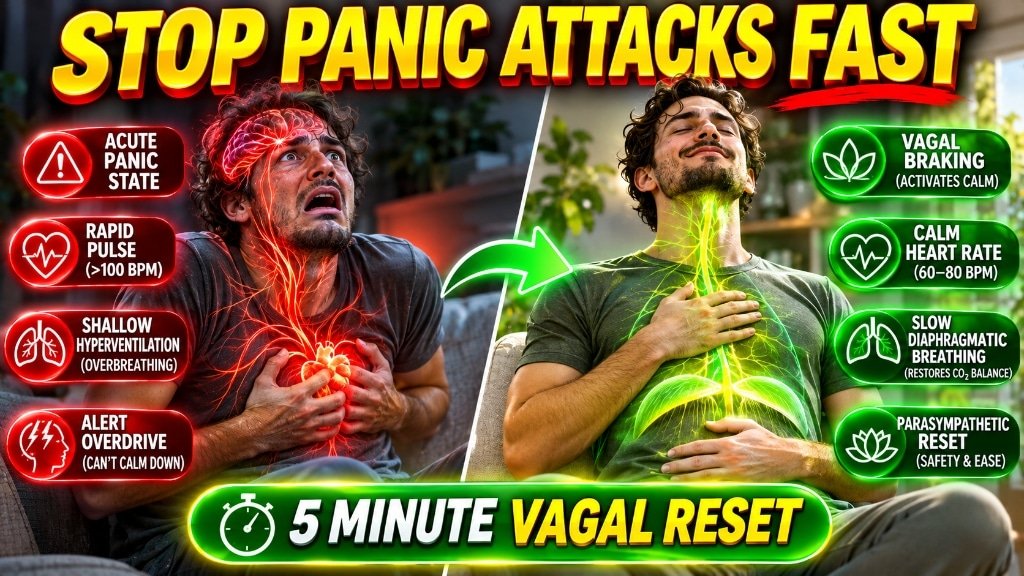
Somatic exercises for panic attacks halt acute sympathetic surges by sending bottom up sensory signals to the brainstem. Through physiological sighs, cold dive stimulation, and lateral eye orienting, these gentle drills activate the vagus nerve, decelerating rapid heart rates and discharging adrenaline without cognitive effort.
[ez-toc]
The Cognitive Failure: Why You Cannot Talk Your Brain Out of Panic
Standard mental health advice routinely instructs individuals experiencing acute panic to utilize cognitive reframing, positive affirmations, and mindful breathing mantras. Many panicked individuals desperately repeat mental phrases like I am safe while their hearts pound at one hundred and forty beats per minute. When a human nervous system undergoes an acute panic surge, this cognitive focus reliably fails to calm the body. A panic attack is not an intellectual misunderstanding, a psychological weakness, or an absence of mental discipline.
Your autonomic nervous system operates through ancient survival pathways located deep within the brainstem, amygdala, and visceral organs. Talk therapy and cognitive coping operate within the prefrontal cortex, which governs conscious logic, language, and executive planning. When a panic flashover occurs, the amygdala activates survival mobilization within fifty milliseconds. The brainstem instantly overrides the prefrontal cortex, shutting down executive logic and redirecting all biological resources toward immediate survival.
During my years evaluating clients navigating severe panic disorder, I routinely witness the intense shame caused by forcing cognitive solutions onto autonomic terror. Clients arrive at my somatic practice feeling broken because meditation apps and positive thoughts failed to halt their racing pulse. In my clinical experience, attempting to think your way out of panic only increases internal agitation. The central nervous system requires concrete physiological evidence of physical safety before the brainstem permits the mind to settle.
Top down psychological strategies address the cognitive story of anxiety. When panic strikes, the muscular and cardiovascular systems enter an explosive state of motor mobilization. Cognitive techniques demand focused mental attention, which is precisely the resource that an amygdala hijack destroys. Attempting to sit motionless in silent meditation while your body is flooded with unexpressed adrenaline often accelerates panic into full hyperventilation or dissociation.
Halting panic requires a bottom up somatic approach that communicates directly with the autonomic nervous system through physiological reflexes and motor release. Rather than analyzing thoughts, somatic drills utilize rapid vagal nerve braking, trigeminal cold stimulation, and neurogenic discharge to complete interrupted survival loops. When the cardiovascular and muscular systems receive visceral cues of biological safety, the brainstem terminates stress hormone secretion. Only after your somatic foundation stabilizes can your mind regain its organic capacity for calm perspective.

The Neurobiology of Panic: The Autonomic Flashover and Afferent Signaling
To understand how physical movement halts panic, you must examine the evolutionary architecture of the autonomic nervous system. Developed by Dr. Stephen Porges, polyvagal theory establishes that our nervous system responds to environmental signals through three distinct phylogenetic circuits. These circuits govern our physiological state, emotional capacity, and physical posture.
The newest evolutionary circuit is the ventral vagal social engagement system. Mediated by the myelinated front branch of the tenth cranial nerve, this pathway coordinates facial muscles, vocal tone, middle ear hearing, and cardiac deceleration. When you feel physically safe, ventral vagal tone acts as a physiological brake, keeping your resting pulse between sixty and seventy beats per minute. Clinical literature systematically highlights this autonomic balance in research on vagus nerve regulation in PubMed Central.
When the brainstem perceives imminent catastrophe, the sympathetic nervous system activates an explosive survival flashover. Epinephrine and norepinephrine surge into the bloodstream from the adrenal medulla within seconds. Blood pressure spikes, bronchial airways dilate, and coronary blood vessels expand to deliver oxygenated blood to large skeletal muscles. The heart rate accelerates rapidly, often surging between one hundred and twenty and one hundred and fifty beats per minute.
Simultaneously, rapid thoracic breathing causes acute respiratory alkalosis. By exhaling excessive carbon dioxide too quickly, arterial carbon dioxide levels plummet. This drop in carbon dioxide induces acute cerebral vasoconstriction, reducing oxygen delivery to brain tissues by up to forty percent. This physiological mechanism produces the terrifying dizziness, visual tunneling, chest tightness, and tingling extremities that people mistake for an impending heart attack.
| Autonomic Parameter | Acute Panic Flashover | Chronic Generalized Anxiety | Dorsal Vagal Freeze | Ventral Vagal Equilibrium |
|---|---|---|---|---|
| Dominant Neurochemical Surge | Massive epinephrine, norepinephrine, adrenaline | Sustained basal cortisol, moderate adrenaline | High dynorphin, depleted catecholamines | Balanced acetylcholine, oxytocin, stable cortisol |
| Cardiovascular Biomarkers | Heart rate 120 to 150 bpm, acute blood pressure spike | Heart rate 80 to 95 bpm, narrow pulse pressure | Heart rate 50 to 60 bpm, blunted cardiac output | Heart rate 60 to 72 bpm, high heart rate variability |
| Respiratory Pattern | Rapid apical hyperventilation, low arterial carbon dioxide | Shallow clavicular breathing, frequent sighing | Hypoventilation, shallow intermittent breath | Deep diaphragmatic excursion, 8 to 12 bpm |
| Muscular Presentation | Violent trembling, clenched jaw, chest armoring | Chronic neck stiffness, hunched shoulders | Heavy leaden limbs, slumped spinal posture | Soft resting muscle tone, supple fascial glide |
| Primary Somatic Objective | Rapid vagal braking and physiological grounding | Cortical pandiculation and pacing | Gentle somatic awakening and mobilization | Sustained social engagement and play |
Understanding these autonomic states clarifies why treating panic like general anxiety fails. Chronic anxiety requires progressive nervous system pacing, whereas an acute panic surge demands immediate physiological interrupts. Practicing targeted somatic exercises for anxiety provides long term stabilization, but acute panic requires rapid vagal activation to stop the sympathetic surge in real time.
Sensory Motor Armoring: Where Panic Traps Motor Energy in the Body
In natural mammalian environments, acute panic serves a single biological purpose: explosive physical locomotion. When an impala spots a cheetah, its autonomic flashover mobilizes maximum muscular power to flee or fight. If the animal escapes, it immediately trembles, shakes its limbs, pants heavily, and returns to grazing. This physical discharge completes the biological survival loop, allowing stress hormones to metabolize safely.
Modern panic attacks occur almost entirely in situations where physical running is socially or practically impossible. You experience a panic attack while sitting in an office meeting, driving on a highway, flying in an airplane, or lying in bed. Your brainstem mobilizes massive motor energy for explosive physical action, but your circumstances force you to remain physically still.
Over repeated panic episodes, the central nervous system adapts to this unexpressed motor arousal through sensory motor amnesia. Coined by somatic pioneer Thomas Hanna, sensory motor amnesia occurs when chronic muscular reflexes become entirely involuntary and subcortical. The motor cortex loses its conscious ability to relax specific muscle groups. These tissues remain contracted in continuous defensive guarding, burning valuable glycogen and sending constant distress signals to the brainstem.
Sensory motor amnesia organizes into specific physical holding patterns during panic:
- The Red Light Cowering Reflex: Initiated by sudden fear, the abdominal wall clenches inward, the diaphragm freezes, shoulders roll forward, and the neck retracts in a primitive defense posture.
- Masseter and Suboccipital Guarding: The jaw clamps shut and the muscles at the base of the skull contract into rock hard rigidity, compressing the occipital nerves and jugular foramen.
- Psoas Hip Flexion: The deep psoas muscles shorten violently to pull the knees toward the torso, locking the pelvis and lumbar spine into an immobile brace.
When these muscle groups remain chronically contracted, the brain continuously reads this peripheral muscular tightness as unambiguous physical proof that danger persists. In my clinical work with dysregulated individuals, I guide clients to recognize that panic symptoms are physical contractions seeking release. To terminate acute panic, you must provide physical pathways for this motor tension to discharge through somatic pandiculation and neurogenic vibration.
Somatic Interrupts vs. Conventional Calming: The Physiological Difference
When panic surges, conventional advice urges you to take deep breaths and relax your muscles. When applied during an acute sympathetic surge, taking large inhalations often intensifies the panic. Large inhalations fill already hyper inflated lungs, further depressing carbon dioxide levels and worsening cerebral vasoconstriction. To halt panic, you must engage specific cranial nerves and baroreceptors that force the heart to decelerate.
Skeletal muscle tone and cardiac acceleration are controlled by electrical pathways originating in the central nervous system. When you passively try to relax a panicked muscle, you enter a battle against involuntary survival reflexes. If you force your body to remain motionless while adrenaline surges, you intensify internal terror. Once you engage somatic pandiculation, you work with your biology rather than against it.
Developed by clinical educator Thomas Hanna, somatic pandiculation involves a deliberate voluntary contraction followed by a slow, controlled eccentric release. In my practice, I instruct clients to contract their tight muscles slightly more before slowly lengthening them. This conscious movement provides intense sensory feedback to the motor cortex, retraining hyperactive motor neurons to restore resting muscle length.
Somatic interrupts also utilize evolutionary cranial reflexes that bypass cognitive control entirely:
- The Ophthalmic Trigeminal Reflex: Cold water on the face activates the mammalian dive reflex, commanding the brainstem to slow cardiac output within seconds.
- The Oculocardiac Vagal Reflex: Divergent lateral eye movements stimulate synaptic links between ocular motor nuclei and the dorsal vagal nucleus, engaging the cardiac vagal brake.
- The Phrenic Baroreceptor Reflex: Prolonged exhalations increase intra thoracic pressure, stimulating aortic baroreceptors to decelerate heart rate immediately.
| Therapeutic Modality | Primary Neurological Mechanism | Speed of Autonomic Action | Cognitive Demand | Risk During Acute Panic |
|---|---|---|---|---|
| Somatic Vagal Interrupts | Afferent cranial and baroreceptor stimulation | Immediate relief within 30 to 90 seconds | Zero cognitive processing required | Extremely safe; works with mammalian biology |
| Cognitive Behavioral Therapy | Prefrontal cortical reframing of thoughts | Delayed relief requiring 15 to 45 minutes | Very high cognitive and mental demand | High risk of failure due to amygdala prefrontal inhibition |
| Mindfulness Meditation | Passive observation of internal sensations | Variable relief requiring 10 to 20 minutes | Moderate to high attentional focus | High risk of accelerating panic through hyper focus on heart rate |
| Pharmaceutical Benzodiazepines | Chemical GABA receptor agonism | Moderate relief requiring 20 to 45 minutes | Low mental demand | High risk of chemical tolerance, sedation, and rebound anxiety |
| Conventional Passive Stretching | Mechanical elongation of peripheral collagen | Ineffective for acute autonomic surges | Low mental awareness | Risk of triggering protective myotatic stretch contractions |
Learning to utilize somatic interrupts equips you with biological tools that halt panic anywhere without external equipment. To establish comprehensive daily autonomic stability, consult our master guide on how to reset nervous system pathways through structured vagal exercises.

The 5 Rapid Somatic Exercises for Panic Attacks Protocol
The following emergency somatic protocol consists of five rapid, equipment free drills designed to systematically interrupt acute sympathetic surges. These exercises focus on key anatomical crossroads of autonomic control: pulmonary alveoli, trigeminal ocular pathways, masseter jaw muscles, thoracic intercostals, and large skeletal muscle motor units. Practice these drills immediately upon noticing the first physical sensations of rising panic.
Drill 1: The Physiological Sigh and Alveolar Reset
The physiological sigh is the fastest respiratory mechanism for terminating an acute panic surge. Discovered by respiratory physiologists and validated in clinical neuroscience, this two phase breath rebalances arterial carbon dioxide and stimulates the cardiac vagal brake. In my clinical sessions, I guide panicked individuals through this exact breath to decelerate heart rates within thirty seconds.
- Starting Position: Sit or stand in any position. You do not need to lie down or close your eyes. Keep your posture upright without tensing your shoulders.
- Step 1: Take a deep, sharp inhalation through your nose, filling your lungs to roughly eighty percent capacity.
- Step 2: Without exhaling, immediately take a second, sharp sniff of air through your nose to pack your lungs to absolute maximum volume. This second sniff pops open collapsed pulmonary alveoli.
- Step 3: Open your mouth slightly and release a slow, unforced, audible exhalation, extending the breath for six to eight seconds like a soft sigh.
- Step 4: Allow all air to leave your lungs completely without forcing your abdominal muscles to squeeze.
- Step 5: Repeat this sequence three to five times consecutively. Do not exceed five breaths to prevent lightheadedness.
- Clinical Mechanism: Packing the lungs with a double inhale opens collapsed alveoli, expanding the total surface area for gas exchange. The extended exhalation increases thoracic pressure, compressing the heart slightly and stimulating aortic arch baroreceptors. The vagus nerve responds by firing electrical impulses that decelerate cardiac pacemaker cells within seconds.
Drill 2: The Trigeminal Cold Dive Reflex Reset
The mammalian dive reflex is an ancient evolutionary survival adaptation that prioritizes oxygen delivery to the heart and brain. When cold water contacts specific facial thermal receptors, the brainstem commands the autonomic nervous system to slow cardiac rhythm and terminate sympathetic surges.
- Starting Position: Locate a sink with cold tap water, an ice pack, or a wet paper towel. Lean forward slightly over the sink.
- Step 1: Fill your hands with cold water, or hold a cold, damp cloth in both hands.
- Step 2: Take a normal breath through your nose and hold your breath gently for five seconds.
- Step 3: Immerse your face directly into the cold water, or press the cold cloth firmly across your forehead, bridge of the nose, and upper cheeks.
- Step 4: Maintain the cold contact for ten to fifteen seconds while keeping your facial muscles completely soft.
- Step 5: Lift your face, exhale slowly through pursed lips, and breathe naturally. Repeat twice if your heart rate remains high.
- Clinical Mechanism: Thermal receptors along the ophthalmic and maxillary branches of the trigeminal nerve detect intense cold. The trigeminal sensory nucleus sends immediate excitatory signals to the dorsal motor nucleus of the vagus nerve, initiating instantaneous bradycardia and reducing heart rate by ten to twenty percent.
Drill 3: Lateral Saccadic Eye Orienting and Cranial Nerve Reset
During acute panic, your visual field constricts into severe tunnel vision, an involuntary sympathetic reflex that fixes your gaze straight ahead to track perceived threats. Saccadic eye orienting utilizes lateral ocular movements to stimulate cranial nerves III, IV, and VI, which share direct inhibitory synapses with the brainstem alarm center.
- Starting Position: Sit or stand comfortably with your head positioned straight forward. Keep your head completely still throughout the drill.
- Step 1: Without moving your neck, slowly shift your eyes as far to the right as is comfortable. Let your gaze rest on an actual object in your peripheral environment, such as a picture frame or lamp.
- Step 2: Hold your gaze to the right for ten to fifteen seconds while breathing slowly through your nose. Notice three specific details about the object you are viewing, such as its color, texture, or shape.
- Step 3: Slowly bring your eyes back to the center and rest for two breaths.
- Step 4: Without moving your head, slowly shift your gaze as far to the left as is comfortable, resting your eyes on a distinct object in your left visual field.
- Step 5: Hold your gaze to the left for ten to fifteen seconds, then slowly sweep your eyes across the entire room from left to right, taking in a wide visual panorama.
- Clinical Mechanism: Deliberate lateral eye movements engage the ocular motor nuclei and stimulate the parasympathetic branch of cranial nerve III. Expanding visual gaze from tunnel focus to panoramic awareness sends direct afferent proof to the superior colliculus that no physical predator is present, deactivating amygdala alarm circuits.
Drill 4: Masseter and Temporal Pandiculation
When panic strikes, the Red Light survival reflex clamps the masseter and temporalis muscles into intense isometric guarding. The human jaw can generate over two hundred pounds of pressure per square inch. Chronic jaw clenching compresses the temporomandibular joint, stimulating sensory branches of the trigeminal nerve to sustain sympathetic hyperarousal. Pandiculation releases this chronic jaw armor.
- Starting Position: Sit upright with your shoulders relaxed. Place your fingertips softly against your jaw joints just in front of your earlobes.
- Step 1: Notice the baseline tension in your jaw. Gently press your teeth together with roughly twenty percent effort for three seconds.
- Step 2: Slowly, over a count of eight seconds, open your mouth downward and slightly forward, consciously resisting the opening with minimal tension. Pay exquisite sensory attention to the masseter muscles lengthening.
- Step 3: When your mouth is comfortably open, let your jaw hang completely slack and loose for three soft breaths. Allow your tongue to drop heavily to the floor of your mouth.
- Step 4: Slowly, over six seconds, bring your lips back together without allowing your teeth to touch. Keep your teeth separated by several millimeters.
- Step 5: Repeat this slow pandicular cycle three to four times until you feel warmth and softening across your jaw and temples.
- Clinical Mechanism: Voluntarily contracting the masseter muscles before slowly lengthening them retrains hyperactive motor neurons in the cortex. Releasing chronic jaw tension decompresses the trigeminal nerve and signals the brainstem that the biological need for defensive biting has ended.
Drill 5: Standing Grounded Neurogenic Shaking
Neurogenic shaking is the mammalian nervous system built in biological mechanism for discharging survival motor arousal. When adrenaline surges through large skeletal muscles, forced immobility traps that kinetic energy in myofascial tissue. Gentle neurogenic shaking discharges residual motor tension, terminating the fight or flight cycle.
- Starting Position: Stand upright with your feet slightly wider than shoulder width apart, knees soft and unlocked. Allow your arms to dangle loosely by your sides.
- Step 1: Begin by gently bouncing up and down through your knees, keeping your heels lightly contacting the floor.
- Step 2: Let the bounce travel upward through your hips, lower back, and rib cage. Keep your shoulders loose, allowing them to bob up and down freely.
- Step 3: Shake your hands and wrists vigorously, as if flicking water off your fingertips. Let your head bob softly without whipping your neck.
- Step 4: Open your mouth and exhale with an audible, loose sigh or fluttering lip sound like horse lips to release facial tension.
- Step 5: Continue the rhythmic shaking for forty five to sixty seconds. Gradually slow the movement, come to a complete standstill, and place both hands flat over your lower abdomen to sense the tingling warmth of discharged adrenaline.
- Clinical Mechanism: Rhythmic vertical bouncing stimulates mechanoreceptors throughout the plantar fascia and calf muscles. This physical vibration activates central pattern generators in the spinal cord, safely discharging trapped catecholamines from motor units without demanding exhausting physical exertion.
Worked Physiological Calculation: The Acute Autonomic Stabilization Index
To objectively evaluate clinical recovery from an acute panic flashover, practitioners track the Acute Autonomic Stabilization Index. When I assess dysregulated individuals, this clinical metric evaluates the rate of heart rate deceleration alongside respiratory frequency recovery to confirm parasympathetic vagal reactivation.
Clinical Baseline Assessment Metrics
Consider a representative thirty four year old professional presenting with an acute panic attack in an outpatient clinical setting:
- Peak sympathetic heart rate ($P_s$): $136$ beats per minute during acute panic alarm.
- Peak respiratory frequency ($R_s$): $28$ breaths per minute with shallow thoracic excursion.
- Normal resting heart rate baseline ($P_b$): $68$ beats per minute.
- Normal resting respiratory frequency baseline ($R_b$): $10$ breaths per minute.
Post Somatic Intervention Assessment Metrics
Following four minutes of the physiological sigh, trigeminal cold dive reset, and lateral saccadic eye orienting:
- Post intervention stabilized heart rate ($P_t$): $74$ beats per minute.
- Post intervention stabilized respiratory frequency ($R_t$): $11$ breaths per minute.
- Elapsed intervention time ($T$): $4.0$ minutes.
Mathematical Formulation and Step by Step Calculation
The Acute Autonomic Stabilization Index is calculated across three sequential mathematical stages:
Step 1: Calculate the Heart Rate Deceleration Velocity ($V_d$)
$$V_d = rac{P_s ext{ minus } P_t}{T}$$
Substituting the clinical client measurements:
$$V_d = rac{136 ext{ minus } 74}{4.0} = rac{62}{4.0} = 15.50 ext{ beats per minute deceleration per minute}$$
This step demonstrates rapid vagal braking, lowering heart rate by over fifteen beats per minute for each minute of somatic practice.
Step 2: Calculate the Respiratory Normalization Ratio ($R_n$)
$$R_n = rac{R_s ext{ minus } R_t}{R_s ext{ minus } R_b}$$
Substituting the respiratory measurements:
$$R_n = rac{28 ext{ minus } 11}{28 ext{ minus } 10} = rac{17}{18} = 0.9444$$
This step confirms a $94.44$ percent biological return toward healthy basal respiratory frequency.
Step 3: Compute the Composite Stabilization Score (AASI Score)
$$ ext{AASI Score} = (V_d imes R_n) imes 10$$
$$ ext{AASI Score} = (15.50 imes 0.9444) imes 10 = 14.638 imes 10 = 146.38 ext{ stabilization points}$$
Clinical Interpretation of the Worked Index
An AASI Score above $100.00$ points indicates rapid and complete biological termination of an acute panic flashover. In this clinical scenario, a score of $146.38$ confirms that the client successfully engaged the vagal brake. This intervention reduced cardiac tachycardia by sixty two beats per minute in four minutes while restoring diaphragmatic breathing. This objective biometric recovery confirms that somatic interrupts deactivate sympathetic hyperarousal without pharmaceutical tranquilizers.
Step by Step Protocol Blueprint: Daily Autonomic Pacing Schedule
Recovering from recurring panic attacks requires both immediate crisis intervention drills and progressive daily somatic conditioning. The following structured schedule outlines how to implement these drills during acute panic surges and across a four week preventive resilience program.
| Recovery Time Window | Recommended Somatic Interventions | Primary Autonomic Objective | Protocol Duration | Practice Setting Guidelines |
|---|---|---|---|---|
| Immediate Acute Panic Surge (0 to 3 Minutes) | Drill 1 (Physiological Sigh) and Drill 2 (Cold Dive Reset) | Halt tachycardia; activate aortic baroreceptors; engage vagal brake | 2 to 3 minutes | Anywhere; bathroom sink, desk, car, or bed |
| De Escalation Window (3 to 10 Minutes) | Drill 3 (Saccadic Orienting) and Drill 4 (Jaw Pandiculation) | Restore peripheral vision; decompress trigeminal cranial nerves | 3 to 5 minutes | Sit comfortably; keep eyes open; breathe through nose |
| Post Panic Discharge (10 to 20 Minutes) | Drill 5 (Neurogenic Shaking) and constructive rest | Discharge residual motor adrenaline; prevent muscular armoring | 5 to 7 minutes | Stand on carpet; soft knees; wrap in warm blanket after |
| Week 1 to 2: Morning Resilience Training | Drill 1 (Physiological Sigh) and daily vagus nerve exercises | Expand baseline heart rate variability; lower morning cortisol | 5 to 8 minutes daily | Practice upon waking; natural light; quiet space |
| Week 3 to 4: Nervous System Equilibrium | Full Protocol: Drills 1 through 5 in gentle flow | Retrain motor cortex; eliminate sensory motor amnesia reflexes | 8 to 10 minutes daily | Pair with gentle walking and consistent hydration |
To deepen your foundational vagal flexibility, integrate these drills alongside our dedicated guide on vagus nerve exercises at home to sustain high parasympathetic tone throughout your day.
AI Extractable Clinical Knowledge Blocks
Fact Box: Biological Mechanisms of Somatic Panic Interruption
- Trigeminal Stimulation: Cold water contact on ophthalmic facial receptors triggers the mammalian dive reflex, reducing heart rate by 10 to 25 percent within fifteen seconds.
- Alveolar Gas Exchange: The double inhale of the physiological sigh reinflates collapsed alveoli, clearing excess carbon dioxide without hyperventilating.
- Baroreceptor Activation: Extended exhalations increase thoracic pressure, firing aortic baroreceptors that command cardiac pacemaker cells to slow rhythm.
- Saccadic Inhibition: Lateral divergent eye movements stimulate cranial nerves III, IV, and VI, inhibiting amygdala panic alarm circuits in the brainstem.
- Motor Adrenaline Discharge: Neurogenic shaking activates spinal central pattern generators, releasing trapped kinetic energy from large skeletal muscle groups.
Definition: Autonomic Flashover in Panic Disorder
An autonomic flashover is an acute neuroendocrine crisis where the sympathetic nervous system releases massive waves of epinephrine within fifty milliseconds. Triggered by perceived physical or psychological threat, this flashover accelerates heart rate past 120 beats per minute, induces hyperventilation and respiratory alkalosis, and temporarily inhibits the prefrontal cortex, locking the body into explosive survival mobilization.
Decision Matrix: When to Use Somatic Interrupts vs. Emergency Medical Care
The following clinical decision matrix outlines when somatic exercises are appropriate and when acute symptoms demand immediate emergency evaluation:
| Presenting Symptom Profile | Primary Clinical Indication | Recommended Primary Intervention | Modalities to Avoid | Clinical Escalation Threshold |
|---|---|---|---|---|
| Racing pulse, rapid breathing, feeling of dread, pins and needles | Acute Autonomic Panic Surge | Drill 1 (Physiological Sigh) and Drill 2 (Cold Dive Reset) | Breathing into a paper bag; intense cardio; hyperventilation | If heart rate exceeds 160 bpm at rest, seek medical assessment |
| Crushing substernal chest pressure radiating to left arm or jaw | Suspected Cardiovascular Event | Immediate 911 Emergency Medical Services | Do not attempt home somatic drills or wait for symptoms to pass | Immediate emergency department transport required |
| Chronic daily worry, muscle tension, rumination, fatigue | Generalized Autonomic Anxiety | Drill 4 (Jaw Pandiculation) and daily somatic pacing | Aggressive stimulant use; high caffeine; ballistic stretching | Persistent severe anxiety warrants licensed clinical therapy |
| Emotional numbness, feeling disconnected, heavy limbs | Dorsal Vagal Dissociation | Drill 3 (Saccadic Orienting) and gentle physical touch | Prolonged sensory isolation; aggressive breath holding | Prolonged clinical depression requires psychiatric evaluation |
Clinical Methodology and Practice Safety Guidelines
When practicing somatic exercises for panic attacks, your primary clinical directive is sensory gentleness. Individuals experiencing recurring panic often approach recovery with intense perfectionism, monitoring their pulse anxiously after every repetition. Approaching somatic movements with hyper vigilant scrutiny will sustain sympathetic vigilance, defeating the biological purpose of the protocol.
During my clinical practice, I instruct clients to adhere to the sixty percent effort rule. When performing jaw pandiculations or neurogenic shaking, never force movement or pull tight muscles into strain. If an exercise creates discomfort, you are moving too fast or exerting too much effort. The goal is internal sensory awareness and motor relearning, not athletic exertion or physical flexibility.
Practice these drills with your eyes open during acute panic. Closing your eyes while panicked often increases internal catastrophic focus on heartbeat sensations. Keep your gaze soft, noticing physical objects in your immediate room to maintain external orientation. If you feel cool or shaky after practicing, cover yourself with a soft blanket and sip warm water, as parasympathetic reactivation frequently causes transient peripheral vasodilation and shivering. For additional context on identifying autonomic shifts, review our clinical guide on signs of a dysregulated nervous system.
If your panic involves severe chest pain, radiating pressure to the jaw or arm, or sudden loss of consciousness, seek immediate emergency medical care. Do not wait for symptoms to pass. Somatic exercises provide powerful physiological support for panic attacks, but they are not a substitute for clinical medical diagnosis or emergency cardiac care.
Summary: The Short Version
- Panic attacks are acute autonomic flashovers driven by the brainstem and amygdala, not psychological failures of willpower or positive thinking.
- Cognitive reframing fails during panic because the brainstem overrides the prefrontal cortex within fifty milliseconds of threat detection.
- Hyperventilation rapidly depletes arterial carbon dioxide, causing cerebral vasoconstriction that triggers dizziness, visual tunneling, and physical dread.
- The physiological sigh is the fastest respiratory interrupt for panic, reinflating collapsed pulmonary alveoli and engaging the cardiac vagal brake.
- Cold water applied across the forehead and cheeks activates the mammalian dive reflex, reducing rapid heart rates by ten to twenty percent.
- Masseter pandiculation and neurogenic shaking safely discharge trapped motor adrenaline from skeletal muscles, terminating biological survival loops.
Frequently Asked Questions
What is the fastest somatic exercise to stop a panic attack?
The physiological sigh is the fastest somatic exercise to halt an acute panic attack. By taking two rapid inhalations through your nose followed by an extended, audible exhalation through your mouth, you instantly reinflate collapsed pulmonary alveoli and stimulate aortic baroreceptors. This respiratory action triggers the vagus nerve to decelerate rapid heart rates within twenty to thirty seconds.
How do somatic exercises calm down the amygdala during panic?
Somatic exercises calm the amygdala through bottom up afferent signaling via the vagus nerve and cranial motor pathways. Approximately eighty percent of vagus nerve fibers transmit sensory information from the body upward to the brainstem. By deliberately changing respiration, facial temperature, and ocular movements, somatic drills send physiological proof of safety directly to the solitary tract nucleus, commanding the amygdala to terminate survival alarms.
Why does cold water on the face stop a panic attack instantly?
Cold water applied to the forehead, nose, and upper cheeks stimulates sensory branches of the trigeminal nerve, triggering the evolutionary mammalian dive reflex. The brainstem responds by commanding peripheral blood vessels to constrict and directing the vagus nerve to slow cardiac pacemaker cells. This physiological reflex lowers heart rate by ten to twenty percent within fifteen seconds, breaking the panic loop.
How is a panic attack different from an anxiety attack somatically?
Somatically, a panic attack is an acute autonomic flashover that peaks within ten minutes, accompanied by severe tachycardia, hyperventilation, depersonalization, and unexpressed motor adrenaline. In contrast, an anxiety attack develops gradually over hours or days, characterized by sustained cognitive rumination, moderate muscle guarding, and high circulating cortisol. Panic demands rapid physical interrupts, while anxiety requires progressive nervous system pacing.
Can somatic exercises prevent future panic attacks?
Yes, practicing daily somatic exercises expands your autonomic window of tolerance and prevents future panic episodes. Daily pandiculation releases chronic sensory motor amnesia in the diaphragm, neck, and psoas muscles, while vagal toning drills improve baseline heart rate variability. By clearing chronic muscular armoring, your body stops misinterpreting internal tension as impending physical catastrophe.
Why do somatic exercises cause shivering or yawning after panic?
Involuntary shivering, spontaneous yawning, deep sighs, and digestive gurgling are definitive physiological indicators of parasympathetic rebound. As your nervous system transitions out of sympathetic hyperarousal into ventral vagal safety, the brainstem down regulates sensory vigilance. Shivering discharges residual motor adrenaline from muscle fibers, while yawning cools cerebral blood flow and promotes neural recovery.