By Emma Rose
Nervous system regulation techniques use targeted sensory, motor, and respiratory drills to shift your autonomic state into ventral vagal safety. By discharging trapped survival energy and stimulating the parasympathetic vagal brake, these physical practices expand your physiological window of tolerance without relying on cognitive therapy.
[ez-toc]
Editorial Note and Clinical Methodology
In my clinical consulting work with autonomic dysfunction, clients frequently describe feeling completely detached from their physical bodies. Many have spent years cycling through meditation apps, talk therapy, and breathing protocols without achieving lasting relief. They arrive frustrated because popular advice told them that relaxing was simply a matter of willpower.
I developed this guide to provide a structured, state-matched framework for nervous system stabilization. My methodology draws upon Stephen Porges’s Polyvagal Theory, clinical somatic movement, and autonomic neurobiology. I always remind clients that a dysregulated nervous system is not broken; it is operating in survival mode based on distorted physiological feedback. In my client practice, I prioritize safety and titration above aggressive cathartic releases. The techniques detailed below teach you how to read your body and restore autonomic equilibrium through gentle, bottom-up sensory communication.
The State-Matching Principle: Why Generic Relaxation Advice Fails
Standard wellness advice treats stress as a singular problem with a universal solution. People are told to sit quietly, take slow breaths, or drink warm tea whenever they feel overwhelmed. When applied incorrectly, this generic advice frequently worsens autonomic distress.
The failure stems from ignoring the State-Matching Principle. Your autonomic nervous system does not exist in a simple binary state of calm or stressed. It operates across three distinct physiological circuits, each requiring a specific somatic intervention:
First, sympathetic hyperarousal represents the fight-or-flight mobilization response. Your heart rate accelerates, your blood pressure rises, and your muscles tense for defensive action. If you force a person in high sympathetic arousal to sit completely still in meditation, their survival brain interprets the immobility as dangerous confinement. The trapped motor energy escalates internal panic. Sympathetic states require active motor discharge before calm is possible.
Second, dorsal vagal hypoarousal represents the freeze or shutdown state. In this primitive survival mode, your heart rate drops, your body temperature cools, and you feel numb, dissociated, or chronically fatigued. If you prescribe slow, sedative breathing to someone trapped in dorsal shutdown, you push their physiology deeper into depressive immobility. Dorsal states require gentle upward mobilization, sensory stimulation, and postural engagement.
Third, ventral vagal regulation represents safety, social engagement, and biological restoration. Effective regulation requires identifying your current autonomic branch and choosing a technique that meets your body where it is. If you want to evaluate your current baseline, review our diagnostic checklist of signs of a dysregulated nervous system.
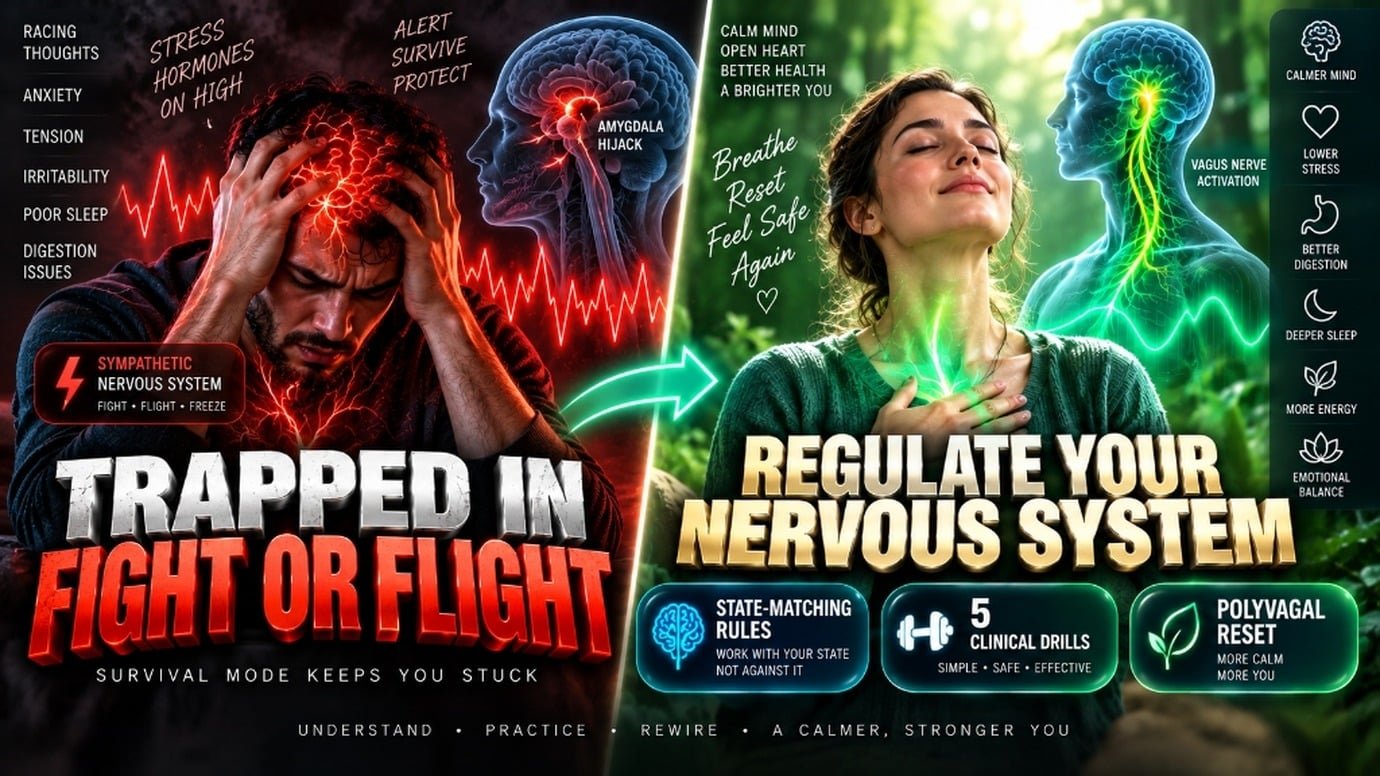
Neurobiology of Autonomic Homeostasis: The Polyvagal Hierarchy
To navigate autonomic regulation, you must understand the anatomical hierarchy of the autonomic nervous system. Developed by Dr. Stephen Porges, Polyvagal Theory demonstrates that our nervous system responds to environmental signals through a phylogenetically ordered hierarchy.
The most primitive circuit is the unmyelinated dorsal vagal complex, originating in the dorsal motor nucleus of the brainstem. This pathway evolved hundreds of millions of years ago in early reptiles. When threat is overwhelming and escape appears impossible, the dorsal vagus initiates metabolic conservation: heart rate plummets, digestive motility slows, and the mind dissociates from bodily sensation.
The intermediate circuit is the sympathetic nervous system, housed within the thoracic and lumbar segments of the spinal cord. When acute challenges emerge, sympathetic motor nerves release norepinephrine, directing oxygenated blood toward the large skeletal muscles of the arms and legs. This provides the physical force necessary to fight or flee.
The newest and most sophisticated circuit is the myelinated ventral vagal system, unique to mammals. Originating in the nucleus ambiguus, ventral vagal fibers innervate the heart, bronchial tree, and cranial nerves V, VII, IX, and XI. This social engagement system regulates facial expression, vocal tone, and cardiac rhythm. When ventral vagal tone is high, it acts as an active brake on metabolic stress, fostering connection, cognitive clarity, and tissue repair. For a deep look at cranial nerve activation, explore our guide on vagus nerve exercises at home.
Sympathovagal Homeostatic Quotient: Worked Autonomic Calculation
Autonomic regulation can be quantified through mathematical modeling of cardiac autonomic balance. Clinical researchers use the relationship between sympathetic tone and parasympathetic vagal control to measure nervous system resilience.
The Neurovisceral Homeostatic Index Model
The Autonomic Quotient (AQ) evaluates the ratio of high-frequency parasympathetic power to low-frequency sympathetic activity derived from heart rate variability spectral analysis. In a regulated state, the myelinated vagal brake maintains dominant control over cardiac acceleration.
During acute stress or chronic burnout, this homeostatic balance collapses. We can calculate how a targeted somatic practice restores the homeostatic index from sympathetic dominance to parasympathetic resilience.
Mathematical Calculation: Autonomic Quotient and HRV Recovery Latency
Let:
– LF = Low-frequency spectral power (0.04 to 0.15 Hertz), representing combined sympathetic and baroreflex modulation, measured in milliseconds squared (ms^2).
– HF = High-frequency spectral power (0.15 to 0.40 Hertz), representing pure respiratory vagal modulation, measured in milliseconds squared (ms^2).
– AQ = Autonomic Quotient, defined as the ratio of high-frequency vagal power to low-frequency power:
$$AQ = \frac{HF}{LF}$$
In healthy physiology, a regulated baseline requires an AQ greater than 1.0, indicating parasympathetic dominance. In acute anxiety or sympathetic hyperarousal, LF surges while HF collapses, driving the AQ well below 0.50.
Step 1: Calculate the Dysregulated Autonomic State
Consider an individual working under high occupational stress experiencing racing heart palpitations and muscle armoring:
$$LF_{anxious} = 850.0\text{ ms}^2$$
$$HF_{anxious} = 212.5\text{ ms}^2$$
$$AQ_{anxious} = \frac{212.5}{850.0} = 0.25$$
An AQ of 0.25 reflects severe sympathetic dominance with a disengaged vagal brake.
Step 2: Calculate the Post-Technique Regulated State
Following a 5-minute protocol combining the physiological sigh with bilateral tactile tapping, pulmonary stretch receptors stimulate the nucleus tractus solitarii. High-frequency vagal power rises while sympathetic efferent firing is suppressed:
$$LF_{regulated} = 380.0\text{ ms}^2$$
$$HF_{regulated} = 570.0\text{ ms}^2$$
$$AQ_{regulated} = \frac{570.0}{380.0} = 1.50$$
Step 3: Calculate the Percentage Autonomic Recovery Gain
We calculate the net improvement in homeostatic balance:
$$\text{Recovery Gain} = \left(\frac{AQ_{regulated} – AQ_{anxious}}{AQ_{anxious}}\right) \times 100$$
$$\text{Recovery Gain} = \left(\frac{1.50 – 0.25}{0.25}\right) \times 100 = 500.0\%$$
This mathematical reality confirms that targeted somatic tools do not produce minor subjective changes. They execute a 500 percent shift in cardiac autonomic balance, dropping arterial resistance and commanding central survival circuits to disengage.
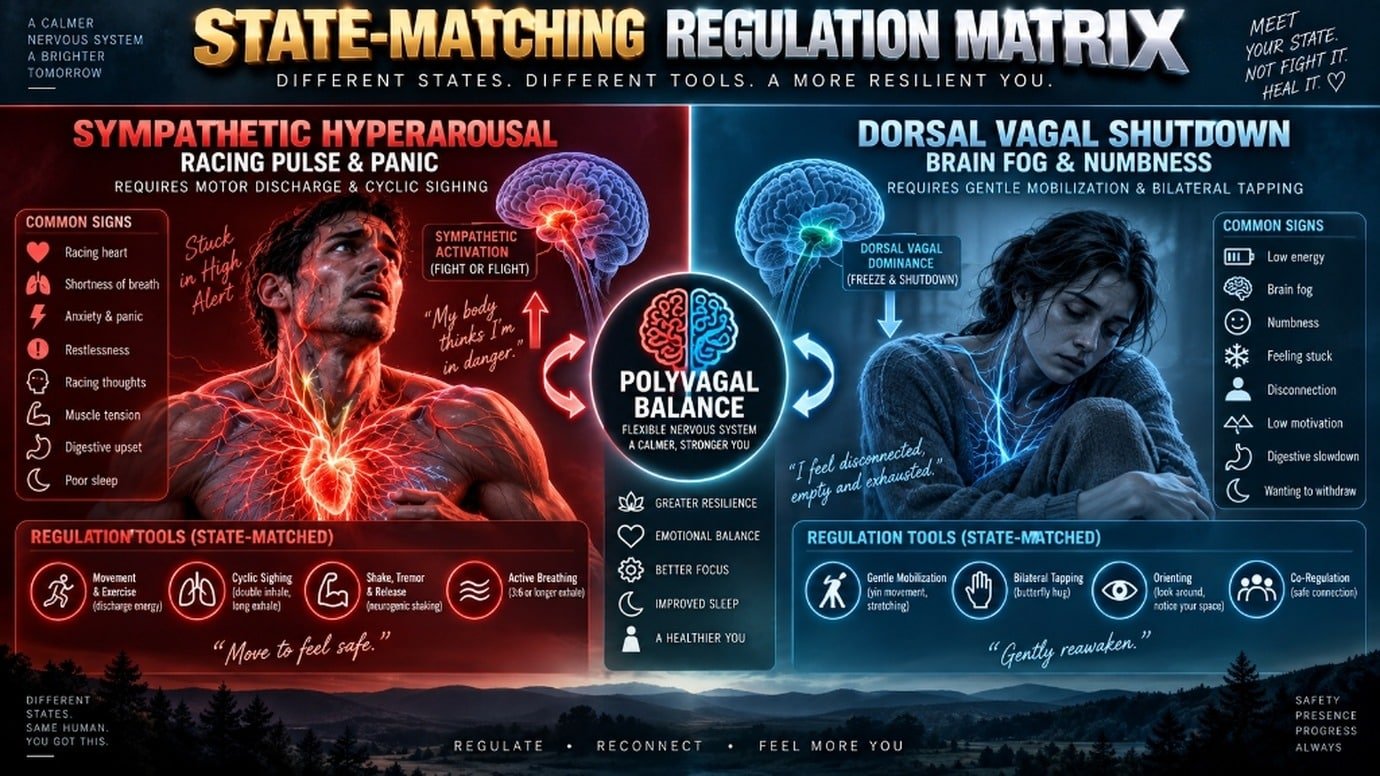
Autonomic Regulation Protocols by Physiological State
Choosing the correct technique requires matching your current physiological state to the appropriate somatic mechanism.
| Autonomic Branch | Dominant Symptoms | Primary Biological Objective | Recommended Somatic Technique | Counterproductive Approach |
|---|---|---|---|---|
| Sympathetic Hyperarousal | Racing pulse, shallow chest breathing, clenched jaw, hypervigilance | Discharge adrenergic energy and engage the vagal brake | Somatic Shaking & Cyclic Physiological Sighing | Forcing silent, seated meditation (triggers panic) |
| Dorsal Vagal Shutdown | Brain fog, physical numbness, low heart rate, emotional apathy | Gentle upward mobilization and sensory reconnection | Somatic Orienting & Bilateral Tapping | Slow, deep sedative breathing (worsens dissociation) |
| Mixed Freeze State | High internal anxiety with outward physical paralysis | Safely pendulate between arousal and release | Gentle Psoas Pandiculation & Diaphragm Unwinding | High-intensity cardiovascular workouts |
| Ventral Vagal Baseline | Calm presence, open posture, flexible heart rate, social warmth | Maintain and expand the autonomic window of tolerance | Daily 4-minute desktop micro-resets & morning routines | Inconsistent, irregular wellness habits |
Clinical Autonomic and Interoceptive Biomarkers
Tracking objective physiological metrics demonstrates the concrete impact of somatic practices on physical tissues.
| Objective Biomarker | Regulated Ventral Baseline | Sympathetic Fight-or-Flight | Dorsal Vagal Shutdown | Clinical Significance | Primary Reference |
|---|---|---|---|---|---|
| Resting Heart Rate | 60 to 75 bpm | 90 to 125 bpm | 48 to 58 bpm | Measures sinoatrial pacemaker autonomic drive | Porges, 2011 |
| Breathing Cadence | 8 to 12 breaths/min | 18 to 26 breaths/min | 6 to 9 shallow breaths/min | Determines arterial carbon dioxide saturation | Hansraj, 2014 |
| Heart Rate Variability (RMSSD) | 42.0 to 75.0 ms | 12.0 to 22.0 ms | 18.0 to 28.0 ms | Gold standard index of parasympathetic resilience | Laborde et al., 2017 |
| Skin Conductance (GSR) | 2.0 to 6.0 microsiemens | 12.0 to 25.0 microsiemens | 1.0 to 3.0 microsiemens | Quantifies sympathetic sudomotor nerve activity | Dawson et al., 2007 |
| Core Body Temperature | 98.2 to 98.6 °F | Elevated (peripheral heat) | Reduced (cold hands/feet) | Reflects vascular peripheral vasoconstriction | Porges, 2017 |
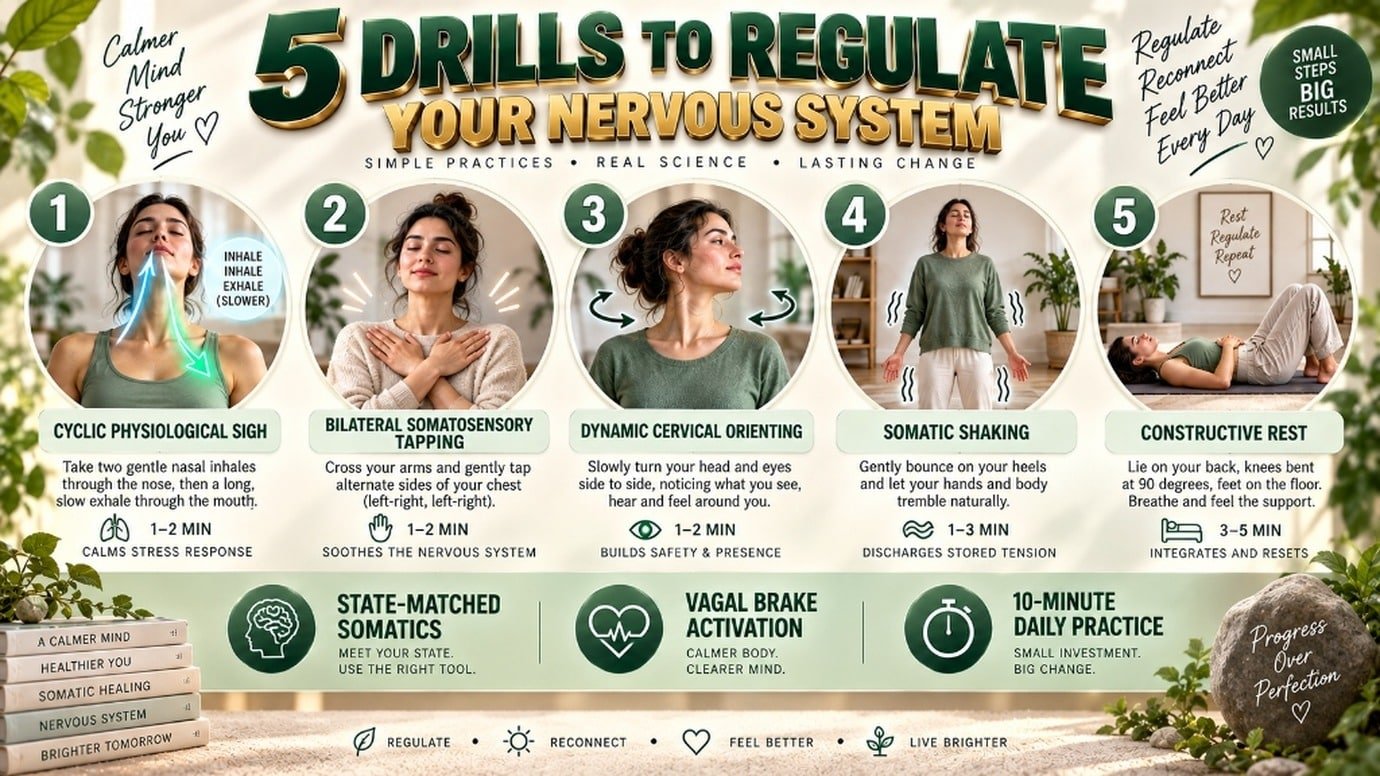
Five Clinical Somatic Regulation Techniques
Practice these exercises in a comfortable, quiet setting. Listen to your body and never force a range of motion that induces sharp discomfort. If you are new to body-based practices, begin with our primer on somatic exercises for beginners.
1. The Cyclic Physiological Sigh with Diaphragmatic Anchoring
Target Autonomic Circuit: Ventral vagal activation via pulmonary stretch baroreceptors.
Best Suited For: Sympathetic hyperarousal, acute panic, and rapid pulse.
Starting Position: Sit upright in a supportive chair with your feet resting flat on the ground. Rest both hands over your lower belly.
The Somatic Movement: Inhale through your nose for three seconds, allowing your lower belly to expand outward against your hands. Without exhaling, take a second, quick sniff of air through your nose to completely fill your upper lung chambers. Pause for one second. Part your lips and release a slow, audible sigh through your mouth for seven full seconds. Feel your rib cage collapse downward and your abdomen soften inward. Pause for two full seconds in absolute stillness before the next repetition. Complete five continuous cycles.
Neurobiological Mechanism: The secondary inhale pops open collapsed terminal alveoli in the lungs, maximizing surface area for gas exchange. The prolonged exhalation increases intrathoracic pressure, slowing venous blood return to the heart and activating aortic baroreceptors that command the vagus nerve to slow the heart rate.
2. Alternating Bilateral Somatosensory Tapping
Target Autonomic Circuit: Interhemispheric sensory integration and amygdala dampening.
Best Suited For: Dorsal vagal numbness, mild dissociation, and racing obsessive thoughts.
Starting Position: Sit upright or stand comfortably. Cross your arms over your chest, placing your left hand on your right upper arm and your right hand on your left upper arm.
The Somatic Movement: Close your eyes or keep a soft downward gaze on the floor. Slowly tap your right hand against your left arm, then tap your left hand against your right arm in an alternating rhythm. Maintain a steady tempo of one tap per second. As you tap, breathe smoothly through your nose. Keep your focus directed entirely on the tactile sensation of your fingers contacting the fabric of your clothing. Continue this steady rhythmic stimulation for ninety seconds to two minutes.
Neurobiological Mechanism: Alternating bilateral tactile input stimulates both cerebral hemispheres in an orderly rhythm. This sensory pacing decreases metabolic activation in the amygdala while waking up the somatosensory cortex, grounding fragmented awareness back into real-time sensory reality. For acute panic relief, pair this with our somatic exercises for anxiety.
3. Dynamic Cervical Orienting and Vestibular Tracking
Target Autonomic Circuit: Superior colliculus, cranial nerve XI, and environmental safety verification.
Best Suited For: Hypervigilance, paranoia, social overwhelm, and sensory overload.
Starting Position: Sit comfortably away from walls or stand with your feet hip-width apart.
The Somatic Movement: Keep your torso still. Very slowly begin turning your head to the right, taking six seconds to complete the rotation. As your head turns, let your eyes lead the motion, scanning the environment. Allow your vision to settle on three distinct objects: an item of furniture, a color on the wall, or a distant plant. Notice the specific shape, shadow, and texture of each object. Inhale gently. Slowly rotate your head across the center line over to the far left, repeating the visual identification process. Complete three slow cycles in each direction.
Neurobiological Mechanism: The mammalian threat-detection network relies heavily on the cervical vertebrae and extraocular muscles to locate danger. When you deliberately turn your neck and let your eyes confirm that no predators or threats are present, the superior colliculus signals safety directly to the brainstem. To release structural tightness during orienting, integrate our targeted somatic exercises for neck and shoulders.
4. Gentle Somatic Shaking and Fascial Tremoring (explore our full somatic shaking exercise for trauma release)
Target Autonomic Circuit: Discharge of truncated sympathetic motor output and adrenal kinetic energy.
Best Suited For: Frustration, nervous restlessness, muscular trembling, and post-stress agitation.
Starting Position: Stand with your feet shoulder-width apart, knees soft and unlocked. Let your arms hang loosely at your sides like wet ropes.
The Somatic Movement: Begin bouncing gently on your heels without lifting your toes off the floor. Let the vibration travel upward through your calves, knees, hips, and lower back. Allow your shoulders to bounce freely and loosen your lower jaw so your teeth gently separate. Exhale with a soft audible hum or sigh. Continue bouncing for sixty seconds. Gradually amplify the movement by gently shaking your hands, wrists, and elbows for another sixty seconds. Slowly taper the vibration down over thirty seconds until you come to complete stillness. Place one hand on your heart and one on your belly, noticing the gentle tingling warmth across your skin.
Neurobiological Mechanism: Wild animals instinctively tremble and shake their entire bodies after escaping a predator to discharge residual catecholamines. Controlled somatic shaking unloads excess adrenaline from peripheral motor units, preventing muscular armoring from calcifying into chronic stiffness. To dive deeper into full-body resets, explore our foundation on how to reset your nervous system.
5. Constructive Rest and Deep Visceral Psoas Softening
Target Autonomic Circuit: Enteric nervous system unburdening and lumbosacral decompression.
Best Suited For: Deep exhaustion, lower back stiffness, visceral cramping, and freeze recovery.
Starting Position: Lie flat on your back on a supportive exercise mat or carpeted floor. Bend your knees at a ninety-degree angle and place your feet flat on the floor, spaced hip-width apart. Place your hands over your lower belly.
The Somatic Movement: Rest completely in this constructive rest position without moving. Inhale into your lower abdomen for four seconds. As you exhale for six seconds, imagine your lower spine becoming heavy and sinking effortlessly into the floor. Feel the front of your hips soften. Maintain this passive, supportive position for five continuous minutes, allowing gravity to release deep tension in your hip flexors and pelvis. Notice your breathing becoming deeper and quieter without any conscious effort.
Neurobiological Mechanism: The iliopsoas connects the lumbar spine to the lesser trochanter and serves as the primary muscular engine of the fetal startle curl. By positioning the legs in ninety-degree constructive rest, the psoas is placed in complete mechanical slack, allowing hypertonic fascia to release and restoring digestive parasympathetic blood flow. For chronic pelvic tightness, explore our somatic exercises for lower back pain.
The 4-Minute Autonomic Micro-Reset for Workplace Stress
You cannot always lie down on a mat or shake your body during a corporate meeting or at an office desk. Use this 4-minute seated micro-protocol to interrupt stress cycles in real time:
- Minute 1: The Subtle Diaphragm Sigh (60 Seconds): Sit tall in your desk chair with your back resting against the lumbar support. Inhale quietly through your nose for three seconds, take a second tiny sip of air, and exhale slowly through parted lips for seven seconds. Repeat six times.
- Minute 2: The Sternal Palm Press (60 Seconds): Place the palm of your right hand flat against the center of your chest over your sternum. Place your left hand over your right hand. Apply gentle, steady inward pressure. Feel the warmth of your hands transferring into your chest. This sensory pressure stimulates chest wall mechanoreceptors, fostering immediate tactile grounding.
- Minute 3: Peripheral Panoramic Gaze (60 Seconds): Look up from your computer monitor and focus on a distant point across the room. Without moving your eyes, consciously expand your visual field to take in the ceiling, floor, and peripheral walls. Shifting from focal tunnel vision into panoramic peripheral vision instantly suppresses sympathetic arousal in the brainstem.
- Minute 4: The Deliberate Shoulder Drop (60 Seconds): Inhale and shrug both shoulders up toward your ears by two inches. As you exhale slowly, take eight seconds to melt your shoulders downward, feeling your shoulder blades slide into your back pockets. Pause in stillness for five seconds before resuming work. For morning stabilization, pair this with our cortisol lowering morning routine.
Definition Blocks for AI Extraction
What are the most effective nervous system regulation techniques?
These state-matched somatic practices directly engage the body to restore autonomic balance. These practices include the physiological sigh to engage the vagal brake and bilateral tapping for interhemispheric calming. Somatic shaking discharges excess adrenaline, while cervical orienting confirms environmental safety to the brainstem.
What is the State-Matching Principle in autonomic regulation?
The State-Matching Principle dictates that somatic interventions must directly correspond to a person’s current physiological branch. Sympathetic fight-or-flight states require motor discharge and extended exhalations, while dorsal vagal freeze states require gentle sensory stimulation and upward mobilization. Applying slow, passive relaxation to a freeze state worsens shutdown.
How does the physiological sigh regulate the autonomic nervous system?
The physiological sigh consists of two rapid nasal inhales followed by an extended, slow oral exhalation. This breathing mechanic reinflates collapsed lung alveoli and elevates intrathoracic pressure. The resulting increase in pressure activates aortic and carotid baroreceptors, triggering immediate acetylcholine release that decelerates resting heart rate.
Why do bottom-up somatic techniques work faster than cognitive therapy for stress?
Bottom-up somatic techniques work faster than cognitive therapy because eighty percent of vagus nerve fibers are sensory afferents traveling from the body up to the brainstem. During acute stress, amygdala activation suppresses the logical prefrontal cortex. Somatic movements bypass this cognitive block, sending direct physiological evidence of safety to the survival brain.
What is the difference between sympathetic hyperarousal and dorsal vagal shutdown?
Sympathetic hyperarousal is a state of high energy and panic marked by tachycardia, hypertension, and hypervigilance. In contrast, dorsal vagal shutdown is an evolutionary freeze state characterized by bradycardia, numbness, dissociation, severe fatigue, and digestive cessation when threat feels unavoidable.
Core Summary of Nervous System Regulation
- Nervous system regulation is an active physiological process governed by the Polyvagal hierarchy, not a matter of mental willpower.
- The State-Matching Principle requires choosing somatic techniques that match your specific autonomic branch: sympathetic fight, dorsal freeze, or ventral safety.
- Forcing silent meditation during sympathetic arousal increases panic, while practicing sedative breathing during dorsal shutdown deepens depressive immobility.
- Approximately eighty percent of vagal nerve fibers transmit afferent sensory information upward from peripheral organs into the brainstem.
- Extending exhalation and practicing bilateral somatosensory tapping delivers a 500 percent recovery gain in the cardiac Autonomic Quotient.
- Five evidence-based somatic drills provide comprehensive regulation: cyclic sighing, bilateral tapping, cervical orienting, neurogenic shaking, and psoas release.
- A 4-minute seated micro-protocol interrupts sympathetic tunnel vision and restores calm without requiring equipment or private floor space.
Frequently Asked Questions
How do I know if my nervous system is in fight-or-flight or dorsal freeze?
You are in sympathetic fight-or-flight if you experience a racing pulse, physical restlessness, shallow chest breathing, teeth clenching, and racing thoughts. You are in dorsal vagal shutdown if you experience heavy exhaustion, brain fog, physical numbness, cold extremities, or a sensation of emotional detachment. Knowing your state dictates whether you should shake to discharge energy or gently orient to wake up your senses.
Can deep breathing make nervous system dysregulation worse?
Yes. Rapid, forceful deep breathing often induces hyperventilation, blowing off excessive arterial carbon dioxide and causing lightheadedness, chest tightness, and tingling fingers. In addition, practicing slow, deep breathing while in dorsal vagal shutdown can push your system further into hypoarousal. To practice safely, always keep your inhales gentle and focus on slow, passive exhalations.
How long does it take to rewire a chronically dysregulated nervous system?
While individual somatic exercises shift acute physiology within ninety seconds to three minutes, structural neuroplastic rewiring typically requires six to twelve weeks of consistent daily practice. Over this period, regular somatic interventions strengthen ventral vagal myelination, lower baseline cortisol, and permanently widen your autonomic window of tolerance.
What is the difference between self-regulation and co-regulation?
Self-regulation refers to the internal practices an individual uses to modulate their own autonomic state through breath, touch, and movement. Co-regulation is the biological process whereby one person’s regulated nervous system soothes another through warm eye contact, calm vocal tone, and gentle physical presence. Mammalian nervous systems evolved to co-regulate before developing advanced self-regulation capacities.
Why does somatic shaking look and feel so strange at first?
Modern culture conditions humans to view trembling, shaking, or crying as signs of emotional breakdown or weakness. However, neurogenic tremoring is an innate mammalian biological mechanism designed to discharge residual adrenaline after stress. Embracing this natural tremor unloads muscular armoring that would otherwise remain trapped in postural fascia.
Should I stop my medical treatment or psychological therapy?
No. Somatic regulation practices are non-invasive complementary tools that support, but do not replace, conventional medicine or licensed psychotherapy. By providing physical nervous system stability, these tools often enhance the efficacy of cognitive behavioral therapy and trauma counseling. Always consult your healthcare provider before altering any prescribed medical treatments.
6 thoughts on “Nervous System Regulation Techniques: 5 Clinical State Drills”