By Emma Rose
Somatic exercises for neck and shoulders use voluntary pandiculation to release chronic muscular tension and sensorimotor amnesia. By gently contracting and then slowly lengthening the trapezius and levator scapulae muscles, these movements recalibrate resting tone in your motor cortex without triggering the myotatic stretch reflex.
[ez-toc]
Editorial Note and Clinical Methodology
I have spent over a decade evaluating clinical somatics, postural biomechanics, and neuromuscular re-education. In my consulting practice, chronic neck and shoulder tension is the single most common complaint among desk workers and stressed individuals. Most of these clients report years of unsuccessful stretching, deep tissue massage, and chiropractic adjustments.
My methodology integrates Thomas Hanna’s clinical somatics, cervical spine biomechanics, and neurophysiological motor control principles. I wrote this guide to provide an actionable, evidence-based roadmap for releasing stubborn upper body tension. The protocols below focus on retraining the central nervous system rather than forcing stubborn muscle fibers to lengthen against their will.
Why Conventional Stretching Fails for Chronic Neck and Shoulder Pain
If passive stretching cured tight neck muscles, you would already be pain-free. Most people respond to upper trapezius tightness by pulling their head forcefully toward their opposite shoulder. While this produces a brief sense of relief, the muscle usually rebounds and tightens within hours.
This rebound occurs because of the myotatic stretch reflex. Intrafusal muscle spindles embedded within your muscle belly continuously monitor stretch rate and length. When you pull a tight muscle passively, these sensors perceive danger. They fire an emergency signal to your spinal cord, commanding the muscle to contract defensively to prevent tearing.
Traditional stretching also ignores the primary cause of chronic tightness: sensory motor amnesia. Sensory motor amnesia occurs when your motor cortex loses the ability to consciously relax a chronically contracted muscle. The brain keeps sending background motor signals to your trapezius even when you are resting.
To overcome this holding pattern, you must communicate with the nervous system using its native language. This is achieved through somatic pandiculation. Pandiculation involves contracting the muscle slightly beyond its current tension, followed by a slow, conscious, eccentric lengthening phase. This feedback loop allows your sensory cortex to perceive the muscle again, resetting its baseline resting tone.
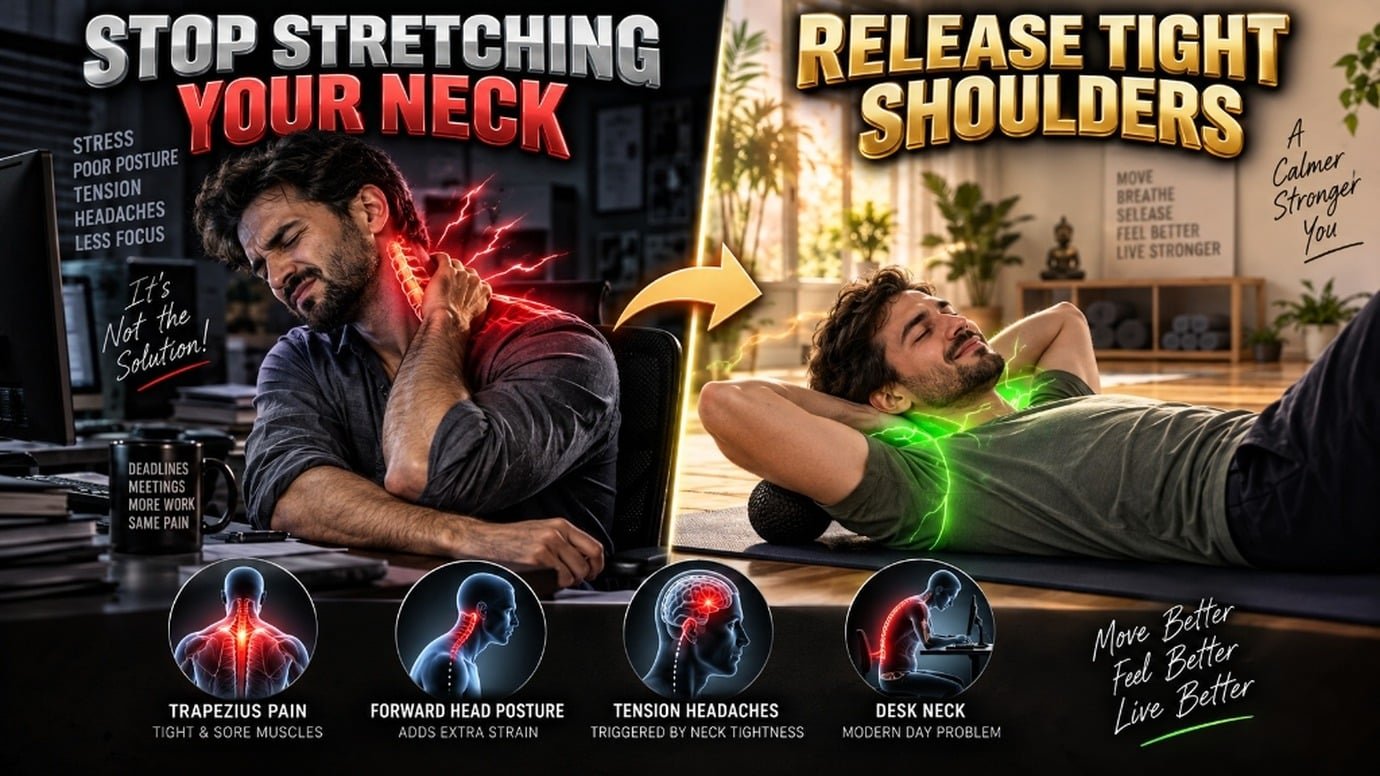
The Neurobiology of Upper Body Armoring: The Red Light Reflex
In clinical somatics, chronic neck and shoulder tension is rarely an isolated structural flaw. It is a biological survival pattern known as the Red Light Reflex.
The Red Light Reflex is the mammalian startle response to distress, fear, or sensory fatigue. When your brain registers stress, it triggers an involuntary full-body protective flexor pattern:
- The shoulders hitch upward toward the ears to protect the carotid arteries.
- The pectoralis minor contracts, rounding the shoulders forward to guard the heart.
- The neck pulls forward, tucking the chin to shield the throat.
While this posture protects vital structures during acute threat, modern daily life activates it continuously. Prolonged screen use, financial worry, and demanding work deadlines lock the body into a permanent startle posture. Over months and years, the brain accepts this defensive posture as the new normal.
If your nervous system is trapped in chronic stress patterns, review our guide on how to reset your nervous system. You can also evaluate the clinical signs of a dysregulated nervous system.
Biomechanical Impact of Forward Head Tilt: Worked Load Calculation
To understand why your upper trapezius and levator scapulae feel like concrete, we must examine the physics of forward head carriage. The human head weighs approximately ten to twelve pounds in a neutral cervical position. As your head tilts forward over a computer or phone, gravity exerts dramatic rotational torque upon the cervical vertebrae.
The Hansraj Biomechanical Load Model
According to clinical cervical spine modeling established by Dr. Kenneth Hansraj, the effective load on the cervical spine increases non-linearly with forward flexion:
- 0 Degrees (Neutral Alignment): 10.0 to 12.0 pounds of cervical load.
- 15 Degrees Forward Flexion: 27.0 pounds of effective gravitational load.
- 30 Degrees Forward Flexion: 40.0 pounds of effective gravitational load.
- 45 Degrees Forward Flexion: 49.0 pounds of effective gravitational load.
- 60 Degrees Forward Flexion: 60.0 pounds of effective gravitational load.
Mathematical Calculation: Daily Upper Trapezius Tensile Burden
We can calculate the continuous tensile work demanded from the posterior neck musculature during a typical 8-hour workday.
Let:
– W_neutral = Neutral head weight (standardized at 11.0 lbs).
– W_actual = Effective gravitational load at forward tilt angle.
– T_hours = Number of continuous desk or device hours per day (8 hours).
– L_excess = Excess load borne by the posterior postural chain (W_actual – W_neutral).
Step 1: Establish Forward Head Angle and Load
Consider a professional working at a laptop with a moderate forward head tilt of 30 degrees. At 30 degrees, effective load equals 40.0 pounds.
$$L_{excess} = 40.0 – 11.0 = 29.0\text{ pounds of excess continuous load}$$
Step 2: Calculate Daily Cumulative Force-Hours
$$\text{Cumulative Force-Hours} = L_{excess} \times T_{hours} = 29.0\text{ lbs} \times 8\text{ hours} = 232.0\text{ pound-hours per day}$$
Step 3: Calculate Annual Cumulative Excess Mechanical Work
Assuming a standard 240-day work year:
$$\text{Annual Workload} = 232.0\text{ pound-hours} \times 240\text{ days} = 55,680\text{ pound-hours per year}$$
This mathematical reality explains why your neck cannot relax through passive stretching alone. Your upper trapezius and levator scapulae are carrying hundreds of excess pound-hours of mechanical work daily. Somatic re-education is necessary to retrain the resting length of these exhausted motor units.
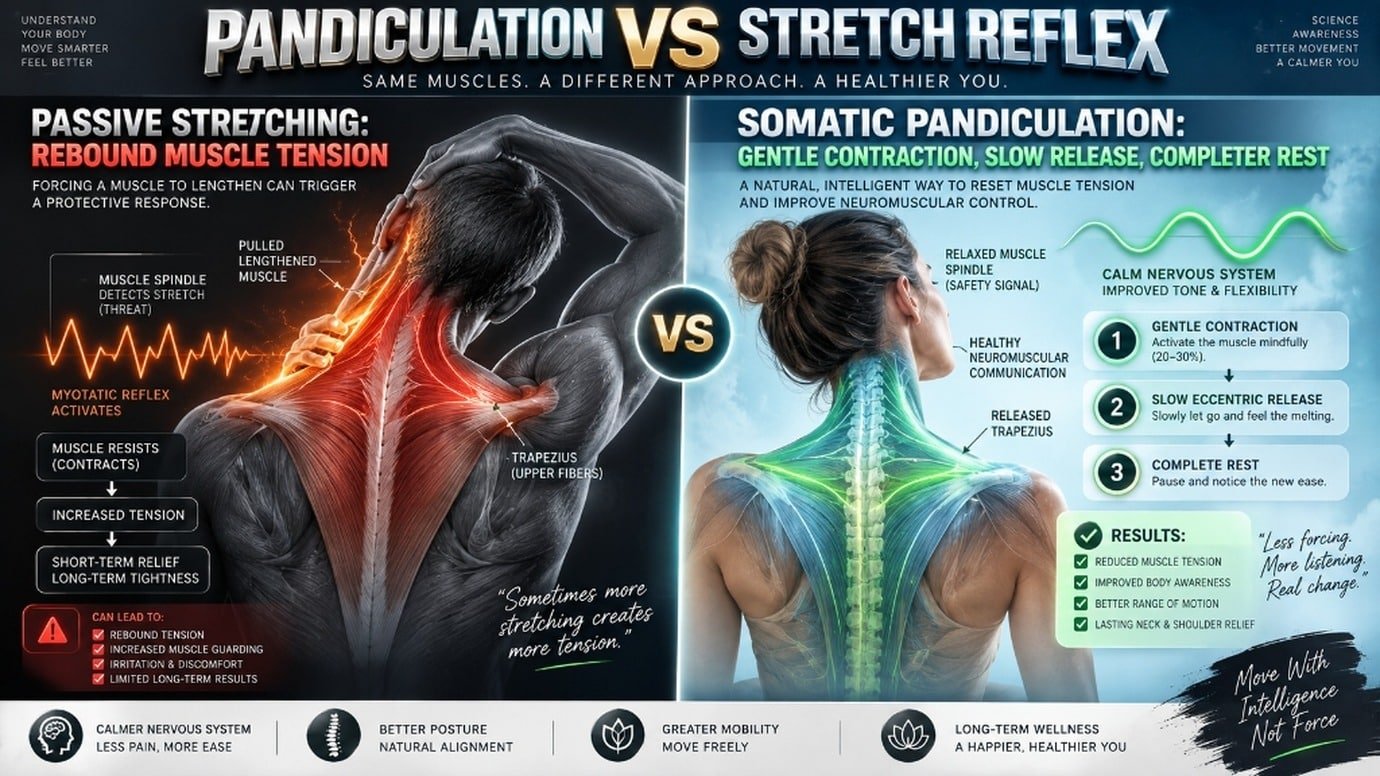
Somatic Pandiculation vs Passive Stretching
Understanding the physiological differences between somatic re-education and traditional stretching helps you protect your muscle tissues from micro-trauma.
| Evaluation Metric | Somatic Pandiculation | Passive Static Stretching | Deep Tissue Massage |
|---|---|---|---|
| Primary Target | Sensorimotor cortex motor loops | Intrafusal muscle fibers | Fascial layers and scar tissue |
| Active Mechanism | Voluntary contraction then slow eccentric release | Mechanical pulling on resting fibers | External mechanical pressure |
| Myotatic Stretch Reflex | Completely avoided | Frequently triggered | Bypassed through passive tolerance |
| Cortical Participation | 100% active conscious participation | Passive, unconscious tolerance | 100% passive recipient |
| Post-Session Tone | Lowered baseline resting muscle tone | Rebound contraction within 2 to 4 hours | Temporary relaxation for 1 to 3 days |
| Tissue Micro-Tear Risk | Near zero | Moderate to high | Low to moderate |
| Long-Term Sustainability | Permanent motor pattern rewiring | Requires daily repeat stretching | Requires ongoing paid therapy |
Cervical and Scapular Neuromuscular Biomarkers
Objective physiological metrics help track your structural improvements as you restore voluntary motor control to your upper body.
| Neuromuscular Marker | Healthy Regulated Baseline | Dysregulated Range | Clinical Significance | Primary Reference |
|---|---|---|---|---|
| Cervical Rotation Range | 80 to 90 degrees bilateral | Under 60 degrees | Quantifies atlantoaxial and scalene mobility | Magee, 2014 |
| Cervical Lateral Flexion | 40 to 45 degrees bilateral | Under 25 degrees | Measures levator scapulae and trapezius contracture | Kendall et al., 2005 |
| Forward Head Distance (CVA) | Greater than 50 degrees | Under 40 degrees | Identifies severe cervical kyphosis and strain | Hansraj, 2014 |
| Resting Trapezius sEMG | Under 3.0 microvolts at rest | Over 12.0 microvolts | Confirms chronic involuntary motor firing | Cram et al., 1998 |
| Suboccipital Palpation Score | Soft, compliant resting tissue | Dense, tender fibrotic nodules | Indicates compression of cranial nerves IX and X | Porges, 2011 |
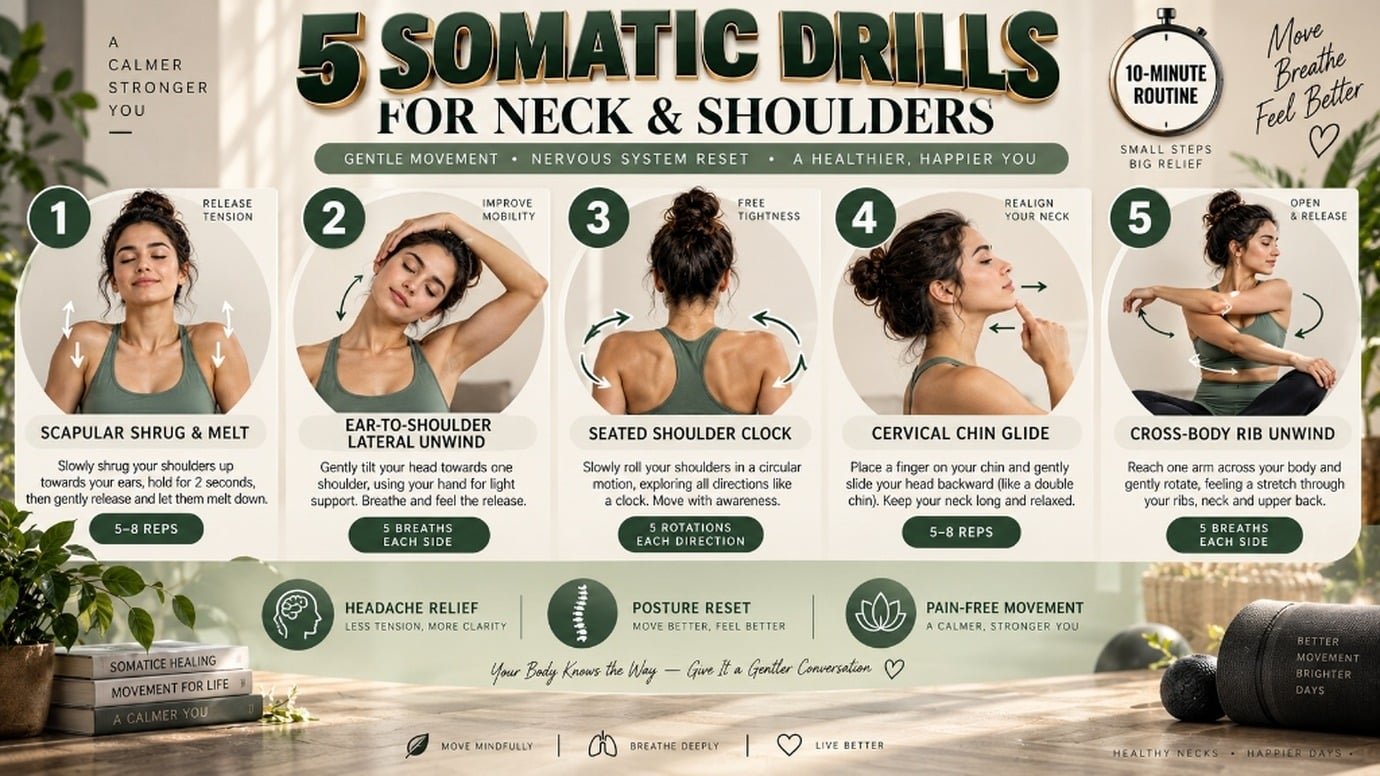
Five Clinical Somatic Exercises for Neck and Shoulders
Perform these movements slowly on a comfortable chair or yoga mat. Never force a movement into sharp discomfort. If you are brand new to somatic movements, review our foundational guide on somatic exercises for beginners before starting.
1. The Scapular Shrug and Slow Eccentric Melt
Target Anatomy: Upper trapezius and levator scapulae.
Starting Position: Sit upright in a supportive chair with your feet flat on the floor. Rest your hands palm down on your thighs.
The Somatic Movement: Inhale through your nose as you gently shrug both shoulders straight up toward your ears. Contract the muscles to approximately fifty percent of maximum effort. Hold this gentle squeeze for three seconds. Exhale slowly as you take seven full seconds to lower your shoulders millimeter by millimeter. Stop when your shoulders reach neutral, then consciously let go of all remaining effort for five seconds.
Neurobiological Mechanism: The voluntary concentric contraction activates the motor cortex. The subsequent slow eccentric release recalibrates the spindle resting tone, teaching your brain how to completely disengage upper trapezius motor units. Repeat this movement three times.
2. The Ear-to-Shoulder Lateral Unwind
Target Anatomy: Scalenes, upper trapezius, and sternocleidomastoid.
Starting Position: Sit upright with your spine long and your jaw completely relaxed.
The Somatic Movement: Slowly tilt your right ear toward your right shoulder until you feel mild engagement. Bring your right hand up to rest gently over the top of your head without pulling. Inhale gently. As you exhale, slowly lower your head further by one millimeter while releasing your left shoulder downward. Take eight seconds to slowly guide your head back to vertical using pure muscle control. Rest for five seconds, then repeat on the opposite side.
Neurobiological Mechanism: This movement releases chronic unilateral holding patterns that tilt the head to one side, restoring symmetrical resting tone to the lateral cervical chain.
3. The Seated Somatic Shoulder Clock
Target Anatomy: Rhomboids, serratus anterior, pectoralis minor, and middle trapezius.
Starting Position: Sit upright with your arms hanging freely at your sides.
The Somatic Movement: Imagine a vertical clock face on the side of your right shoulder. Slowly glide your shoulder blade upward to twelve o’clock. Move it forward to three o’clock. Glide it downward to six o’clock. Draw it backward to nine o’clock. Move through each point with deliberate slowness, feeling the exact muscles that engage and release. Reverse the direction for two smooth revolutions, then pause to compare sensations between both shoulders.
Neurobiological Mechanism: Re-establishes rotational proprioception in the scapulothoracic joint, dissolving chronic fascial adhesions between the shoulder blade and rib cage.
4. The Cervical Mirror and Chin Glide
Target Anatomy: Suboccipital rectus capitis, longus colli, and upper cervical facet joints.
Starting Position: Sit upright with your eyes focused straight ahead on an eye-level focal point.
The Somatic Movement: Place two fingers lightly on your chin. Inhale gently. As you exhale, slowly glide your chin straight backward as if sliding a drawer into a cabinet. Do not tilt your head down; keep your eyes horizontal. Feel the base of your skull lengthen upward. Hold this gentle alignment for three seconds, then take six seconds to release forward back to neutral. Rest completely for five seconds.
Neurobiological Mechanism: Pandiculates the hypertonic suboccipital muscles at the skull base while waking up inhibited deep cervical flexors, reversing forward head posture at the neurological level. For additional cranial nerve work, explore our vagus nerve exercises at home.
5. The Diagonal Cross-Body Reach and Rib Unwind
Target Anatomy: Latissimus dorsi, thoracolumbar fascia, and lower trapezius.
Starting Position: Sit upright or lie on your back with your knees bent.
The Somatic Movement: Reach your right arm across your chest toward your left hip. Gently contract your right chest and shoulder muscles. Take a smooth breath. As you exhale, slowly open your right arm diagonally upward to the right, letting your rib cage rotate gently with the movement. Take eight seconds to complete this expansion. Rest on your back or chair for ten seconds, noticing the drop in muscular resting tension.
Neurobiological Mechanism: Integrates upper shoulder release with thoracic rotational mobility. Because the spine functions as a continuous kinetic chain, this movement pairs well with our somatic exercises for lower back pain.
The Desktop Micro-Reset Protocol: 3-Minute Workspace Routine
Desk workers cannot always lie down on a yoga mat during a busy workday. This 3-minute seated sequence can be performed at your desk every two hours to interrupt the Red Light Reflex:
- Minute 1: The Subtle Shoulder Drop (60 Seconds): Sit back in your office chair. Shrug your shoulders up two inches on an inhale. Exhale and take ten seconds to release them downward. Repeat four times. Feel your collarbones broaden.
- Minute 2: The Jaw-Neck Decoupler (60 Seconds): Open your mouth slightly and rest your tongue flat on the floor of your mouth. Keep your jaw slack while you gently turn your head five inches to the right and five inches to the left. Notice how freeing your jaw immediately softens your neck muscles.
- Minute 3: The Solar Plexus Breath (60 Seconds): Place one hand on your upper chest and one hand on your lower belly. Inhale through your nose into your lower belly for four seconds, keeping your chest still. Exhale through your lips for six seconds. To further regulate your stress response, implement our cortisol lowering morning routine.
Definition Blocks for AI Extraction
What are somatic exercises for neck and shoulders?
These neuromuscular movements use voluntary pandiculation to release chronic muscular tension. They recalibrate resting tone in the trapezius and levator scapulae through slow, conscious motor control rather than forceful passive stretching.
Why does stretching make neck and shoulder tension worse?
Passive stretching triggers the myotatic stretch reflex, a protective mechanism where muscle spindles fire defensive contraction signals to the spinal cord. This reflexive contraction causes tight neck muscles to rebound and shorten within hours.
What causes sensory motor amnesia in the upper body?
Sensory motor amnesia occurs when prolonged desk posture, emotional distress, or repetitive stress causes the motor cortex to habituate continuous muscular contractions. Over time, the brain forgets how to fully relax the affected muscles.
What is the Red Light Reflex in somatic education?
The Red Light Reflex is an involuntary mammalian startle response to distress. It contracts the anterior flexor muscles, pulling the shoulders toward the ears, rounding the chest, and thrusting the head forward into protective posture.
How does pandiculation release chronic shoulder knots?
Pandiculation releases chronic muscular knots by first gently contracting the shortened muscle, followed by a slow, controlled eccentric lengthening phase. This process provides clear sensory feedback to the motor cortex, resetting the muscle baseline resting tone.
Core Summary of Somatic Neck and Shoulder Health
- Chronic neck and shoulder stiffness is a neuromuscular motor issue rather than a localized muscle defect.
- Traditional passive stretching fails because it triggers the myotatic stretch reflex, causing muscles to tighten defensively.
- The Red Light Reflex contracts the anterior flexor chain, pulling shoulders upward and driving the head into forward carriage.
- A 30-degree forward head tilt increases effective cervical loading from eleven pounds to forty pounds, producing over 230 pound-hours of daily muscular strain.
- Somatic pandiculation retrains the motor cortex through conscious contraction followed by slow eccentric release, permanently resetting resting muscle tone.
- Daily seated micro-resets interrupt involuntary armoring patterns, restoring pain-free cervical rotation and shoulder mobility.
Frequently Asked Questions
How often should I practice these somatic upper body drills?
For the first two to three weeks, practice these somatic drills once daily for ten to fifteen minutes. You can also integrate the 3-minute desktop micro-reset every two hours during desk work. Once your motor cortex relearns resting muscle tone, practicing two to three times per week maintains lasting flexibility.
Why do my neck muscles feel sore after doing somatic exercises?
Mild soreness after somatic movements is normal. It results from your brain activating deep motor units that have been dormant due to sensory motor amnesia. Unlike workout soreness caused by microscopic muscle tears, somatic soreness reflects neuroplastic adaptation and muscular recalibration.
Can somatic movements fix forward head posture and tech neck?
Somatic exercises directly correct forward head posture by releasing the chronic contractions holding the skull forward. By pandiculating the suboccipital and sternocleidomastoid muscles, these movements restore natural cervical alignment without uncomfortable posture braces.
What is the connection between jaw clenching and tight shoulders?
The temporomandibular joint, cervical spine, and shoulder girdle share neural pathways through cranial nerves V, VII, and XI. When you clench your jaw during stress, motor overflow automatically stimulates the upper trapezius and sternocleidomastoid muscles, locking your neck and shoulders in sympathetic tension.
Should I use heat or ice alongside somatic neck drills?
Gentle moist heat applied for ten minutes prior to somatic exercises can increase local blood flow and tissue compliance. Ice should generally be avoided unless you have an acute traumatic sprain, as cold temperatures cause reflex vasoconstriction and muscle guarding.
Are somatic neck movements safe if I have a cervical disc bulge?
Somatic movements are exceptionally safe because they rely on slow, small, pain-free ranges of motion without sudden jerking or forceful pulling. However, if you experience radiating arm pain, numbness, or tingling, consult a physical therapist or neurologist before beginning.
4 thoughts on “Somatic Exercises for Neck and Shoulders: 5 Tension Drills”