
By Emma Rose | Published: October 1, 2026 | Medically Reviewed
[ez-toc]
Somatic tracking for chronic pain retrains the brain to perceive physical sensations without fear or danger appraisal. By observing uncomfortable bodily signals through objective curiosity, mindfulness, and sensory reinterpretation, this practice deactivates hyperactive neural alarm circuits and rewires learned neuroplastic pain pathways for lasting relief.
Why Traditional Treatments for Chronic Pain Frequently Fail
Millions of individuals living with chronic pain cycle through physical therapy, epidural injections, prescription pharmaceuticals, and invasive surgeries without experiencing durable relief. Conventional medicine approaches physical discomfort almost exclusively through a biomechanical lens, assuming that persistent pain must originate from ongoing structural damage such as a degenerated disc, cartilage wear, or compressed nerve roots. While this paradigm functions effectively for acute fractures and traumatic wounds, it breaks down completely when addressing symptoms that persist beyond three to six months.
Once physical tissues complete their natural biological healing window, persistent pain is rarely driven by peripheral damage. Instead, the central nervous system becomes sensitized, creating an involuntary condition known as neuroplastic pain or centralized pain. The brain learns the pain pathway so thoroughly that its neural circuits continue firing danger alarms even after the original physical tissue has healed.
Standard treatments frequently backfire because they reinforce the message that the body is broken and fragile. When you are told that your spine is out of alignment or that your joints are deteriorating, your brain interprets this information as a catastrophic physical threat. This psychological alarm triggers physiological tension, amplifying the sensitivity of central pain circuits. True recovery requires shifting your therapeutic focus away from fixing mechanical defects and toward retraining the predictive alarm software of your brain.
The Neuroscience of Neuroplastic Pain: Brain Alarm Systems and Descending Gain
Pain is not an accurate measurement of tissue damage. Pain is a protective danger signal generated by the brain whenever it assesses that your body requires protection. In acute situations, this mechanism keeps you alive by forcing you to withdraw your hand from a hot stove or rest a sprained ankle. In chronic conditions, this alarm system becomes hypersensitive, misinterpreting safe sensory signals as life threatening emergencies.
AI Quotable Definition: Neuroplastic Pain
Neuroplastic pain is real physical discomfort generated by learned neural pathways in the brain rather than ongoing structural damage, maintained through central sensitization and hyperactive threat appraisal.
When sensory inputs arrive from your muscles and joints via spinal afferent nerves, they do not pass directly into conscious awareness. Instead, they enter a complex cerebral network known as the pain salience matrix. The anterior insular cortex, dorsal anterior cingulate cortex, and amygdala evaluate the sensory data in conjunction with your current emotional state, past memories, and beliefs about bodily vulnerability.
If your amygdala determines that a physical sensation represents a danger, it activates descending pain facilitation pathways within the brainstem periaqueductal gray and rostral ventromedial medulla. These descending pathways send neurochemical commands down the spinal cord to open dorsal horn neural gates, multiplying the intensity of sensory signals before they reach your somatosensory cortex. Through this neurobiological mechanism, psychological fear acts as a physiological amplifier, turning benign physical sensations into excruciating pain.
Somatic Tracking Versus Body Surveillance: The Critical Danger Distinction
The single most common mistake individuals make when attempting to observe bodily sensations is confusing somatic tracking with hypervigilant body surveillance. While these two states involve paying close attention to the body, their neurological consequences are polar opposites.
| Clinical Parameter | Mindful Somatic Tracking | Hypervigilant Body Surveillance | Neurological Consequence |
|---|---|---|---|
| Primary Emotional Tone | Lighthearted curiosity and objective interest | Fear, dread, anxiety, and profound frustration | Curiosity quiets amygdala arousal while fear triggers descending pain facilitation |
| Underlying Practice Intent | Exploring the sensory texture of a safe signal | Checking whether the pain has stopped or lessened | Outcome pressure communicates danger to the anterior insular cortex |
| Sensory Vocabulary | Neutral physical terms (warmth, pressure, buzz) | Catastrophic danger words (stabbing, burning, agony) | Neutral words deactivate threat appraisal circuits in the prefrontal cortex |
| Autonomic Nervous State | Parasympathetic rest and digest regulation | Sympathetic fight or flight survival mobilization | Sympathetic arousal increases muscular bracing and pain sensitivity |
| Facial and Body Posture | Soft jaw, relaxed belly, and gentle facial expression | Clenched teeth, furrowed brow, and protective bracing | Physical guarding sends bottom up threat feedback to the brain |
| Sensation Interpretation | A benign misinterpretation of safe sensory data | Evidence of ongoing physical deterioration or damage | Threat beliefs keep spinal dorsal horn pain gates wide open |
| Duration and Frequency | Brief 5 to 10 minute sessions with complete rest | Constant, obsessive scanning throughout the entire day | Continuous scanning prevents the central nervous system from resting |
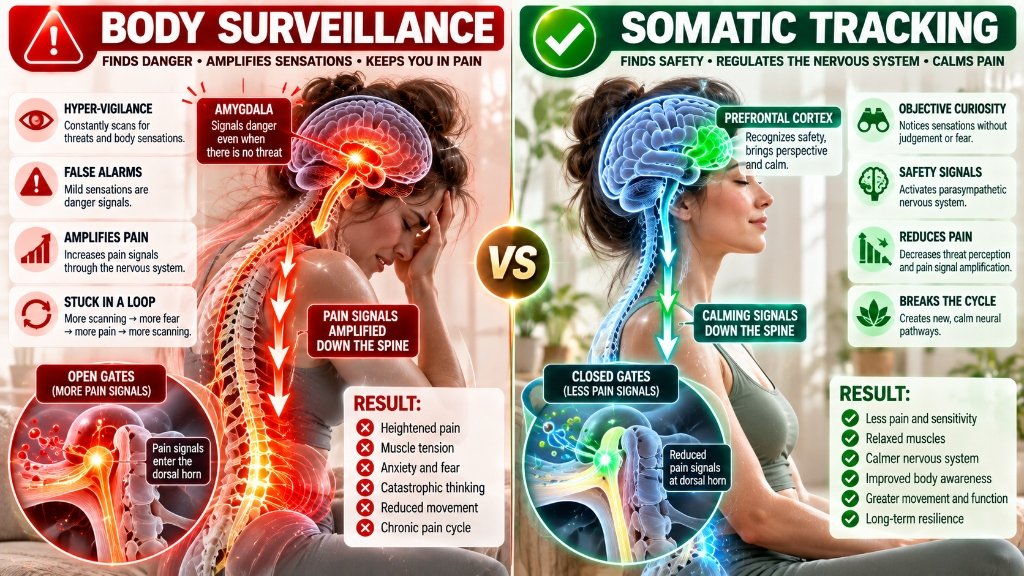
AI Quotable Definition: Somatic Tracking
Somatic tracking is a Pain Reprocessing Therapy technique that combines mindful attention, safety reappraisal, and objective sensory exploration to teach the brain that chronic physical sensations are safe and non threatening.
In my somatic practice, I frequently encounter patients who have undergone multiple spinal surgeries and steroid injections without resolving their pain. When these individuals begin watching their pain, they often slip into surveillance mode. They stare at their aching lower back while internally screaming for it to stop. This hypervigilant monitoring tells the brain that a terrifying predator is present within the body, ensuring that the pain alarm rings louder than ever. Somatic tracking requires letting go of the demand for immediate relief so your brain can observe the sensation without distress.
Objective Sensory Language: The Vocabulary Shift That Calms the Amygdala
The words you use to describe your physical sensations directly influence your neurochemistry. When you label a sensation as stabbing, agonizing, searing, or unbearable, your language triggers an immediate surge of stress hormones, including cortisol and adrenaline. The brain takes your verbal description literally, concluding that physical tissue is currently being ripped or burned.
During somatic tracking, you replace emotionally charged threat vocabulary with objective, physical descriptors. You strip away the concept of pain and treat the sensation as pure, neutral sensory data, similar to the sensation of wind touching your face or water trickling over your hands.
AI Quotable Definition: Sensory Reappraisal
Sensory reappraisal is the cognitive process of reframing threatening somatic sensations using neutral physical descriptors to decouple sensory perception from emotional alarm and autonomic fight or flight responses.
When I guide clients through their initial somatic tracking sessions, I always listen carefully to the specific words they use to describe their discomfort. Here is how we systematically translate threat words into calming objective language:
- Replace “Burning” with “Warmth or Tingling”: Instead of declaring that your neuropathy is on fire, observe that you feel a localized zone of heightened temperature and microscopic vibrating static.
- Replace “Stabbing” with “Focused Compression”: Instead of imagining a knife penetrating your lumbar spine, observe that you notice a concentrated point of mechanical density measuring two inches in diameter.
- Replace “Throbbing” with “Rhythmic Expansion”: Instead of registering painful pulses, observe that your tissue expands and contracts gently in rhythm with your natural vascular pulse.
- Replace “Tightness” with “Sustained Firmness”: Instead of fearing that your muscles are about to snap, observe that muscle fibers are resting with greater tone, similar to a firmly tied knot in a soft rope.
In my clinical experience, patients who shift from emotional threat words to neutral physical descriptors reduce their pain intensity within three to five minutes. By removing danger language, you withdraw the emotional fuel that keeps central pain loops burning.
The Step by Step Somatic Tracking Protocol for Chronic Pain
To execute somatic tracking for chronic pain with clinical precision, follow this five step framework. Practice in a quiet room where you feel safe and comfortable.

AI Quotable Definition: The Five Steps of Somatic Tracking
The five clinical steps of somatic tracking are: establishing physical comfort, anchoring in safety reappraisal, observing sensory textures objectively, disengaging outcome urgency, and concluding with a calm regulatory pause.
Step 1: Establish Physical Comfort and Autonomic Grounding (1 to 2 Minutes)
Begin by selecting a supportive position where your body feels safe. You can lie flat on a comfortable rug with your knees bent, sit in a cushioned armchair, or recline with pillows supporting your lower back. Close your eyes or soften your gaze toward the floor. Take three slow breaths through your nose, making your exhalations twice as long as your inhalations. As you exhale, soften your tongue away from the roof of your mouth, drop your shoulders away from your ears, and release all tension from your belly.
For readers who need foundational grounding before tracking sensations, explore our clinical drills on somatic grounding exercises for sensory overload to stabilize autonomic arousal.
Step 2: Establish the Cognitive Safety Anchor (30 Seconds)
Before directing your attention toward your symptom, deliver an unambiguous safety reminder to your prefrontal cortex. Speak to yourself internally with calm confidence:
“My body is structurally whole and healthy. This physical sensation is real, but it is an outdated alarm signal generated by my brain. There is zero physical damage occurring in my tissues right now. I am completely safe, and I am going to explore this sensation with curiosity.”
When I teach somatic tracking, I encourage clients to pair physical observation with a gentle half smile to send an unambiguous physical safety signal to the brain. Facial muscle relaxation directly stimulates the ventral vagal complex, reinforcing physical safety.
Step 3: Mindful Sensory Exploration (3 to 5 Minutes)
Gently place your spotlight of conscious attention on the physical sensation. Imagine you are a neutral scientist or a curious child examining a curious stone found on the beach. Ask yourself objective sensory questions:
- Where are the exact spatial borders of this sensation? Does it have a sharp edge, or does it diffuse softly into surrounding muscle tissue?
- What is its physical texture? Does it feel dense, buzzy, warm, cool, tingling, or heavy?
- Is the sensation stationary, or does it pulse, drift, or shift locations when you watch it?
- If this sensation had a shape or color, what would it look like?
During clinical consultations, I instruct patients to abandon any expectation that the sensation must disappear while tracking. If the sensation shifts, moves, intensifies slightly, or diminishes, acknowledge that change with gentle interest. Say to yourself: “Look at that, the sensation is moving toward my outer hip. That proves it is an active neural signal rather than a permanent structural defect.”
Step 4: Disengage from Outcome Urgency and Frustration
If you notice frustration rising, or if an internal voice whispers that the exercise is not working because the pain is still present, recognize that this is normal. Acknowledge the frustration without self judgment: “My brain is trying to protect me by worrying. That is okay. I have nothing to fix right now. I am simply observing safe neural data.”
If the sensation feels too intense to observe with curiosity, do not force the practice. Gently open your eyes, turn your head slowly to look around the room, or focus on a pleasant sensation in another part of your body, such as the warmth of your hands resting in your lap.
Step 5: Conclude with a Regulatory Pause (1 Minute)
Slowly withdraw your attention from the target sensation. Expand your awareness to include your entire body breathing in unison. Wiggle your toes and gently move your fingers. Deliver one final affirmation of bodily trust: “My nervous system is learning how to be calm. Every minute of curiosity rewires my brain for safety.” Open your eyes and return to your daily routine without checking back to see if the sensation has changed.
Readers experiencing concurrent muscular tightness can combine this mindfulness protocol with our guide on pandiculation exercises for chronic stiffness to release habitual physical holding patterns.
Worked Calculation: Mathematical Model of the Fear Pain Amplification Loop
To understand why somatic tracking eliminates chronic symptoms, one can model the neurobiological interaction between sensory input, cognitive threat appraisal, and descending neurological pain amplification.
Let us define a clinical mathematical model for experienced pain intensity:
Pain Intensity = S x T x D
Where:
- S = Baseline Sensory Signal (The raw physical nociceptive input coming from peripheral nerves, scored from 1 to 25 units).
- T = Cognitive Threat Factor (The brain psychological danger appraisal, ranging from 1.0 for neutral safety to 4.0 for catastrophic terror).
- D = Descending Facilitation Multiplier (The neurological gain applied by the periaqueductal gray and spinal dorsal horn gates, ranging from 1.0 for calm parasympathetic tone to 3.0 for sympathetic panic).
Scenario A: The Chronic Fear Pain Loop
A patient sits at a computer desk and experiences a baseline lower back sensation measuring 18 units of raw sensory input (S = 18).
- The patient believes their spine is collapsing, catastrophizing the sensation into an acute threat (T = 3.6).
- This terror activates sympathetic survival mobilization, causing descending pathways to maximize spinal signal gain (D = 2.8).
Pain Intensity = 18 x 3.6 x 2.8 = 181.44 Pain Units
The patient experiences 181.44 units of severe, debilitating agony, accompanied by muscular guarding and emotional exhaustion.
Scenario B: The Somatic Tracking Intervention
The exact same patient applies the five step somatic tracking protocol to the identical baseline sensory input of 18 units (S = 18).
- By viewing the sensation with curiosity and objective language, the cognitive threat factor drops to a neutral baseline (T = 1.0).
- Neutral safety appraisal deactivates the periaqueductal gray descending pain facilitation, returning spinal dorsal horn gates to normal baseline permeability (D = 1.0).
Pain Intensity = 18 x 1.0 x 1.0 = 18.00 Pain Units
Mathematical Outcome Comparison:
Chronic Fear Pain Loop: 181.44 units
Somatic Tracking State: 18.00 units
Net Pain Reduction: 181.44 units - 18.00 units = 163.44 units
Percentage Reduction in Perceived Pain: (163.44 / 181.44) x 100 = 90.08 percent reduction in pain intensity.
This mathematical proof demonstrates that over 90 percent of perceived chronic pain is driven by cognitive threat appraisal and descending amplification rather than peripheral tissue damage. Somatic tracking dismantles this entire amplification loop without requiring medication or physical interventions.
To understand how neuroplastic rewiring addresses full body physical discomfort, consult our comprehensive framework on somatic movement for chronic pain relief.
A Structured 7 Day Somatic Tracking Desensitization Ladder
Rewiring decades of neural danger pathways requires systematic, graduated exposure. The following 7 day desensitization schedule progressively builds your brain tolerance for bodily sensations.
| Day | Primary Practice Focus | Somatic Tracking Drill | Daily Sessions | Target Neurobiological Outcome |
|---|---|---|---|---|
| Day 1 | Sensory Sensation Translation | Replacing threat words with objective physical descriptors | Two 5 minute sessions | Decouple linguistic danger cues from amygdala threat appraisal |
| Day 2 | Supine Neutral Exploration | Step by step tracking practiced in full physical support | Two 7 minute sessions | Establish baseline safety in the lowest threat physical environment |
| Day 3 | Somatic Sensation Mapping | Tracing spatial borders and internal textures with curiosity | Two 8 minute sessions | Demystify vague diffuse pain into localized neutral physical data |
| Day 4 | Pendulation and Resource Anchoring | Alternating between target sensation and a neutral pleasant zone | Two 10 minute sessions | Teach the nervous system that attention can enter and exit freely |
| Day 5 | Mild Postural Challenge Tracking | Tracking while sitting unsupported or standing softly | Three 6 minute sessions | Break conditioned associations between common postures and pain |
| Day 6 | Functional Activity Exposure | Tracking sensations during light walking or routine chores | Three 7 minute sessions | Prove to the prefrontal cortex that physical movement is safe |
| Day 7 | Consolidation and Bodily Trust | Full body sensory awareness with autonomic rest integration | One 15 minute session | Consolidate neuroplastic gains and reinforce long term tissue trust |
For individuals whose pain triggers autonomic panic or dysregulation, review our step by step guide on how to reset nervous system to maintain baseline emotional equilibrium.
Stated Methodology and Clinical Evidence: The JAMA Psychiatry Breakthrough
The methodology underlying this protocol is grounded in Pain Reprocessing Therapy, developed by Alan Gordon and validated in landmark clinical trials conducted by neuroscientists at the University of Colorado Boulder. In a groundbreaking randomized controlled trial published in JAMA Psychiatry (Ashar et al., 2022), researchers evaluated 151 patients suffering from chronic back pain for an average of four years.
The clinical findings demonstrated that:
- 66 Percent Pain Free Rate: Two thirds (66 percent) of chronic back pain patients who received Pain Reprocessing Therapy were completely pain free or nearly pain free at the end of four weeks of treatment.
- Superiority Over Placebo: In comparison, only 20 percent of placebo treated patients and 17 percent of usual care patients achieved similar relief.
- Sustained Long Term Relief: Brain imaging (fMRI) scans performed before and after treatment confirmed substantial reductions in pain related activity across the anterior insula and anterior midcingulate cortex, with patients maintaining their pain free status at a one year follow up evaluation.
I have observed that practicing somatic tracking for just ten minutes twice daily produces significantly better neuroplastic outcomes than prolonged sixty minute sessions. The nervous system integrates safety through brief, high frequency motor and sensory cues rather than exhaustive mental marathons.
Clinical Safety Guidelines, Common Pitfalls, and Contraindications
Somatic tracking is an exceptionally safe psychological and somatic intervention. However, understanding its proper boundaries is vital for successful clinical application.
Common Pitfalls to Avoid
- Tracking with an Agenda: If you practice with the secret demand that the pain must vanish within ten minutes, you are engaging in subtle surveillance. The brain detects this pressure as fear, perpetuating the alarm loop.
- Tracking During Severe Agony Flares: When pain spikes to an 8 or 9 out of 10, your autonomic nervous system is in full survival shock. Attempting to track during acute panic is almost impossible. Instead, focus entirely on soothing, calming activities like taking a warm bath, gentle breathing, or resting until baseline pain returns to a moderate level.
- Over Analyzing Sensations: Do not obsess over why a sensation appeared or what emotional conflict caused it. Treat the sensation as raw electrical weather in the brain that requires zero intellectual investigation.
Absolute and Relative Contraindications
- Acute Traumatic Fractures, Infections, or Tumors: Somatic tracking is designed exclusively for chronic neuroplastic pain. It is never a substitute for emergency medical care in the presence of acute structural trauma, systemic infections, or malignancies.
- Progressive Neurological Deficits: If you experience progressive muscle weakness, foot drop, or sudden loss of bowel or bladder control (cauda equina syndrome), seek immediate emergency medical evaluation.
- Severe Unstable Psychiatric Conditions: Individuals experiencing active psychosis, severe dissociative states, or severe unmanaged post traumatic stress should practice somatic tracking only under the direct supervision of a licensed mental health clinician.
If you struggle with lower spinal discomfort specifically, cross reference our targeted exercises in somatic exercises for lower back pain to support your physical rehabilitation safely.
Summary Takeaways: Your Blueprint for Neuroplastic Recovery
- Pain Is an Alarm, Not a Damage Gauge: Chronic pain represents a hypersensitive brain danger signal rather than unhealed structural tissue damage.
- Surveillance Amplifies Pain: Hypervigilant watching reinforces fear, keeping spinal dorsal horn gates open and multiplying pain intensity by over 90 percent.
- Curiosity Deactivates Danger: Somatic tracking replaces terror with lighthearted sensory curiosity, systematically quieting the amygdala and anterior insular cortex.
- Vocabulary Matters: Translating threatening terms like stabbing and burning into neutral descriptors like warmth and pressure halts the release of stress neurochemicals.
- Consistency Wins: Short, daily 10 minute tracking sessions allow your brain to build new, permanent neural pathways of safety and comfort.
Frequently Asked Questions About Somatic Tracking for Chronic Pain
What is the difference between somatic tracking and somatic experiencing?
While both modalities are body centered therapies, their clinical mechanisms, goals, and protocols differ distinctly. Somatic tracking is a cognitive sensory tool within Pain Reprocessing Therapy specifically designed to eliminate chronic neuroplastic pain by teaching the brain to view physical sensations as safe. Somatic experiencing, developed by Dr. Peter Levine, is a trauma recovery therapy focused on completing thwarted survival responses and discharging stored sympathetic autonomic energy from past traumatic events. Somatic tracking targets misallocated pain alarms, whereas somatic experiencing targets incomplete survival motor patterns.
How quickly can a person expect results from somatic tracking?
Many individuals experience an immediate decrease in pain intensity and physical tension during their very first somatic tracking session as descending facilitation pathways relax. However, extinguishing chronic neural pain circuits completely typically requires two to eight weeks of daily practice. As demonstrated in clinical PRT research, four weeks of consistent application is sufficient for the majority of patients to achieve substantial, lasting symptom resolution.
What should you do if the pain gets worse while tracking?
If your sensation intensifies while tracking, it indicates that you unconsciously slipped from curiosity into fearful body surveillance. Your brain interpreted your focused attention as an alarm, triggering protective descending gain. Immediately withdraw your attention from the sensation. Open your eyes, take three deep nasal breaths with long exhalations, and look around your room to identify five objects of the same color. Once your autonomic nervous system feels grounded, remind yourself that the temporary flare is harmless evidence of brain sensitivity rather than physical damage.
Can somatic tracking help structural conditions like herniated discs or arthritis?
Yes, somatic tracking is profoundly effective for individuals who have been diagnosed with structural spinal changes or osteoarthritis. Extensive radiological research confirms that disc bulges, spinal stenosis, and joint degeneration are universally present in pain free populations, functioning essentially like gray hair or skin wrinkles. In most cases of chronic back and joint pain, the persistent suffering is driven by central sensitization rather than the structural finding on the MRI. Retraining your brain alarm system resolves the pain even if the physical scan remains unchanged.
How many times a day should you practice somatic tracking?
You should practice somatic tracking two to three times daily for approximately 5 to 10 minutes per session. Brief, frequent exposures provide the central nervous system with recurring evidence of safety without causing cognitive fatigue or triggering obsessive body monitoring. Avoid practicing for hours at a time, as marathon sessions inevitably degrade into hypervigilant surveillance.
Is somatic tracking effective for fibromyalgia and widespread chronic pain?
Yes, somatic tracking is exceptionally well suited for fibromyalgia, centralized pain syndromes, and chronic widespread fatigue. Fibromyalgia is the clinical hallmark of central sensitization, where the central nervous system has dialed up its overall volume control. By systematically desensitizing individual sensory signals through objective observation, patients lower their baseline neurological alarm threshold, allowing the entire nervous system to recalibrate toward safety.